%20png%20copy.avif)
Marketing for B2B tech companies is a specialized field. You're dealing with a sophisticated business audience, proving clear ROI for complex products, and navigating sales cycles that can last for months with a committee of decision-makers.
Success isn’t about running flashy ads. It's about building unshakeable trust by proving your expertise.
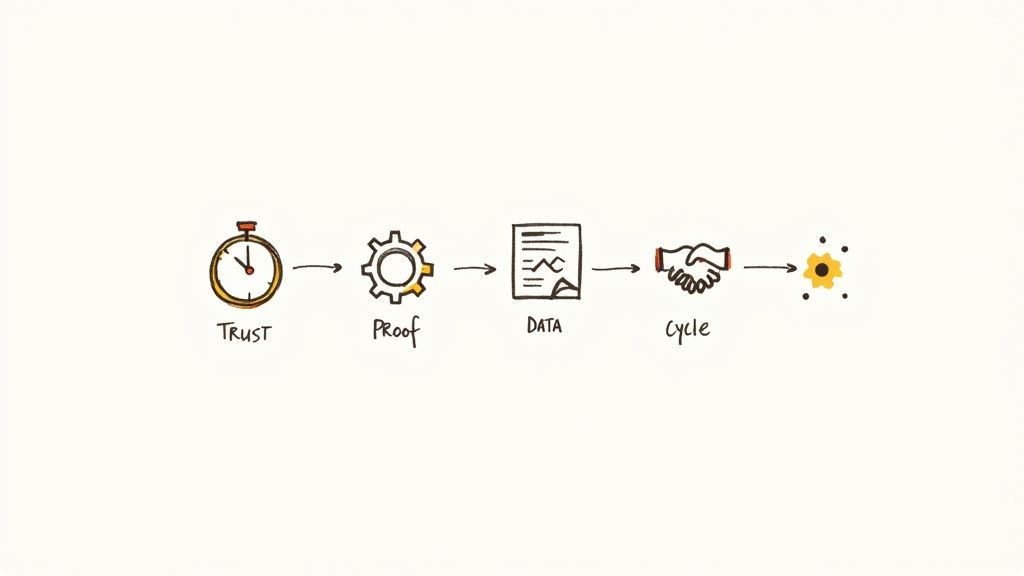
Let’s get one thing straight: marketing a B2B tech product is unlike selling anything else. You're not just pushing software or hardware; you're selling a genuine solution to a deep-seated business problem. The entire process is shaped by long sales cycles, highly technical products, and a smart audience that demands proof, not just promises.
Think of it less like setting up a simple retail shop and more like designing a city's power grid. It demands precision, a real understanding of what the end-user needs to accomplish, and a long-term vision. Every single piece has to work perfectly with the others to deliver results you can count on.
This guide treats these challenges not as roadblocks, but as opportunities. Each hurdle is a chance to build authority, earn credibility, and create lasting partnerships with your clients.
In the B2B tech world, your buyers are often experts themselves. They’re engineers, IT directors, or C-suite executives who have already done their homework. Your marketing must meet them at their level, offering real insights that help them improve their work.
This is exactly why content marketing is essential here. Business buyers consume, on average, 13 pieces of content before they even think about making a purchase decision. The game shifts from promotion to education. Your main goal is to become a trusted advisor by creating valuable resources that solve their specific pain points and operational headaches.
The heart of marketing for B2B tech companies is turning your team's deep knowledge into a magnet for qualified leads. It’s about showing—not just telling—how your solution delivers real, measurable business value.
Unlike a quick consumer purchase, a B2B tech deal can take months, sometimes even years, to finalize. You’re dealing with multiple decision-makers—from the person who will use the software every day to the CFO scrutinizing the budget—and each one has different priorities. Your marketing needs to speak to all of them, covering everything from technical feasibility and financial justification to strategic alignment.
The stakes are incredibly high. A bad tech investment can cost a company millions in lost productivity and botched implementation. Your marketing has to build a powerful case for change, and it needs to be backed by hard data, compelling case studies, and crystal-clear evidence of ROI.
To get a handle on this unique environment, checking out an overview of the Top B2B SaaS Marketing Strategies can give you a solid foundation. From here, this guide will lay out a clear, actionable path to mastering this field and achieving real, sustainable growth.
Before you write a single line of copy or spend a dollar on ads, the most important work in B2B tech marketing must happen first. This is the bedrock of your entire strategy: positioning. It’s the art and science of defining exactly where your product fits in the market—and more importantly, where it fits in the mind of your ideal business customer.
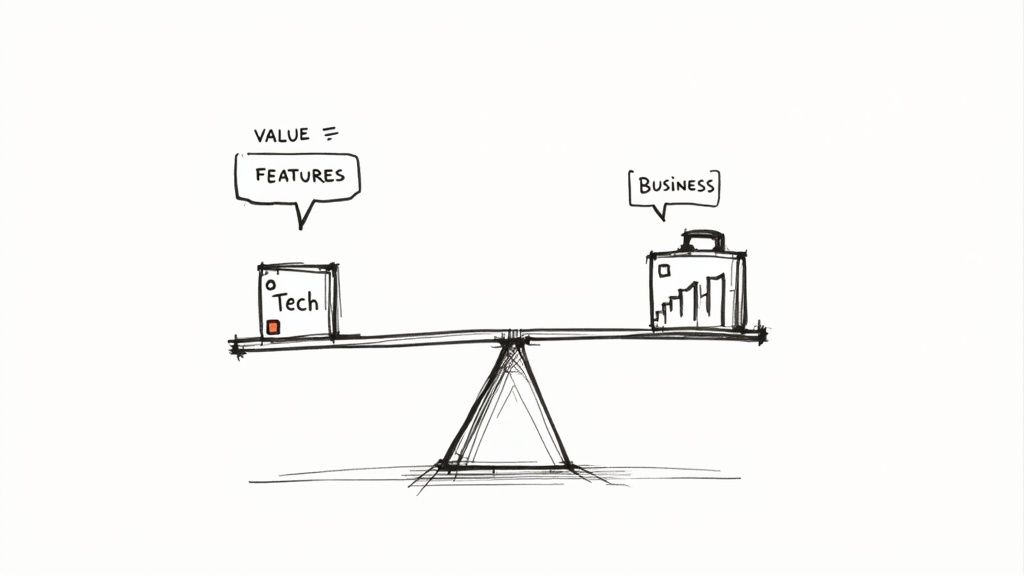
So many B2B tech companies make the same mistake. They fall into the trap of leading with features, rattling off endless lists of technical specs and what their software can do. But the true market leaders know better. They shift the conversation away from what their product does to the tangible business outcomes it delivers. This isn't just a minor tweak in language; it's a fundamental change in perspective.
Your goal is to stop selling software and start selling a solution to a critical business problem.
Think of your product's features as the individual tools in a master craftsman's toolbox. A home buyer doesn't care about the specific grade of steel in a hammer; they care about the sturdy, beautiful house it helps build. In the same way, your B2B buyers aren't really buying your "AI-powered algorithm." They're buying the ability to slash operational costs by 30% or accelerate their time-to-market.
To make this happen, you must break free from a feature-centric mindset and embrace a value-driven story. It boils down to a few key steps:
This story becomes the compass for every single marketing activity that follows, ensuring your message is always perfectly tuned to what your business audience actually cares about.
Trying to be the perfect solution for every business is a surefire recipe for being the preferred choice for none. The most successful B2B tech firms don't just compete in a crowded arena; they create their own. This starts by identifying a specific, high-value niche where your solution provides an unmatched advantage.
A niche isn’t just a small market. It's a focused group of customers with a distinct set of needs that you are uniquely equipped to solve better than anyone else. For a deeper look at this process, our complete guide on what is product positioning offers a detailed framework. This laser-focused approach allows you to concentrate your marketing resources where they’ll have the greatest impact.
Your unique value proposition isn't a catchy slogan. It's a clear, concise promise of the specific value a customer will get from you that they absolutely cannot get from any competitor.
This kind of clarity is your best weapon in a noisy digital world. The global digital marketing industry is projected to hit $786.2 billion by 2026, a testament to how crowded the space has become. And with search engines driving a staggering 93% of all website traffic, a sharp, well-defined position is non-negotiable for cutting through the static and attracting the right business buyers. You can discover more insights about the state of digital marketing on seo.com.
Ultimately, strong positioning is your strategic anchor. It dictates who you talk to, what you say, and where you say it, ensuring every marketing dollar and every ounce of effort builds toward a single, unified goal.
You’ve sharpened your positioning and dialed in your messaging. So, what’s next? Figuring out where to actually tell your story. It’s a critical step, and frankly, it's where a lot of B2B tech companies stumble. With a dizzying number of marketing channels out there, a scattered approach is a surefire way to burn through your budget with very little to show for it.
The secret isn’t to be everywhere. It’s to show up precisely where your B2B tech buyers are already looking for answers. This means ditching the old "spray and pray" mindset for good. Instead, you need to build a focused, multi-channel engine that pulls in the right crowd and walks them through their buying journey. It’s all about making deliberate choices based on where your ideal customers spend their time and how they research big-ticket tech purchases.
The most effective marketing for B2B tech companies happens when you meet your buyers on their own turf. Think about it: a CTO looking for a new enterprise security platform isn’t scrolling through TikTok for advice. They're digging into in-depth industry reports, running highly specific Google searches, and tapping their network on professional platforms like LinkedIn.
Your job is to show up in those moments of need. This requires a real understanding of who you're talking to. For example, a staggering 73% of B2B buyers turn to LinkedIn to research purchases, which makes it an absolute powerhouse for things like account-based marketing (ABM) and targeted outreach. By mapping out your customer's journey, you can plant your best content right where it will make the biggest splash.
The goal isn't to master every single channel. It's to completely dominate the handful of channels that matter most to your specific audience. This focus ensures every marketing dollar is working overtime to generate qualified leads and build real authority.
This decision tree helps visualize the process. You can see how nailing your niche, value, and message are the essential first steps that have to happen before you even think about channel selection.
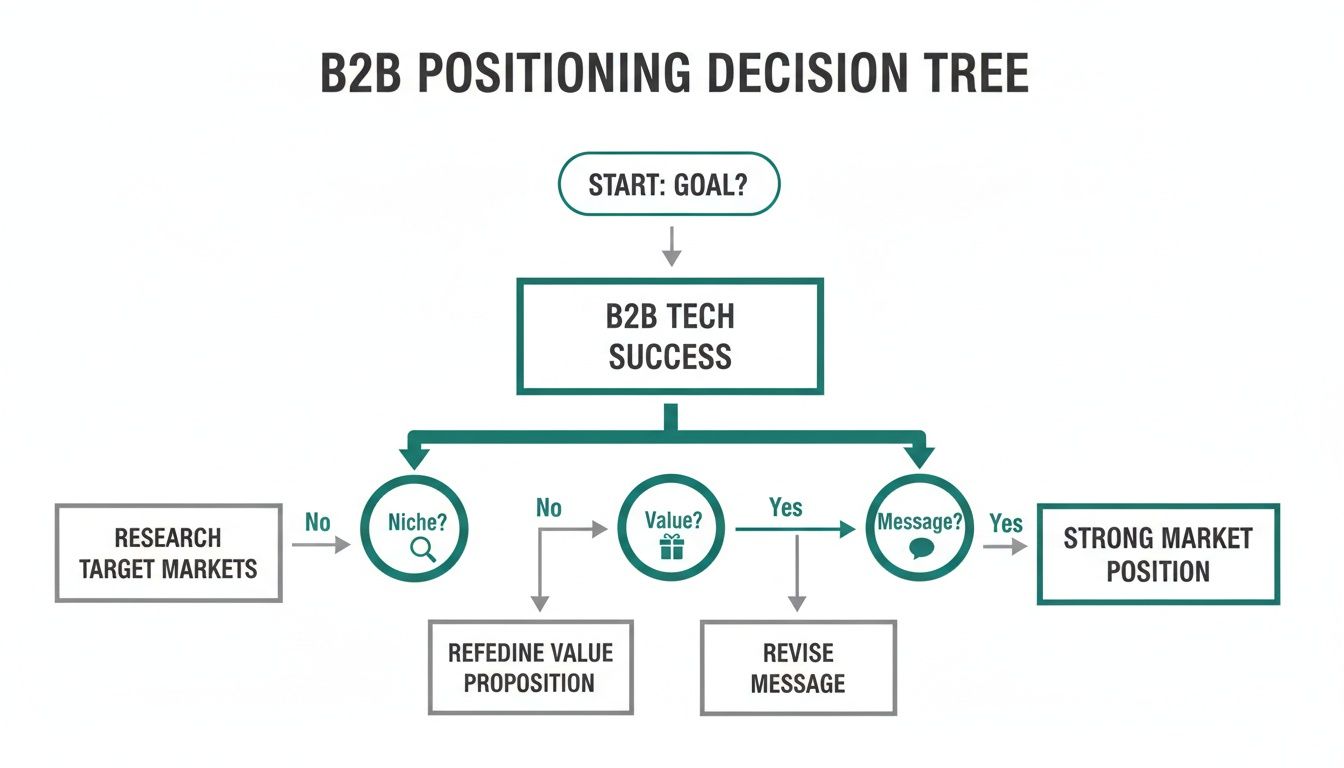
As the graphic shows, a clear path—from finding your niche to shouting your value from the rooftops—is what ultimately guides your channel strategy to success.
While the perfect marketing mix is unique to your product and audience, some channels are consistent workhorses for B2B tech companies. These are the platforms built for educating sophisticated buyers and nurturing the kind of long-term relationships that lead to major deals.
Here are the heavy hitters you should be considering for your strategy:
To help you weigh your options, this table breaks down the strengths and weaknesses of the most common channels in B2B tech.
This comparison makes it clear that there's no single "best" channel; the right choice depends on your specific goals, from generating high-quality leads with SEO to accelerating late-stage deals with targeted ABM on LinkedIn.
Putting together a smart channel strategy takes careful planning. If you want to go deeper, our guide to choosing the right B2B channel mix for growth offers a practical framework for making these decisions. By focusing your energy on these proven channels, you’ll build a powerful system that consistently brings in high-quality leads and cements your company's place as a leader in your field.
Powerful communication is the engine that drives all great marketing for B2B tech companies. Once you’ve dialed in your positioning and picked your channels, your message must connect with two totally different mindsets: the hands-on technical expert and the bottom-line-focused business leader.
It’s an art, but one you can master.
Many tech firms fall into the trap of leading with dense, technical jargon. They think that detailing every complex feature of their solution automatically proves its superiority. But while technical accuracy is non-negotiable for building credibility, it often tunes out the non-technical decision-makers who actually control the budget and sign the checks.
Your job is to translate those intricate product details into compelling stories about solving real problems and driving business forward.
The secret to resonating with a diverse B2B buying committee is to constantly connect what your product does with why it matters to the business. This means every single feature needs a corresponding benefit that speaks to a tangible, measurable outcome.
Think of it this way: an engineer cares that your API has low latency and robust documentation. A CFO, on the other hand, cares that this low latency reduces customer churn by 15% and that the clear documentation cuts developer onboarding time in half, saving thousands in operational costs.
The most effective tech messaging doesn’t just describe the tool; it paints a clear picture of the masterpiece the tool helps create. It shifts the focus from your product’s capabilities to your customer’s future success.
This approach ensures you build credibility with every word, speaking fluently to both the technical evaluators and the strategic decision-makers in the room.
A messaging hierarchy is just a structured framework that organizes your communication from the big-picture value down to the nitty-gritty features. It’s what keeps your story consistent and clear across every ad, email, and landing page.
A simple yet incredibly effective hierarchy has three core layers:
This structure allows you to tailor your communication on the fly. When you're talking to a CEO, you can stay high-level, focusing on the value proposition. When a technical team is digging in, you can dive deep into the features and proof points that matter to them.
For a detailed guide and some great inspiration, you can explore several powerful messaging framework examples to see how leading companies structure their stories.
Ultimately, a well-crafted message acts as a translator, ensuring that whether your audience is an engineer or an executive, they understand one simple thing: your solution is the answer to their problem.
Even the most brilliant strategy gathers dust without rock-solid execution. In the B2B tech world, that execution comes down to one thing: the quality of the content you put out into the world. This is where your carefully crafted positioning and messaging stop being theoretical and become real assets that educate, build authority, and actively pull your sales cycle shorter.
Your job isn’t just to churn out content. It's to create cornerstone assets—substantial, high-value pieces that act as the very pillars of your marketing. These are the resources that don't just tell people you're an expert; they prove it, giving prospects the deep-seated confidence they need before making a six-figure investment.
Let's be blunt: B2B tech buyers are looking for substance. They're drowning in fluff and need more than a simple blog post to be convinced. They need hard proof that you understand their world, their challenges, and have the data to back up every claim you make.
This is exactly where cornerstone assets shine. Think of them as the definitive, peer-reviewed research papers of your marketing. They're meticulously researched, packed with data, and built for a sophisticated audience that can spot a phony a mile away.
These heavy hitters become the fuel for your entire marketing engine. They can be sliced and diced into webinars, social media snippets, and lead nurturing campaigns for months to come.
In a space often bogged down by complexity, video is your secret weapon for clarity and human connection. It has an almost magical ability to make abstract concepts feel simple and build trust in a way that text just can't. Whether it's a quick explainer or a deep-dive demo, video makes your technology feel real and accessible.
Video has become a non-negotiable for B2B tech companies trying to connect with audiences. Projections show that 89% of businesses will use video marketing, and 68% of those who aren't plan to start soon, a clear nod to its engagement power. This lines up with how people buy today—with search engines driving 93% of traffic, your online presence is everything. You can discover more insights about these marketing statistics from HubSpot.
Here are the video formats that consistently deliver the biggest punch in B2B tech:
To make these work, you must recognize that the modern buyer's journey is a visual one. To dig deeper into this, you can explore how B2B organizations use video and influencer marketing to forge unbreakable trust.
Your best content does more than just inform—it inspires confidence. It gives the entire buying committee, from the engineer to the CFO, the proof they need to say "yes."
By investing in high-value content and compelling video, you're not just making marketing materials. You're building a library of assets that works for you 24/7, educating prospects, cementing your brand's authority, and paving a much smoother path for your sales team to close deals.
The future of marketing isn't about working harder—it's about working smarter. AI and automation are no longer buzzwords; they're the essential tools you need to scale your operations, get stunningly clear insights into your audience, and free up your team for what humans do best: big-picture strategy and creative breakthroughs.
Think of AI less as a replacement for your team and more as a powerful partner. It's the brilliant analyst that can sift through millions of data points to find a hidden trend your competitors missed. It's the tireless assistant that can personalize a thousand emails without breaking a sweat. Its real job is to take on the repetitive, data-heavy lifting, so your team can focus their energy on hitting ambitious growth goals.
The most immediate win with these technologies comes from turning routine, manual tasks into automated, intelligent workflows. This shift lets marketing teams operate with a level of precision and speed that was simply impossible a few years ago, which directly translates to better lead nurturing and faster, more relevant customer engagement.
For B2B tech companies, this goes way beyond just scheduling a few social media posts. It’s about building deeply personalized journeys for high-value accounts that feel like they were crafted by hand.
These aren't just small efficiencies; they turn AI into an engine for hitting your most audacious growth targets. For teams looking to get more advanced, a guide on using an AI Twitter bot for lead generation can show you how to automate outreach and scale your social media efforts in a smart way.
The move toward AI in marketing isn't just a slow-moving trend—it's a fundamental reshaping of the entire industry. The sheer amount of money pouring into these technologies signals a massive strategic shift happening in boardrooms around the globe.
AI is quickly becoming the central nervous system of modern B2B tech marketing. It connects the dots between data, automates execution, and delivers the insights needed to make smarter decisions faster. It’s how marketing finally shifts from a cost center to a predictable revenue driver.
The numbers don't lie. Right now, 63% of marketers are already using generative AI. By 2025, an incredible 71% of marketers are planning to invest at least $10 million into AI over the next three years. This isn't just a grassroots movement either; 83% of CMOs are optimistic about what the technology can do. With the generative AI market in marketing alone projected to hit $22 billion by 2032, it's clear this isn't a fad—it's the future.
Getting started with AI doesn't mean you need to blow up your entire marketing department and start from scratch. The key is to begin with a clear business problem and identify how technology can actually help solve it. Start small, prove the value, and then scale what works.
For example, you could begin by using an AI-powered tool to analyze your website traffic and figure out which content pieces are your real conversion workhorses. Use that insight to plan your next content sprint. Once you see the results, you can start exploring more advanced applications.
Our 2026 practical AI implementation guide for B2B marketers gives you a step-by-step framework to help you integrate these powerful tools without the headache. By taking a measured, results-first approach, you can build a smarter, more impactful marketing function, one win at a time.
You've made it this far, which means you're serious about building a marketing engine that actually drives revenue. But theory is one thing—execution is another. Let's tackle some of the most common, practical questions that come up when it's time to turn strategy into action.
Think of this as the "Okay, but what about..." section. We'll get straight to the point on budgeting, measuring what matters, and selling complex tech without putting your audience to sleep.
There’s no magic number, but a solid starting point for an established B2B tech company is 7-10% of annual revenue. But let's be clear: this is just a benchmark, not a rule. Your company's stage and ambition are what really dictate the budget.
An early-stage startup trying to carve out its first piece of the market? You will have to invest more aggressively to build that initial momentum. For you, a budget closer to 15-20% of revenue is far more realistic. You're not just marketing; you're buying market share. On the flip side, a well-established leader might spend a smaller percentage, but it's a smaller slice of a much, much bigger pie.
The most important mindset shift is to stop seeing marketing as a cost center. It's an investment in growth. Every dollar should be accountable, tied to a measurable outcome like qualified leads in the pipeline.
My advice? Start with a budget that’s big enough to run meaningful tests on two or three core channels. Let the data tell you where the gold is, then double down on what works and cut what doesn't.
It's incredibly easy to get distracted by vanity metrics. Website traffic, social media likes, and follower counts can feel good, but they don't pay the bills. If you want to prove marketing’s value and earn a seat at the leadership table, you must speak the language of the business: revenue.
Here are the KPIs that should be glued to every B2B tech marketer's dashboard:
Tracking these numbers gives you an undeniable picture of your funnel's health. It’s how you move the conversation from "marketing is spending money" to "marketing is generating revenue."
Marketing a deeply technical product is a classic challenge, but the answer is surprisingly simple: translate features into business outcomes. Your audience isn't a monolith; it's made up of technical evaluators who need to know how it works and business decision-makers who need to know why it matters.
Your job is to bridge that gap. Stop leading with the "how"—the algorithms, the architecture, the code. Instead, focus on the so what. What problems does your tech solve that keep your customers up at night? Use analogies and real-world examples to make the value crystal clear.
For instance, don't just say, "Our platform uses a proprietary asynchronous processing algorithm." Nobody is buying an algorithm.
Instead, frame it as a benefit: "Our platform processes data 5x faster, which means your team gets critical reports in minutes instead of hours. What could they do with that time back?"
This isn't about dumbing down your product; it's about elevating the conversation. You’ll still need the deep-dive technical content—the whitepapers, the docs, the spec sheets—for the engineers who need to kick the tires. But for the executive signing the check, you need to tell a story about ROI, efficiency, and business advantage. Create two streams of messaging and you'll speak everyone's language.
Ready to stop guessing and start building a high-impact marketing strategy that wins deals? Big Moves Marketing specializes in helping B2B SaaS and AI startups go to market with powerful positioning, messaging, and sales tools that drive revenue. I partner with founders to translate complex technology into a story that sells.
Let's build your go-to-market strategy together at Big Moves Marketing.
Explore Big Moves Marketing services and resources:




%20-%20white.svg)