%20png%20copy.avif)
Most sales enablement content libraries are liabilities disguised as assets. They contain too much material, carry too little context, and force sellers to search for answers while a live deal is moving. The popular advice is to produce more collateral. That advice is backwards.
A sales enablement content strategy should make the right message findable, current, and useful inside a specific buying motion. If it doesn't, another deck, guide, or case study only increases the noise. The commercial question isn't how many assets marketing shipped. It's whether a seller used the right asset with the right stakeholder at the right point in the deal, and whether that interaction helped the opportunity progress.
Sales enablement libraries usually fail as operating systems, not as writing projects. Teams produce assets without connecting them to a sales motion or buying stage. They review them less often than the product, market, and competitive story changes. Then they place the files somewhere sellers will not search while speaking with a customer.
The result is busywork disguised as coverage. Marketing counts assets shipped, enablement counts training completed, and leadership sees a larger library. Sellers still cannot find a current answer quickly. Around 65% of marketing content is reported as unused by salespeople, often because it is outdated or difficult to find, according to research on B2B sales enablement statistics. Revenue teams also spend 440 hours per year searching for or creating content, according to the same source. Those hours are operational debt, not selling time.
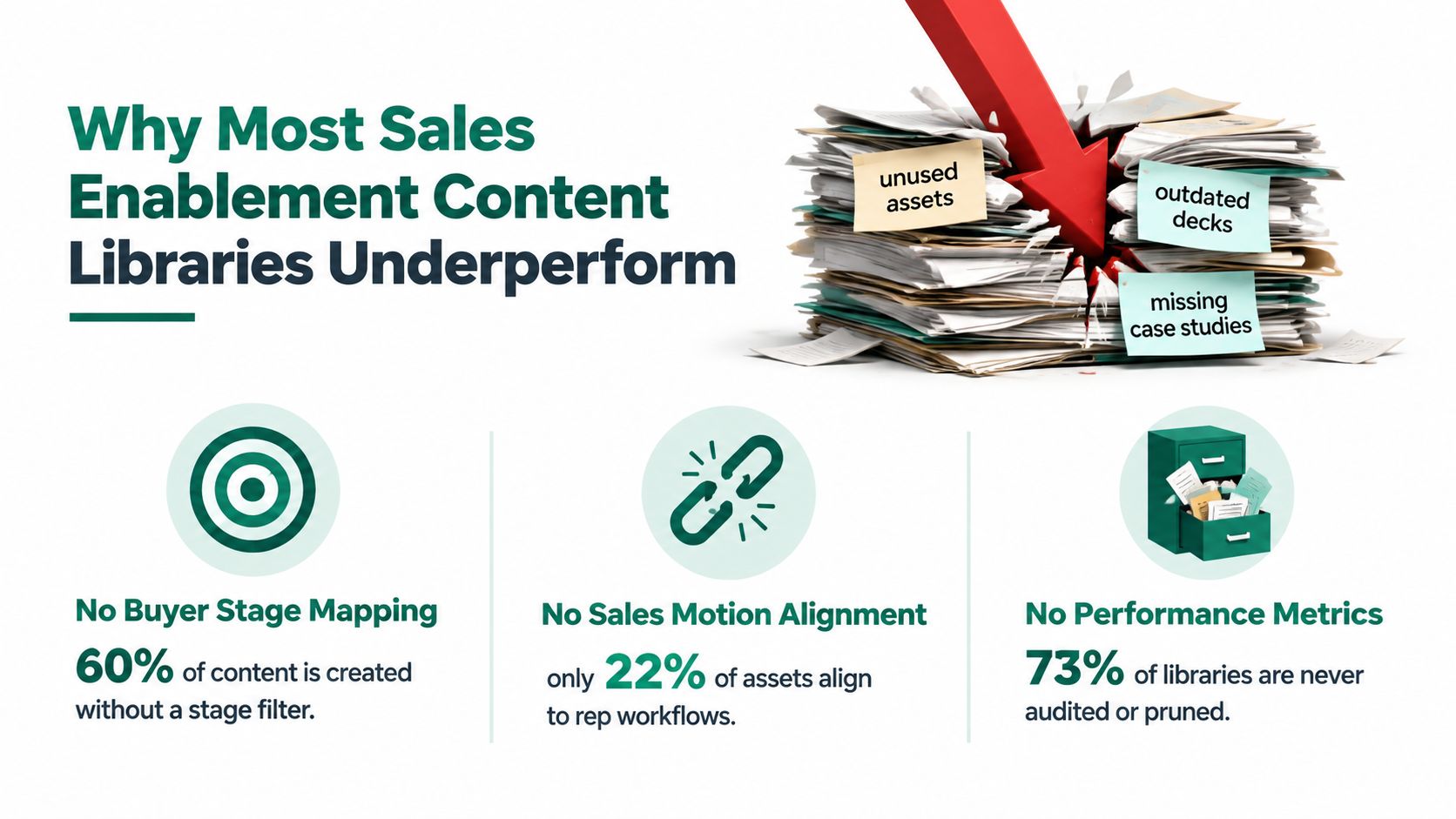
A library creates value through deployment. A polished executive deck in a shared drive contributes nothing until a seller can retrieve it, adapt it responsibly, and send it to a buyer whose question it answers.
Track the operating signals:
A sales battlecard shows the standard. Its value comes from helping a seller handle a specific objection with an approved, relevant answer. A long list of competitor claims adds little if the rep cannot locate the right response during the conversation.
Governance and retrieval are the failure points; creativity was never the constraint. Fix those first, then decide what deserves production.
Start with the commercial system, not the content calendar. A calendar answers what marketing will publish. It doesn't answer which buyer is stuck, which seller is responsible, or what action the asset should support.
Begin by defining the ICP in operational terms. Identify the company profile, the initiating problem, the economic buyer, the technical evaluator, the daily user, and the internal champion. A single account may include all of them. Treating “the buyer” as one person produces generic assets that satisfy nobody.
Next, map the buying stages your deals move through. Avoid inherited funnel labels if they don't reflect how your customers make decisions. A sales-led enterprise motion may need problem recognition, internal alignment, technical validation, business-case approval, procurement, and security review. A product-led motion may need activation, habit formation, team expansion, and conversion support. The stages should describe buyer decisions, not internal marketing activities.
Then separate the sales motions. Inbound self-serve, founder-led sales, outbound prospecting, PLG-assisted selling, partner-led selling, and enterprise sales create different content demands. A product comparison that helps an enterprise committee may be useless in a founder-led discovery call. A short implementation guide may matter more than a brand deck for a technical evaluator.
Build a content-to-motion matrix before assigning production work. Each row should connect one buying stage and sales motion to a buyer question, a content job, and a seller action.
| Buying Stage | Sales Motion | Buyer Question | Content Job | Seller Action |
|---|---|---|---|---|
| Problem recognition | Inbound self-serve | Is this problem material enough to address? | Clarify the cost and shape of the problem | Share an educational asset and qualify urgency |
| Evaluation | Sales-led | Why this approach instead of the alternatives? | Explain differentiation in the buyer's language | Use a comparison guide during evaluation |
| Technical validation | Enterprise | Can this work in our environment? | Reduce implementation and risk concerns | Send technical proof and coordinate specialist review |
| Internal alignment | PLG-assisted | Can I justify this to my team? | Give the champion a concise internal case | Provide a forwardable business-case asset |
| Decision | Enterprise | Can we approve this with confidence? | Resolve commercial, security, and adoption objections | Build the final decision package |
This structure belongs beside your B2B customer journey mapping, not buried in a content brief. It forces a hard question for every asset: what changes in the deal because this exists?
If the answer is “it supports awareness” or “it explains the product,” the assignment isn't ready. Define the buyer's question and the seller's next action first.
A sales enablement library earns its place by helping a specific buyer take the next decision step. Asset volume is a weak proxy for coverage. Stage, sales motion, buyer role, and decision pressure determine whether a document gets used or ignored.
DocSend's analysis of 34 million content views found that prospects spend less than three minutes on average with sales content, and more than 80% of visits occur on desktop. Those findings support a practical design rule: make every asset easy to scan, easy to forward, and focused on one job. DocSend's sales enablement content benchmarks provide the underlying view data.
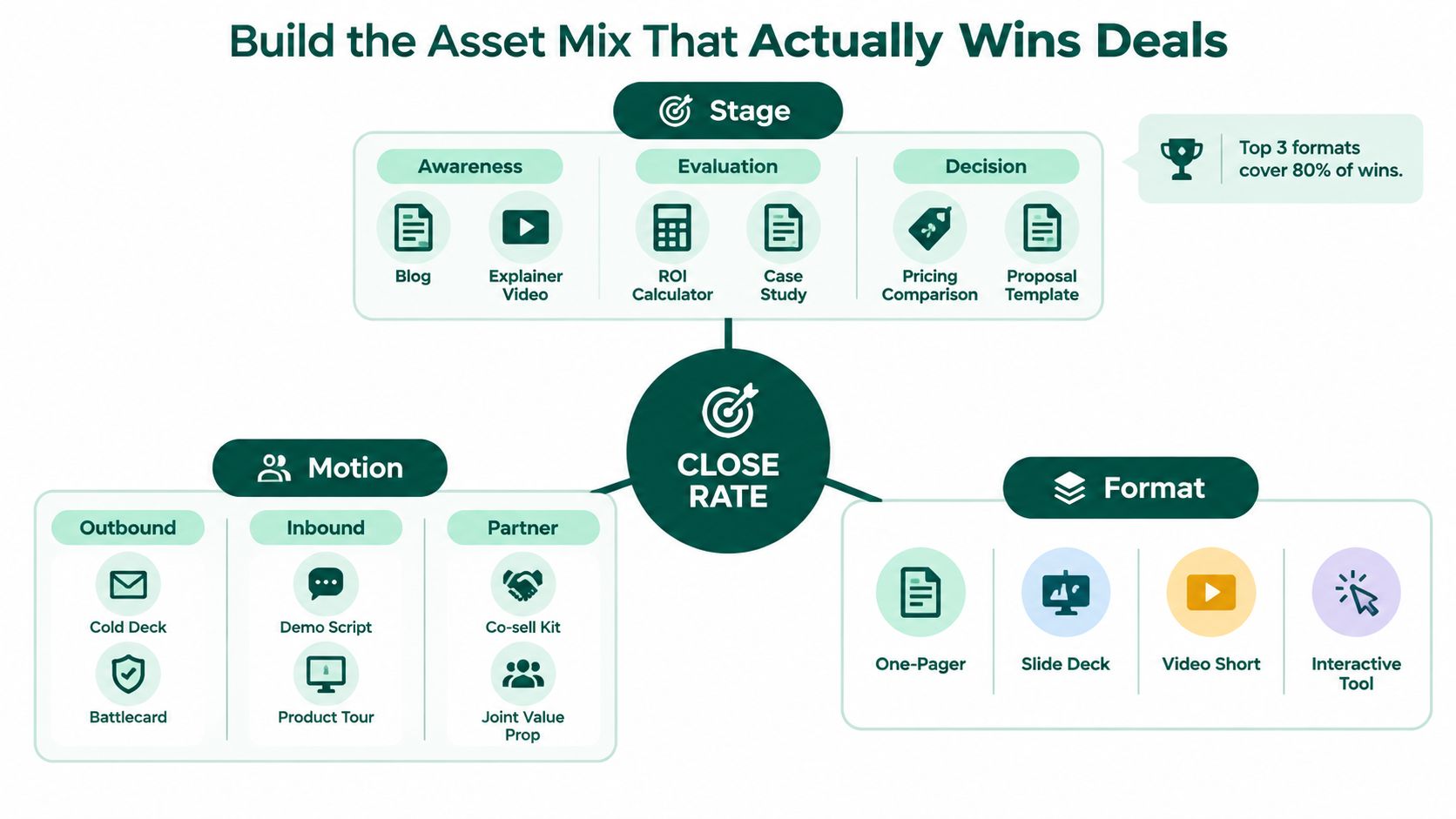
During evaluation, give buyers material that helps them judge fit quickly. Use a focused solution brief, a relevant customer story, a comparison guide, or a one-page explanation of the problem and your approach. Each piece should answer a question the buyer has already raised, rather than repeat positioning from the website.
Late-stage buyers need evidence they can use to secure approval. Build ROI models, implementation plans, security responses, commercial summaries, and proposal templates for that point in the process. Their job is making approval easier, not making the brand memorable. A finance leader needs assumptions and payback logic. An IT reviewer needs architecture, controls, and ownership. An operations leader needs rollout requirements and adoption evidence.
Stakeholder selling requires assets that travel without the original seller. Use role-specific proof, reference decks, call recordings, and internal champion kits. Gartner Peer Community reports that 71% of sales professionals provide case studies or customer success stories, 60% provide product demos, and 55% provide product one-pagers. Its buyer-journey mapping insight on enablement content also reports that 40% say buyers engage most with awareness content and 40% say buyers engage most with written content. Written assets remain useful because buying committees can forward, annotate, and review them without a live meeting.
Prune any asset that fails one of these tests:
A smaller set of current, role-specific assets will outperform a warehouse of near-duplicates. Too many options slow sellers down and make quality inconsistent. Start with the formats tied to your highest-value motions, then add an asset only when deal reviews reveal a recurring information gap.
Use B2B content examples for successful sales enablement to evaluate useful formats, then keep the inventory narrow enough for sellers to remember where each asset belongs.
A library becomes usable when someone owns every asset, one system holds the approved version, and metadata makes retrieval predictable. Without those controls, content decays. Reps create local copies, marketing updates the master, and buyers receive conflicting narratives.
Assign an owner for each asset. The owner doesn't need to write every revision, but they must be accountable for accuracy, review dates, audience, and retirement. Separate the roles where necessary: a subject-matter contributor, a reviewer, and a publisher can be different people. Accountability cannot be shared so widely that nobody acts.
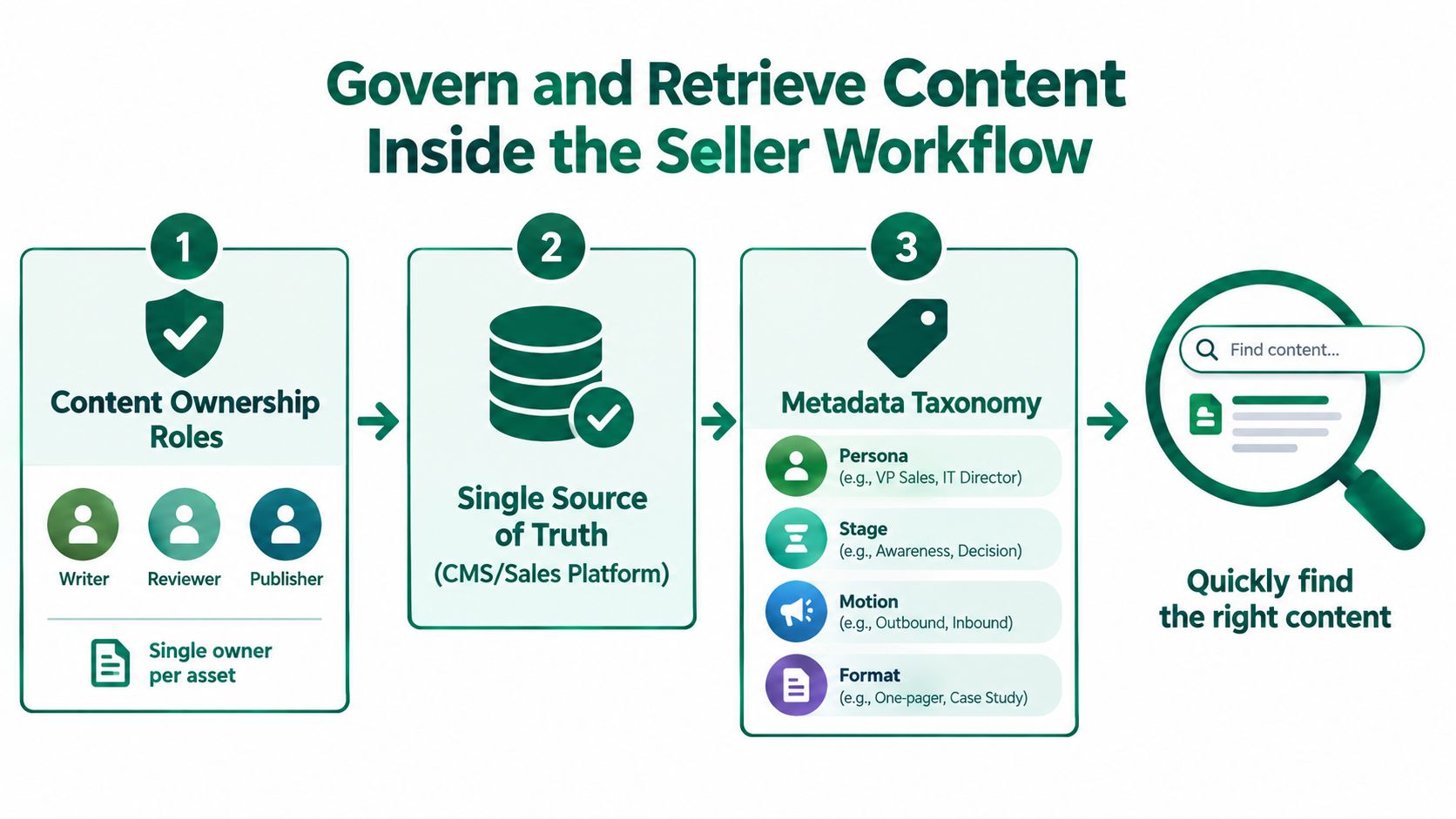
Every approved asset should carry structured tags for:
The single source of truth should sit in the CMS or sales platform connected to the seller workflow. A separate portal that requires deliberate browsing will become an archive. Surface approved content through CRM opportunity stages, deal rooms, sales sequences, call preparation, and search tools reps already use.
This matters for specialized workflows too. Teams responding to complex tenders may need a governed reference system for what is bid writing software, especially when approved answers, evidence, and version control affect proposal quality. The principle is the same: retrieval must happen where the work happens.
Run a quarterly prune cycle. Archive duplicate, inaccurate, and unused assets. Refresh material affected by pricing, packaging, product changes, positioning, or competitive movement. A library should earn its place continuously.
Your sales playbook template should point to governed assets, not reproduce them in a second location. Duplicated guidance creates version conflicts and trains sellers to distrust the system.
Placement beats production. A useful asset buried in a portal is less valuable than a plain asset inserted into the opportunity record immediately before a relevant action.
Start with the CRM. When an opportunity reaches a defined stage, show the recommended assets inside the record. A seller preparing for a discovery call should see the discovery guide, relevant industry proof, and objection notes without opening a separate application. A seller approaching procurement should see the security package, implementation plan, and commercial explanation that match that motion.
Use the same principle across the deal workflow:
Newsletters and Slack drops can announce updates, but they shouldn't be the primary distribution mechanism. They create awareness inside the company, not dependable usage in the field. Buyers won't see them, and reps may miss them at the moment of need.
| Channel | Rep Usage | Buyer Influence | Priority |
|---|---|---|---|
| CRM opportunity record | High when stage-triggered | High through timely sharing | Highest |
| Buyer workspace or deal room | High for active committees | High during evaluation and decision | Highest |
| Sales sequence | High when attached to a defined touch | Moderate to high | High |
| Call preparation notes | High before strategic meetings | Indirect but meaningful | High |
| Standalone enablement portal | Variable | Low unless linked from a live deal | Selective |
| Slack announcement | Short-lived | Low | Low |
| Internal newsletter | Passive | None | Low |
A distribution system should reduce the number of decisions a rep must make. If a seller must ask, “Which of these twelve decks should I send?” the system has failed even if search technically works.
Page views are useful only when they explain behavior that affects pipeline. They shouldn't be the headline metric for a sales enablement content strategy.
Measure four dimensions: activity, feedback, adoption, and impact. This measurement model aligns with the Forrester framework for revenue enablement and sales content management. Activity shows what sellers and buyers do. Feedback captures whether the content is credible and useful. Adoption shows whether teams use it in real deals. Impact connects those touches to opportunity progression and revenue.
Track each asset against the opportunity lifecycle:
Don't claim that an asset caused a win because it appeared in the deal. Use influence carefully. Compare opportunities where the asset was used with comparable opportunities where it wasn't, then look for consistent patterns rather than one impressive anecdote.
Founders need a compact view that supports decisions. Marketing and enablement teams can maintain the detail, but leadership should see which content deserves investment, revision, or retirement.
| KPI | Funnel Stage | Reports To | Cadence |
|---|---|---|---|
| Asset activation by stage and motion | All active stages | Head of Revenue | Weekly |
| Time-to-content for priority use cases | Discovery and evaluation | Sales leadership | Weekly |
| Seller rating and qualitative feedback | All stages | Enablement owner | Monthly |
| Content-assisted opportunity progression | Evaluation to decision | CEO or revenue leader | Monthly |
| Content presence in closed-won and closed-lost deals | Decision | Executive team | Monthly or quarterly |
| Asset age versus current usage | All stages | Marketing owner | Monthly |
| Adoption score by rep | Active pipeline | Sales managers | Weekly |
Define a weekly rep adoption score from actual usage, not from logins. Review which assets appeared in live opportunities, which sellers bypassed them, and what requests surfaced repeatedly. Those requests reveal content gaps, workflow problems, or messaging confusion.
Hold a monthly enablement review with sales, marketing, product marketing, and revenue operations. Decide what to keep, revise, retire, or create. For a broader list of practical indicators, the Overvue sales enablement guide provides useful context, but don't let a longer dashboard replace judgment.
The executive question is simple: which content is helping sellers move qualified opportunities, and what evidence supports that conclusion? Your marketing ROI measurement framework should connect these content signals to the wider pipeline model rather than isolate enablement as a publishing function.
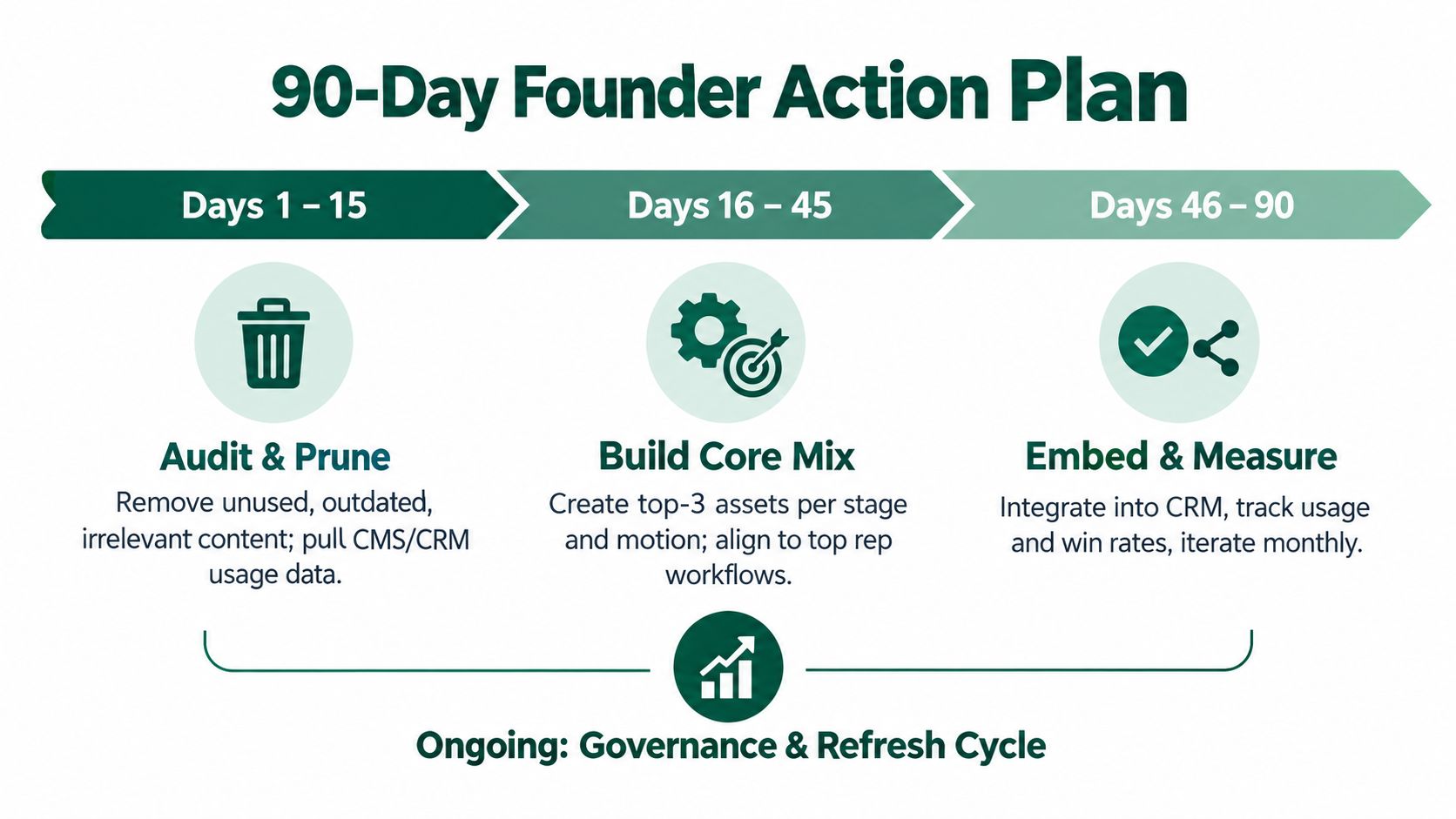
You don't need another hire to fix a broken library. You need a sequence, a named owner, and enough discipline to stop producing assets before the operating system is usable.
Pull usage data from the CMS, CRM, and sales engagement platform. Inventory assets by owner, persona, buying stage, motion, format, last review, and recent deal usage. Ask five sellers to identify the material they use, the material they avoid, and the answers they keep rebuilding from scratch.
Then delete or archive dead weight. Don't preserve an asset because someone senior once requested it. Keep the survivors that support an active motion, answer a repeated buyer question, or provide credible proof.
Deliverable: a clean inventory and a one-page content-to-motion map.
Owner: founder or revenue leader, with one marketing or operations operator.
Exit criterion: every retained asset has a defined audience, stage, motion, owner, and next review date.
Create a starter library around the highest-value motions. The plan calls for 25 assets, but that number should function as a controlled starting point, not a target for endless production. Give each stage and motion a small set of essential formats, such as a one-pager, relevant proof, objection guide, implementation explanation, and decision support.
Embed those assets into CRM stages, sequences, call preparation, and buyer workspaces. Hold a weekly content office hour with sellers. Bring one live deal, one failed retrieval, and one buyer objection to each session. Revise the system from observed friction, not from abstract preference.
Deliverable: a 25-asset starter library embedded in active workflows.
Owner: marketing or product marketing, with a sales manager validating use.
Exit criterion: sellers can retrieve the approved asset for each priority motion without asking marketing to locate it.
Connect enablement touches to opportunity stages. Record which assets were shared, by whom, with which persona, and at what point in the deal. Build a dashboard that shows activation, adoption, progression, feedback, freshness, and outcome signals.
Review the dashboard in QBRs, but don't wait for a quarter to fix obvious problems. Weekly adoption data should expose broken tags, missing proof, stale messaging, and workflows that reps ignore.
Deliverable: a pipeline-attribution dashboard with agreed definitions.
Owner: revenue operations or the founder's designated operator.
Exit criterion: leadership can identify which assets are used in live deals and whether those deals progress.
Name a permanent owner for the library. Set an intake SLA for new requests, including the buyer problem, target role, motion, stage, required evidence, and expected seller action. Establish the quarterly prune-and-refresh ritual, with explicit authority to archive material that no longer earns attention.
Deliverable: a governance charter covering ownership, intake, review, retirement, and measurement.
Owner: the revenue leader, with marketing and sales operations accountable for execution.
Exit criterion: every asset has a lifecycle, every request follows a defined path, and the next prune cycle is scheduled.
The result shouldn't be a larger library. It should be a smaller, fresher, findable system that fits how your team sells. Big Moves Marketing helps B2B SaaS leaders clarify positioning, map buyer and sales motions, and connect content decisions to measurable pipeline systems. Visit Big Moves Marketing to discuss a governance-first sales enablement content strategy for your company.





%20-%20white.svg)