%20png%20copy.avif)

A sales battlecard is a tool for winning a specific moment in a deal. It is not a product manual or an exhaustive feature list. It is a weapon, designed to arm a representative with the precise talking point, competitor takedown, or objection-handling response they need, exactly when they need it. The entire purpose is to deliver a decisive advantage in under 30 seconds.
If it cannot do that, it has failed.
Most sales battlecards created by B2B SaaS companies are useless.
They are bloated, generic documents—digital graveyards of product specs, marketing fluff, and corporate messaging. Sales reps ignore them because they fail in the one moment they are supposed to work: the critical seconds of a live conversation with a prospect.
The problem is a fundamental misunderstanding of a battlecard's function. It is not a library; it is a tactical tool built for a specific combat scenario. Its value is measured not by how much information it contains, but by how quickly it helps a rep win a conversational point.
Founders and GTM leaders must reframe how they view battlecards. Stop treating them as static "sales enablement assets" and start treating them as dynamic tools for executing strategy on the front lines. This requires being ruthless about utility over comprehensiveness. Packing every feature and competitor detail into a single document is a recipe for cognitive overload, ensuring it remains buried in a shared drive.
The first principle of effective battlecard design is this: it must deliver a decisive advantage to a rep mid-conversation. If they cannot glance at it and pull out a killer question or a sharp rebuttal instantly, it has failed.
This shift has a measurable impact. An analysis of B2B sales cycles found that teams using concise, structured battlecards close deals up to 27% faster than those who do not. That speed comes directly from equipping reps to dismantle competitor claims and handle objections with precision. You can find more details in this HubSpot study on sales strategy.
The objective is to equip your team to win, not just to be informed. A great battlecard is the physical manifestation of your competitive strategy, translated into actionable talking points. It is less about listing what your product does and more about codifying how your team wins.
This approach transforms the document from a passive resource into an active component of your sales motion, directly influencing pipeline and revenue. For this to work, it must be integrated into your broader strategy, much like a well-defined sales playbook. You can find out more about assembling one with this B2B SaaS sales playbook template.
Forget the templates you have seen online. A battlecard that swings a deal is not a checklist of your product’s features or a brain dump of marketing slogans. It is a curated intelligence brief, designed for one purpose: deployment in the heat of a live sales conversation. Its value is measured in conversational control, not in how much information you can cram onto a page.
Too many teams build encyclopedias when their reps need a knife. They list features when the prospect is asking about outcomes. The entire game is about shifting from theoretical components to razor-sharp intelligence a rep can use mid-call to gain an immediate edge.
This is the fundamental shift: moving from the old way of thinking (the battlecard as a static document) to the new way (the battlecard as a dynamic weapon).

This evolution separates the teams that hit their numbers from those that just hit "send" on another ignored email.
Let's break down the difference between what most teams do and what winning teams do.
This is not a semantic difference; it is a strategic one. Let’s get into the specifics of what these winning components look like.
This is the most critical section, and it is where most battlecards fail. A generic list of "Competitor X’s weaknesses" is worthless. Your reps need specific, surgical questions and statements that expose a competitor's core flaw in the context of the buyer's pain.
These are not just negative points; they are strategic traps. The goal is to lead the prospect to realize the competitor’s weakness on their own, positioning you as a trusted advisor, not just a salesperson.
This forces the competitor to defend a known weak point while positioning you as an expert who understands real-world implementation challenges. Your battlecard should have 3-5 of these pre-scripted for each major rival. Building these requires a sharp understanding of your market, which is where a robust competitive analysis framework becomes indispensable.
Most "Objection Handling" sections are filled with generic, defensive rebuttals that sales reps ignore because they sound robotic. A winning battlecard frames this section around specific "if-then" scenarios. It recognizes that why a prospect objects is as important as what they object to.
A great battlecard does not just give the answer; it diagnoses the objection's root cause. An objection about price is rarely about the number—it is about a failure to establish value.
For your top 5-7 objections, your battlecard should provide a concise, two-part response:
Your core value proposition is not one-size-fits-all. A Head of Engineering cares about different outcomes than a CFO does. A useful battlecard must equip the rep to pivot the messaging on the fly, based on the buyer persona.
This is not about listing different features for different roles. It is about translating your product's capabilities into the specific language and metrics that matter to that individual.
Each pivot should include key discovery questions, relevant metrics, and a customer story that resonates with that specific persona.
Case studies are for your website. In a live sales call, reps need specific, quantifiable data points they can drop into conversation. These are the sharp facts that cut through the noise and build instant credibility.
Instead of a long paragraph about a happy customer, the battlecard should distill it into a single, powerful line.
Each proof point must be specific, quantifiable, and easily recited. A good battlecard has a library of these, categorized by industry, company size, or use case, so a rep can pull the perfect one at the perfect moment.
A sales battlecard is only as good as its intelligence. The problem is that most B2B SaaS teams build theirs on the weakest possible foundation: their competitor's public-facing marketing.
They scrape homepages, analyze pricing tiers, and call it a day. Then they hand their sales team a document full of information the prospect has already seen.
This is a surefire way to lose. It is like prepping for a boxing match by only watching your opponent’s press conferences. You are reacting to the story they want you to hear, not the reality of how they fight.
Winning teams know the most valuable intelligence is not found on a polished website. It is buried in the unfiltered truth of what it is actually like to be their customer. To build a battlecard that gives you a real edge, you must dig deeper than marketing fluff and uncover the operational reality of using a rival’s product.
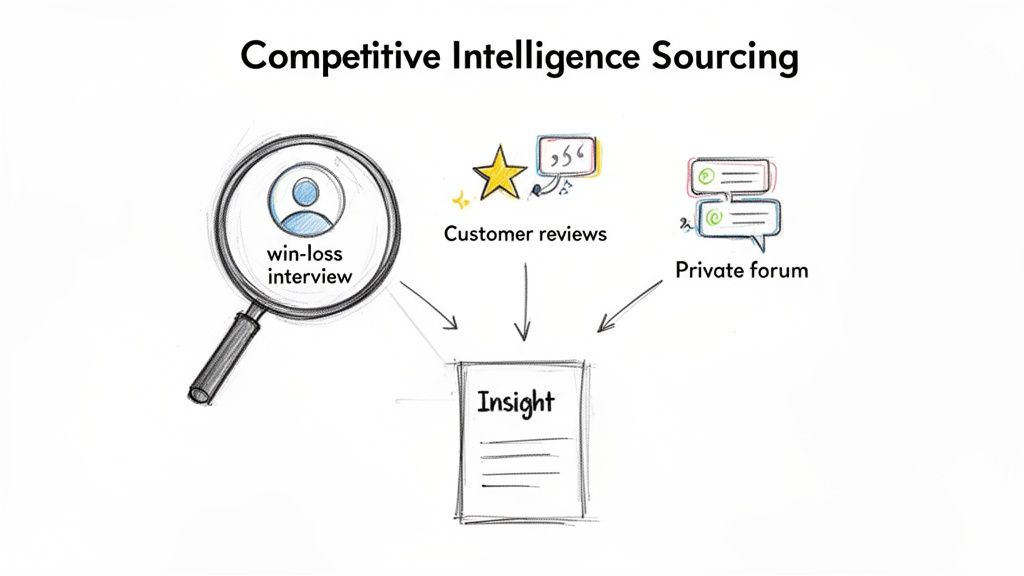
This means shifting from being a passive observer to an active investigator.
The single most valuable source of competitive intelligence is a structured conversation with a buyer who just finished evaluating you against the competition. Yet, for most companies, this is a box-checking exercise for the sales team, not the strategic goldmine it is.
The goal is not just to find out why you won or lost. It is to deconstruct the buyer's evaluation journey from their point of view. You are hunting for the unvarnished truth about your competitor’s product, their sales process, and their hidden weaknesses.
Your interviews should be designed to extract answers to questions like:
Every interview should yield at least one "landmine"—a painful truth about the competitor that your reps can use to build trust and sow strategic doubt. Making this a systematic part of your SaaS competitive analysis turns this intelligence into a repeatable weapon.
Public review sites are not just for collecting star ratings. They are live, unstructured focus groups where your competitor's customers go to vent. Your product marketing team should be systematically deconstructing these, not just glancing at the overall score.
Forget the five-star raves and the one-star rants. The real gold is in the three- and four-star reviews. This is where you find nuanced feedback from smart users who understand the product but are frustrated by specific, recurring limitations.
The most potent competitive insights come from your rival's power users. When a sophisticated customer points out a workflow limitation or a functionality gap, that is not an opinion—it is an early warning signal of a core product weakness.
Look for patterns. Are people constantly complaining about a slow API? A clunky reporting module? A missing integration? These are not just feature gaps; they are strategic openings. These recurring pain points become the raw material for sharp, evidence-backed talking points your reps can deliver with total confidence.
The most honest conversations about B2B software do not happen on Twitter. They happen in private Slack channels, niche subreddits, and industry-specific forums where real practitioners ask for help and trade war stories.
This is where you find the "off-the-record" intelligence. You will see real users discussing bugs, requested features, and the awkward workarounds they have built to make a product usable.
This high-context intelligence gives your sales team an undeniable edge. Imagine a rep being able to say, "A lot of teams we talk to who use Competitor X mention they have to manually export data for weekly reports. Is that something you have run into?"
That one question instantly repositions your rep from a salesperson reading a script to an expert who genuinely understands the prospect's day-to-day reality. This is the kind of sourcing that transforms a battlecard from a cheat sheet into an unfair advantage.
Creating the battlecard is the easy part. That is perhaps twenty percent of the job. The other eighty percent—adoption, maintenance, and integration—is where nearly every B2B SaaS company fails. They invest weeks building the “perfect” asset, only to watch it gather digital dust in a forgotten folder.
The result is a total waste of strategic effort and a sales team that is still flying blind. This is not a random outcome; it is the predictable result of a few common, catastrophic mistakes. Most leaders blame the reps for not using the asset, but the real fault lies in a broken process.
An investment in competitive intelligence only pays off when it is used on the front lines. Anything less is an expensive academic exercise.
The most common way battlecards die is the "launch and abandon." Marketing finishes the card, attaches it to an email, a VP sends a “check this out” note, and then… nothing. There is no training, no follow-up, and no one owns its success.
This approach guarantees failure. Sales reps are creatures of habit, working in a high-pressure environment. A new document, no matter how good, is an interruption unless it is actively woven into their workflow. Without someone responsible for driving adoption and tracking usage, the battlecard is dead on arrival.
The fix is simple but not easy: assign explicit ownership. This almost always falls to Product Marketing. Their job is not just to build the card; it is to own its entire lifecycle. That means running training sessions, facilitating role-playing exercises, and establishing a regular quarterly review to keep it current.
The second cardinal sin is turning the battlecard into an encyclopedia. Proud of their research, marketing dumps every data point, feature spec, and competitor tidbit into a sprawling document. They have built a library when what the rep needs is a single, sharp sentence.
A rep on a live call does not have time to scroll through dense paragraphs. They have maybe 15 seconds to find the perfect talking point to dismantle an objection. If they cannot find it instantly, they will ditch the tool and use their gut. The battlecard becomes a source of stress, not confidence.
The core principle of a usable battlecard is ruthless curation. It must be built for a glance, not a deep read. Its value is in its speed and precision.
To fix this, enforce a strict one-page limit per competitor. Use punchy bullet points, bold text for key takeaways, and clear headings. Every word must earn its place. If it does not help a rep win a specific conversational moment, cut it.
Finally, battlecard projects fail when they are built in an ivory tower. Marketing creates assets based on their own analysis without consulting the people who will actually use them: the sales team. This creates a tool that may be strategically sound but is practically useless in the trenches.
Marketing might think a certain competitor weakness is a silver bullet, but sales knows from hundreds of calls that prospects never ask about it. The language is often stiff corporate-speak, not the direct, conversational style reps use with customers. This disconnect breeds immediate distrust, and sales rightfully sees the battlecard as another irrelevant marketing handout.
The only solution is to co-create the battlecard with your top-performing reps from day one. Involve them in gathering intelligence, get their gut-check on talking points, and have them sign off on the final format. This not only makes the asset ten times better, but it also creates built-in champions who will drive adoption across the team. It is a foundational step in truly aligning your sales and marketing teams for go-to-market impact.
A battlecard sitting in a shared drive is worthless. It is a strategic asset that has depreciated to zero because it is not being used. Real sales enablement is about weaving this intelligence so deeply into the sales process that it becomes muscle memory for every rep.
Too many leaders stop after creating and distributing the cards. They build the asset, send an email, and check the box. This is a fundamental misunderstanding of how high-performing sales teams operate. Activation is not the last step; it is the entire point. The goal is to make the battlecard a living, breathing tool—not a static PDF that is obsolete the moment you save it.
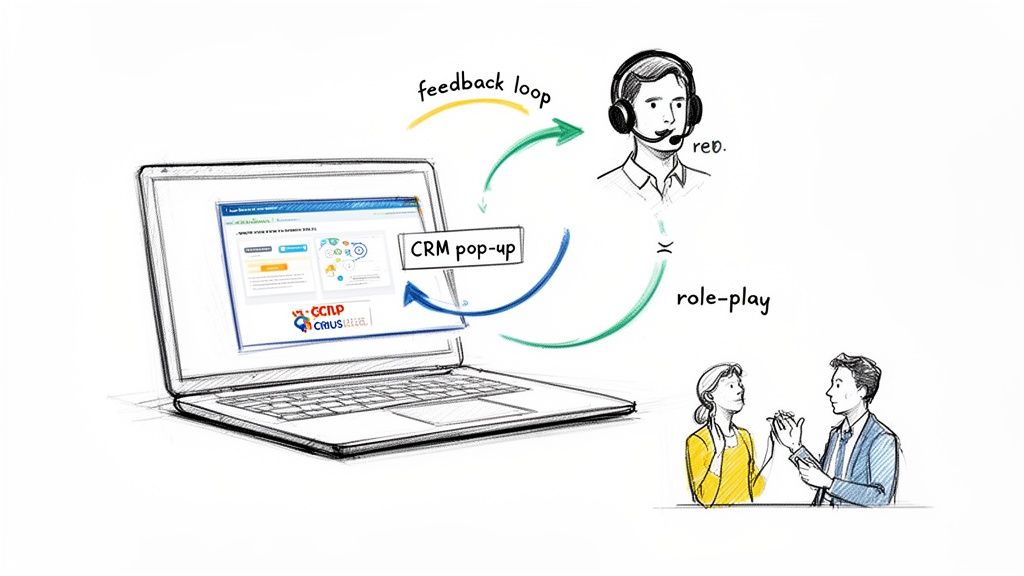
This ensures your team does not just have the information, but can actually use it with confidence when a deal is on the line.
The most effective way to drive rep adoption is to eliminate all friction. Do not make them hunt for it in another tab or a separate system. It needs to appear contextually, right where they live all day: their CRM.
This is not about convenience; it is about gaining a tactical edge in real time. When a rep logs a call against an opportunity where a key competitor is mentioned, the correct battlecard should pop up automatically. That simple trigger transforms a passive document into an active, on-the-fly coaching tool.
When intelligence is delivered at the precise moment of need, it stops feeling like a resource to be consulted and starts feeling like an extension of the rep’s own expertise.
Many modern sales enablement tools can facilitate this. The small investment pays for itself almost instantly by ensuring your competitive strategy is executed on the front lines, call after call.
Handing a rep a battlecard and expecting mastery is like giving a pilot a flight manual and telling them to fly a 747. Knowledge is useless without practice. The only way to build real confidence is through realistic, high-pressure role-playing.
Sales training on new battlecards should never be a passive PowerPoint presentation. It must simulate real-world conditions.
These are not just training exercises; they are controlled stress tests. They build the reflexes your reps need when they are on a live call and the pressure is on. For more ways to frame these sessions, review core sales enablement best practices.
Your battlecard must be a two-way street. Intelligence cannot only flow from marketing down to sales. The most valuable, up-to-the-minute intelligence comes directly from the field. Your reps hear about new competitor features, pricing tricks, and customer complaints weeks—sometimes months—before it becomes public knowledge.
You must build a formal feedback loop to capture this information.
This system turns your sales team from passive consumers of intelligence into active co-creators. It ensures your battlecards are never static but are constantly sharpened with fresh, ground-truth data from the market. It turns a simple document into a dynamic competitive weapon.
As a founder or early-stage leader, your to-do list is already impossible. The idea of building a "competitive intelligence library" sounds like a distraction.
Good. Because that is not what this is.
The goal is not to create a perfect, all-encompassing encyclopedia of your competition. It is about getting a decisive advantage into your team's hands, fast. This is about execution, not theory. The checklist below is designed to get you from zero to a Minimum Viable Battlecard (MVB) that your team can use to win its next deal.
Do not try to boil the ocean. Who is the one competitor that keeps showing up in deals? The one that creates the most friction and uncertainty?
Pick one. For this first iteration, your entire focus is on neutralizing them.
Your most powerful intelligence is not in a market report; it is fresh in the minds of recent buyers. Get on the phone with three prospects who just chose between you and your target competitor. An ideal mix is two who chose you and one who chose them.
Your only goal is to find the patterns. What story did the competitor tell? Where did it fall apart? What was the one feature that almost made you lose the deal? This is not a sales call. It is an intelligence-gathering mission.
Take what you learned from those interviews and distill it into five brutally simple, high-impact statements. This is the core of your MVB.
Write these as if your sales rep needs to read them aloud, mid-call, without missing a beat. No jargon. No corporate fluff. Just pure, actionable intelligence.
Put these five points into a simple one-page document and share it with your sales team. Schedule a 30-minute call to walk them through it, making it clear this is version one.
The most critical step is establishing the feedback loop. The battlecard is not done when you send it; it is only just begun. Your reps are now your front-line intelligence officers.
This process transforms the battlecard from a static asset into the foundation of a competitive intelligence system. It is a living system built on speed, focus, and direct market feedback—a system that will scale alongside your growth.
Here are answers to common questions B2B SaaS founders and GTM leaders ask when building sales battlecards that win deals.
As often as the market moves. A formal quarterly review is a decent starting point, but relying on a calendar reminder is a recipe for irrelevance.
The best systems are built around real-time triggers. Did a competitor launch a major feature? Did they slash their prices? Those are your update signals. The moment your sales team gets wind of a market shift, your battlecard needs to reflect that new reality. This responsibility typically falls to product marketing, but it only works if they have a direct feedback loop from the sales team. Market truth, not a task manager, should drive your updates.
Treating it like a marketing asset instead of a sales weapon.
You can spot this mistake a mile away. The card is stuffed with generic value propositions and fluffy feature lists—content you would find on a homepage. It's written from the perspective of what the product is, not how a rep can win with it in a live conversation.
Here is the acid test: if your sales rep cannot glance at the battlecard and pull out the exact phrase needed to dismantle an objection in under 15 seconds, it has failed. It is a tool for the trenches, not a brochure.
Start with one. Pick your most dangerous, most frequently encountered competitor and build a world-class battlecard exclusively for them. Nail the process, get your reps to use it, and prove it moves the needle.
Only then should you expand. A mature competitive program might have several cards—one for each major rival, perhaps different versions for different sales roles or industries. But resist the urge to build a massive library from the start. It is far better to have two razor-sharp, always-current battlecards that your team trusts implicitly than ten outdated ones that nobody opens.
At Big Moves Marketing, we help B2B SaaS founders build the strategic clarity and GTM tools needed to win competitive deals. If you need to sharpen your positioning and arm your sales team, let's connect. Learn more at https://www.bigmoves.marketing.
Explore Big Moves Marketing services and resources:

%20-%20white.svg)