%20png%20copy.avif)
There's nothing more intimidating than a blank document staring back at you, cursor blinking, with the title 'Marketing Plan.' It's paralyzing.
But here’s the thing: the best B2B SaaS marketing plan isn't some static, formal document you create once and forget. It’s a living, breathing blueprint for growth. It’s built on a deep, almost obsessive understanding of the one specific problem your product solves better than anyone else.
This guide is designed to turn that intimidating blank page into an energizing, step-by-step process that directly connects your product vision to real-world revenue.
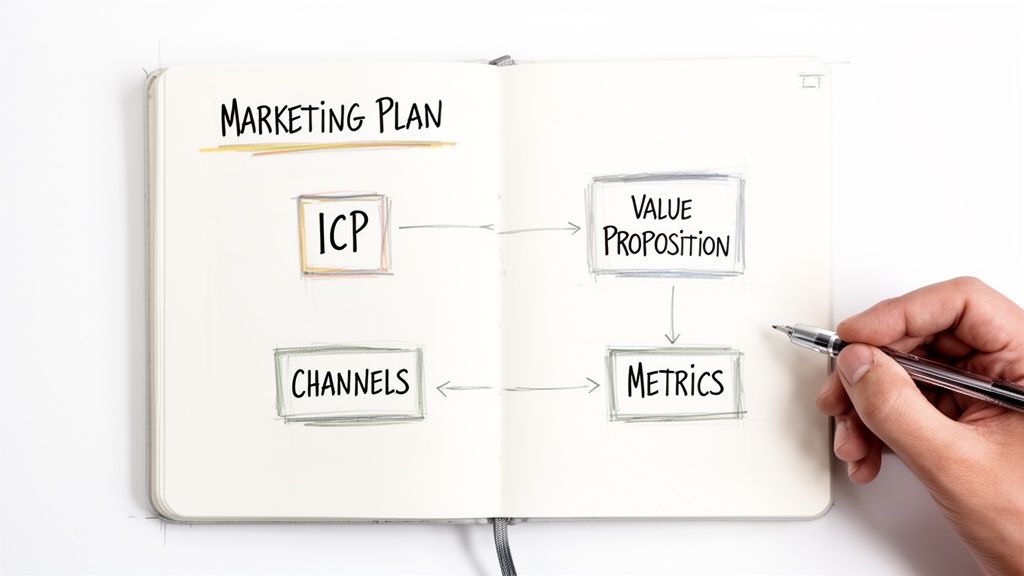
In a B2B market where precision is everything, trying to "wing it" is a recipe for failure. Without a clear map, it's dangerously easy to burn through precious cash and time on marketing channels that don’t deliver or messaging that doesn't connect. A solid plan gives your entire team—from product to sales—the clarity and confidence to pull in the same direction.
Having a structured plan has never been more critical. The global B2B SaaS market is exploding, hitting USD 242.3 billion in 2025 and projected to climb to USD 254.8 billion with a 5.2% compound annual growth rate. That’s a lot of noise. A focused plan is how you cut through it.
A winning B2B SaaS marketing plan isn't about doing everything at once. It’s about doing the right things, in the right order, for the right audience. We're going to build out these foundational pillars together, making sure every single step contributes directly to sustainable, predictable growth.
Here's what we'll cover:
This isn't just theory. It's a practical framework pulled from over a decade of launching and scaling B2B SaaS products. The goal here is to demystify the process and show you exactly how to build a plan that actually works.
This guide gives you the "what" and the "how," but a truly successful plan always starts with a strong strategic foundation. Before diving into the tactical details of filling out a template, it’s worth taking a moment to understand the core principles of a B2B marketing strategy framework. You can find a great overview of that here: https://www.bigmoves.marketing/blog/b-2-b-marketing-strategy-framework.
For a deeper dive into building that initial framework from scratch, this guide on building a killer digital marketing strategy for startups is an excellent resource. We'll be building on these core concepts as we move through each section of your customized plan.
Every solid B2B SaaS marketing plan starts right here. Before you even think about channels or features, you need a rock-solid answer to two questions:
Get this part right, and every other marketing decision you make gets a whole lot easier. Get it wrong, and you're just shouting into the void.
This isn't about creating vague "buyer personas" with cheesy stock photos. We're talking about building a hyper-specific Ideal Customer Profile (ICP). This foundational work is what separates the SaaS companies that scale from the ones that stall out.
A generic persona might be something like "Marketing Mary." An ICP, on the other hand, is ruthlessly specific. It defines the exact type of company that gets the most value from your product and, just as importantly, is the most profitable for you.
To build an ICP that actually works, you have to look past simple job titles and dig into the firm-level attributes that signal a perfect match.
A strong ICP is the focusing lens for your entire business. It tells your marketing team where to find prospects, helps your sales team qualify leads without wasting time, and gives your product team clarity on what features to build next.
Putting this profile together is a team effort. You need to pull insights from sales calls, sift through customer support tickets, and tap into those early founder conversations to find the common threads connecting your absolute best customers.
If you need a more structured way to tackle this, our guide on creating a detailed ICP can walk you through it step-by-step. You can grab the ideal customer profile template and follow along.
Once you know exactly who you're talking to, the next step is to craft a message that resonates. Here's a hard truth: B2B customers don't buy features. They buy better business outcomes. Your value proposition has to connect those dots.
Think about it. A project management tool isn't really selling "Gantt charts and task dependencies." It's selling "on-time, on-budget project delivery" to a stressed-out Operations Manager. A cybersecurity platform isn't selling "end-to-end encryption;" it's selling "peace of mind and compliance" to a CISO who's tired of losing sleep.
A great way to get to the heart of your value is to run your team through the "so what?" test.
That final statement? That's your value proposition. It’s a compelling, outcome-driven message your sales team can use with confidence and your marketing team can build entire campaigns around. It's the promise that makes your ICP stop scrolling and finally pay attention.
Your go-to-market (GTM) strategy is your playbook for reaching, winning over, and keeping your ideal customers. This isn't just a list of channels; it's where you decide which battlegrounds to fight on and, more importantly, how you plan to win. A sharp GTM strategy keeps you from spreading your resources too thin and wasting months on channels that never pan out.
Many founders fall into the trap of trying to be everywhere at once. A much smarter play is to pick one primary GTM motion, master it, and then start adding others. Your choice will come down to your product, how your ideal customers actually buy software, and your average contract value (ACV).
For most B2B SaaS companies, the decision boils down to four core motions: inbound, outbound, product-led growth (PLG), and partnerships. Each has its own rhythm and is better suited for different business models.
Here’s a quick rundown of what each motion looks like in the real world:
Think of these motions as different tools in your toolkit. An early-stage AI startup might use a highly targeted outbound strategy to secure its first ten enterprise customers, proving the model before investing in broader inbound marketing.
This decision tree helps visualize how defining your customer—the essential first step—feeds directly into choosing the right GTM motion.
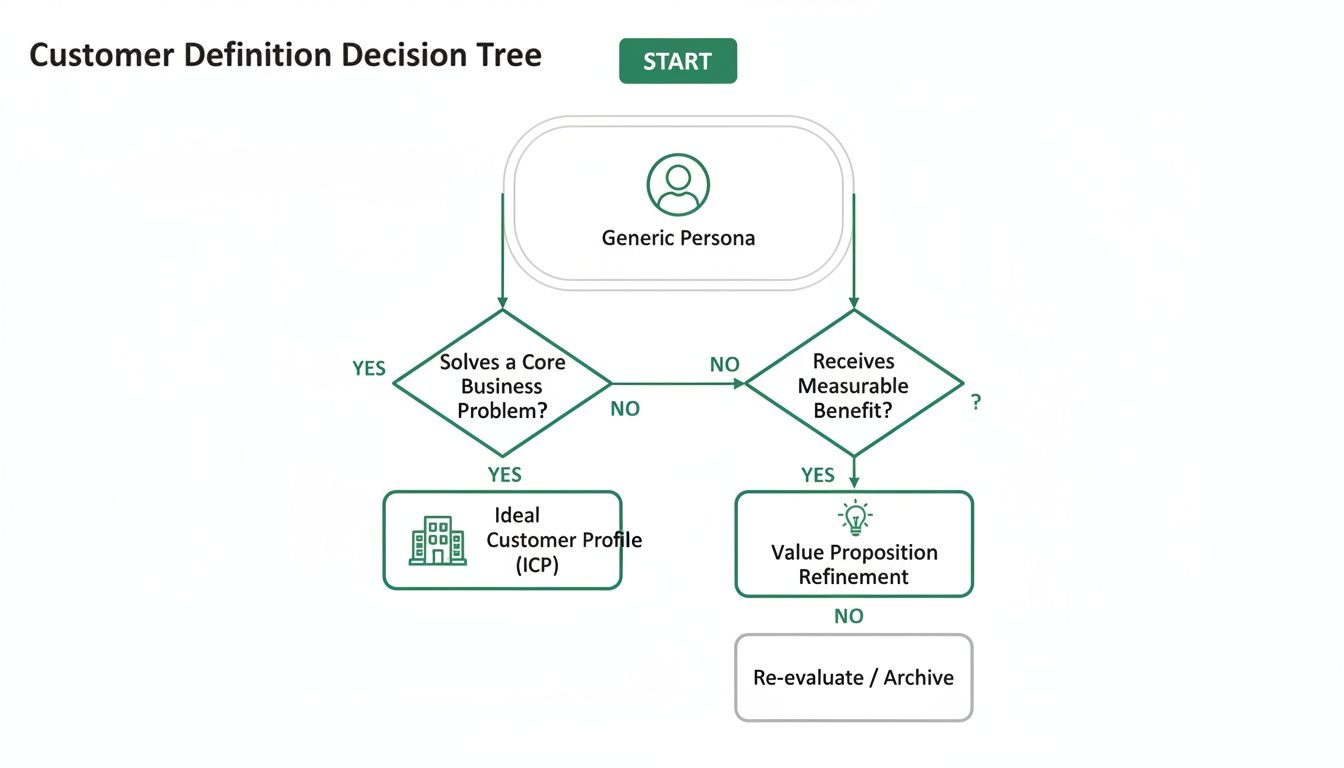
As you can see, starting with a vague persona is a recipe for wasted effort. You either need to sharpen it into a precise Ideal Customer Profile or use that feedback to refine your entire value proposition. A crucial part of this process is figuring out how to create a content strategy that perfectly matches your GTM motion and speaks directly to that refined customer profile.
To help you make a more informed decision, it's useful to see how these motions stack up against each other. Each one demands a different focus and is measured in a unique way.
Looking at this table should give you a clearer picture of where your SaaS fits. An early-stage company without a big budget might lean into PLG or a highly focused inbound strategy, while a well-funded startup with a premium product might go straight to building an outbound sales team. The key is to commit to one path before getting distracted.
Once you’ve locked in your primary motion, the next step is to get specific about the channels you’ll use. For an inbound strategy, your world might revolve around SEO, blogging, and maybe a podcast. An outbound strategy, on the other hand, would be all about cold email sequences, LinkedIn outreach, and personalized video messages.
It’s absolutely critical that you pick channels where your ICP actually spends their time. Selling to developers? You’ll probably find them on technical blogs, in community forums like Stack Overflow, or on specific subreddits. Targeting C-level executives? Your best bet is a strong presence on LinkedIn and in executive-focused publications.
For a deeper dive into building out your GTM plan, this comprehensive go-to-market strategy for B2B SaaS guide provides the kind of detailed frameworks you need to make these decisions with confidence. Your goal is to build a focused, repeatable engine for acquiring new customers—one that you can fine-tune and scale as your company grows.
Let's talk about what really moves the needle. Traffic reports and social media impressions might look good on a slide deck, but they won't impress investors or keep the lights on. A powerful marketing plan is built on the cold, hard numbers that signal the health and momentum of your business.
This is where you connect every marketing action directly to revenue. Forget tracking everything under the sun. Your focus should be on a handful of key performance indicators (KPIs) that tell a clear, undeniable story about your acquisition efficiency, customer value, and retention. These are the numbers that matter.
For any B2B SaaS business, success boils down to a simple economic principle: you have to make more money from your customers than it costs you to get them. Three core metrics tell this story better than anything else.
Customer Acquisition Cost (CAC): This is the total cost of your sales and marketing efforts divided by the number of new customers you brought in over a specific period. It’s the price you pay to win a new logo. Simple as that.
Lifetime Value (LTV): This metric represents the total revenue you can realistically expect from a single customer account over the entire time they stick with your product.
The LTV to CAC Ratio: The magic really happens when you put these two together. A healthy, sustainable B2B SaaS should aim for an LTV that is at least 3x its CAC. If your ratio is hovering around 1:1, you’re essentially lighting money on fire.
The most successful B2B SaaS companies are absolutely obsessive about this ratio. It’s the clearest indicator of a scalable business model and the very first thing sophisticated investors will ask you about.
In the world of recurring revenue, retention isn't just important—it's everything. Landing a new customer is just the opening act. The real, compounding growth comes from keeping them happy, engaged, and expanding their accounts over time.
This is where Net Revenue Retention (NRR) becomes your north star.
NRR measures your recurring revenue from a specific group of customers, but it also includes upsells, cross-sells, and downgrades. Top-performing public SaaS companies often boast an NRR of 120% or more. Think about that: it means they would continue to grow even if they didn't sign a single new customer.
For a deeper dive into these crucial numbers, check out our complete guide to essential SaaS marketing metrics.
This data-driven approach is critical, especially as the number of SaaS apps used by a single company climbs past 130. In one example, a company focused on fit and intent over sheer volume—targeting just ~6K ideal fits from a pool of 2.7M apps. The result? They generated 183 sales-ready meetings in only 130 days.
You don't need a complicated analytics suite to get started. Building a simple dashboard in a spreadsheet to track these core KPIs will give you the clarity you need to make smarter decisions and prove marketing’s direct impact on the bottom line.
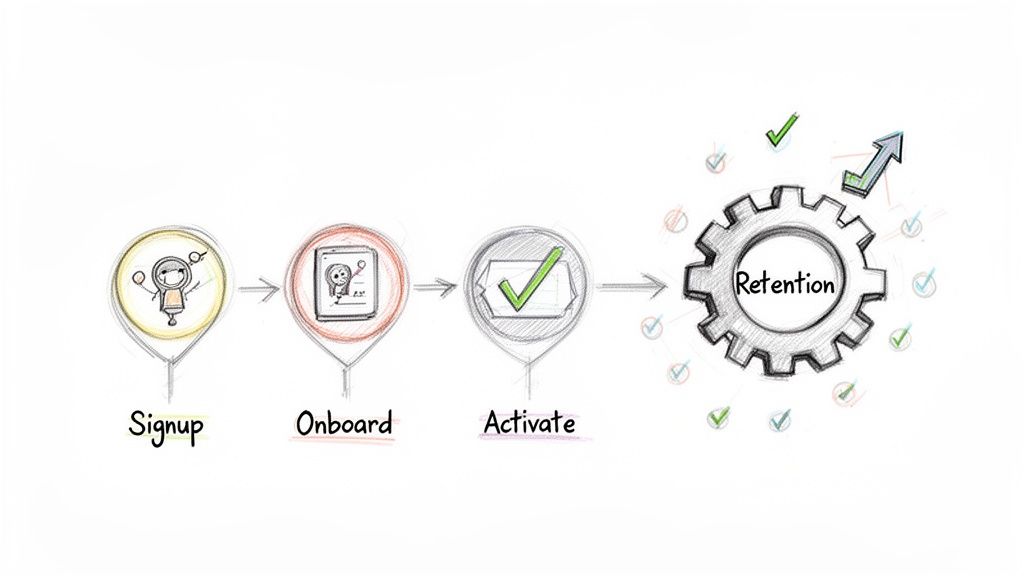
It’s an incredible feeling to land a new customer, but in B2B SaaS, that’s just the beginning. The real, sustainable growth doesn't come from a constant stream of new logos. It comes from turning those new users into deeply engaged, long-term partners. This is where your customer activation engine kicks into high gear.
Too many marketing plans pour all their energy into acquisition, only to drop the ball the second a contract is signed. That’s a massive mistake. Your post-acquisition journey—especially user activation and onboarding—is where you truly lock in future annual recurring revenue (ARR) and stop churn before it even has a chance to start.
The first few moments a new user spends with your product are everything. This initial experience is what decides whether they find that "aha!" moment and stick around, or get confused and disengage forever. A generic, one-size-fits-all onboarding flow just won’t cut it.
The key is to guide users to value as quickly and painlessly as possible. This means understanding what different user roles need to accomplish to feel like they’ve made the right choice. For a much deeper dive into designing these make-or-break first steps, check out our complete guide on customer onboarding best practices.
Think of it this way: your product is a powerful tool, but your onboarding is the instruction manual. If the manual is confusing or irrelevant to their job, they'll never see the tool's true potential.
Retention metrics are the lifeblood of any solid SaaS marketing plan template. Top performers are hitting gross revenue retention (GRR) above 90%, with net revenue retention (NRR) soaring to 110-120%. We saw one business intelligence platform completely overhaul its onboarding process by role. Analysts got SQL templates, operations teams received campaign guides, and executives were shown KPI dashboards. The result? Their activation rate jumped from 52% to an impressive 71%. You can find more insights like this in these SaaS marketing guide benchmarks.
Activation isn't a one-and-done event; it's the beginning of an ongoing conversation. Lifecycle marketing is how you keep providing value, encourage deeper product adoption, and spot expansion opportunities long after the initial onboarding wraps up.
This really comes down to creating targeted campaigns that are triggered by what users do (or don't do) in your app.
By segmenting your communication this way, every message feels relevant and genuinely helpful, not intrusive. This kind of proactive engagement is what turns happy customers into a major source of new ARR, building a powerful growth loop that fuels your business for years to come.
Even with the best template in hand, you're going to have questions. That's a good thing—it means you're thinking critically about how to apply it to your business. Let's tackle a few of the most common questions from B2B founders.
There's no single magic number here, but a reliable starting point for early-stage B2B SaaS companies is to earmark 20-40% of your target annual recurring revenue (ARR) for your combined sales and marketing budget. Yes, that sounds aggressive, but it reflects the reality of needing to build momentum from a standing start.
Now, if you're pre-revenue, that formula goes out the window. Your budget isn't a percentage; it's a strategic investment in founder-led activities that deliver outsized results. This is the time for hyper-targeted content for a tiny niche and direct, personal outreach—not splashing cash on broad advertising campaigns.
Your initial marketing spend should be treated like a series of small, calculated bets. The goal isn't just to spend money. It's to learn which channels actually generate pipeline and which ones are a waste of time, so you can confidently double down on what works.
Resist the temptation to hire a deep specialist right away. Your first marketing hire shouldn't be a niche SEO expert or a paid ads guru. You need a versatile marketer who can solve a range of problems and isn't afraid to get their hands dirty.
Often, the perfect fit is a Product Marketing Manager or a Content Marketing Manager who is genuinely obsessed with understanding your Ideal Customer Profile (ICP).
This person becomes the foundation of your go-to-market engine, handling the critical early tasks that founders simply run out of time for:
You need an adaptable marketer who can wear multiple hats while you're still figuring out your most effective growth motions. You can bring in the specialists later.
Think of your marketing plan as a living document, not a stone tablet you carve once a year. It needs to breathe and adapt to the feedback the market gives you. I recommend a two-part cadence: strategic reviews and tactical monitoring.
Give the entire plan a major overhaul quarterly. This is your chance to zoom out, analyze what worked (and what bombed), and formally reallocate your budget and team focus for the next 90 days. This keeps your day-to-day activities tied to your bigger business goals.
At the same time, you should be checking your key performance indicators (KPIs) weekly. If a specific channel is bleeding money or a new opportunity suddenly appears, don't wait three months to react. The startups that win are the ones agile enough to pivot their tactics based on real-time data. This constant loop of action, measurement, and adjustment is what really fuels sustainable growth.
Ready to turn strategy into action? Big Moves Marketing specializes in helping B2B SaaS and AI startups build and execute marketing plans that drive adoption and revenue. Let's build your growth engine together. Learn more at bigmoves.marketing.
Explore Big Moves Marketing services and resources:

%20-%20white.svg)