%20png%20copy.avif)
Most advice about SaaS marketing is wrong at the point where it matters most. It starts with channels.
That's backward.
Founders ask whether they need SEO, paid search, LinkedIn, webinars, email, ABM, content, or partnerships. However, the key question is whether the business has earned the right to run any of those well. If your positioning is muddy, your go-to-market motion is mismatched, and your post-sale story is weak, more activity won't fix the problem. It will hide it.
This is why so many B2B SaaS teams stay busy and still stall. They confuse marketing motion with marketing progress. They launch campaigns on top of an unresolved strategic foundation, then wonder why pipeline quality is poor, win rates are inconsistent, and sales says the leads “don't get it.”
The usual diagnosis is “we need better tactics.” It's rarely true.
Most B2B SaaS marketing failures come from bad sequencing. Teams run acquisition before they've nailed positioning. They add channels before they've chosen a primary go-to-market motion. They chase lead volume before they've built a convincing path from first touch to value. Then they blame execution.
That's why generic playbooks create so much waste. A list of tactics assumes the business is already clear on who it's for, why it wins, how buyers buy, and what happens after the deal closes. In real companies, those assumptions are often false.
In practice, two failures show up again and again:
Everything downstream gets distorted.
Ads amplify vague messaging. Content scales confusion. Email sequences automate irrelevance. Sales enablement becomes a patch for a strategy problem.
Practical rule: If marketing performance improves only when a founder joins the call, your issue probably isn't channel optimization. It's message clarity and sales motion.
There is an order to effective SaaS marketing:
Teams often start at step three.
That's why the machine feels expensive and fragile. You're trying to optimize conversion rates inside a system that doesn't know what it is yet.
The fix isn't “do more marketing.” The fix is to repair the layer beneath the tactic that's underperforming.
Founders often treat positioning like brand garnish. A messaging workshop. A homepage rewrite. A prettier version of what sales already says.
That's a category error.
In B2B SaaS, positioning is your operating system. It determines which buyers you pursue, which problems you center, which competitors you frame against, what proof matters, and which channels will even make sense. When that layer is weak, the rest of the go-to-market system inherits the confusion.
The competitive context makes this essential. The worldwide SaaS market was valued at $390.46 billion in 2025 and is projected to reach $466 billion in 2026, while organizations use an average of 106 SaaS applications, according to SellersCommerce's SaaS market summary. In a market this crowded, product availability is irrelevant. Buyers need a reason to remember you.
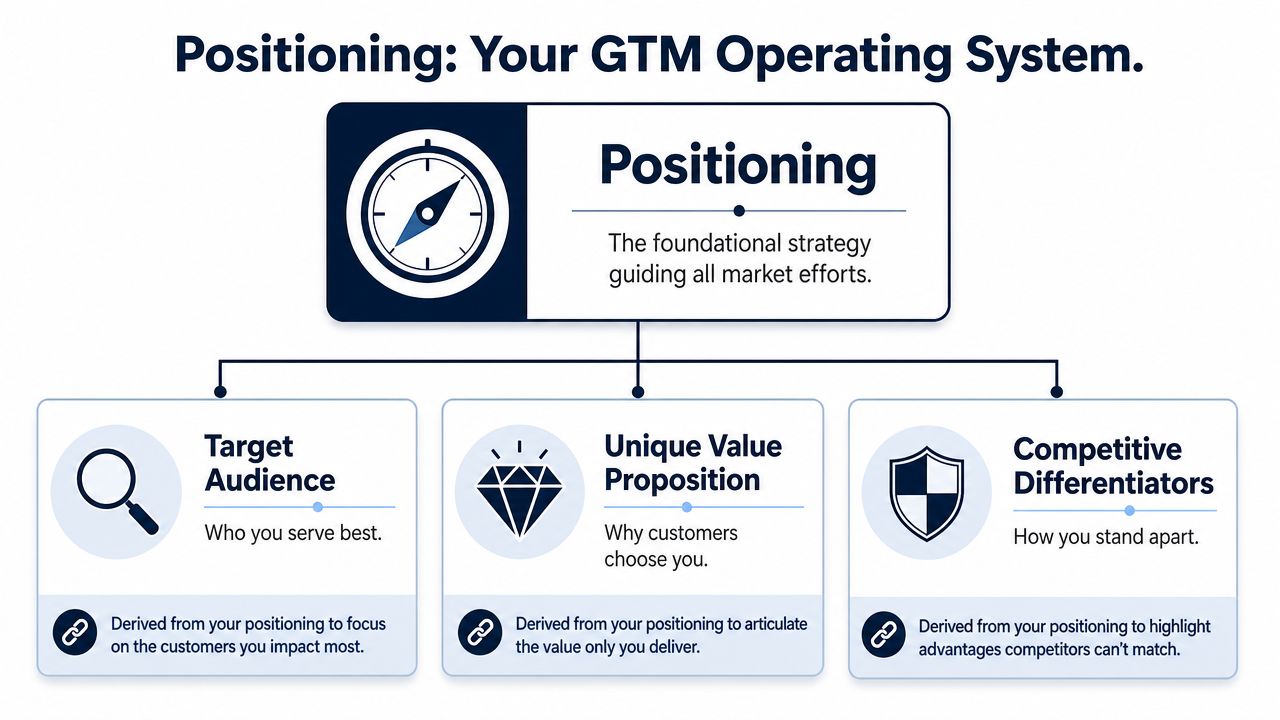
Most positioning documents are too abstract to be useful. They use category language that could describe five other vendors. They list attributes instead of decisions. They avoid saying who the product is not for.
That kind of positioning doesn't guide execution. It decorates it.
You need a version that sales can use in live calls, product can use for roadmap trade-offs, and marketing can use to decide which stories to tell. If it can't shape actual decisions, it isn't positioning. It's a brand artifact.
A strong positioning layer answers four hard questions.
| Question | What it clarifies | What breaks if it's weak |
|---|---|---|
| Who is this for? | The real ICP, not a broad market | Targeting, lead quality, pipeline focus |
| What urgent problem do they have? | Pain buyers will pay to solve | Messaging, sales narrative, urgency |
| Why this product? | Outcome, not feature inventory | Conversion, demos, proof points |
| Why now and why you? | Differentiation and category angle | Win rate, pricing power, recall |
This is why I push founders to make positioning narrow enough to feel uncomfortable. If everyone on the team can interpret it differently, it's too loose.
A useful test is simple. Ask your sales leader, founder, and product marketer to answer the same three questions: who do we win with, why do they switch, and what alternative are we really replacing? If the answers drift, your positioning isn't operational yet.
Start with customer reality, not internal opinion.
If you need a sharper structure for this work, the five pillars of B2B positioning is a practical model.
Positioning should reduce decisions across the company. If it adds language but not clarity, it's unfinished.
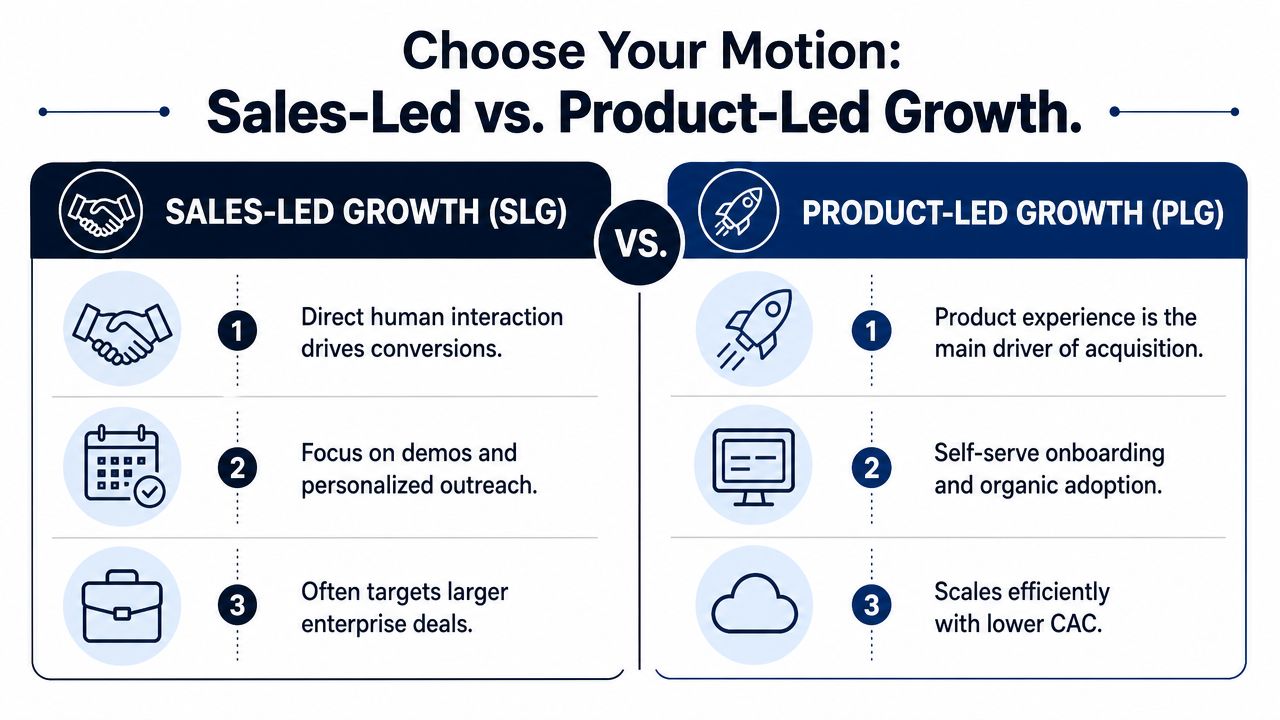
A lot of SaaS teams waste time debating sales-led growth versus product-led growth as if they're choosing a brand aesthetic.
You're not picking a trend. You're choosing the commercial motion your product and market can support.
The wrong motion creates expensive friction. A product-led wrapper on a sales-led reality usually means lots of signups, weak activation, and no serious revenue path. A sales-heavy motion on a naturally self-serve product means unnecessary demos, slower cycles, and bloated cost to acquire.
Here's the core principle. Channel strategy sits downstream of motion. As Paddle's SaaS marketing guidance points out, the right GTM motion dictates channel priority. Search-led buyers and relationship-led buyers don't discover software the same way, so “do content, SEO, and paid” is not a strategy.
The wrong question is “Which model is better?”
The right question is “What has to be true for this model to work?”
For sales-led growth, buyers usually need guidance, internal consensus, proof, and commercial negotiation. The product may be strong, but purchase risk is high enough that people want a human involved.
For product-led growth, the product has to communicate value quickly with very little friction. The user can start, understand, and get meaningful value without booking time with your team.
Use decision criteria, not ideology.
A useful reference point for the broader thinking is this guide to go-to-market strategy for SaaS.
Later in the buying journey, the distinction becomes even clearer.
The most common failure mode is the middle.
A founder says the company is product-led because they have a free trial. But the product still needs handholding, data setup, cross-functional buy-in, or category education before the value makes sense. That isn't PLG. That's a sales-led product with a self-serve front door.
Or the reverse happens. A company hires enterprise reps too early, builds layers of process, and slows down a product that buyers would have adopted on their own.
If users can sign up but can't understand the value without a call, you don't have product-led growth. You have a form fill with extra steps.
The practical implication is simple. Choose one primary motion. Then align channel mix, website flow, onboarding, and sales process to it. Multi-channel works when the system is coherent. It fails when each channel assumes a different buyer journey.
A lot of SaaS marketing teams say they're doing demand generation when they're really doing lead collection.
That confusion matters because demand creation and demand capture are different jobs. They require different assets, different timing, and different expectations. If you blend them together, you either overfund channels that only harvest existing intent or you spend months on brand activity with no path to pipeline.
The economics are already pushing teams toward a more disciplined mix. One 2026 benchmark summary reports that the median SaaS company spends $2.00 to acquire $1.00 of new ARR, while SEO delivers a 702% ROI with a 7-month break-even time, and organic search generates 44.6% of all B2B revenue. The same summary says organic channels are almost 40% cheaper than paid channels and convert 110% better. Email marketing also returns £36–£40 for every pound spent according to the same benchmark roundup in Oliver Munro's SaaS marketing statistics. The point isn't “stop paid.” The point is that paid-only growth gets expensive fast.
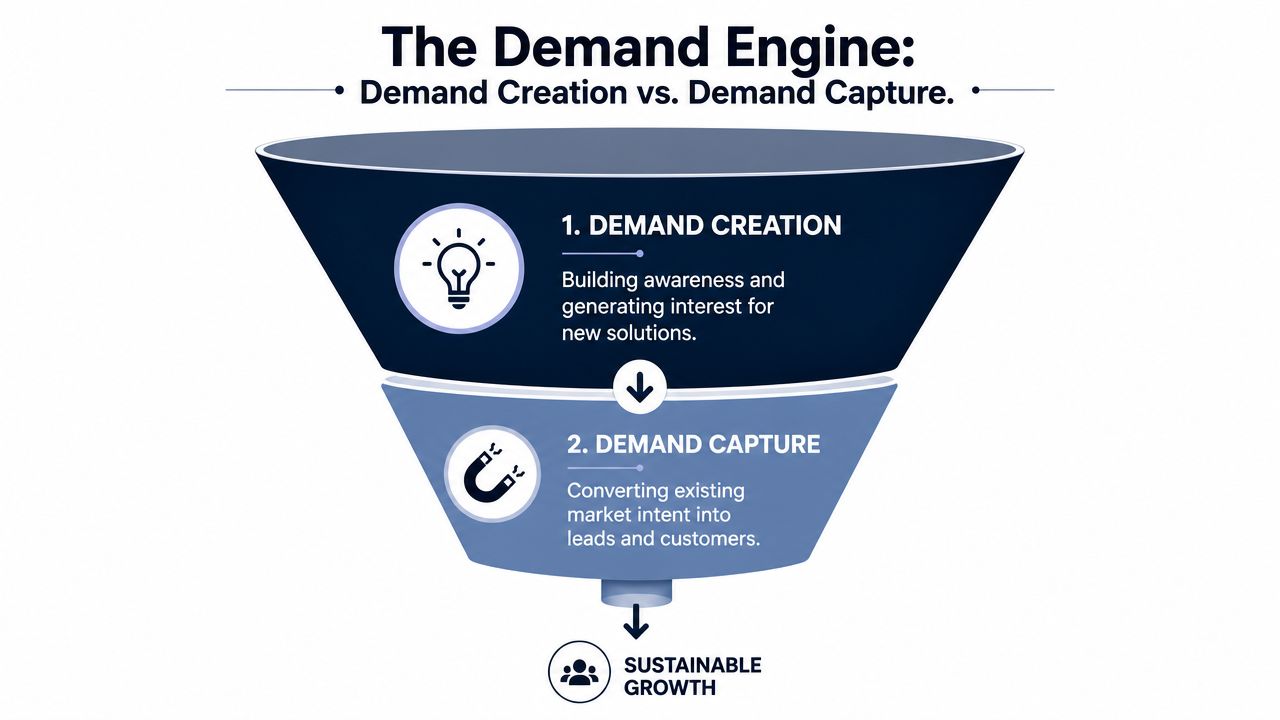
Demand capture wins buyers who are already in market.
Demand creation shapes future demand before buyers start searching.
Those are not interchangeable. Search ads, bottom-funnel SEO, review sites, demo pages, comparison content, and high-intent retargeting all sit closer to capture. Founder content, category education, webinars, podcasts, partnerships, and strong social distribution often sit closer to creation.
You need both. But you shouldn't expect them to behave the same way.
Demand capture is the part founders usually understand first because the feedback loop is faster.
Good capture strategy includes:
This layer is about relevance and speed. When intent exists, your job is to remove friction and make the decision easier.
Demand creation matters because most of your market isn't buying today.
That doesn't mean they're irrelevant. It means you need to shape how they understand the problem before they enter an active buying cycle. In this context, sharp points of view, clear category framing, and distributed expertise matter.
LinkedIn is one of the most underused channels here when founders treat it like a press release feed. A better model is a structured LinkedIn posting strategy built around repeated buyer problems, strong opinions, and direct lessons from the field.
Field note: Demand creation is usually less about publishing more and more about repeating the right argument until the market associates you with it.
This is also where underused channels can outperform crowded ones. Partnerships, integration ecosystems, founder networks, customer communities, and company-wide social participation often work because they carry borrowed trust. They don't look like textbook marketing, which is part of why they still create edge.
The sequence matters.
Early on, the focus should be on building enough capture to convert existing demand, then invest steadily in creation so they aren't trapped in rented attention forever. After that, the job is coordination. Creation should feed capture. Capture data should refine creation. Sales conversations should sharpen both.
A simple operating model works well:
| Layer | Primary job | What to watch qualitatively |
|---|---|---|
| Demand capture | Convert active intent | Lead quality, conversion friction, sales feedback |
| Demand creation | Build future preference | Message resonance, audience engagement, recall in calls |
| Lifecycle | Pull prospects forward | Re-engagement, meeting creation, momentum in deals |
If you need a more structured view of the system, this breakdown of demand gen strategy is useful.
The mistake isn't choosing one side. The mistake is running them without knowing which one you're funding.
Most SaaS companies still behave as if marketing ends when a deal closes.
That's amateur thinking.
In SaaS, the first sale is just the start of the revenue story. If users don't adopt, if stakeholders don't see value, or if the customer never expands, your acquisition engine is carrying too much weight. You're paying to replace what the product experience should have kept.
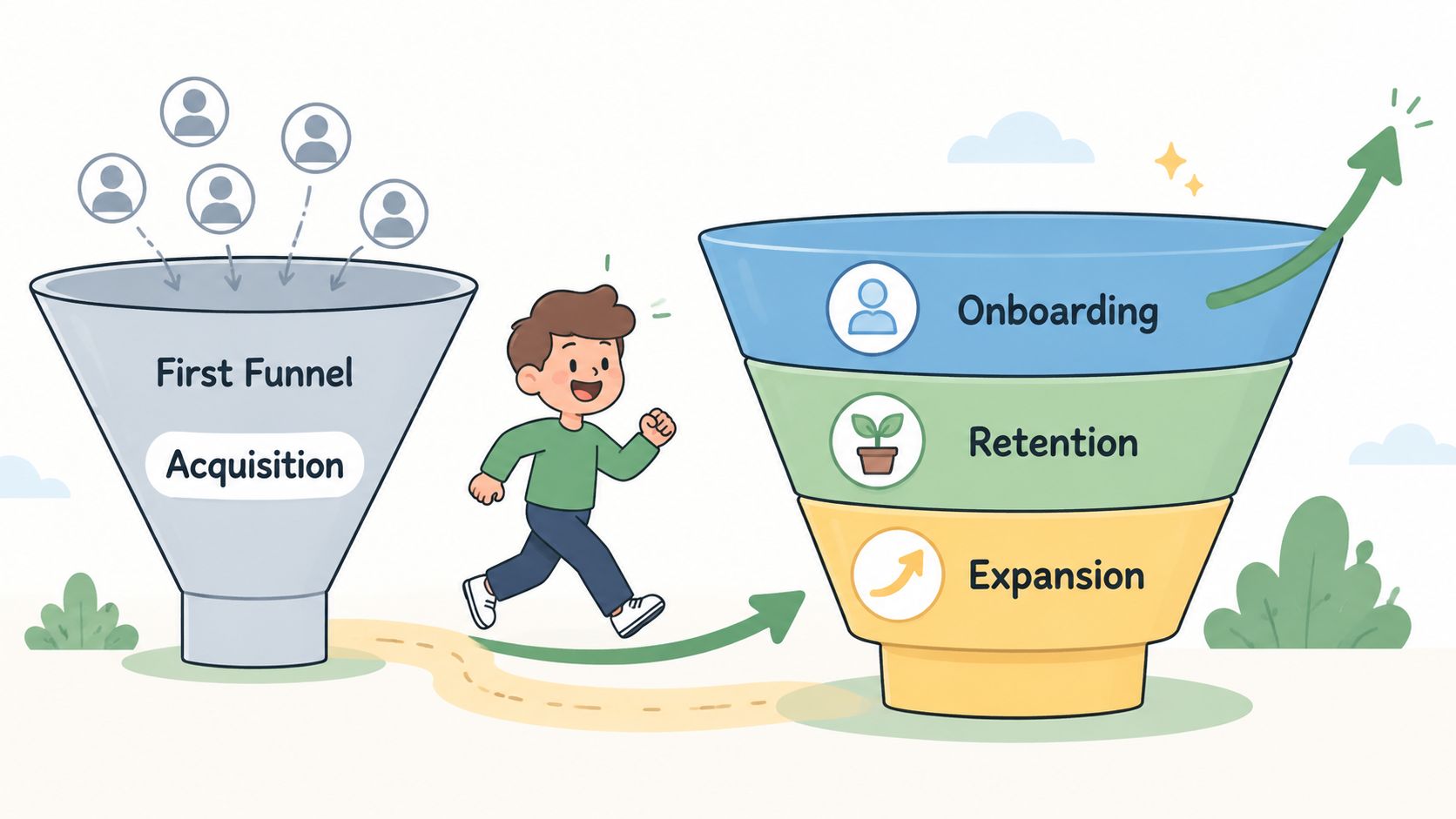
The second funnel starts at first login, first use case, first proof of value.
Many teams create an artificial handoff. Marketing acquires. Customer Success retains. Product handles adoption. Sales handles expansion. Nobody owns the story across the whole lifecycle.
That split is one reason messaging degrades after purchase. The promise that won the deal isn't reinforced in onboarding. Proof isn't surfaced at the right moments. Upgrade paths show up before the customer has internal confidence.
The role of marketing after acquisition is communication design.
As Leadfeeder's SaaS marketing guidance notes, effective SaaS marketing now turns product usage and customer outcomes into a demand-generation system through customer evidence, targeted email, in-product prompts, and structured advocacy. That's the right lens.
Marketing should actively shape:
A useful reference for this operating layer is SaaS customer retention strategies.
Expansion doesn't start with an upsell message. It starts with visible value.
If the customer can't explain internally why the product matters, expansion stalls. If usage is isolated to one champion, expansion stalls. If your team only contacts accounts when renewal is close, expansion stalls.
Marketing can help by turning product behavior into communication triggers. When a team reaches a meaningful usage milestone, reinforce the business outcome. When another department fits the same use case, arm the champion with internal-selling material. When a customer succeeds, turn that story into social proof that helps both retention and new demand.
The cleanest growth loop in SaaS is simple. Better adoption creates stronger proof. Stronger proof improves retention, expansion, and new pipeline.
A lot of B2B SaaS dashboards are full of activity and empty of judgment.
Traffic is up. Click-through rate improved. Social impressions look healthy. None of that tells a CEO whether marketing is creating revenue or just creating evidence of movement.
The scorecard needs to reflect how SaaS businesses grow. Winning by Design argues that a strong data model combines volume metrics, conversion metrics, and absolute time metrics, because each shows a different bottleneck in the system. It also notes that small improvements in stage-by-stage conversion rates compound across the funnel, making conversion optimization and cycle-time reduction more powerful than isolated increases in top-of-funnel volume, as explained in their SaaS data model.
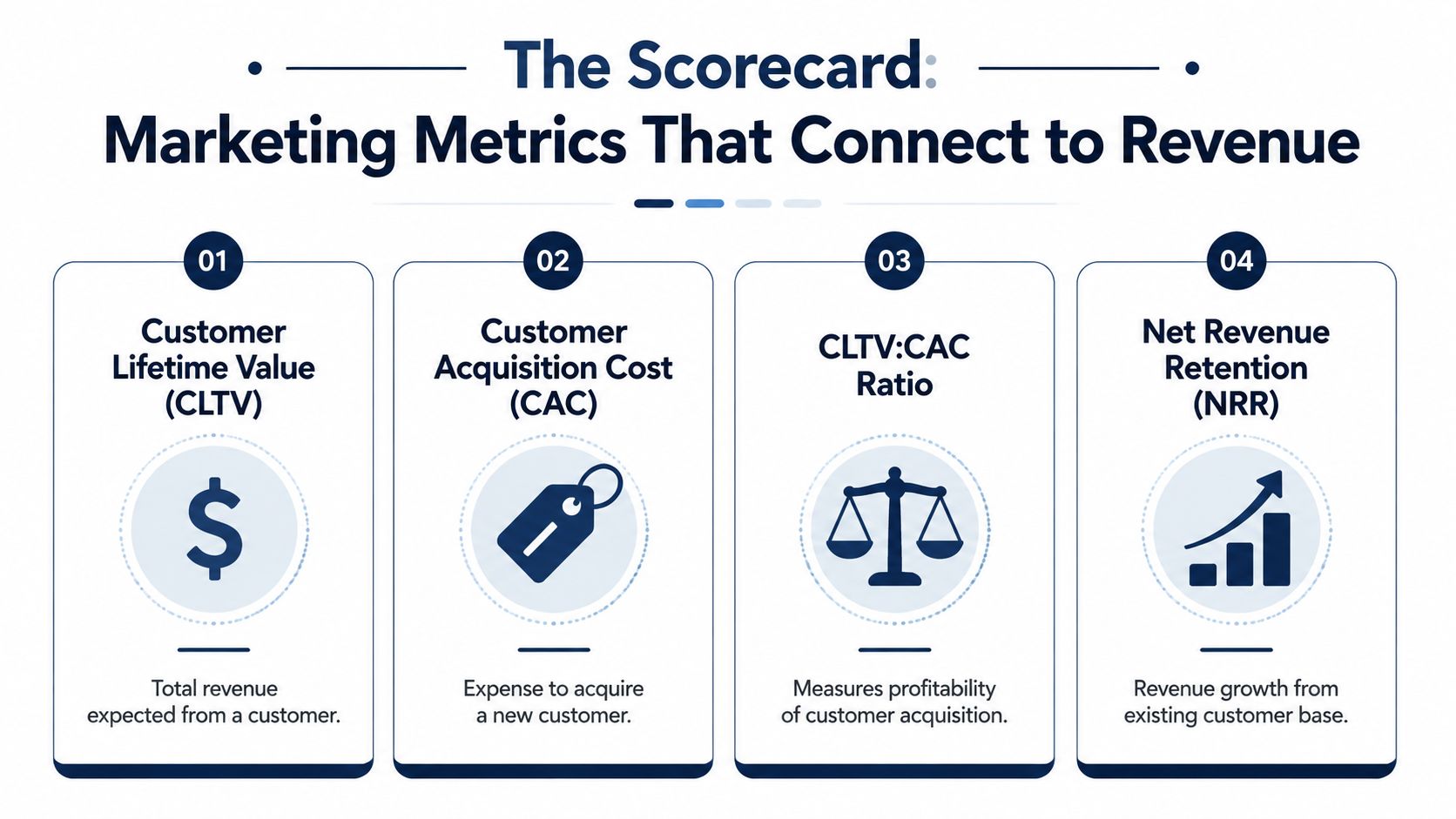
Vanity metrics aren't useless. They're just weak signals.
If traffic rises but pipeline doesn't, the issue might be ICP fit, page intent, offer quality, or sales follow-up. If MQLs rise but opportunities don't, the issue is qualification logic. If opportunities rise but deals stall, the issue may be messaging, proof, pricing, or cycle friction.
That's why isolated metrics mislead. You need to read them in sequence.
Use a scorecard that forces cause-and-effect thinking.
If you want a more practical breakdown, this guide to SaaS marketing metrics is a solid reference.
A simple executive view looks like this:
| Metric type | What it answers |
|---|---|
| Volume | Are we generating enough of the right activity? |
| Conversion | Where is the funnel actually breaking? |
| Time | How fast does marketing turn effort into revenue? |
This part gets ignored too often in B2B SaaS.
The buyer, payer, and user are frequently different people. If your analytics are only contact-level, attribution will be wrong in exactly the deals you care most about. The right structure is account-level. That means ingesting account events, passing account ID with user events, and segmenting by user-only, account-only, or combined data so marketing can see buying committee behavior rather than isolated touches.
Without that, your reporting rewards the wrong channels and undercounts the campaigns that influence pipeline.
One practical note. If you're rebuilding this measurement layer, options range from internal ops work to outside support such as Big Moves Marketing, which includes marketing operations as part of its B2B SaaS advisory work. The point isn't who does it. The point is that attribution logic needs to match how B2B software gets bought.
SaaS marketing isn't failing because teams lack tactics. They have too many tactics and too little order.
The companies that build real momentum fix things in sequence. They start with positioning, because nothing else works for long if buyers can't quickly understand who the product is for and why it matters. They choose a primary go-to-market motion, because channel choices only make sense once the buying path is clear. They build a demand engine that separates demand creation from demand capture, instead of asking one channel to do both jobs badly.
Then they keep going.
They treat onboarding, retention, and expansion as part of marketing's remit, not someone else's problem after the sale. And they measure the system with revenue logic, not dashboard theater.
That's the mental model I'd use to audit any SaaS marketing program:
If one layer is broken, don't paper over it with more campaigns.
Fix the layer beneath the symptom.
If you need a strategic reset on positioning, go-to-market, demand generation, or lifecycle growth, Big Moves Marketing works with B2B SaaS founders and senior teams to identify the actual constraint, fix the order of operations, and build a marketing system that can support revenue.




%20-%20white.svg)