%20png%20copy.avif)

Most SaaS founders treat retention as a reactive, tactical problem for the Customer Success team. They see churn dashboards and last-ditch "save-a-customer" playbooks as the solution. This is a fundamental misunderstanding of how durable growth works.
The highest-performing SaaS companies see retention not as a function, but as the direct output of their entire go-to-market and product strategy. Every decision—from pricing and positioning to onboarding friction and feature development—is a retention decision. The common mistake is bolting on retention efforts late in the customer lifecycle, long after the foundational cracks have appeared. This reactive stance guarantees you will always be fighting churn instead of preventing it.
The correct approach is to build a business where customers find it irrational to leave. This requires moving beyond generic platitudes about "customer delight" and implementing specific, structured systems that create compounding value. Retention isn't about saving accounts; it’s about making your product indispensable from day one and demonstrating increasing value over time. It's an outcome, not an activity.
What follows are not "best practices." This is a structured breakdown of ten operational models for embedding powerful SaaS customer retention strategies into the core of your company. We will dissect each strategy, providing actionable guidance for founders who understand that keeping a customer is the most potent form of acquisition. These are the systems that shift retention from a departmental concern to your default operating system.
Most SaaS companies treat customer success as a reactive function—a glorified support queue for high-value accounts. This is a fatal, growth-limiting mistake. Proactive Customer Success is not about better firefighting; it’s about preventing fires by treating customer value realization as a core product deliverable. It’s an offensive strategy designed to drive retention by ensuring customers achieve the specific business outcomes they hired your product to deliver.
This approach shifts the focus from product usage to customer progress. Instead of waiting for a support ticket or a low health score, you systematically engage customers at critical points in their journey to ensure they are hitting the milestones defined at the start of the relationship. This transforms the customer dynamic from a simple vendor transaction into a strategic partnership.

Proactive CSM is one of the most effective saas customer retention strategies because it directly links your product to your customer’s P&L. When a customer can draw a straight line from your software to their revenue growth or cost savings, the renewal conversation becomes a formality. This method also creates a powerful feedback loop, providing your product team with high-fidelity insights into what a valuable outcome actually looks like for your best-fit customers.
Most B2B SaaS onboarding is a feature-dump disguised as a tutorial. It overwhelms new users with a comprehensive tour of every button, assuming product knowledge equals product value. This is a flawed premise that drives early-stage churn. Value-Based Onboarding abandons the feature tour and instead focuses obsessively on guiding the new customer to their first meaningful win—the "aha moment"—as quickly as possible.
This strategy re-engineers the first-run experience to be an accelerated path to a specific, high-value outcome. It’s not about showing them everything your product can do; it’s about getting them to achieve the one thing they hired it to do. This creates immediate momentum, proves the product's worth, and anchors the user's perception of your platform as a solution, not just a toolset.
Achieving a fast time-to-value is one of the most powerful saas customer retention strategies because it combats the initial friction and buyer's remorse that plague new software adoption. When a customer experiences a tangible benefit within their first few sessions, they become operationally invested. This initial win creates the "stickiness" needed to weather future challenges and builds the foundation for deeper product exploration later.
Most SaaS companies view community as a marketing function: a top-of-funnel asset for brand awareness. This is a profound underestimation of its strategic value. Community is a retention engine, not a lead magnet. It creates powerful switching costs by embedding your product not just into a customer's workflow, but into their professional identity and network.
When customers connect with each other, they solve problems, share best practices, and validate their decision to choose your platform. This peer-to-peer ecosystem transforms passive users into active participants and, eventually, evangelists. It moves your product from a line-item expense to the center of a valuable professional network, making churn a far more complex decision.

This is one of the most durable saas customer retention strategies because it builds a defensive moat that competitors cannot easily replicate. While features can be copied, a vibrant, engaged community is a unique asset built on shared knowledge and relationships. It also creates a direct, unfiltered feedback channel to your product team, accelerating your roadmap with high-signal insights from your most committed users. Exploring the capabilities of enterprise loyalty software can be a valuable step for companies looking to manage customer relationships and drive retention effectively.
Product-Led Growth is not a pricing model; it's a go-to-market strategy that treats the product as the primary engine for acquisition, conversion, and expansion. Too many founders misinterpret PLG as simply offering a free trial. The real discipline lies in architecting a product experience where value is so immediate that users naturally adopt, deepen their usage, and ultimately upgrade without heavy sales intervention.
This model inverts the traditional sales-led funnel. Instead of a sales team convincing a prospect of future value, the product itself delivers that value upfront, creating a self-qualifying pipeline of users who have already experienced the "aha!" moment. Retention becomes a natural byproduct, as users become deeply embedded in the platform by solving their own problems, on their own terms. This is how companies like Figma and Slack created compounding growth from the bottom up.
PLG is one of the most powerful saas customer retention strategies because it aligns your business model directly with user value realization. Churn is mitigated from day one because users who convert to paid plans have already validated the product’s utility. The model creates a frictionless path to expansion revenue; as a user's needs grow, upgrading becomes the logical next step, not a hard sell. This creates a more capital-efficient growth loop.
Most SaaS founders treat retention metrics as historical artifacts, reviewing churn rates in a rearview mirror. A data-driven retention framework isn't about reporting what happened; it's about building a predictive engine that identifies at-risk accounts and expansion opportunities before they become obvious. It operationalizes data to turn insight into proactive intervention.
This strategy moves you from lagging indicators like annual churn to leading indicators that signal customer health or distress. By dissecting user behavior and feature adoption patterns by segment, you can pinpoint the exact moments that define a customer’s long-term trajectory. It’s the difference between performing an autopsy on a lost account and giving a healthy one a targeted booster shot.
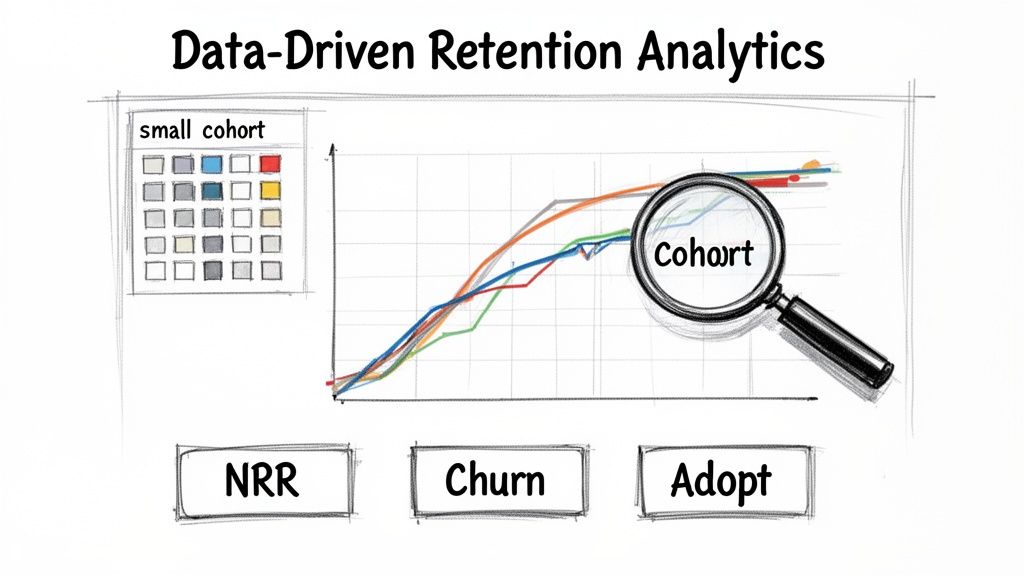
This is one of the most powerful saas customer retention strategies because it systematically de-risks your revenue base. When you know which features correlate with high Net Revenue Retention (NRR) or which onboarding actions prevent early churn, you can steer every customer toward that "golden path." This data-first culture also forces alignment between product, success, and sales, creating a shared language for the entire customer lifecycle.
Retention is not just about preventing churn; it’s about deepening relationships. Treating expansion revenue as an afterthought is a critical miscalculation. A deliberate Expansion Revenue Motion treats customer growth as a core go-to-market function, systematically identifying and capitalizing on opportunities to deliver more value to your existing base. It redefines retention from a defensive game of saving accounts to an offensive strategy for compounding revenue.
This motion is built on the premise that your best future customers are your current customers. Instead of focusing solely on new logos, you build a machine to drive upsells, cross-sells, and usage-based growth. Done correctly, your Net Revenue Retention (NRR) can exceed 100%, meaning you would grow even if you acquired zero new customers. This transforms your unit economics.
An intentional expansion motion is one of the most powerful saas customer retention strategies because it aligns your revenue model directly with your customer’s success. As their business grows, your product scales alongside them, becoming more embedded and valuable. This creates a virtuous cycle: delivering value unlocks expansion, and expansion funds further value creation. It also dramatically increases customer lifetime value (LTV).
Treating your entire customer base as a monolith is a direct path to churn. Personalized communication is not about using a {{first_name}} merge tag; it's an account-based retention strategy that acknowledges high-value customers deserve a high-value, tailored experience. It’s about moving from broad-stroke campaigns to precision-guided engagement that directly addresses each account's specific industry, use case, and business objectives.
This approach rejects the one-size-fits-all retention playbook in favor of deep segmentation. Instead of sending the same feature update email to everyone, you deliver hyper-relevant messaging that aligns with a customer's unique adoption stage and expansion potential. When a customer feels like your communication is built specifically for them, your product transforms from a utility into an indispensable part of their operational fabric.
This is one of the most powerful saas customer retention strategies because it demonstrates a deep understanding of your customer's business context. It proves you see them as a partner, not just another logo. For your top accounts, this level of personalization makes renewal a foregone conclusion and opens the door to significant expansion revenue. For mid-market customers, automated personalization at scale creates a perception of high-touch service without the associated cost.
Most SaaS founders treat customer feedback as a validation mechanism or a feature request inbox. This passive stance is a quiet killer of retention. A robust feedback loop isn't about collecting suggestions; it's about systematically turning customer insight into product momentum and then closing the loop by communicating that progress. This transforms customers from passive users into active co-creators.
This strategy moves beyond simply listening. It involves building a transparent, predictable system where customer problems are heard, prioritized, acted upon, and reported back. When customers see their real-world pain points directly influence your roadmap, your product ceases to be a mere tool and becomes a strategic partner in their success. This creates a powerful emotional investment that is nearly impossible for competitors to replicate.
This is one of the most powerful saas customer retention strategies because it directly aligns your product development with the realized needs of your paying customer base. It eliminates roadmap guesswork and ensures every engineering cycle contributes to value that prevents churn. When customers feel heard and see tangible results from their input, they develop a profound sense of ownership and loyalty. This also arms your sales team with undeniable proof that your company is customer-centric.
Most SaaS founders view customer education as a cost center managed by support to reduce ticket volume. This is a profound misunderstanding of its strategic value. A formal education program is not a defensive tactic; it's an offensive moat-building exercise. It transforms users from passive consumers into deeply invested product experts, fundamentally altering the retention equation.
This strategy shifts the burden of value discovery from the customer to you. Instead of hoping users stumble upon advanced features, you provide a structured path to mastery. When a customer invests time to get certified in your platform, they are not just learning a tool; they are investing in their own career capital. This makes your product an integral part of their professional identity and dramatically increases the psychological costs of switching.
This is one of the most powerful saas customer retention strategies because it creates a lock-in effect rooted in human capital, not just technical dependency. An educated customer is a more successful customer. They use more of your product, adopt advanced features faster, and can quantify the value they receive, making renewals a non-event. It also turns your most skilled users into internal champions who onboard and train their own colleagues.
Most SaaS companies treat churn as a lagging indicator—a number to report at the end of the quarter. A sophisticated approach to retention involves a dual strategy: proactively identifying at-risk accounts before they cancel and systematically re-engaging those who have already left. This isn't just about damage control; it's about building a resilient revenue base by acting on the root causes of customer departure.
This strategy requires you to stop viewing churn as an unavoidable event and start treating it as a solvable problem with clear leading indicators. It shifts your focus from reacting to cancellation requests to building an early-warning system that flags behavioral changes. The goal is to intervene when the relationship is salvageable. Similarly, a churned customer isn't a lost cause; they are a highly qualified prospect who simply needs a new value proposition.
This two-pronged approach is one of the most powerful saas customer retention strategies because it directly mitigates revenue loss. Proactive prevention protects your existing MRR, while effective win-back campaigns create a new, high-ROI acquisition channel from a pool of already product-aware users. This system also generates invaluable product and market feedback, revealing precisely where your value proposition is breaking down.
The strategies detailed in this article are not a menu of options. They are interconnected systems that reflect a fundamental shift in how successful SaaS companies operate. High retention isn’t achieved through heroic saves or last-ditch discount offers. It is the logical output of a business that is relentlessly focused on delivering and expanding customer value.
Chasing churn is a lagging indicator of a broken system. You are reacting to problems that started months ago: a poor onboarding experience, a pricing model that punishes growth, or a product that fails to evolve with your customers' needs. The real work is proactive, not reactive. It’s about building a retention engine so deeply embedded in your operations that churn becomes a manageable edge case, not a quarterly fire drill.
The most critical takeaway is this: you cannot bolt on retention. It must be designed into every facet of the customer lifecycle.
Instead of asking, "How do we stop customers from leaving?" the better question is, "How do we make our product indispensable to their success?" This reframing moves the focus from loss prevention to value creation. The most effective SaaS customer retention strategies are offensive, not defensive. They are about creating such a strong value proposition that leaving becomes an illogical business decision.
Consider the strategies we covered:
Your GTM motion and your product roadmap must be aligned around this principle. Every decision, from feature prioritization to CSM compensation, should be weighed against its impact on net revenue retention (NRR).
Do not attempt to implement all ten strategies at once. That is a recipe for wasted motion. Your task as a founder or GTM leader is to diagnose your single biggest point of leverage.
Stop treating retention as a separate department’s problem. It is the ultimate measure of your company’s health and the clearest signal that you have built something that truly matters. True growth isn't just about acquiring customers; it's about building a business that customers refuse to leave.
Diagnosing the root cause of churn and building a cohesive retention strategy requires a level of clarity that is difficult to achieve from inside the business. Big Moves Marketing works with B2B SaaS founders and GTM leaders to build the strategic foundation for durable growth, ensuring your positioning, messaging, and customer experience are all aligned to maximize retention from day one. Find your focus at Big Moves Marketing.
Explore Big Moves Marketing services and resources:


%20-%20white.svg)