%20png%20copy.avif)

Most advice about saas and b2b is shallow because it treats the category like a label. It isn't. B2B SaaS is a financial and operating model with hard constraints. If you misunderstand those constraints, you'll make bad decisions about product, positioning, hiring, sales motion, and pricing, then blame execution.
Founders usually get trapped by a simple mistake. They think a good product plus “marketing” should create growth. That logic fails in B2B SaaS because recurring revenue changes everything. Your economics depend on what happens after the first sale, your sales design depends on who buys and why, and your pricing determines whether growth creates enterprise value or just expensive noise. If you want a cleaner baseline on the category itself, Big Moves has written separately about saas and b2b fundamentals. This piece is about the operating logic founders need.
B2B SaaS is not a software category. It's a model built on subscription revenue, delayed payback, and compounding retention. Most founders fail because they build and market as if they're selling software once, when they're signing up for a long-term economic relationship with each account.
That distinction matters because the model rewards a narrow set of behaviors and punishes everything else. You can't brute-force your way through sloppy customer selection. You can't patch weak onboarding with more pipeline. You can't separate product from go-to-market and expect the numbers to work later.
The reason this matters now is scale. The global B2B SaaS market is projected to be valued at USD 634.39 billion in 2026 and reach USD 4,441.49 billion by 2034, growing at a CAGR of 27.54%, while approximately 75% of business applications are SaaS-based as of 2025, according to Fortune Business Insights on the B2B SaaS market. That doesn't just mean the market is big. It means buyers already expect subscription software to fit into critical workflows, budgets, and operating systems.
Recurring revenue is attractive because it compounds. It's dangerous for the same reason.
A bad-fit customer doesn't disappear after a failed deal cycle. They consume support, create roadmap noise, distort your positioning, and pollute your data. In B2B SaaS, weak decisions echo across renewals, expansion, and referrals. The model magnifies both quality and error.
B2B SaaS rewards precision early. It punishes ambiguity for years.
This is why founders who talk only about top-line growth usually miss the point. The core question isn't whether revenue is coming in. The core question is whether the model gets stronger with each customer added, or weaker.
The phrase “saas and b2b” sounds simple. The mechanics aren't.
When software is sold business-to-business on a subscription basis, four things happen:
You are not building an app and then finding customers. You are designing a system where customer fit, value delivery, and revenue durability have to align.
A simple mental model helps:
| Element | Wrong assumption | Correct view |
|---|---|---|
| Product | Features create demand | Fit creates demand |
| Sales | A closer can fix weak interest | Sales amplifies a clear value case |
| Marketing | More leads solve growth | Better market selection solves growth |
| Customer success | Post-sale support function | Core revenue protection function |
If you remember one thing, remember this. In B2B SaaS, growth is not created by activity volume. It's created by business model coherence.
Most founders treat positioning like homepage copy. That's amateur thinking. Positioning is the decision that determines who you sell to, what they'll pay, which features matter, and whether your GTM has a chance of working at all.
If you get positioning wrong, every downstream function becomes expensive. Marketing attracts the wrong traffic. Sales takes meetings with people who can't buy. Product teams build for edge cases. Pricing becomes defensive because buyers don't see clear value.

If you want a more formal breakdown, this is why the five pillars of B2B positioning should come before channel planning, campaign design, or team expansion.
Founders often resist strong positioning because they're afraid of excluding revenue. In practice, weak positioning excludes the right revenue and invites the wrong kind.
Saying “we help teams work better” is not positioning. It's evasion. Serious buyers need to know three things quickly:
If you can't answer those clearly, your company will spend the next year compensating with demos, discounts, content volume, and founder heroics.
Good positioning doesn't just improve messaging. It changes the economics of the company.
Practical rule: If your sales team needs a long call to explain what the product is for, the problem is not sales training. It's positioning failure.
A product-strong founder usually believes specificity can wait. They think broad framing creates optionality while the company learns. That logic sounds sensible and destroys momentum.
The first market story your company tells becomes the default lens through which buyers, hires, partners, and investors interpret the business. If that story is vague, the business starts drifting. Drift is expensive. It shows up as mixed win-loss reasons, conflicting roadmap priorities, and channels that look active but never become reliable.
Here's the cleaner test.
| Positioning question | Weak answer | Strong answer |
|---|---|---|
| Who is this for | Any business with this problem | A defined buyer in a defined environment |
| What problem do you solve | Efficiency | A costly, urgent operational bottleneck |
| Why now | Market interest | Trigger events that force action |
| Why you | Better product | Better fit for a specific use case |
Don't start with taglines. Start with market exclusion.
Decide who you are not for. Decide which use case deserves the homepage. Decide which pain point gets repeated by marketing, sales, and product. Then pressure-test that against real calls, not internal opinion.
Positioning should make the company narrower at first. That's the point. Narrow enough to become obvious. Obvious enough to become memorable. Memorable enough to become buyable.
Most GTM advice is cargo cult strategy. Founders copy the motion of a company that looks successful, without asking whether the underlying conditions are similar. That's how teams end up forcing PLG onto products that need sales guidance, or building outbound teams before the message is stable.
A useful GTM strategy isn't a slogan. It's a set of linked decisions about market, message, motion, and money.
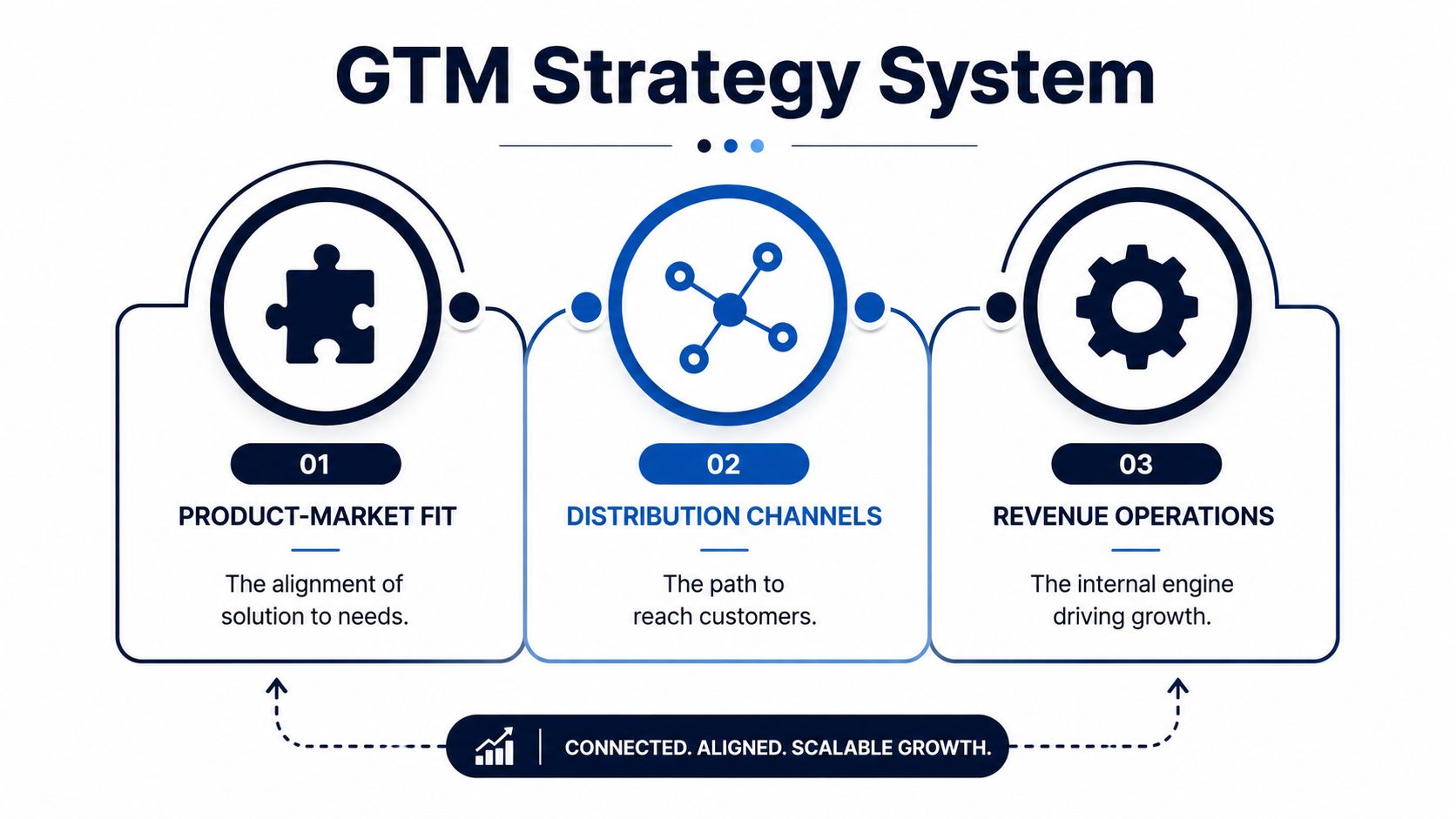
There's a reason the conversation around B2B SaaS go-to-market strategy has to start with system design rather than channel tactics. GTM fails when one component contradicts the others.
The laziest mistake in SaaS is selling into the same overworked tech audience everyone else targets. Founders do it because those buyers are visible, easy to reach on LinkedIn, and legible to investors. But visible markets aren't always the best markets.
According to SaaStr's analysis of non-tech vertical SaaS growth, SaaS companies targeting non-tech verticals like construction and logistics are growing 250%+ faster than tech-focused peers. That matters because underserved sectors don't need another nice-to-have dashboard. They often need a must-have operating tool tied to an immediate workflow problem.
You need to make three decisions in sequence, not all at once.
PLG, sales-led, and hybrid are not brand identities. They are consequences of product complexity, buyer risk, and price sensitivity.
Founders often choose based on aspiration. Choose based on friction. If a prospect needs data integration, stakeholder alignment, security review, and process change, you do not have a pure PLG business no matter how much you want one.
Don't ask which channel is best. Ask which channel matches buyer behavior and your current message clarity.
| GTM channel | Good fit | Common failure mode |
|---|---|---|
| SEO and content | Problem-aware buyers doing active research | Broad topics that generate traffic without pipeline |
| Outbound | Narrow ICP with a clear pain signal | Generic messaging and weak list discipline |
| Partners | Existing trust paths in the market | Wishful alliances without shared incentives |
| Events | Markets where relationships matter | Expensive attendance with no follow-up system |
RevOps is often treated as cleanup. That's backwards.
If your data model is sloppy, your GTM learning is fake. Enterprise lead scoring in B2B SaaS requires a weighted model built from behavioral and firmographic signals, centralized into a single source of truth, then calculated through query logic against historical conversion patterns, as described in Hightouch's guide to B2B SaaS metrics and lead scoring. Translation: stop relying on opinion-based lead quality.
Your GTM isn't “working” if sales and marketing are reading different versions of reality from different tools.
Match the GTM motion to the buying environment, not the identity you want your startup to project.
If the product is easy to try but hard to operationalize, hybrid is often right. If the pain is urgent and the category is ignored, targeted outbound plus founder-led proof can beat months of passive content. If the audience is concentrated in a non-tech vertical, field events and co-marketing can outperform software-native tactics that everyone else is chasing.
GTM is not about copying a playbook. It's about reducing contradiction between your product, your buyer, and your economics.
Most KPI dashboards are distractions. They're packed with metrics that describe activity, not business health. Founders watch traffic, demo volume, MQLs, open rates, and content output because those numbers move every week. The problem is that many of them don't tell you whether the revenue engine is structurally sound.
The control panel for a B2B SaaS company is smaller. You need to know whether acquisition is becoming more expensive, whether activation is proving value early, and whether retention is strong enough to justify continued spend. The SaaS marketing metrics that matter are the ones that expose cause and effect across the full customer lifecycle.
The acquisition side has become harder. The median customer acquisition cost to acquire $1.00 of new ARR has risen to $2.00, which is a 14% increase from 2023, according to Oliver Munro's SaaS marketing statistics roundup. That means loose targeting and fuzzy messaging are no longer survivable inefficiencies.
At the same time, the same source notes that a 5% reduction in churn can increase profits by 25% to 125%. Founders who still treat retention as a post-sale function are misreading the business. In B2B SaaS, retention and expansion are not support outcomes. They are core growth mechanics.
Use a simple hierarchy.
The weakest link matters most. If acquisition is expensive, better targeting and sharper positioning become urgent. If activation is weak, your onboarding and product education are failing. If retention is unstable, expansion will be fantasy.
Many B2B SaaS teams still measure product health with generic engagement. That's lazy. Product analytics should tie activation to a small set of core behaviors completed within a short window after signup, then segment those patterns by cohort, pricing tier, and ICP, as outlined in Metabase's product metrics framework for activation and feature adoption. If a user hasn't reached product comprehension early, the account is already at risk.
That's why product and revenue can't be managed separately. Weak activation later shows up as churn, stalled expansions, and sales objections from references who never fully adopted.
The fastest way to waste growth spend is to pour leads into a product experience that doesn't deliver a clear first win.
One more hard truth. MQL volume often creates false confidence.
The same Oliver Munro source reports MQL-to-SQL conversion at 13%, identifying it as the biggest bottleneck in many SaaS sales funnels. That tells you something important. You do not have a lead problem if handoff quality is weak. You have an ICP, message, qualification, or buying-intent problem.
A better executive review asks:
| Question | Why it matters |
|---|---|
| Are we acquiring the right accounts? | Low-quality demand inflates CAC and burns sales time |
| Are new users hitting the core value moment early? | Activation predicts future retention |
| Are customers staying for the right reason? | Durable retention reveals real product value |
| Are expansions happening from usage, not pressure? | Healthy growth inside accounts is a signal of fit |
Founders should stop asking for more dashboard tabs and start asking which single KPI is exposing the constraint in the system right now.
Most SaaS companies don't have a pricing problem. They have a courage problem. They underprice because their positioning is weak, their packaging is vague, or their sales team has been trained to rescue deals with discounts.
Pricing is not a finance-side clean-up task. It is the clearest statement of how your company believes value is created and who should pay for it.
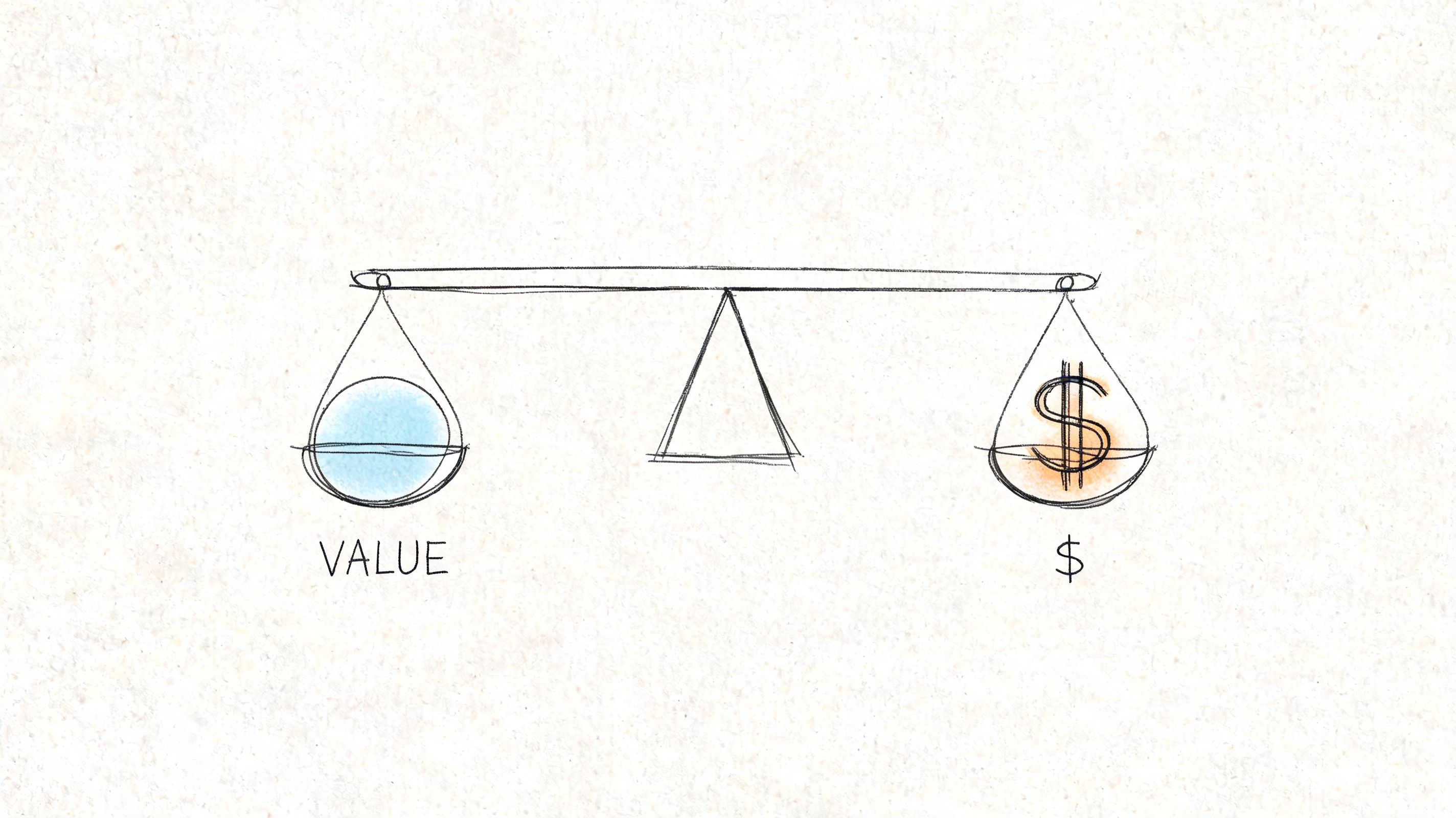
The pressure is real. Baringa's analysis of B2B SaaS value creation notes that mid-market SaaS spend has surged to $8,580 per employee annually, and many companies still give away value through undisciplined discounting. That is a self-inflicted wound.
Per-seat, usage-based, and tiered pricing aren't cosmetic packaging choices. Each one pushes customer behavior in a different direction.
If you sell workflow software into cross-functional teams, per-seat pricing can punish the very adoption you need. If you sell infrastructure or data-heavy products, usage may align better with real value delivered. The model should reinforce customer success, not tax it.
A pricing page is not pricing strategy. Governance is pricing strategy.
That means defining discount boundaries, approval logic, packaging rules, and a shared internal view of where value comes from. Without that, every rep writes a different story in the market. Buyers learn to wait for concessions. Margin erodes.
For teams reviewing their current subscription packaging, practical external examples can help. A focused resource like this SaaS pricing guide for Zendesk users is useful because it shows how subscription structures shape cost control and buyer decisions in a real software environment, rather than in abstract theory.
Buyers don't pay premium prices for feature abundance. They pay when the price structure matches the business impact they expect to get.
Packaging should make the buying decision easier. Most companies do the opposite.
Too many plans create hesitation. Feature gates in the wrong places create resentment. Enterprise plans that are just “contact sales” without a clear value case make the company look uncertain.
A more disciplined approach starts with clear segment logic. If you need a deeper framework for that, Big Moves has published a practical piece on how to define value-based pricing in B2B environments where packaging, buyer context, and sales motion all interact.
The strategic point is simple. If your pricing can't explain your value, your market won't either.
A useful discussion on pricing mechanics and buyer psychology is below.
Most founders scale too early because they confuse motion with evidence. They hire before the message is stable, add channels before one works, and delegate sales before they understand why customers buy. Then they wonder why growth feels expensive and fragile.
A better path is sequential. Not slower. Sequential.
Before launch, your real job is not audience building. It's pattern recognition.
Talk to prospects directly. Run founder-led sales. Watch where the buyer leans in, where they hesitate, and what they compare you against. Your first customers aren't just revenue. They are the raw data for positioning, onboarding, and pricing.
Ignore broad demand generation at this stage. Ignore brand campaigns. Ignore the urge to look bigger than you are.
In the first year, don't build a channel portfolio. Prove one route from market attention to closed revenue.
That could be outbound into a narrow vertical. It could be SEO around a high-intent use case. It could be partner-led introductions in a market with concentrated trust networks. The point is not diversity. The point is repeatability.
A useful operating sequence looks like this:
If you need six channels to create pipeline, you probably haven't earned one yet.
Once the basics are working, then you add structure.
This is where a strategic partner can matter. Some teams use internal operators. Some bring in a fractional CMO. Some use firms like Big Moves Marketing when they need structured help with positioning, message architecture, website clarity, and early GTM pilots before committing to full internal scale.
Your job here is to codify what already works, not invent complexity. Add process to protect signal, not to look mature.
Growth always creates financing pressure. Founders should think clearly about capital because GTM mistakes become more dangerous when the burn rate rises. If you're evaluating alternatives to traditional dilution, this guide to startup funding without giving up equity is a practical resource for understanding non-dilutive options and the trade-offs around control.
The operating principle stays the same at every stage:
Founders don't need more tactics. They need a stricter order of operations.
The central mistake in saas and b2b is treating growth like a collection of tactics. It isn't. It's the outcome of a tightly linked system. Positioning determines who listens. GTM determines how efficiently you reach them. Product experience determines whether they stay. Pricing determines whether value turns into durable revenue.
That's why many smart teams still stall. They have capable people working hard inside a model that doesn't fit together cleanly. Marketing says one thing, sales sells another, the product delivers a third, and pricing tries to patch the gap. That is not a scaling problem. It is a model design problem.
The better mental model is simple. Think like an architect, not just a builder. Builders add features, channels, and people. Architects decide what the structure can support before adding load.
That shift matters even more as software markets broaden and adjacent categories evolve. Founders exploring adjacent infrastructure or emerging platform opportunities may also find it useful to review specialist providers in connected areas, such as web3 solutions for startups and enterprises, because the strategic lesson is the same across categories. Business model clarity comes before execution volume.
If you master the model, execution gets sharper. If you ignore the model, more execution just makes the confusion louder.
If your team needs sharper thinking on positioning, GTM design, pricing logic, or the sequence of growth decisions, Big Moves Marketing works as a strategic partner for B2B SaaS founders and growth leaders who want clarity before they scale.
Explore Big Moves Marketing services and resources:




%20-%20white.svg)