%20png%20copy.avif)
Most B2B SaaS founders are told to make their positioning statement shorter, catchier, and easier to remember. That advice is usually wrong. A positioning statement isn't primarily a writing exercise. It's an internal alignment artifact that tells product, marketing, sales, and leadership who the company is for, what category it competes in, why it should win, and what it will deliberately ignore.
The standard positioning statement definition is a concise description of the place a brand wants to occupy in the target customer's mind relative to alternatives. Modern marketing frameworks consistently reduce it to four elements: target customer, frame of reference, point of difference, and reasons to believe (Product Marketing Alliance, Lumen Learning). The sentence matters, but the decisions behind it matter more.
Most “positioning statements” in B2B SaaS pitch decks are taglines wearing strategic language. They may sound polished, yet they give a sales rep no clear buyer to prioritize, a product leader no use case to defend, and a demand team no audience to exclude.
“Make work better.” “The future of revenue.” “One platform for modern teams.” These phrases can support campaign copy after the strategy is settled. They fail as positioning because they make no competitive choice and give the company no decision rule.
Positioning became a mainstream marketing concept in 1969, when Jack Trout published “Positioning is a game people play in today's me-too marketplace” in Industrial Marketing. Al Ries and Trout expanded the idea in Positioning: The Battle for Your Mind, published in 1981, shifting attention from product features to the mental space a brand occupies. The history points to the right operating principle: positioning is not a catalogue of everything the product can do. It defines how the market should categorize and remember the company.
A useful statement answers four operating questions:
This makes positioning a constraint. It tells the team what to leave out, which prospects to deprioritize, and which benefits deserve the most attention.
Practical rule: If your positioning statement could describe three competitors after removing your brand name, it is category language, not positioning.
A tagline can be memorable without being specific. A positioning statement must help the team choose. The same statement should guide the website toward one market promise, give sales a consistent qualification lens, and shape demand campaigns around the right audience. The wording can adapt by channel, but the strategic choice cannot.
If the homepage says one thing, the sales deck says another, and paid campaigns target a third audience, fix the internal foundation before rewriting the copy. The distinction between product attributes and market perception also matters in product positioning: the product is what you build, while positioning is the meaning buyers attach to it.
A positioning statement earns its place when it helps the company make decisions. It must define four connected elements: target customer, category or frame of reference, point of difference, and reason to believe (Varsity Tutors, LinkedIn). Treat the statement as an internal alignment artifact first. Website copy, sales conversations, and demand campaigns can adapt the wording, but they must preserve the same strategic choice.
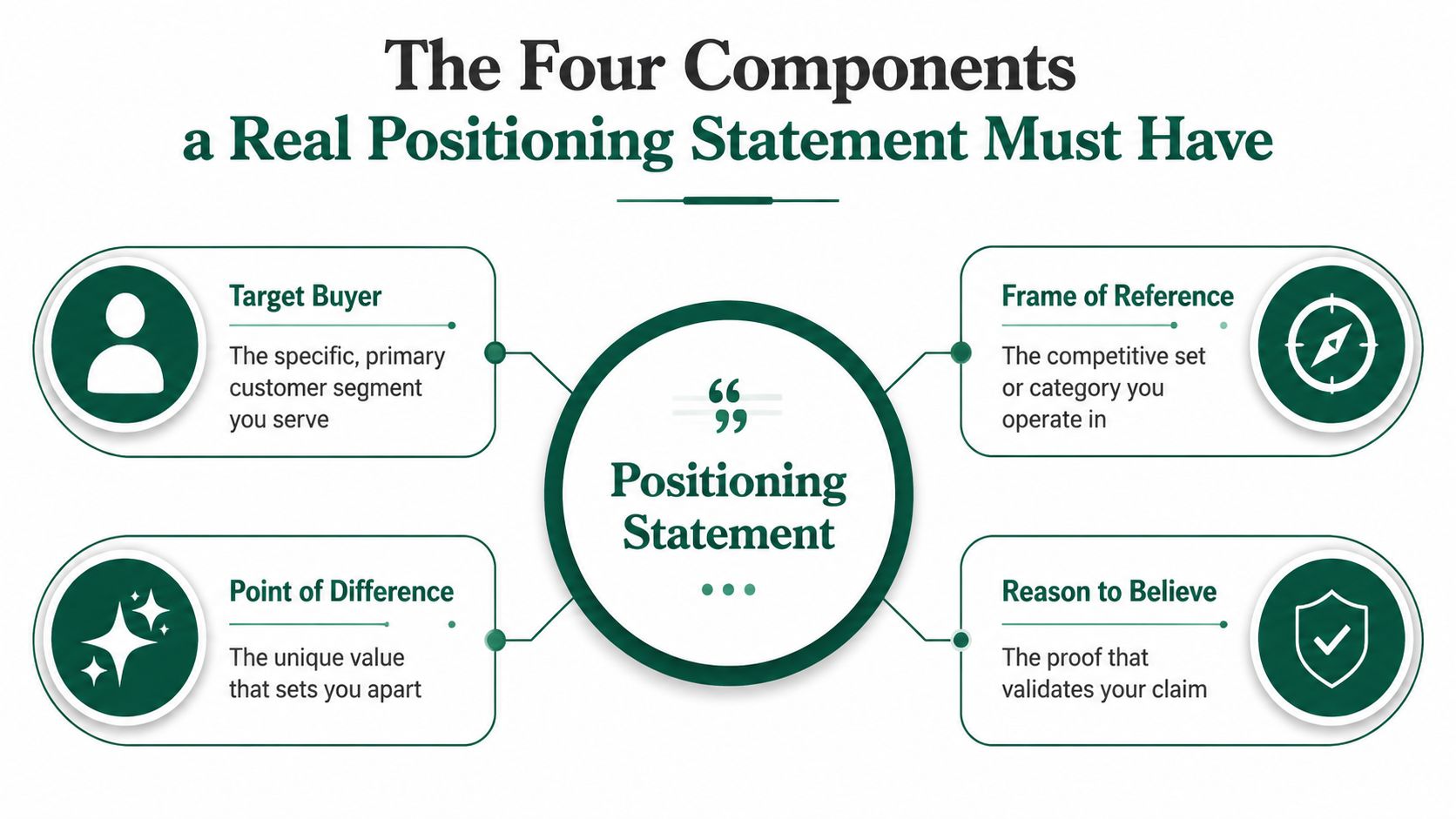
“B2B companies” is not a target buyer. Neither is “modern revenue teams.” Specify the role, company context, and trigger creating urgency. A finance leader at a regulated enterprise replacing spreadsheet-based forecasting has a different buying problem from a startup founder seeking lightweight planning.
Precision creates a tradeoff. A clearly defined primary buyer gives the team sharper language and better qualification, while adjacent segments may feel less represented. That restriction is useful when the company needs focus.
Use this prompt: Who has the problem, controls the budget, and bears the consequences if it remains unresolved?
The frame of reference tells buyers where to place the product. It can be a recognized category, an established workflow, or a familiar alternative. Buyers need that mental container before they can evaluate the difference.
Category-creator language often makes the buyer learn the market and the product at once. Use a familiar comparison early. A new category label can come later, after the company has established what it replaces or changes.
A feature says what the product contains. A point of difference explains why the buyer should choose it over an alternative. “AI-powered workflows” is a capability claim. “Lets revenue teams automate forecast updates without forcing reps into a new planning process” connects the capability to a preference-changing outcome.
Proof keeps positioning grounded. It can come from product capabilities, implementation experience, customer evidence, or a credible operating model. Evidence must support the stated difference directly. A feature list does not validate a specific market claim.
Before drafting, sharpen the audience with an ideal customer profile template. If the team cannot agree on the target buyer, rewriting the sentence will not solve the underlying alignment problem. A strong statement tells the website what promise to lead with, gives sales a qualification rule, and directs demand toward the audience most likely to value the difference.
SaaS teams often use positioning statement, value proposition, messaging, and tagline as if they were interchangeable. They aren't. Confusing their jobs creates the familiar symptoms: a homepage that tries to serve every audience, sales decks packed with disconnected benefits, and campaigns that generate attention without useful demand.
The positioning statement comes first because it defines the strategic choices. The value proposition translates those choices into a buyer-facing promise. Messaging expands the promise into a coherent system of claims. The tagline compresses one memorable idea for external use (Freimi).
| Artifact | Audience | Primary Job | Format |
|---|---|---|---|
| Positioning statement | Internal teams | Define the audience, category, difference, and proof | One sentence or one to two sentences |
| Value proposition | Buyers and evaluators | Explain the relevant benefit and business case | Short customer-facing statement |
| Messaging | Marketing, sales, and buyers | Organize claims by audience, problem, proof, and objection | Framework with pillars and supporting points |
| Tagline | Broad external audience | Create a memorable expression of the brand idea | Short phrase |
Founders often start with the tagline because it feels tangible. That reverses the work. A tagline written before positioning tends to become a vague promise that marketing then has to stretch across every audience.
The positioning statement is internal and strategic. It defines how the business wants to be perceived relative to alternatives. The value proposition is external and persuasive. It expresses why the buyer should care. Messaging connects the two by giving sales and marketing reusable language for different stages, roles, and objections.
A positioning statement can be structurally dense without appearing on the homepage. In fact, it usually shouldn't appear there verbatim. The homepage needs a compressed expression of the same choices. Sales needs a narrative that makes the category and difference relevant to a specific account. Demand needs variations that preserve the same strategic frame while adapting to channel context.
A tagline is a memory device. A positioning statement is a management device.
Read what a value proposition is before deciding which artifact your team lacks. If the internal strategy is unclear, don't ask the copywriter for a better headline. Ask leadership to make the tradeoffs the headline is currently hiding.
Write the statement as a sequence of forced decisions. Don't open a blank document and wait for elegant language. Start with the commercial reality the company needs to address.
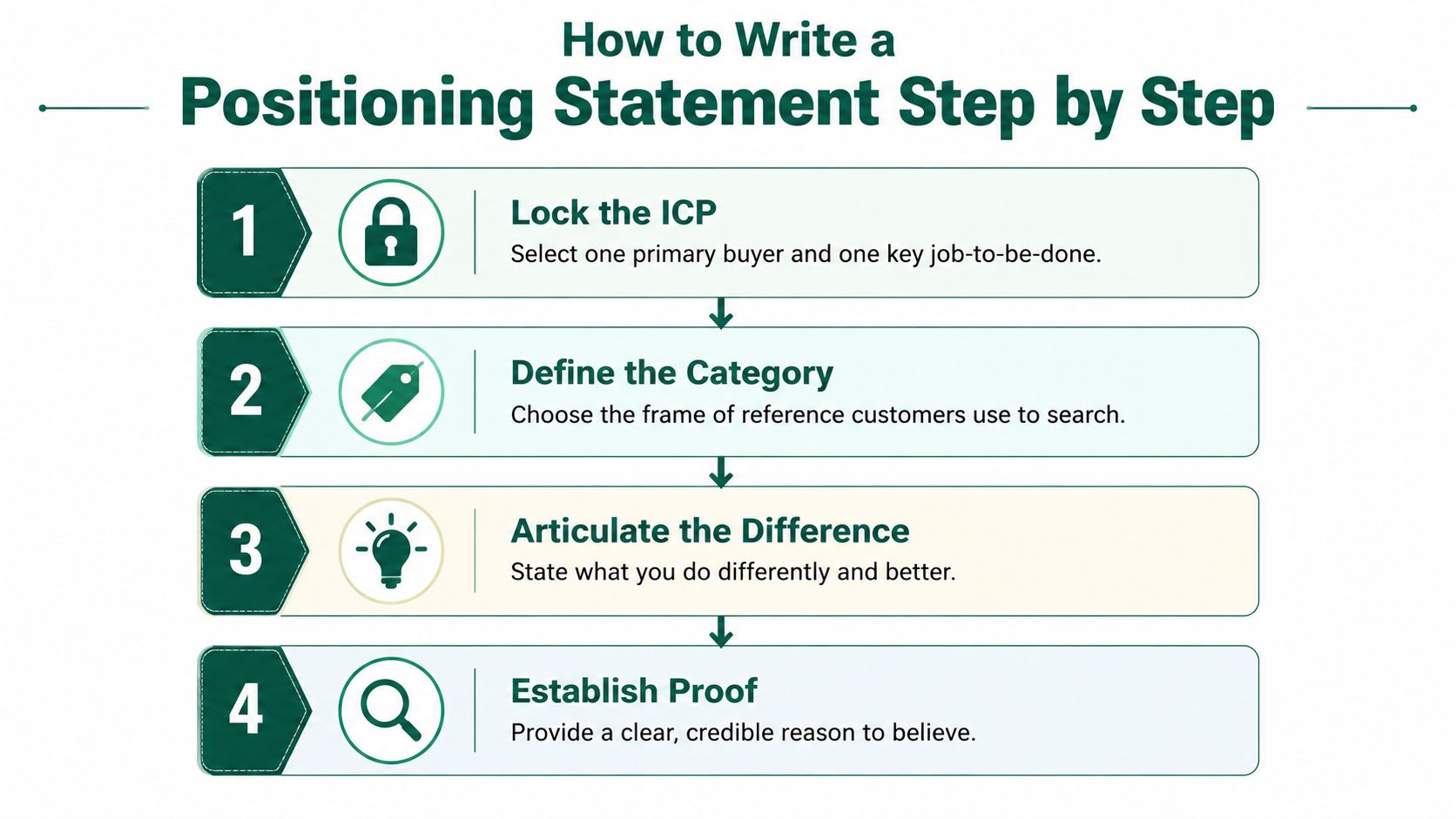
Choose one primary buyer and one funded job-to-be-done. “Marketing leaders” is still broad. A stronger starting point identifies the role, company stage, operating environment, and recurring problem.
Ask: Who is already spending money, time, or political capital to solve this? If the answer changes between the founder, sales leader, and product leader, stop drafting and resolve the disagreement.
Use the category buyers already understand, unless there is a compelling reason to educate them into a new one. Ask what they search for, what alternatives appear in their evaluation, and what internal process your product replaces.
The frame can include a familiar category plus a meaningful qualifier. That structure helps buyers understand the product without forcing the company to sound identical to every incumbent.
State what changes for the buyer and why your product is better suited to the job. Avoid adjectives such as “powerful” unless you can attach them to a concrete operating difference.
Use this prompt: What can the customer do, avoid, or achieve with us that they can't reasonably do with the primary alternative?
Attach a reason to believe that a buyer can verify. Proof might be a product mechanism, a specific capability, a credible implementation model, or customer evidence. Don't add proof that the company can't consistently deliver.
For teams still arguing over what customers understand, structured survey templates for marketing clarity can help collect language from buyers instead of relying only on internal preference.
A useful working formula is:
For [specific buyer] who [urgent job or problem], [brand] is a [category] that [meaningful outcome]. Unlike [primary alternative], it [distinctive difference], supported by [reason to believe].
The fifth element, proof, is optional in the shortest version but recommended in the internal artifact. It keeps the team honest. A statement without evidence invites sales and marketing to compensate with softer adjectives.
Finally, read it aloud. Can a rep turn it into a discovery opener? Can product use it to reject an attractive but distracting feature request? Can demand create a campaign without booking a meeting to interpret the strategy? If not, revise the decisions, not just the grammar. A brand messaging framework template can help propagate the final statement into usable claims and proof points.
Public SaaS statements are useful only if you analyze the choices beneath the wording. The important question isn't whether a sentence sounds polished. It's what the company has chosen to make clear, and what it has chosen to leave out.
The examples below use recognizable B2B SaaS patterns rather than invented company claims. They show how the four components work together in practice.
Statement: For data teams managing growing analytical workloads, a cloud data warehouse provides scalable infrastructure for storing and analyzing data, differentiated by an architecture built specifically for cloud operation and supported by a product model that separates key infrastructure functions.
The critical choice is the category frame. “Data warehouse” gives buyers a familiar mental container. “Built for the cloud” introduces the difference without requiring the company to invent an opaque category. The tradeoff is that the statement invites comparison with established warehouse and cloud infrastructure vendors.
Statement: For operations leaders at multi-location service businesses, vertical workflow software coordinates scheduling, field activity, and reporting in one operating system, differentiated by workflows designed around the needs of distributed teams and supported by domain-specific functionality.
This company gives up broad horizontal appeal to become more relevant inside a defined operating environment. The buyer immediately knows whether the product belongs in their evaluation. That clarity is worth more than claiming to serve every operations team.
Statement: For revenue teams replacing fragmented forecasting processes, revenue planning software creates a shared operating view, differentiated by faster collaboration across sales and finance and supported by workflows that fit existing planning behavior.
Here, the competitor isn't necessarily a named vendor. It may be spreadsheets, disconnected systems, or an incumbent process. Naming the replacement clarifies the buying moment and creates a sharper reason to switch.
| Company Type | Target Customer | Market Category | Pain Point | Promised Outcome |
|---|---|---|---|---|
| Horizontal infrastructure | Data teams | Cloud data warehouse | Rigid analytical infrastructure | Flexible data operations |
| Vertical workflow tool | Operations leaders in multi-location businesses | Vertical workflow software | Disconnected field workflows | Coordinated execution |
| Competitive replacement | Revenue teams | Revenue planning software | Fragmented forecasting | Shared operating visibility |
Strong statements don't hide the tradeoff. They choose one job, one buyer, and one category. The common upgrade is sharper evidence, not softer adjectives. Replace “better” with the mechanism that makes better credible.
Broken positioning rarely fails because the sentence contains a grammatical error. It fails because leadership avoided a decision and pushed the ambiguity downstream into the homepage, pipeline motion, and product narrative.
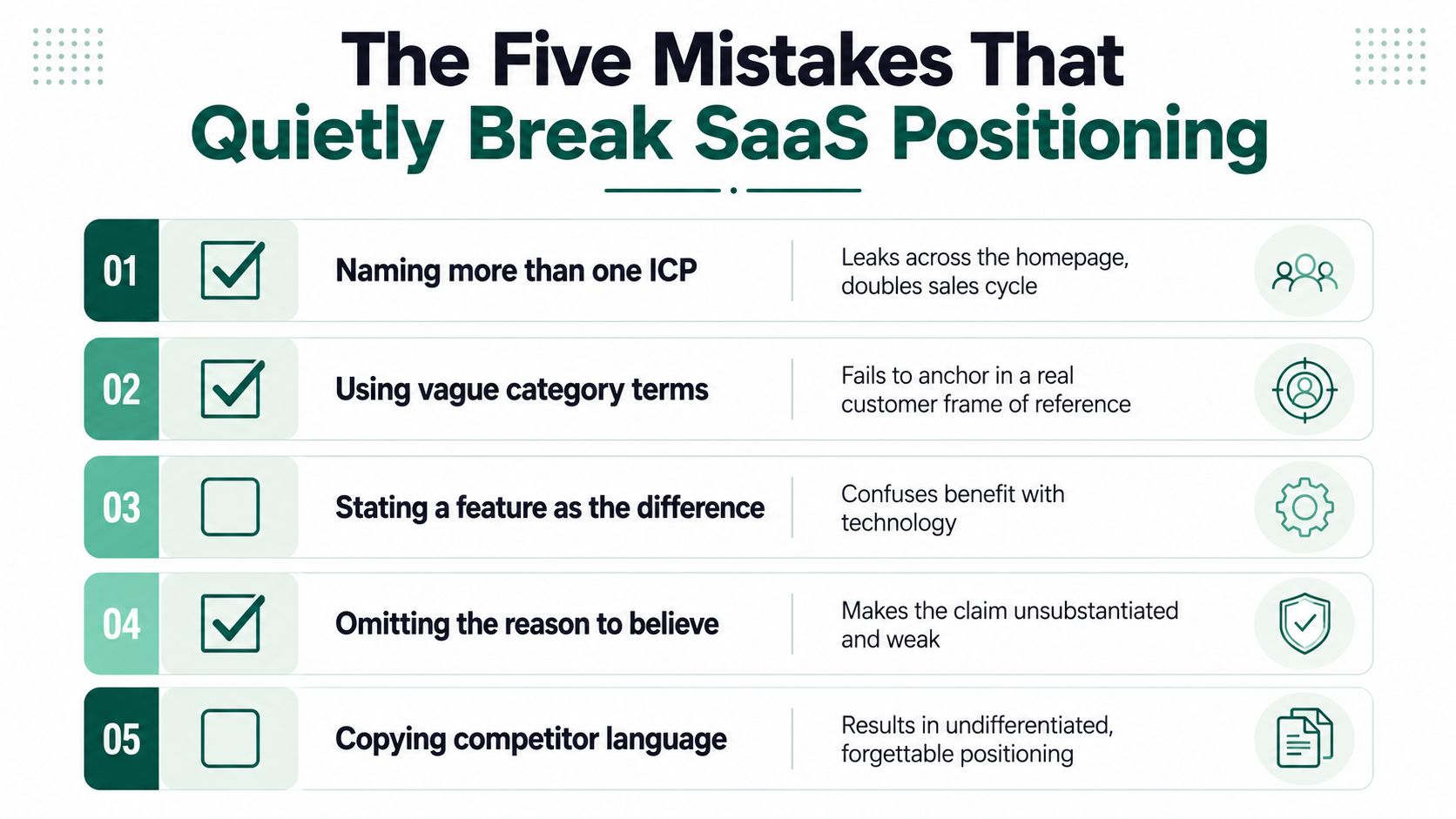
If one statement names founders, enterprise IT, finance leaders, and developers, it doesn't define an ICP. It lists possible audiences. The diagnostic is simple: ask which buyer should receive the next dollar of demand spend. If the answer contains “it depends,” the statement is leaking.
The downstream cost appears in diluted campaigns, inconsistent qualification, and longer sales conversations because reps must discover which problem the company wants to solve.
“Business transformation platform” and “intelligent orchestration layer” don't help buyers place the product. Category-creator language becomes a crutch when the team hasn't earned the right to redefine the market.
Use a familiar frame first, then add the specific difference. Buyers can't evaluate a claim they can't mentally categorize.
An API, dashboard, workflow builder, or AI assistant is not automatically a point of difference. The diagnostic is whether a buyer could value the feature without caring about the business problem. If yes, you have a capability list, not a buying reason.
Unsupported claims force every channel to improvise proof. Sales adds anecdotes, demand adds adjectives, and product adds feature detail. The message becomes louder while credibility gets weaker.
If your competitors all say “simple,” “powerful,” or “secure,” repeating those words won't create distinction. Compare your draft against the language used in real evaluations. If your statement could sit on a competitor's homepage unchanged, it positions against no one.
The fix isn't cosmetic. Weak positioning wastes spend, extends sales cycles, and gives buyers fewer reasons to prefer you. For a visual breakdown of these failure modes, watch the accompanying explanation:
Treat the positioning statement as a constraint and audit every place where the market encounters it. Validation isn't a workshop where everyone says the wording feels good. It's a consistency test.
Start with the website. The homepage hero, meta description, and primary CTA should compress the same buyer, category, and value. They don't need identical wording, but they can't point to different audiences or competitive frames.
Sales needs a deeper translation. Audit the discovery opener, demo narrative, and follow-up email. A rep shouldn't have to ask marketing what the company means before explaining why the product belongs in the buyer's evaluation.
Demand needs breadth without strategic drift. Sample paid ads, organic posts, and nurture emails. Flag any headline that targets a different buyer, invokes a different category, or promises a benefit the product can't substantiate.
| Surface | Customer | Category | Value |
|---|---|---|---|
| Website | Does the hero identify the primary buyer? | Does the page establish the comparison frame? | Does the CTA reflect the core outcome? |
| Sales | Does discovery prioritize the right role and job? | Does the demo use the buyer's category language? | Does follow-up reinforce the differentiated value? |
| Demand | Do campaigns attract the intended segment? | Do ads and content preserve the same frame? | Do nurture claims connect to the central proof? |
Mark each cell as aligned or misaligned. Don't create a third status called “mostly aligned.” That label protects inconsistent copy from being rewritten.
The result should inform sales and marketing alignment, but alignment isn't achieved by sharing a document. It comes from enforcing the same decision rule in each channel.
Your positioning statement should answer one question across the entire go-to-market system:
When a buyer encounters us in any channel, do they understand who we serve, what category we belong to, what we replace, and why we're different?
If the answer is yes, the statement is doing its job. The website can simplify it. Sales can turn it into a conversation. Demand can adapt it to a campaign. Product can use it to judge whether a roadmap decision strengthens the company's chosen position.
If the answer is no, you don't have a homepage problem. You have an alignment problem. Rewriting the hero section won't fix a product team that describes the company as infrastructure, a sales team that sells it as workflow software, and a demand team that targets an audience neither group can close.
Positioning is also not permanent text. The statement should be revisited when the ICP, pricing, packaging, buying group, or competitive frame changes. But revision isn't permission for committee-driven vagueness. Keep the statement short, structurally dense, and owned by leadership.
Decision rule: Every downstream GTM artifact must reconcile with the positioning statement, or it gets rewritten.
That is the practical positioning statement definition for B2B SaaS. It isn't a slogan to admire or a document to archive. It's a contract between product, marketing, sales, and leadership about the market the company intends to win and the claims it can credibly defend.
Big Moves Marketing helps B2B SaaS teams clarify positioning, turn it into a reusable messaging system, and connect that strategy across websites, sales enablement, and demand channels. If your teams are describing different companies to the market, visit Big Moves Marketing to discuss a sharper go-to-market foundation.




%20-%20white.svg)