Companies buy link building for SaaS the way they'd buy office supplies. They set a monthly quantity, accept a spreadsheet of domains, watch a score move, and call it growth. That's the wrong unit of work. A buyer doesn't care how many sites linked to you. An answer engine doesn't either. Both care whether a credible page validates a specific claim about your product, on a page that can influence a shortlist, a demo, or a deal already in motion.
The common failure isn't weak outreach. It's a procurement target disguised as strategy. A vendor gets asked for referring domains, the homepage metric improves, and nobody can name one influenced opportunity. The broken assumption underneath is that every followed link is the same commercial asset.
It isn't. A citation inside a workflow guide your buyer already trusts does a different job from a directory listing. A partner logo page built so two companies can exchange links does less still. The original logic hasn't changed. A link works like a citation, and its weight comes from the credibility of the referring page and the topical neighborhood around it.
First, links pile onto the homepage while the category, integration, or use-case page that's supposed to rank stays thin. The asset that needs authority never gets it. Second, placements get bought or swapped on terms that exist only to affect rankings. That's not distribution. That's risk dressed as output.
Third, reporting stops at domain count. No one maps placements to the B2B customer journey, so no one can say where a citation helps a buyer discover, evaluate, or justify the product. Finance sees spend. Sales sees nothing usable. Leadership sees a chart that can't survive one hard question.
A link program that can't name the target page, the buyer, and the sales use isn't a growth program. It's inventory.
This pattern shows up before product-market fit, after a Series A, and at Series C. The budget grows. The thinking often doesn't. Teams add vendors, publish more posts, and chase publications their buyers don't read. Meanwhile, the pages that answer migration risk, security review, implementation effort, or integration fit still lack third-party proof.
Stop asking how many links you need this month. Ask which commercial claim lacks evidence, which page must win that claim, and which independent source your buyer already believes. That changes the budget conversation completely.
Fund links by commercial use, not by how easy they are to acquire. Start with sources that give buyers, partners, and search systems a reason to treat a specific page as credible.
| Source | Who it reaches | What it validates | Risk | Fund it |
|---|---|---|---|---|
| Original benchmark or research | Analysts, category buyers, journalists | Claims and entity facts | Low if the method is real | Yes, one flagship |
| Integration and implementation pages | Practitioners already in the workflow | Technical fit | Low | Yes, one workflow per ICP |
| Customer operational stories | Peers with the same motion | Outcome proof | Low | Yes, after proof exists |
| Expert commentary and podcasts | Category operators | A repeatable point of view | Low | Selective |
| Independent comparisons and reviews | Shortlist buyers | Category membership | Medium if incentivized | Yes, earned not paid |
| Partner pages built only to cross-link | At best the partner's customers | Little | High if reciprocal or required by contract | No |
| Paid placements and link networks | Whoever the seller can place | Nothing defensible | High unless marked sponsored or nofollow | No |
| Directories and exact-match anchors | Rarely the buyer | Almost nothing | High once the pattern looks manipulative | No |
The funding order follows how rankings associate with links. In the Ahrefs links-with-traffic study of 44,589 non-branded keywords with monthly search volumes between 2,000 and 5,000, URL Rating was the strongest correlating factor among the tested link metrics. The same analysis found the total organic traffic of referring pages correlated more strongly with rankings than merely counting referring pages with traffic, while traffic at the referring-domain level added little advantage over the total number of referring domains.
Read that practically. You don't need another mention pointing at your homepage from a large but irrelevant domain. You need relevant pages with their own authority linking to the page that must rank and convert. Integration documentation, implementation guides, analyst resources, and strong industry publications fit because they're close to the buyer's actual work.
Here, a genuine SaaS SEO strategy separates itself from a link quota. Map each target URL to one topic. Identify the competing URL with stronger page-level authority. Then pursue editorial links that improve that specific URL, not your domain in the abstract.
Independent comparisons still matter for category membership. They help buyers place you in the right set. They don't justify paid inclusion that passes ranking credit. Earn the listing, keep the facts accurate, and treat incentivized placement as advertising.
Set the operating KPI as qualified referring domains and page-level authority gained per target page. Don't report total backlinks as success. The evidence here is correlational, so pair links with search intent alignment, useful content, and internal links from pages sales and support already send to customers.
Pace acquisition by editorial capacity, not by a monthly quota. A steady flow of relevant placements is defensible. A sudden obligation to produce a fixed number of domains pushes teams toward sellers, swaps, and exact-match anchors. That's how a budget line becomes a liability.
Volume stopped being a safe proxy more than a decade ago. The Portent analysis of Google's declining spam tolerance notes that Google launched Penguin in April 2012 to target websites that appeared to use external links to manipulate rankings, including link schemes, spam networks, and over-optimized anchor text.
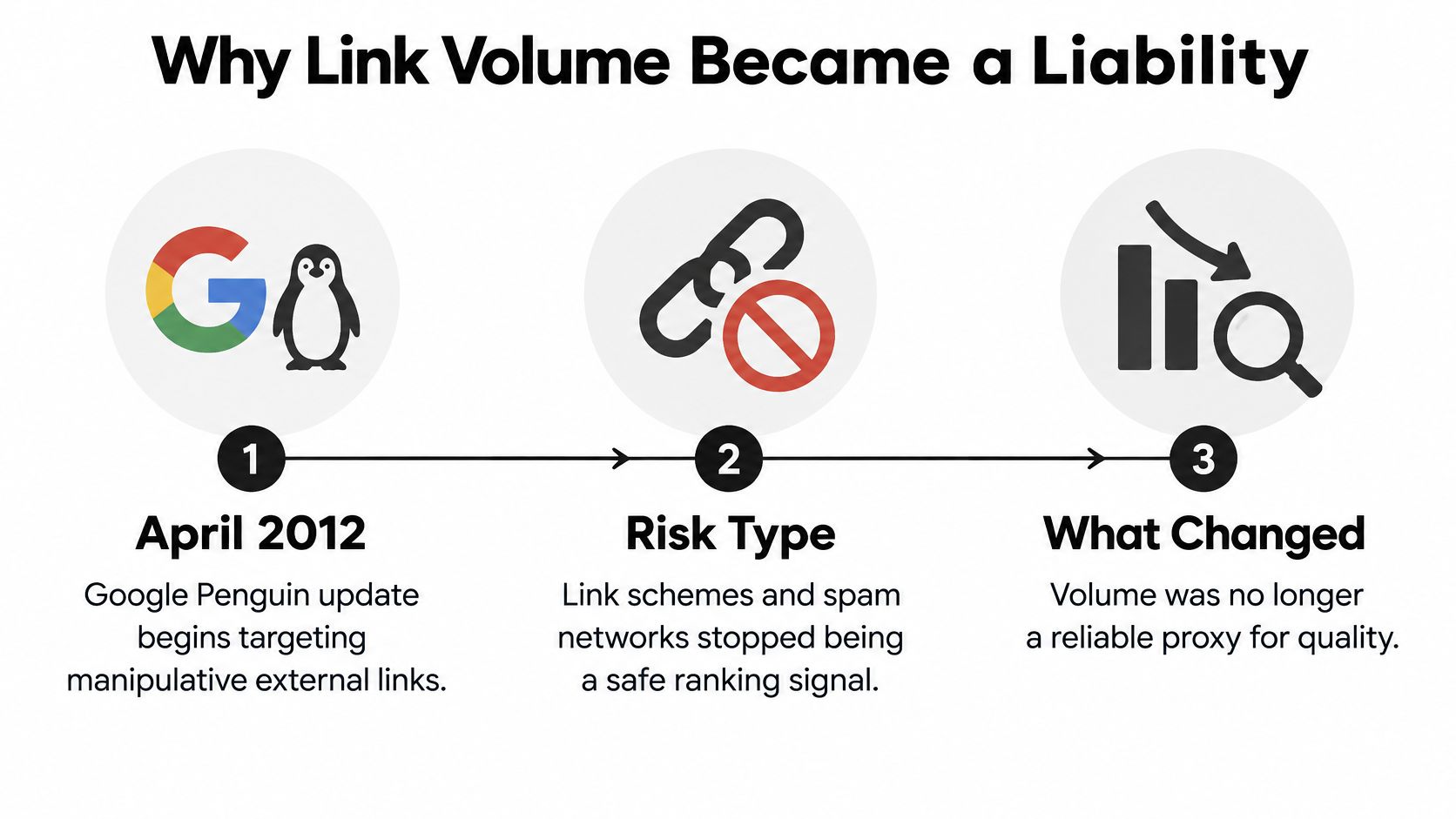
The analysis examined approximately 10,000 links pointing to each of the top 50 companies in the 2012 Inc. 5000 list, covering more than 250,000 links to penalized sites and another 250,000 links to non-penalized sites. It found 36 of the 50 high-growth companies had clean profiles, with fewer than 10% of links classified as questionable.
Early in Penguin's development, sites generally needed more than 80% manipulative links to be penalized. By October 2012, sites could reportedly face penalties when roughly 50% of their links were considered manipulative. Don't treat those figures as a current cutoff. Treat them as a dated benchmark showing tolerance falling fast.
That's the point founders miss. Risk doesn't begin when a manual penalty arrives. It builds when the pattern looks purchased, repetitive, or detached from editorial judgment. By the time rankings drop, you've already paid for the problem and staff now have to clean it up.
Keep test: Keep a link only if the publisher would keep it when rankings weren't at stake.
For SaaS, refuse the patterns that look like ranking purchases. Skip indiscriminate directory submissions. Don't buy network placements. Don't build partner pages whose only purpose is cross-linking. Don't require a followed link in a partnership contract. Don't stack exact-match anchors on pricing, comparison, or feature pages.
Paid promotion itself isn't the issue. The issue is passing ranking credit through a commercial placement. Mark sponsored placements correctly so they don't pass that credit, and judge them as media, not as link building for SaaS. If the audience is wrong, even a properly qualified placement wastes money.
Diversify anchors the way real editors write. Use the company name, the product name, the study title, or a plain description of the resource. If every placement uses the same money phrase, you're not earning citations. You're leaving a pattern.
A linkable article starts with a commercial page, not a blank draft. Outrank is useful when your bottleneck is production capacity rather than judgment. It generates SEO-focused long-form articles and on-brand images, supports publishing to WordPress, Webflow, and Notion, and includes keyword research and content customization for a defined brand voice.

Use it in a tight sequence tied to one URL at a time.
Multi-user access, rewrites, and API integrations help when several people review positioning, product facts, and final copy. They don't replace editorial ownership. Someone senior still has to decide what's true, what's differentiated, and what shouldn't be published.
Use Outrank when you have a clear asset brief and need faster drafting and publishing. Don't use it to flood the blog with interchangeable posts. If you're comparing acquisition routes, this overview of the best places to buy backlinks is a useful reminder to separate paid placement options from earned editorial work before you commit budget.
Linkable assets often get built backward: they start with a broad topic, publish it on the blog, then ask why the product page still has no authority. Build fewer assets and bolt each one to a revenue URL. The economics of informational volume keep weakening. Data reported in Digiday's AI in publishing analysis from a 2025 analysis of more than 10 million keywords found Google AI Overviews appeared for over 13% of queries in March 2025, up from 6.49% in January. When a summary satisfies the query, the top organic result loses part of its audience.
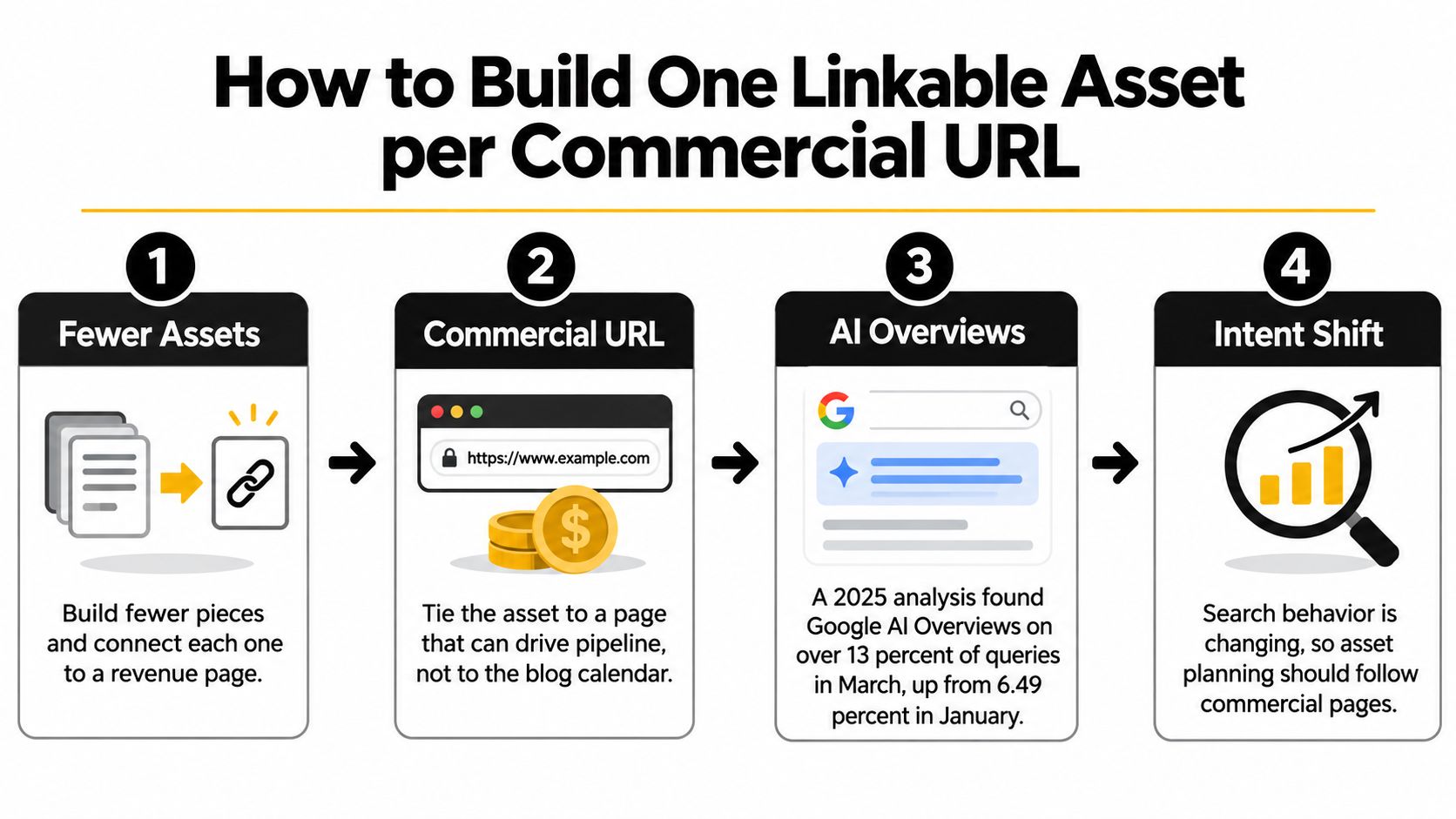
That makes undifferentiated blog volume hard to defend. A page can rank, lose the click, and still matter if it carries a fact buyers remember and answer engines can retrieve. A generic explainer does neither reliably. Your content strategy for websites should fund proof assets before it funds more explainers.
Say a SaaS company sells to operations leaders and loses deals late over implementation risk. A broad article about operational efficiency will not move that deal. A migration checklist built from real deployments can support the migration page, give partners a process worth citing, help champions answer internal objections, and give sales an attachment that shortens technical review.
Compare production and promotion cost against five outcomes. Track non-brand movement for the target page, sales usage, partner referrals, branded demand, and assisted pipeline. If the asset only improves article traffic, it is a publishing success and a commercial failure.
An asset is linkable when an independent editor, partner, or customer can repeat its central fact without sounding like your sales team.
Start with a deal problem, not a topic cluster. Which objection appears in calls? Which technical question slows procurement? Which integration decides whether trials activate? Build the evidence for that moment, place it on the relevant commercial URL, and earn citations to that proof.
Use the same test to decide between links and more publishing. When the target page matches intent but lacks credible third-party support, fund the asset and outreach. When the page is vague, thin, or aimed at the wrong ICP, fix positioning and page content first. Links cannot rescue a page buyers do not believe.
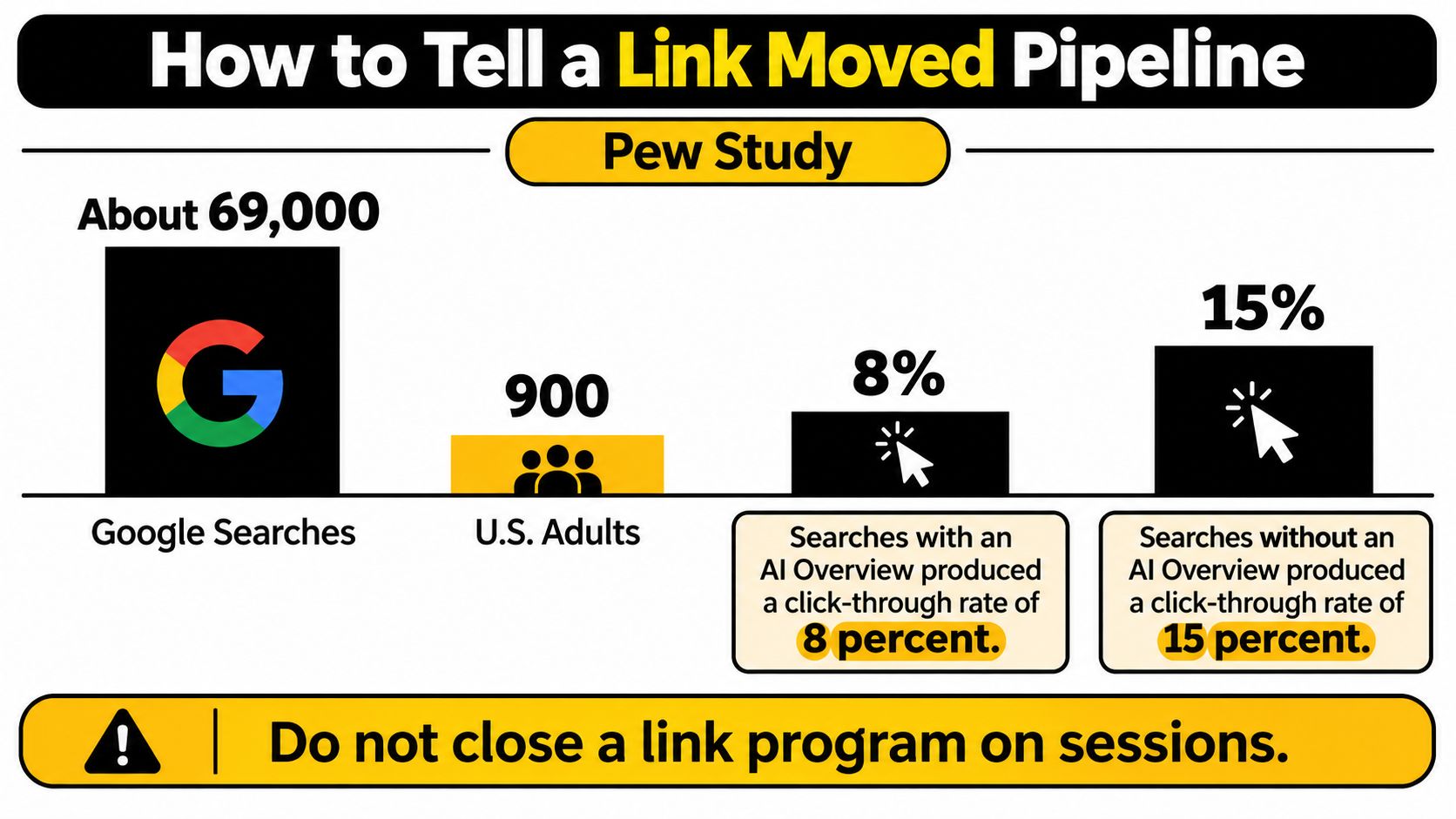
Don't close a link program on sessions. Search behavior no longer supports that shortcut. In the Pew Research Center study of approximately 69,000 Google searches from 900 U.S. adults, searches showing an AI Overview produced a click on a conventional result only 8% of the time, compared with 15% when no AI Overview appeared. Users clicked a cited source inside the AI Overview in just 1% of visits.
A link can still matter when it generates few visits. It may validate that your product belongs in a category, or it may supply a claim an answer engine can retrieve with confidence. That's why you need to score placements by job, not by traffic alone. A clear view of how to measure marketing ROI helps you separate useful influence from activity reporting.
| Signal | What to count | Why clicks mislead | Decision |
|---|---|---|---|
| Target-page authority | New followed referring domains to that URL | Homepage links do not move a solution page | Keep or kill the URL |
| Topical fit | Buyer job match of the referring page | High authority can still be the wrong audience | Accept or decline the placement |
| Assisted conversions | Demos or trials on the linked page | Blog sessions flatter weak assets | Compare assets |
| Branded demand | Brand plus category queries | Answers can suppress clicks and still raise demand | Judge entity validation |
| Answer-engine citations | Times the product or study is named | A citation click happened in about 1 percent of visits | Fund evidence links |
| Commercial use | Partner-sourced opportunities and sales attachments | A link sales never uses is a trophy | Stop production |
Read that table as a monthly operating review, not a vendor dashboard. Keep a target URL when new followed referring domains are topically relevant, indexable, and connected to assisted demos, branded growth, partner opportunities, or sales usage. Kill it when the only movement is homepage authority or referral sessions from people who will never buy.
Say two placements arrive in the same month. One is a broad business publication that sends a short traffic spike and never appears in a deal. The other is a specialist implementation guide that cites your benchmark, gets named in AI answers, and shows up in a champion's internal thread. The second placement wins. It changed what buyers could verify.
Report five lines to leadership. Name the target URL, new relevant referring domains, branded demand, assisted pipeline, and whether sales used the asset. If those lines are empty, the program didn't work, however large the domain count looks.
The asset types stay consistent. The constraint changes. What you can credibly prove, who will cite it, and where revenue pressure sits all shift by stage. The short visual below sets up that progression before the operating choices.
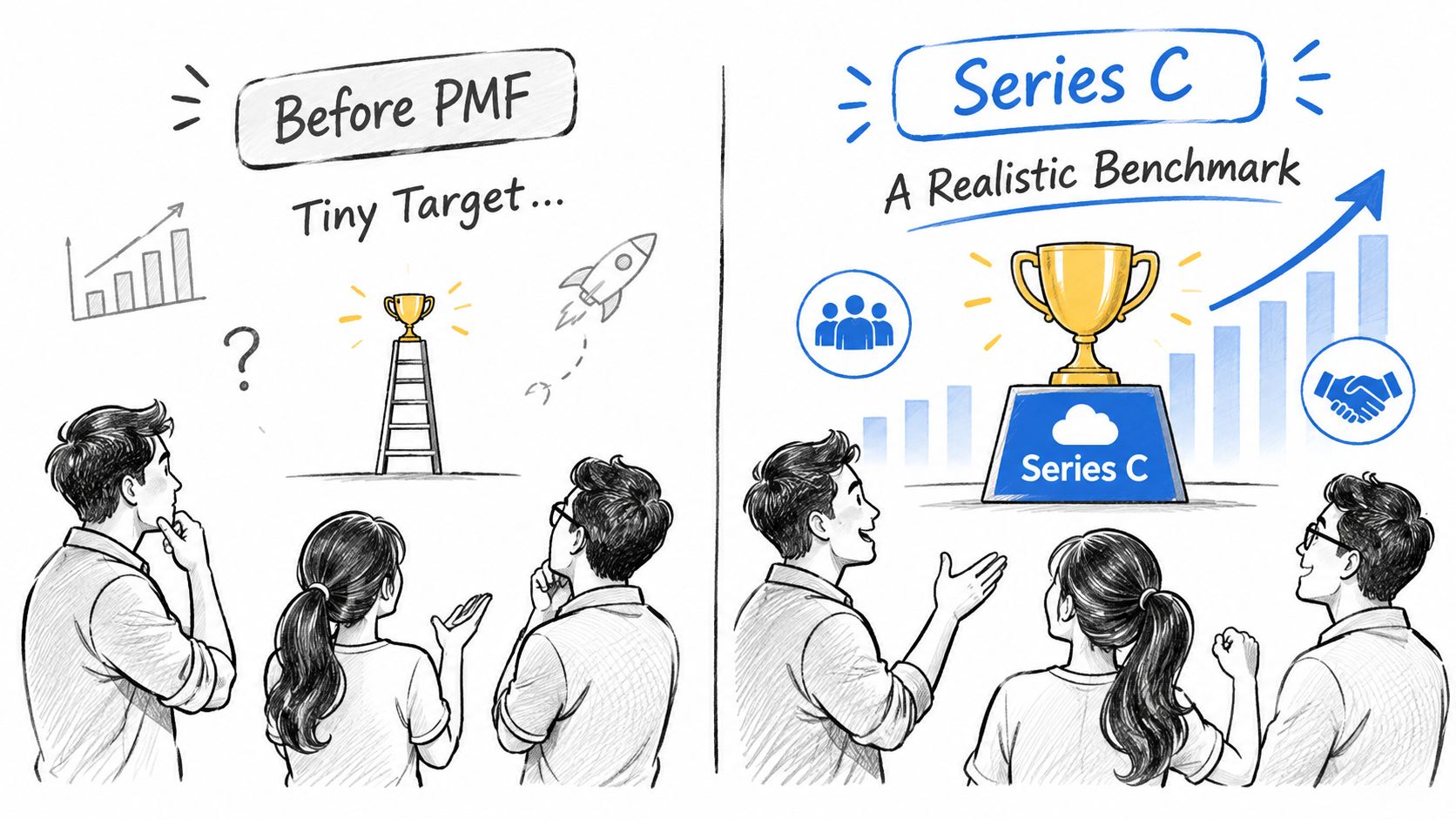
Before product-market fit, a benchmark the market won't believe is a vanity project. You don't have the sample, the segment clarity, or the reputation to carry it. The earnable object is usually a narrow implementation note from design-partner work. One workflow, one integration, and one before-and-after result the founder can defend on a call. If founder-led sales won't attach that note to the deck, don't pitch it for links.
At Series A, the failure mode is ICP confusion dressed up as content. A sales-led team should put links on pages that unblock deals, including security and compliance explainers, a migration checklist, and customer stories from the same segment. A product-led team should focus on integration and template pages where activation happens. Chasing national press while the product page lacks a credible third-party description wastes the quarter.
The explainer below is useful context for how stage and motion change the work, but your funding decision still has to come back to one buyer problem and one commercial page.
By Series B and C, the temptation is a domain-rating program that ignores the sales-led and product-led split. Fund the side that creates revenue. If partners source real opportunities, build joint implementation research and a marketplace listing buyers can act on. If outbound targets a tight account list, commentary matters only when those accounts already read the source. A quieter citation from a trusted community beats a generic mention they'll never see.
That stage logic also belongs in your view of the product life cycle and marketing, because channel maturity means little if the proof asset doesn't match the company's current constraint.
| Stage | Fund | Drop |
|---|---|---|
| Pre-PMF | One design-partner implementation note, used in the founder deck | Benchmarks the market will not believe |
| Series A, sales-led | Security and compliance explainer, migration checklist, two same-segment customer stories on deal-blocking pages | National press pitches while the product page has no third-party description |
| Series A, product-led | Integration and template pages where activation happens | Generic publication outreach |
| Series B to C, partner-sourced | Joint implementation research and a marketplace listing | Logo-farm partner pages |
| Series B to C, outbound | Expert commentary and data placed in sources target accounts already read | Domain-rating programs |
At every stage, stop work that can't name the page, buyer, and sales use. Stage doesn't excuse vague authority building. It makes the cost of wasted motion higher.
Fund link building the way you fund product bets: one asset per quarter, one commercial URL it must serve, one claim that asset has to prove. Assign an owner. Build the promotion list from customers, integration partners, and editors your buyers already trust. Set the gate before production starts, while the team can still judge the idea on merit instead of on effort already spent.
At quarter end, review five lines. Name the target URL, new relevant referring domains, branded demand, assisted pipeline, and sales usage. Keep the asset only if the pipeline or sales-use lines moved. Kill it if the result is limited to homepage authority or referral sessions from audiences who won't buy.
A referring domain your buyers and answer engines never touch adds no evidence to the page that sells. That is the standard the gate enforces: every new citation either strengthens the commercial URL's claim or it never gets built. This is how you spend less on links and get more out of each one.
If sales hasn't used the asset, don't commission a second one. Fix the claim, the page, or the internal distribution first. Retire paid networks, reciprocal partner pages, and directory patterns before new outreach begins. Cleaning the risk out later costs more than refusing it now.
Big Moves Marketing offers fractional CMO planning, positioning and messaging, website and content work, and SEO and AIO programs for B2B SaaS companies, so if you want a senior call on which commercial page to back, contact the team.