%20png%20copy.avif)

Your B2B SaaS sales pitch is broken if it revolves around your product. You need to stop explaining what your product does and start articulating the business model evolution your prospect must undertake.
The objective isn't to demo features. It's to build such an airtight argument for change that your solution becomes the only logical path forward.
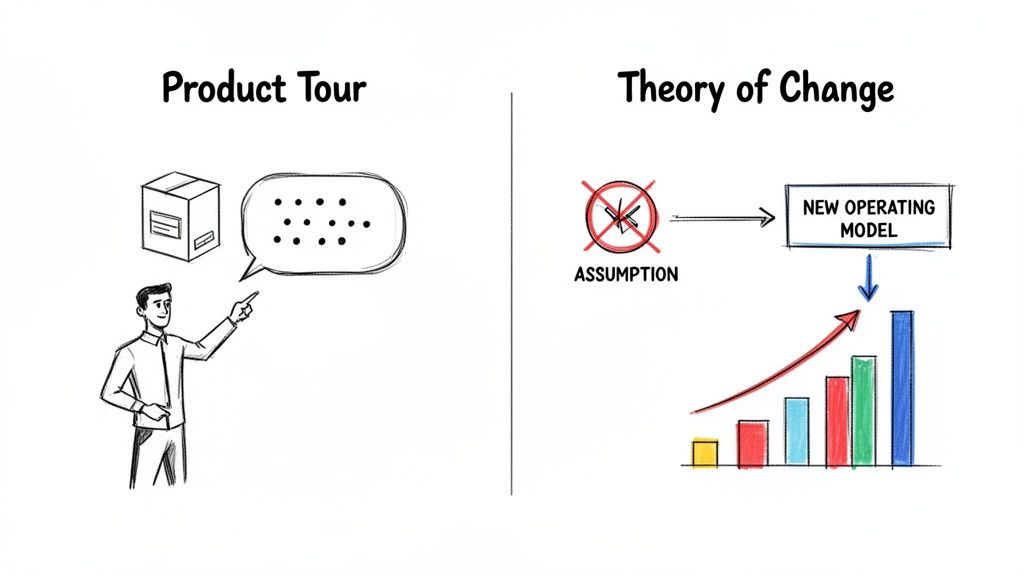
Most sales pitches from early and growth-stage SaaS companies are doomed from the first slide. They are nothing more than product monologues.
Founders and sales leaders, convinced their solution is the hero of the story, default to feature walkthroughs and technical deep dives. This is a strategic error.
Sophisticated B2B buyers—especially the senior leaders with budget authority—are not buying features. They are buying a competitive advantage, a new operational model, or a way to de-risk their strategy. A pitch that obsesses over the "what" and "how" of your product signals a lack of strategic acumen. It positions you as a vendor, not a peer.
This feature-first obsession is a primary driver of poor sales performance. The average B2B SaaS win rate hovers around a grim 22%. In my work with over 70 SaaS companies, I’ve observed that top-quartile performers invert the model entirely. They win by leading with a strategic, value-driven narrative.
You've poured years into building your product. Your prospect has spent years building their business. Your pitch must connect to their reality, not yours.
When you lead with features, you force the prospect to do the cognitive labor of translating your product's functions into tangible business outcomes. This is work they are neither willing nor equipped to do in a live sales call.
The goal of your pitch is not to demo features. It is to articulate a compelling theory of change for the prospect's business—one that makes your solution the only logical conclusion.
Instead of a product tour, your pitch must present a cogent argument about their market, their operational model, or an unseen risk they are carrying. You are not just selling software; you are selling a new perspective that redefines their problem and illuminates a superior path forward.
This argument—your "theory of change"—must be built on a strong, often provocative, point of view. It must challenge a core assumption the prospect holds about their business. Digging into strategic business planning principles is one way to build the muscle for developing these robust arguments.
This strategic foundation is the most critical component of knowing how to write a sales pitch that moves a deal. It's the pre-work before any slide deck or demo script is considered. It's the difference between hearing "that's interesting" and sparking a "we need to act on this." This thinking is directly linked to your core messaging, which we detail in our guide on how to write a positioning statement.
Your product simply becomes the proof that your theory of change is real and achievable. When you successfully shift the conversation from what your product does to how their business must evolve, the sale becomes an outcome of a shared strategic vision. That is how you win.
A winning sales pitch isn’t improvised; it’s engineered. Before opening PowerPoint or Google Slides, the real work must be done. Most SaaS teams skip this strategic architecture, which is why their pitches feel hollow and lead to stalled deals.
They jump straight into designing slides and scripting demos without first pressure-testing the core argument.
A high-stakes pitch—the kind that moves six- and seven-figure budgets—stands on three strategic pillars. Get these right, and the pitch practically writes itself. Get them wrong, and you will spend sales cycles fighting skepticism and indifference.
Your pitch cannot start with your product. It must begin with a sharp, challenging perspective on your prospect’s world. A strong Point of View (POV) isn't a summary of a market trend; it’s an argument that reframes how they see their own business.
It is the insight that makes the status quo feel untenable.
Many founders mistake a POV for a simple problem statement. A problem statement is, “Managing remote teams is hard.” A POV is, “The metrics you’ve used to measure engineering productivity for the last decade are now actively misleading you in a remote-first world.” One is an observation; the other is a provocation.
Your Point of View is intellectual property. It is the lens through which you want the prospect to see their problem—a lens that makes your solution the only logical outcome. If your POV isn't challenging a core belief, it isn't working.
Once you've unsettled their worldview, you must immediately connect your insight to a material economic impact. Vague promises of "increased efficiency" are meaningless to a CFO. You have to translate your POV into the language of the balance sheet.
This means moving beyond soft ROI claims and building a quantifiable business case. Does your solution reduce headcount costs, mitigate specific compliance risks with documented fines, or shorten sales cycles? By how much?
Drill down into specifics:
This pillar must be an airtight financial argument. Without it, your pitch is a "nice-to-have."
The final pillar answers the inevitable question: "I see the problem and the value. But how, exactly, do you deliver this in a way no one else can?" This is your differentiated mechanism. It is not a list of features. It’s the unique architecture, proprietary data set, or novel workflow that underpins your product's ability to deliver on the economic promise.
For example, your mechanism isn’t "an AI-powered dashboard." It's "a proprietary machine learning model trained on five years of industry-specific procurement data that identifies cost-saving opportunities no human or competitor can see." The key is to connect your unique how to the promised what. Exploring these concepts is critical for effective communication, as seen in our discussion on the three pillars of B2B marketing.
This is where you demonstrate technical credibility, but only in service of the business outcome. Your mechanism is the ultimate proof point—it shows your claims are rooted in a genuine, defensible advantage.
You have done the hard thinking and defined your pillars. Now you must structure the pitch narrative.
This is where many sales teams fail. They fall back on the tired "Problem-Agitate-Solve" formula. Your buyer has seen this a thousand times. They can feel the scripted manipulation coming, and their guard goes up.
In a high-stakes B2B conversation, you need a more sophisticated narrative. The goal isn't just to agitate a known problem; it's to reframe their reality. You are selling a new, more intelligent way of seeing their world.
This is about building a logical, financially sound argument rooted in a defensible point of view—one that makes your solution the only logical conclusion. The entire narrative rests on your market view, its economic value, and your differentiated mechanism.
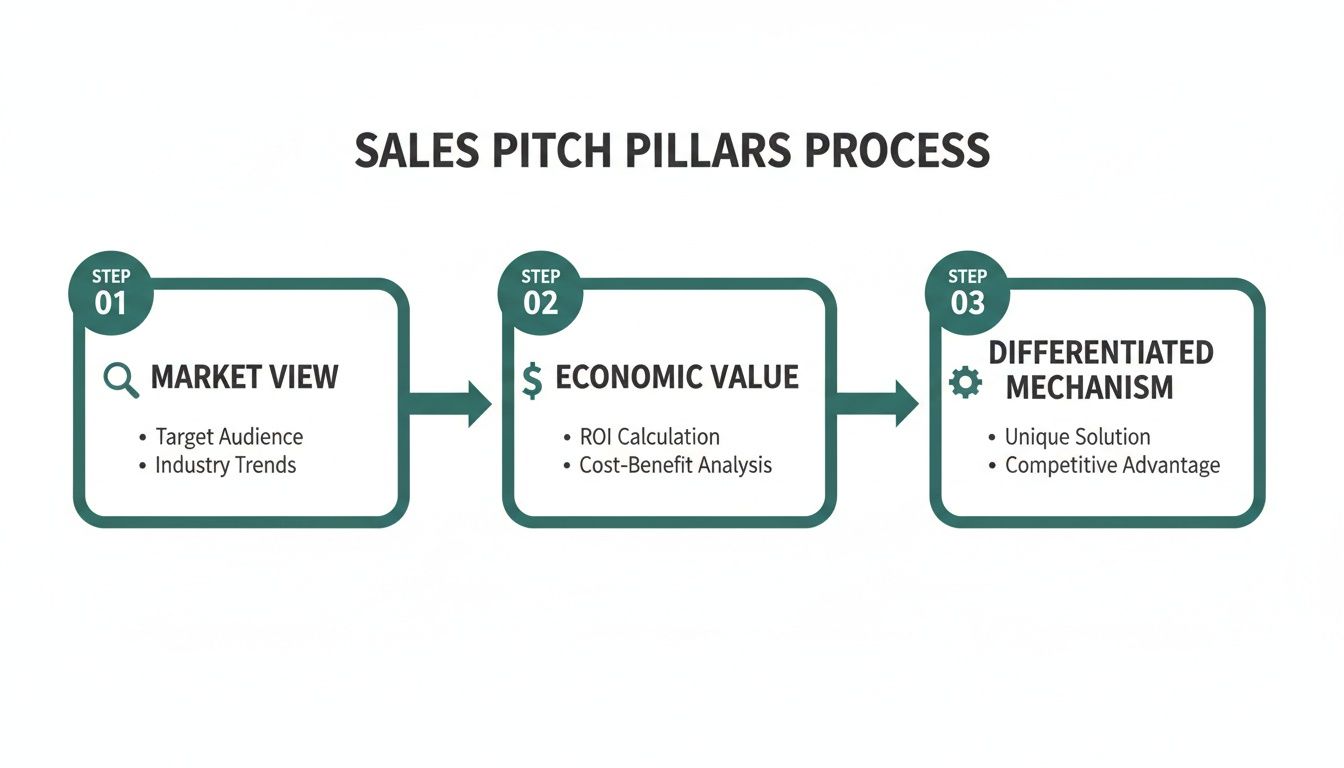
This strategic approach transforms a generic sales pitch into a provocative business case for change.
Let's examine how this plays out. The conventional pitch is about you—your company, your product, your features. The strategic narrative is about them—their world, their missed opportunities, and their path to a better future state.
This table breaks down the difference between the common, low-impact pitch and the high-impact narrative framework you must use.
The high-impact approach creates urgency and positions you as a strategic advisor, not a vendor hitting a quota. Let's break down each stage of this winning structure.
Your first 90 seconds are critical. Do not waste them on your company’s founding story or a logo slide. Your opening must immediately challenge a core assumption the prospect holds about their business, market, or strategy.
This is your hook. It is a direct consequence of your unique Point of View, and it should create a moment of genuine curiosity.
This isn't fear-mongering. It's introducing a new, more accurate way of seeing their world—a perspective that creates intellectual and strategic urgency. You're not telling them they have a problem; you're showing them they're looking at the world through the wrong lens.
Once you've introduced the reframe, you must connect it to the bottom line. This is where your Economic Value Proposition comes to life. Do not just talk about the problem in vague terms; put a dollar amount on it.
Your job is to show them the "invisible tax" they're paying every day by not changing. This could be:
By quantifying this pain, you shift the conversation from an operational issue to a tangible P&L impact.
The goal is to make inaction feel like a conscious, expensive, and risky business decision. You are not just presenting a problem; you are building a business case for change, authored by their own data and circumstances.
Now, and only now, do you introduce your solution. But you do not pitch it as a "tool" or a "product." You present it as a new system or operating model that makes the old way of working obsolete.
This is where your Differentiated Mechanism becomes the hero. Explain how your unique approach solves the reframed problem in a way competitors cannot.
Instead of saying, "We have an analytics dashboard," you say, "We provide a new data model that connects marketing spend directly to customer lifetime value, giving you a real-time profitability lens that was previously impossible."
This positions your product not as a collection of features, but as the enabling technology for a smarter way of doing business. To see how top B2B companies execute this, analyze these sales pitch deck examples to see how they frame their solutions as new systems.
Big claims require hard proof. This stage is about demonstrating that your proposed new system is not a theory—it delivers real, measurable results.
This is not the time for generic testimonials. Present a concise, powerful case study anchored in metrics your buyer values.
"A company just like yours was losing $2M a year to the exact issue we identified. After implementing our system, they recaptured $1.8M of that revenue within nine months by changing one core process."
Anchor your proof in their world. Use their industry, their scale, and their metrics. Make the transformation feel not just possible, but inevitable.
The final step is not to meekly ask for the sale. The goal is to propose a logical, low-friction next step that continues the momentum. A strong CTA is specific and offers clear, mutual value.
Ditch the weak, "Any questions?" or the aggressive, "Are you ready to buy?"
Instead, use a decisive, consultative close:
"Based on our conversation, the logical next step is a 30-minute workshop with your operations lead to model the specific financial impact for your team. How does next Tuesday look?"
This makes the "yes" easy. It frames the next step as a collaborative diagnostic, solidifying your role as a partner in their decision-making process.
A powerful narrative is useless if it only lives in the founder's head or a 50-slide "master deck." The most common failure in go-to-market execution is the gap between a strong message and the sales team’s ability to use it. Your reps need an arsenal of tools, not just a story.
This is where you operationalize your core pitch, breaking it down into a suite of assets your sales team can deploy with precision at each stage of the deal. Stop handing them a monolithic deck and expecting them to carve out what they need. That is a recipe for inconsistent messaging and lost deals.
Instead, deliberately build a modular system of assets, each designed for a specific job.
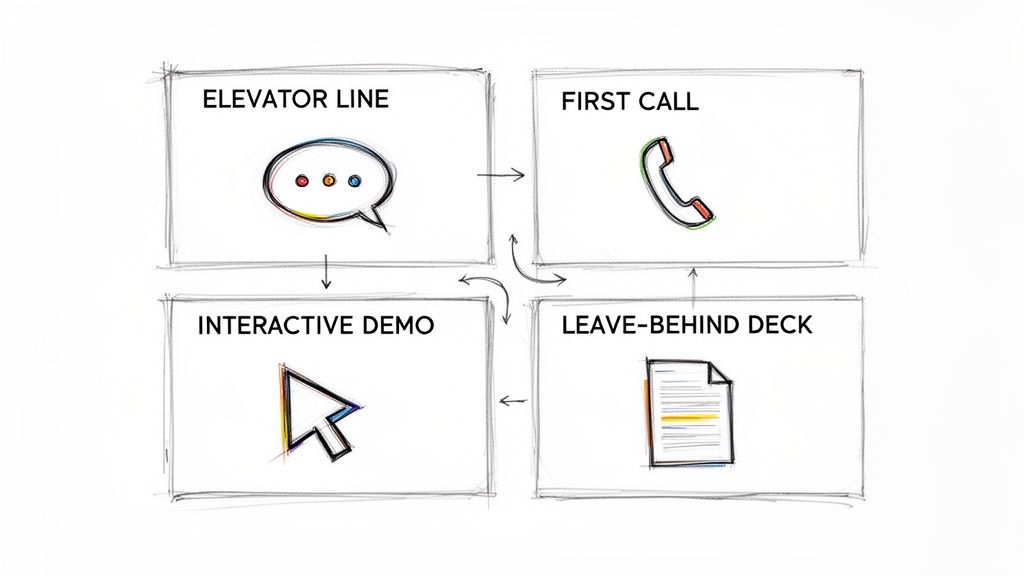
First, distill your entire narrative into a single, provocative sentence. This is the line that fits in an email preview pane or a LinkedIn message and stops a busy executive mid-scroll.
This is not a summary of what you do. It's a jab that hints at a costly problem they may not be tracking, framed from your unique Point of View. A good elevator line doesn't sell your product; it sells the next three minutes of their attention. Learning how to write a sales letter that converts readers can provide principles for crafting these compelling one-liners.
The goal of a first call is not to demo the product. It’s to validate the problem and earn the right to a deeper conversation. For this, your reps need a tight, 5-to-7-minute verbal pitch.
This mini-pitch is a diagnostic tool, not a presentation. It’s structured around insightful questions that lead the prospect to articulate their pain in their own words, perfectly aligning their problem with the one you solve best.
This is where most SaaS sales pitches fall apart. Reps default to a feature-by-feature tour, which is a surefire way to put the buyer to sleep. The purpose of the demo isn't to show features—it's to prove transformation.
Your demo script must be a direct continuation of your narrative. Every click must illustrate how your unique solution solves the prospect’s now-quantified problem. While the average demo-to-close ratio is a dismal 22-30%, I’ve seen teams push this to 60% or higher by shifting from feature tours to value-driven, interactive stories.
A demo is not a training session. It is the climax of your argument, where you make the promised future state feel tangible, achievable, and inevitable with your solution.
After the call, your pitch must keep working. This is the job of the "leave-behind" deck—a visually polished, self-explanatory version of your core narrative. It is designed to be shared internally, arming your champion to sell on your behalf to the buying committee.
This asset must stand on its own without a voiceover. It should concisely reiterate the core argument:
A well-crafted leave-behind is your most important internal salesperson. We provide a structured approach to building these critical assets in our detailed guide and sales deck template for B2B SaaS leaders.
By building out this system of assets, you move from simply knowing how to write a sales pitch to engineering a repeatable GTM machine. You equip your sales team not just with a story, but with the specific tools needed to win at every step of the deal.
Your first sales pitch is a hypothesis. The real world is where that hypothesis is validated or destroyed.
I see it constantly: founders and sales leaders pour immense energy into crafting their initial pitch, but almost none into building a system to make it better.
A static pitch is a liability. It grows disconnected from your market with every passing quarter. The companies that consistently win are those that treat their pitch not as a finished product, but as a living asset that evolves with every sales conversation.
This is how you build a go-to-market motion that gets smarter and more effective every time a prospect says "no," or "I don't get it," or "how is this different from Competitor X?"
First, stop relying on CRM notes and rep summaries. They are filtered, biased, and miss the crucial nuances of a conversation. You need a system that captures the raw, unfiltered voice of your market.
This means recording and transcribing every single sales and demo call. For any SaaS company serious about growth, this is non-negotiable.
The point isn't just to review deals. The goal is to create a searchable database of your prospects' exact language. You need to hear the hesitation in their voice when you bring up pricing, know the specific competitor they mention, and pinpoint the moment their engagement drops during a demo. These are the data points that matter.
Once you have this raw data, you need a way to make sense of it. Not all feedback is equal. A single objection might be an outlier, but a pattern is a strategic signal you cannot ignore.
I recommend grouping all feedback—every objection, question, and moment of confusion—into three buckets:
Messaging: The prospect doesn't understand your point of view, the value you're claiming, or how your solution works. You will hear phrases like, "So, you're basically just like [Competitor]?" or, "I'm still not sure how this fits in."
Product: The prospect understands the value proposition but sees a critical gap in your solution. This is feedback like, "This is great, but it doesn't integrate with Salesforce," or, "We can't move forward until you have SOC 2 compliance."
Pricing: The prospect understands the value but feels there's a mismatch with the cost. This includes objections about the pricing model (per-seat vs. usage-based), the sticker price, or the perceived ROI.
Most teams obsess over pricing and product feedback. But in my experience, 70-80% of early-stage sales friction is actually a messaging problem in disguise. The prospect objects to the price because you failed to establish the economic value in the first place.
Raw data and a sorting framework are useless without a commitment to act. You need a formal, recurring process to analyze feedback and update your core narrative. This is the Quarterly Pitch Review.
This is a mandatory meeting for the CEO, Head of Sales, Head of Marketing, and Head of Product. The agenda is simple but powerful:
Review the Patterns: The sales leader presents a summary of the most common objections and questions from the past quarter, categorized into Messaging, Product, and Pricing. This isn't a high-level summary; it must include direct quotes and call snippets.
Diagnose the Root Cause: A recurring "you're too expensive" objection is not necessarily a pricing problem. Is it a symptom of a weak Economic Value Proposition in the pitch? Is that feature request a one-off, or does it signal you are talking to the wrong customer profile? Dig deep.
Prescribe the Action: Based on the diagnosis, assign clear, concrete actions. This could be refining a slide in the sales deck, updating a competitive battle card, or prioritizing a specific integration. In more serious cases, it might trigger a complete overhaul of your positioning. If you need a starting point for these assets, our comprehensive sales playbook template can provide structure.
This closed-loop system turns every sales conversation into a micro-experiment. It ensures your pitch never drifts from market reality. This is how you stop guessing at how to write a sales pitch and start building a narrative that is constantly validated, refined, and improved by your buyers.
You have built the pitch, the deck, and the one-pagers. You have a process for iteration. But sales rarely sticks to a clean script. When your pitch meets reality, tough, practical questions always emerge.
These are the most common questions I hear from founders and revenue leaders as they implement their new pitch.
This is the wrong question. The right question is, “How long until I lose their attention?” The answer is always: not long.
Stop thinking about the clock and start thinking about insight density. Your goal isn't to dump every feature on them; it’s to earn the right to keep talking.
In a first discovery call, you must land your core message—the reframe of their problem and your unique Point of View—in under 10 minutes. You're not there to give the whole tour, just to make them believe you have a map to a place they need to go.
A full demo might run 30-45 minutes, but it cannot be a monologue. It must be a dialogue, broken up by questions and small moments of agreement. The true measure of length is not minutes; it is momentum. The second you feel engagement dip, your pitch is too long.
The most common mistake? Wasting the first five minutes on your company's origin story, funding rounds, or a logo slide. Get straight to their problem and your challenging perspective on it. Everything else is noise.
Easy. The single most damaging mistake is pitching the product’s technical elegance instead of its business impact.
Founders are, understandably, in love with what they’ve built. They’ve agonized over the architecture, the UI, the tech stack. The fatal assumption is that the buyer cares about the how nearly as much as they do.
They do not.
An economic buyer—the person who signs the check—cares about a short list of business outcomes:
Founder passion is an asset, but it must be aimed at the right target. Use it to explain the business transformation your product makes possible, not the sleepless nights you spent coding it. Ruthlessly translate your pitch from "product-speak" into "business-speak." Your genius isn't the code; it's the outcome that code delivers.
Your core story—your strategic narrative—must remain the same. This is your company's position in the market. It cannot shift from meeting to meeting. If it does, you don't have a strategy; you have ad-hoc tactics.
What must change is the emphasis. You are delivering the same core message, but through a different lens, highlighting the proof points and financial justification that matter to each specific stakeholder.
Your core story is fixed. The proof points and financial justification you highlight are variable. The mistake is creating entirely different pitches, which dilutes your positioning and confuses your own team.
Think of it this way: your sales assets should be modular. The core narrative is the chassis, but you can swap out "value modules" depending on the audience.
Your sales team shouldn't rewrite the pitch for every call. They should reconfigure pre-built, approved modules that tailor the story without breaking it.
Use AI for augmentation, not origination.
Thinking an LLM can be prompted to spit out a winning sales pitch reveals a fundamental misunderstanding of what a sales pitch is. Your company's unique point of view, its quantified value, and its differentiated approach are the core of your strategy. This comes from first-principles thinking that only a leadership team can do. It's born from understanding market nuances, competitive dynamics, and the deep psychology of your buyer.
Outsourcing that strategic work to a machine will yield a generic, derivative pitch that sounds exactly like everyone else's.
Where AI becomes powerful is in the tactical execution that follows:
Use AI for efficiency. Own the strategic thinking completely. Your core argument is your most valuable intellectual property. Do not delegate it to an algorithm.
Your sales pitch is the sharpest edge of your go-to-market strategy. Getting it right is not about finding the perfect words; it is about achieving profound clarity on your market, your value, and your differentiation. At Big Moves Marketing, we partner with B2B SaaS leaders to achieve that clarity and build the strategic messaging and sales enablement assets that drive pipeline and win deals.
If your pitch isn't performing and you’re ready to move beyond generic playbooks, let’s talk. Explore how we can help you build a GTM strategy that wins at https://www.bigmoves.marketing.
Explore Big Moves Marketing services and resources:




%20-%20white.svg)