%20png%20copy.avif)

Most B2B SaaS sales decks are built on a flawed premise. Founders treat them like static brochures—forms to be filled out with features and logos, then emailed into the void. This isn’t just a tactical error; it’s a symptom of a deep misunderstanding of a sales deck’s true function.
The 'fill-in-the-blanks' template model is a direct path to commoditizing your solution. It encourages a feature dump, forcing your sales team to talk at prospects, not engage them in a diagnostic conversation. This is how promising deals stall.
Your sales deck is not a product tour. It’s a tool for controlling the narrative in a high-stakes conversation. Yet I consistently see early-stage and even Series B companies sabotage their sales cycles with the same generic, company-centric decks. They download a template, cram it with feature screenshots, and then wonder why prospects are disengaged five minutes into the call.
The core problem is that most templates are designed to present information, not to provoke a decision. This approach is doomed because sophisticated buyers aren't short on information; they're drowning in noise. What they need is clarity and a compelling reason to abandon their status quo—which is always your most dangerous competitor.
The traditional sales deck template leads to predictable, value-destroying outcomes. It frames the sales conversation as a one-way broadcast instead of what it must be: a strategic dialogue.
This broken structure guarantees several critical errors:
This approach forces your AEs into the role of a tour guide walking prospects through a museum of features. They should be acting as physicians, diagnosing a deep-seated problem and prescribing a clear path to a healthier future. To move beyond this generic model and build an effective sales tool, you must understand the principles behind the best startup pitch deck template that actually gets investors to listen.
Your deck must be an argument, not a catalog. Its primary job is to make the status quo untenable and frame your solution as the only logical path forward. Anything less is a wasted conversation.
Ultimately, a poorly structured sales deck doesn't just lose a deal; it poisons your market positioning. It trains prospects to see you as another vendor with a list of features, forcing you into a price war. The rest of this guide is about reframing the deck’s role—from a presentation tool to a conversation guide designed to expose the high cost of your prospect's current reality.
A winning sales deck follows a narrative arc, not a feature list. Too many founders build presentations like they’re assembling IKEA furniture—following a generic manual without considering the human on the other end. The result is a deck that may be logical, but is lifeless. It moves no one to action.
The objective is not to present information. It is to create a shift in perspective.
You must architect a conversation that moves a prospect from skepticism to conviction. It's not about the number of slides; it's about the psychological journey. The entire structure is designed to destabilize their comfort with the status quo, making inaction feel riskier than change.
The fundamental flow is simple: establish the problem, paint a compelling vision of a solved future, and then offer proof that your solution is the bridge.
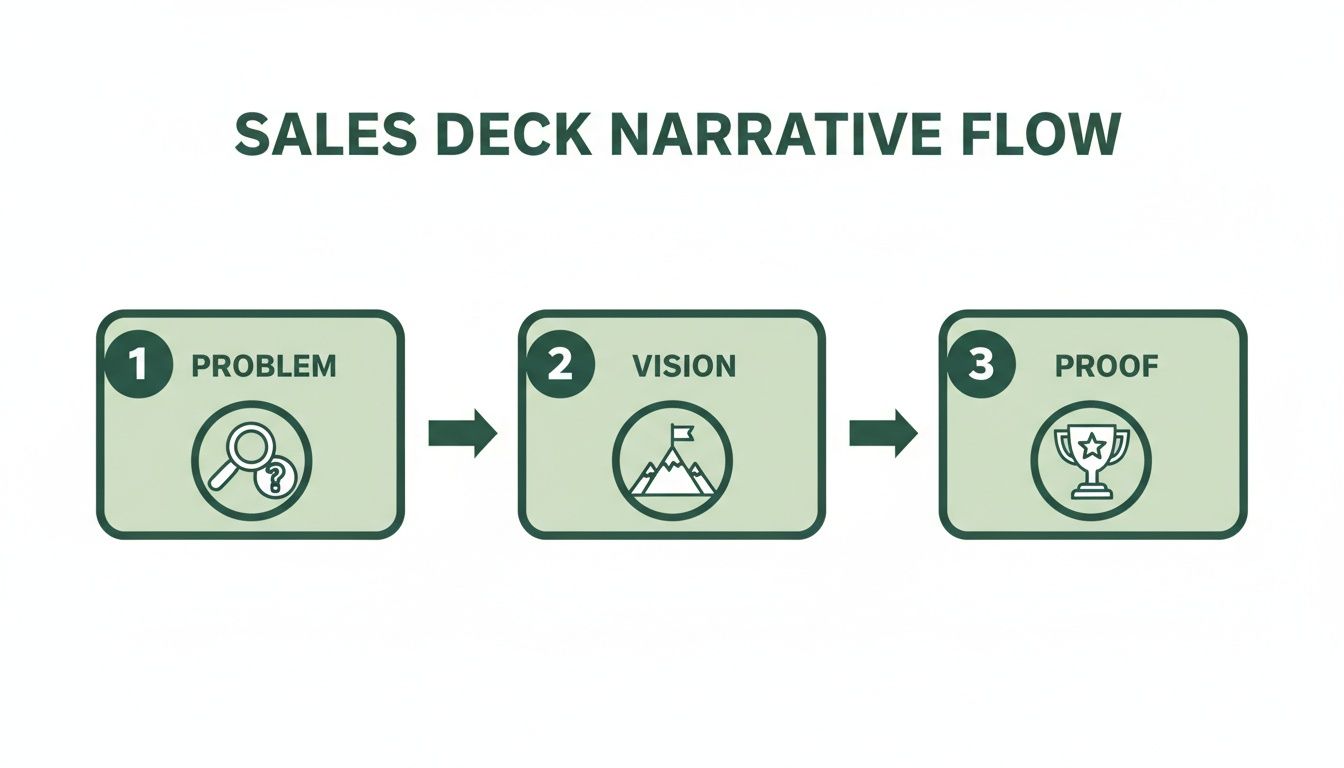
This progression—from problem to vision to proof—is the core engine of persuasion. It moves the conversation from what is to what could be.
This is the blueprint. I’ve seen it work repeatedly across B2B SaaS, from founders on their first sales calls to scaling revenue teams. It transforms your deck from a passive document into an active persuasion tool.
Here are the six slides that form the narrative backbone:
The Market Shift: Open with an undeniable truth about how the world has changed for your buyer. This is not about you. It’s a macro trend they already recognize, which earns immediate agreement.
The Reframed Problem: Connect that market shift to a specific problem it creates. The key is to frame a problem they misunderstand or underestimate. Introduce a new diagnosis they haven't considered. Your core messaging is critical here; a solid brand messaging framework template is a prerequisite for this slide.
The Cost of Inaction: Make the status quo feel untenable. Quantify the pain of the reframed problem in terms of wasted resources, missed revenue, strategic risk, or operational drag. Use credible numbers to build tension and create urgency.
The 'Promised Land' Vision: With the problem established, paint a picture of the future state your solution makes possible. This is not about features. It’s about the outcome, the new capability, the strategic advantage. Describe their world after the problem is solved.
The Mechanism: Only now do you introduce your solution. Explain how you deliver that Promised Land. This is not a feature list; it's the unique process, proprietary data, or differentiated architecture that makes the outcome a reality. Focus on the one or two things that make your approach fundamentally different.
The Proof: Back it all up with credible evidence. This means quantified results from similar customers, relevant case studies, and other signals of authority. The proof must directly support the claims made in your Mechanism and Promised Land slides.
This structure forces discipline. It prevents you from talking about your company, team, or product features too early.
A great sales deck isn’t a monologue about your solution. It’s a guided discovery of the prospect’s problem, framed in a way that makes your solution the only logical conclusion.
The difference between a generic, feature-first deck and a narrative-driven one is stark. One broadcasts information; the other orchestrates a decision.
This narrative architecture is a strategic imperative. It aligns your sales pitch with how senior leaders make decisions. They first buy into a new way of thinking about their problem, then they look for the tool to solve it. Your deck must guide that journey.
Building your sales deck is not about dropping facts onto slides. It's about constructing an argument, piece by piece, that makes your solution feel inevitable. Each slide must build on the last, creating a narrative that dismantles the prospect's status quo and replaces it with a compelling vision.
Most teams fail by treating each slide as an island of information. They show a market trend, list problems, then jump to their solution. The information is correct, but there's no connective tissue, no logical thread pulling the prospect to the next point.
Your goal is to build a case so airtight that by the time you mention your product, the prospect has already decided they need a new way of doing things.
This first slide is your entry point. It is not about you. It's an observation about the world that gets the prospect nodding in agreement.
Frame an external trend or force fundamentally changing how companies in their industry operate—a shift in buyer behavior, new regulatory pressure, or a technological disruption. The key is that it's an objective truth they already recognize.
Avoid these common mistakes:
The goal is to establish common ground. You are aligning with them on a reality they cannot dispute. This earns you the right to continue.
Once you've aligned on the market shift, connect that change directly to their bottom line. This is where you put a price tag on the pain of doing nothing.
Most decks are weak here. They list vague pains like "wasted time" or "inefficiency." This is insufficient. You must translate that pain into metrics the CFO cares about: wasted payroll, missed revenue, compliance risk, customer churn.
The objective of this slide is to make the status quo feel expensive and dangerous. If doing nothing seems like a safe option, you have lost the deal.
To execute this, build a simple ROI model. Example: "For a team of 50 sales reps spending 5 hours a week on manual reporting, that’s 1,000 hours of wasted payroll a month. At an average loaded cost of $75/hour, you're burning $75,000 every month on an activity producing zero revenue."
This slide transforms an abstract problem into a concrete business liability. It creates the tension required to drive a conversation about change.
Now that you've established the cost of their current reality, you can present the "Promised Land." This is your vision of the future state they can achieve—the new capability, the strategic advantage, the operational excellence that becomes possible.
This slide is not about your product features. It is about the outcome. It describes what their world looks like and feels like once their expensive problem is solved. Building your narrative slide-by-slide is about articulating powerful value proposition statements that connect with your audience.
Instead of saying, "Our platform offers AI-driven analytics," you describe the Promised Land: "Imagine your revenue team starting each week with a prioritized list of the exact accounts most likely to close, and the specific talking points to use for each one."
This approach creates desire before you introduce the solution. It elevates the conversation from a feature checklist to a discussion about strategic outcomes.
Only now—after establishing the stakes and painting the vision—do you introduce your mechanism. This is how you deliver the promise. This is not a feature dump. It is the one or two core differentiators—your unique process, proprietary data, or novel architecture—that make the Promised Land possible.
Explain your point of view on solving the problem. What broken model do you replace? This is where your company's positioning comes to life. If you haven't defined this, stop and read our guide on how to write a positioning statement.
For instance, instead of listing "integrations," you explain your mechanism: "We deliver this through a unified data architecture that fuses your CRM, marketing automation, and product analytics into a single cohesive customer view, eliminating data silos."
This slide explains why your solution is fundamentally different. It frames your product not as a collection of features, but as a system designed to deliver a specific result.
The generic logo slide is dead.
Senior leaders have seen thousands of them. A wall of logos signals only that you have customers—the bare minimum for any post-PMF company. It is not impressive; it is expected.
Real credibility isn't broadcasting who you've worked with. It’s methodically de-risking the decision for the specific person in the room. You must provide quantified, relevant evidence that makes choosing your solution feel intelligent and validated. This requires a more surgical approach than a logo dump.
The evidence that convinces a CFO is different from what persuades a Head of Engineering. A one-size-fits-all approach to proof is lazy. Segment your credibility points to align with the motivations and anxieties of each key stakeholder.
For the CFO or CRO: They care about financial impact. Your proof must speak their language: Total Cost of Ownership (TCO), Return on Investment (ROI), revenue uplift, or reductions in customer acquisition cost (CAC).
For the Head of Engineering or Product: This buyer focuses on execution risk. Their fears revolve around integration, reliability, and security. Resonant proof points include uptime statistics, API success rates, time-to-implement metrics, and case studies about seamless integration.
For the End User (e.g., a Sales Manager): This persona needs proof of usability and adoption. Their world is workflow efficiency. The best evidence includes time saved per user per week, increased team productivity, or testimonials about ease of use.
"We increased ROI" is meaningless. "We helped a similar-sized company in your vertical reduce their average sales cycle from 90 to 62 days, unlocking an additional quarter of revenue" is an argument. Be specific and quantified.
To do this, go beyond collecting logos. Build a library of quantified success stories. Focus on depth over breadth. Digging deep to find and articulate these results is the work of building a powerful sales narrative. Our guide on how to influence B2B buyers with impactful case studies provides a framework for this process.
Leading SaaS companies layer different signals to create a statement of authority. This goes beyond customer logos.
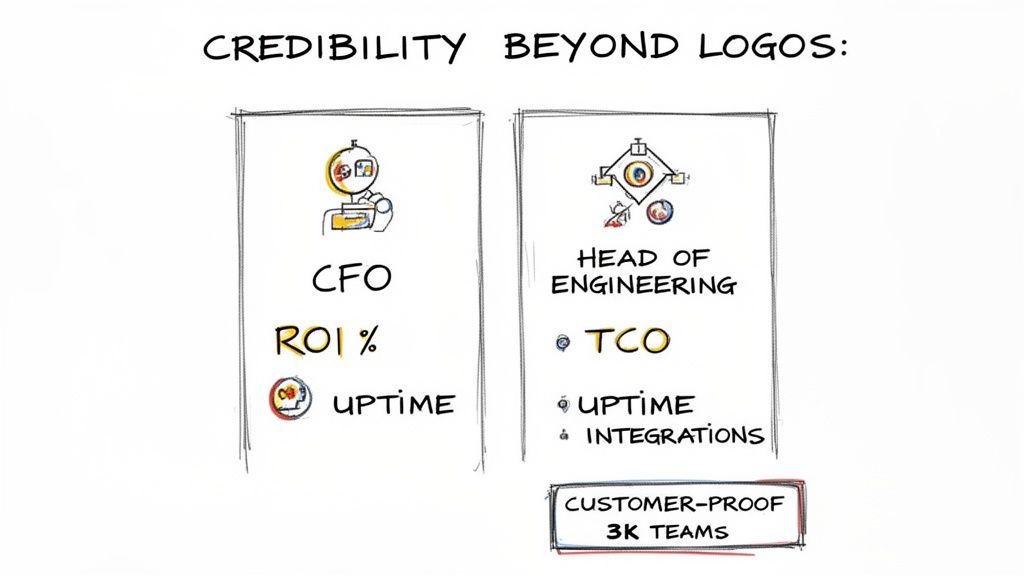
This single visual communicates multiple layers of trust. It combines high-profile brands with hard data ("millions of businesses") and the implicit backing of sophisticated technology companies. This is not just a list; it is a powerful statement about market leadership.
It makes the decision to choose them feel like joining the winning team, not taking a risk on an unknown vendor. Your sales deck must communicate this same level of trust.
Most sales decks are rigid, one-size-fits-all documents. Founders craft a "master" deck, only to find it breaks down in real conversations.
What happens next is predictable. Reps either stick to the script, sounding tone-deaf, or they go rogue—deleting slides, adding unapproved stats, and shattering the core narrative.
This is a design problem, not a discipline problem. A monolithic deck creates a false choice between message consistency and conversational relevance.
The solution is to stop thinking of your sales deck as a single file. Treat it as a modular system designed for controlled customization. This gives your sales team the power to tailor conversations to specific buyers without diluting your core message.
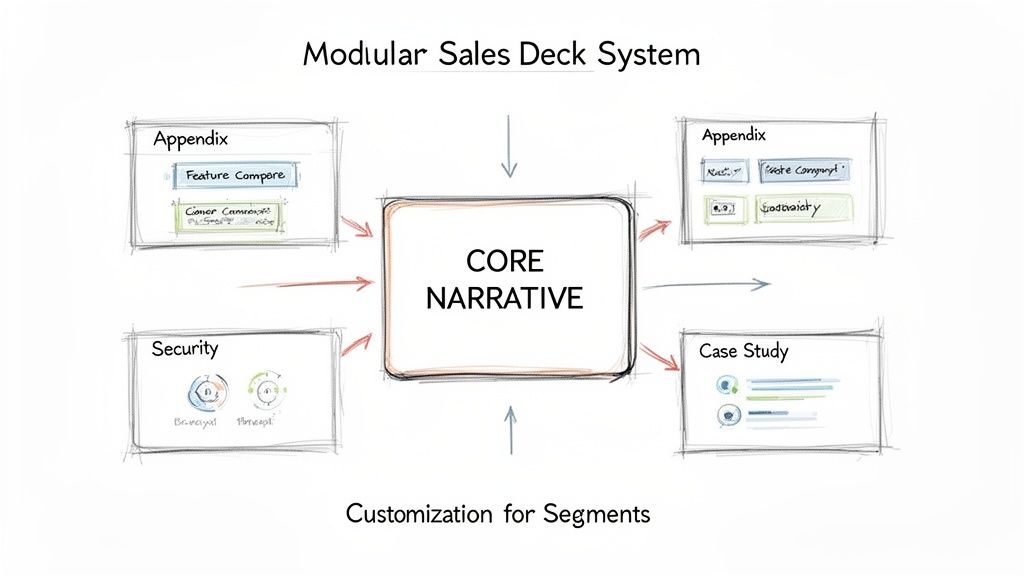
The system's foundation is the separation of your non-negotiable story from situational proof points. This gives reps a narrative spine and a library of approved components.
The Core Narrative: This is a set of 10-12 slides that lay out your strategic argument. It covers the Market Shift, Reframed Problem, Promised Land, Mechanism, and essential proof. These slides are mandatory and presented in order.
Appendix Modules: This is a curated library of optional slides reps can add as needed. These modules handle specific questions, personas, or objections. Examples include deep-dive feature comparisons, security specs, persona-specific case studies, or technical architecture diagrams.
This modular design allows personalization while maintaining message discipline. A rep preparing for a call with a CISO can slot in the security module without derailing the main story. This structure is a central component of an effective GTM motion, detailed in our sales playbook template.
With a modular system, the design must prioritize clarity over cleverness. The goal is not a visually stunning document; it is an effective communication tool.
Focus your design on three principles:
Strict Visual Hierarchy: Every slide needs one clear focal point. Use size, color, and placement to guide the prospect's eye. Avoid cramming slides with competing ideas.
Strategic Data Visualization: Never just paste a chart from your BI tool. Translate complex data into a clear business insight. Use simplified graphs and bold callouts to tell the story behind the numbers.
A Clean, Unforgiving Template: Your master template enforces consistency. Lock down fonts, colors, and layouts. The design should be professional but spartan, making your message the hero.
Your sales deck is an instrument for conveying strategic clarity. If the design distracts from the message, it has failed, no matter how beautiful it looks. A simple deck with a powerful argument will always outperform a gorgeous deck that says nothing.
Data supports this. Customized sales content can increase reading time by 41%. Top-performing sales teams achieve 2.7 times more conversions by delivering value-focused, tailored first meetings. Explore more findings on value-focused sales decks at Dock.us.
Building a flexible sales deck system is a strategic investment in sales enablement. It gives your team the structure to stay on-message and the flexibility to win deals.
Even with a strong narrative, founders and sales leaders get hung up on execution details. Here are the most common questions I get from teams overhauling their sales decks.
This is the wrong question. It frames the deck as a document to be "finished."
A better question: "How concise can we make our core argument?"
Your main narrative deck—the one you present live—should be 10 to 15 slides, maximum. This forces ruthless messaging discipline. The goal is to build a logical case, not to cram information.
Extra details—technical deep dives, feature lists—belong in an appendix, not the primary flow.
Almost never before the first call. Sending your deck ahead of time cedes control of the narrative. The deck is a visual aid for a conversation you lead, not a replacement for it.
Prospects will skip to the pricing slide, misinterpret key points, and make snap judgments without context.
Instead, send it as a follow-up, tailored with specific slides discussed during the meeting. This reinforces your message and gives your internal champion the material they need to sell on your behalf.
Your core story—the reframed problem, the new vision, your mechanism—should not change. If you find yourself changing your fundamental argument for each persona, your positioning is weak.
Adaptation happens in the proof points and the appendix slides.
When talking to a CFO, you spend more time on ROI and TCO slides. For a Head of Engineering, you might pull in slides from your appendix covering security and implementation.
The story remains constant; the evidence is tailored to the audience. This maintains narrative strength while addressing specific concerns. Be prepared for pushback, which requires a solid grasp of how to handle sales objections from different departments.
The single biggest mistake when presenting is talking about your product before the prospect agrees they have a problem worth solving. If you haven't earned agreement on the problem, you have not earned the right to pitch your solution.
This is the golden rule. Breaking it is why deals stall. The first third of your conversation must be about diagnosing their pain and quantifying its cost. Only after they verbally agree the problem is severe should you transition to your vision and solution.
At Big Moves Marketing, we help B2B SaaS founders build the strategic narrative that powers their entire go-to-market motion, starting with a sales deck that drives pipeline. If you need to move beyond generic templates and create a sales engine built on clarity, let's connect. Learn more at bigmoves.marketing.
Explore Big Moves Marketing services and resources:





%20-%20white.svg)