%20png%20copy.avif)
In the world of B2B technology, 'differentiation' is more than a slide in your pitch deck; it's the core of your survival. Simply adding more features or undercutting prices is a race to the bottom, a surefire way to become another forgotten name in a saturated market. True market leaders create separation through deliberate, strategic choices in their product, their pricing, their go-to-market motion, and the very fabric of the customer experience they deliver. They don't just compete; they redefine the terms of engagement.
This article moves past generic advice and dives deep into 10 specific, actionable differentiation strategy examples from innovative companies that have successfully carved out a defensible space. We're not just telling you what they did. We are breaking down the tactical execution, the "why it worked" analysis, and the measurable outcomes that followed. You will get a clear blueprint to build your own defensible position and win the hearts and minds of your ideal B2B customers.
This isn't just theory; it's a practical guide built for founders, product marketers, and GTM leaders who need to create real separation and drive meaningful growth. Forget the buzzwords. It's time to explore replicable strategies that will make your B2B brand impossible to ignore. From Product-Led Growth and niche domination to innovative pricing models and ecosystem plays, you will find tangible methods to set your company apart and build a lasting advantage.
Instead of leading with a sales pitch, Product-Led Growth (PLG) makes your product the primary engine for acquisition, conversion, and expansion. This go-to-market motion lets business users experience your product’s value firsthand through a freemium plan, a free trial, or an open-source model. It’s a powerful differentiation strategy because it replaces telling with showing, building trust and demonstrating value before asking for a purchase order.
Companies like Slack, Notion, and Figma built empires on this model. They created generous free tiers that solved real problems for individual business users. As those users shared the product with colleagues, adoption spread organically within organizations. This created a groundswell of support that sales teams could then engage for larger, enterprise-wide deals. The product effectively sold itself.
The core of PLG differentiation lies in lowering the barrier to entry. By eliminating sales friction and letting the product prove its own worth, you create a powerful, self-perpetuating growth loop. This approach fundamentally alters your product positioning by making user experience the central focus of your entire business.
Key Insight: PLG turns your product into your most effective salesperson. Every feature, onboarding tooltip, and upgrade prompt is a chance to guide a user from initial discovery to becoming a paying customer and, eventually, a vocal advocate.
Rather than building a one-size-fits-all solution, vertical-specific positioning involves tailoring your entire business to serve a single, focused industry. This strategy allows you to go incredibly deep on a niche's unique workflows, compliance needs, and language. By becoming the undisputed expert for a specific market, you build a powerful moat that horizontal, generalist providers simply cannot cross.
Companies like Veeva (pharma CRM) and Toast (restaurant management) are masters of this approach. They didn't just add a few features for their industries; they rebuilt the entire product and go-to-market motion around them. This creates immense customer loyalty and high switching costs because their solutions are deeply embedded in their customers’ core operations. This is a prime example of a differentiation strategy that turns focus into an overwhelming advantage.
The power of vertical positioning comes from transforming your business into an indispensable partner rather than just another software vendor. By concentrating all your resources—product development, marketing, and sales—on a single niche, you develop profound domain expertise. This allows you to solve industry-specific problems so effectively that customers see your solution as the only viable choice. This deep focus is a critical first step in defining your ideal customer profile.
Key Insight: Vertical specialization turns your narrow focus into your greatest strength. You're no longer competing on features alone; you're competing on a deep, almost-native understanding of your customer's world.
Embedding proprietary AI or automation directly into your product creates a powerful, defensible advantage that others struggle to replicate. This strategy moves beyond generic features by using custom machine learning models, intelligent automation, or predictive analytics to deliver measurable efficiency gains. It’s a compelling way to differentiate because it transforms your product from a passive tool into an active, intelligent partner that drives tangible business outcomes.
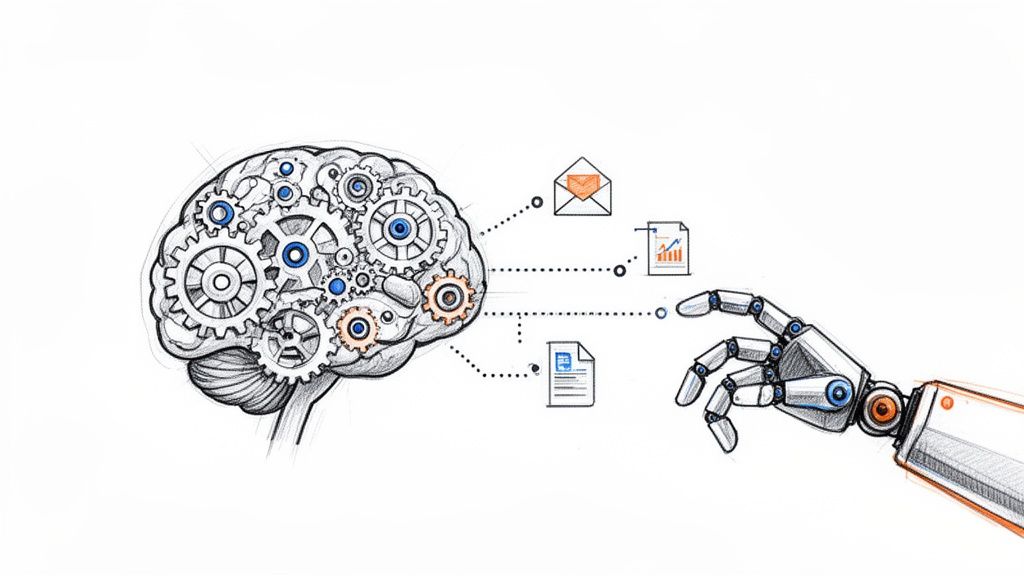
Companies like Gong.io and Jasper are masters of this approach. Gong uses AI to analyze sales conversations, providing teams with data-backed insights to close more deals. Jasper built an entire platform on AI-powered copywriting, enabling marketing teams to generate high-quality content at scale. They don't just sell software; they sell an automated outcome, justifying premium pricing and creating deep customer dependency.
The essence of AI-led differentiation is solving complex problems that were previously manual, time-consuming, or impossible. By training models on unique, proprietary data, you create an intelligent engine that gets smarter with every use. This approach positions your product not just as a better workflow, but as a fundamentally new and more effective way of working.
Key Insight: True AI differentiation isn't about adding "AI" as a buzzword. It's about targeting a specific, high-value business process and making it dramatically faster, smarter, or more cost-effective through intelligent automation.
While others chase feature parity, a superior customer experience (CX) design carves out a defensible market position by making your product dramatically easier and more enjoyable to use. This strategy goes beyond a slick interface; it’s an obsessive focus on every touchpoint, from the first click in onboarding to the resolution of a support ticket. It differentiates by reducing friction and creating genuine user delight.
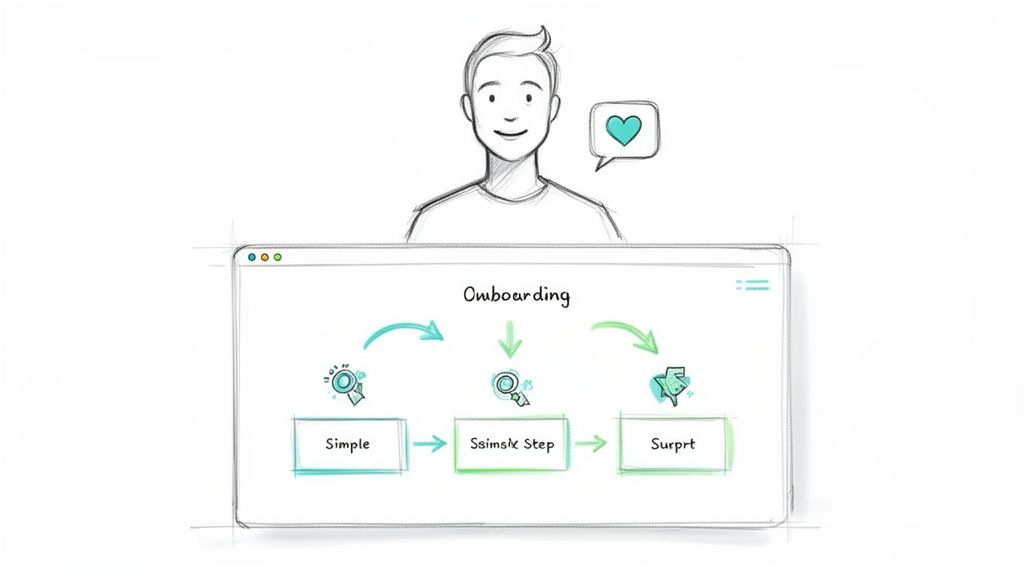
Companies like Stripe and Calendly exemplify this approach. Stripe won over developers not just with powerful APIs but with elegant documentation and a frictionless setup process. Calendly simplified the universal annoyance of scheduling meetings into a few intuitive clicks. They proved that a seamless experience is a powerful feature in itself, one that business users will actively seek out and advocate for.
The essence of CX differentiation is treating user-friendliness as a primary business objective, not an afterthought. It shifts the focus from "what" your product does to "how" it feels to use it. This strategy directly impacts customer loyalty and retention because a positive experience builds an emotional connection that feature lists alone cannot replicate. It’s a commitment to empathy-driven design.
Key Insight: A delightful user experience turns customers into evangelists. When your product is intuitive and solves problems without frustration, users don't just stay, they actively recruit others on your behalf.
Instead of being just another tool, this strategy positions your product as the essential hub that connects your customer’s entire tech stack. It's about becoming indispensable by building deep, meaningful integrations with the other applications your buyers rely on every day. This approach transforms your product from an isolated solution into a central platform that amplifies the value of their entire ecosystem.
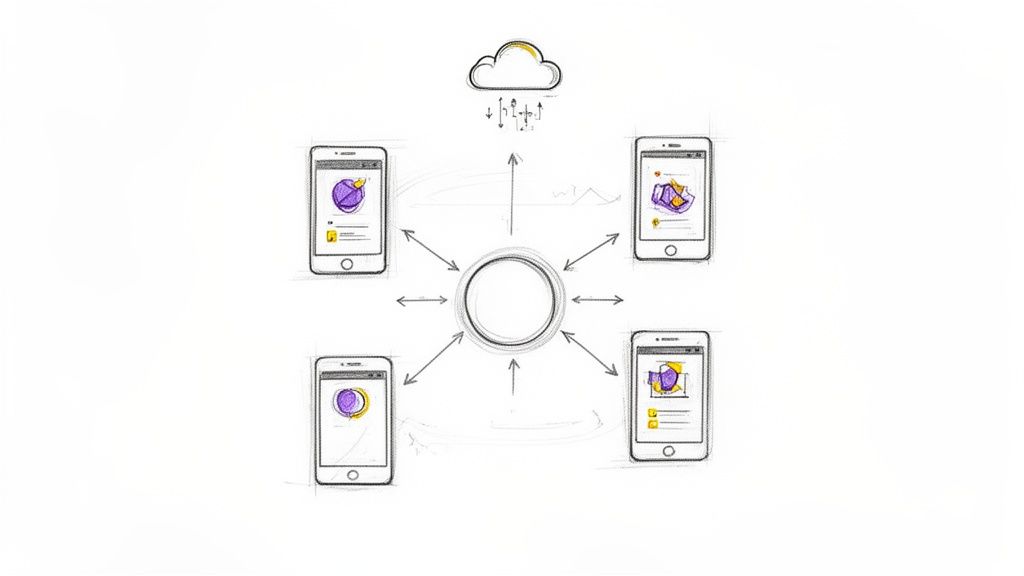
Companies like Zapier, HubSpot, and Slack have mastered this. Zapier built its entire business on connecting over 6,000 apps, while HubSpot became the core of the modern marketing and sales stack by integrating with everything from CRMs to ad platforms. This strategy creates powerful network effects; the more tools your product connects with, the more valuable it becomes to every user, creating significant switching costs.
The power of ecosystem positioning comes from solving cross-system problems. You’re not just offering a feature; you’re offering a seamless workflow that eliminates data silos and manual work. This fundamentally differentiates your business by making your product the connective tissue that holds your customer's operations together, a key element in many B2B channel marketing strategies.
Key Insight: Deep integration turns your product into a "system of record" for a specific workflow or data set. When other tools feed into your platform, your product’s gravity increases, pulling in more users and making it incredibly difficult to replace.
Instead of competing on features alone, Price/Value Model Innovation differentiates your business by fundamentally rethinking how customers pay. This strategy aligns your revenue model directly with the value your customers receive, creating a more intuitive and fair exchange. This could mean usage-based pricing, outcome-based pricing, or a transparent, simplified tier system that cuts through the confusing packages offered by others.
Companies like Stripe and Twilio pioneered this approach in the B2B space. They rejected complex enterprise contracts and instead offered simple, pay-as-you-go pricing for their API services. This allowed a solo developer to get started for pennies and a large enterprise to scale its usage predictably. Their pricing wasn't just a number; it was a core part of their product experience, built on transparency and alignment with customer growth.
The power of this differentiation strategy lies in reducing customer risk and increasing transparency. When your pricing scales directly with a customer's success or usage, the purchasing decision becomes much easier. It reframes the conversation from "How much does this cost?" to "How much value will I get?" This approach builds immense trust and can become a formidable moat, as customers grow accustomed to the fairness and predictability of your model.
Key Insight: Innovative pricing isn't about being the cheapest; it's about being the clearest and most aligned with your customer's definition of value. Your pricing model becomes a statement about your company's philosophy.
In industries where data is the most valuable and vulnerable asset, trust isn't a feature; it's the entire foundation. This differentiation strategy positions your product as the safest, most compliant choice for heavily regulated sectors like healthcare, finance, and government. Instead of leading with bells and whistles, you lead with the promise of impenetrable security and certified adherence to standards like HIPAA, SOC 2, or GDPR.
Companies like Box and Okta built their brands on this principle. Box didn't just sell cloud storage; it sold secure, FedRAMP-authorized content management that the U.S. government could trust. Similarly, Okta provides identity management built around a security-first ethos, giving enterprises the confidence to manage access across complex environments. This approach turns a potential deal-breaker into your core value proposition.
Compliance and security-first positioning builds a powerful business moat. Achieving certifications like SOC 2 or FedRAMP is an expensive, time-consuming process that creates a high barrier to entry for others. It shifts the conversation from "Which product has the best features?" to "Which product will protect us from catastrophic fines and data breaches?" For buyers in these markets, the peace of mind you offer is worth a significant premium.
Key Insight: This strategy transforms compliance from a burdensome cost center into a powerful marketing and sales asset. It reassures risk-averse buyers that you have engineered your product from the ground up to meet their specific regulatory and security needs.
Instead of selling directly to end-users, this strategy turns your product into a powerful, invisible engine that other businesses can rebrand, embed, and resell. By offering a white-label or embedded solution, you differentiate by becoming the underlying infrastructure for countless other companies. This shifts your position from a single tool to a platform, enabling massive market expansion through partner networks.
Companies like Stripe and Twilio are titans of this model. You rarely "buy" Stripe directly, yet it powers payments for millions of businesses, from startups to global platforms like Shopify. Twilio provides the communication APIs that developers at companies like Uber and Airbnb use to build SMS notifications and voice calls into their own applications. They sell the core functionality, allowing partners to own the customer relationship and brand experience.
The core of this differentiation strategy is creating a B2B2C or B2B2B motion. You build the technology once and empower an army of partners to take it to market. This approach positions your product as a fundamental utility, making it deeply integrated into your partners' operations and creating incredibly high switching costs. Success requires a shift in mindset from building a customer-facing app to creating robust, well-documented APIs and infrastructure.
Key Insight: A white-label or embedded model transforms your addressable market. Instead of going after individual customers, you aim to become the foundational technology for an entire ecosystem of businesses.
This strategy moves beyond the product itself to build an ecosystem around it. By fostering a vibrant community of users, developers, or partners, you create powerful network effects. The product becomes more valuable as more people join, creating a self-reinforcing loop that builds a deep, defensible moat and high switching costs.
Companies like GitLab and HashiCorp exemplify this approach. They built their foundations on powerful open-source projects, attracting a global community of developers who contributed code, created plugins, and evangelized the tools. This community became their most potent marketing engine and a rich source of product innovation. As adoption grew, the value of the network—knowledge, integrations, and talent pool—made it the default choice for enterprises.
The essence of this strategy is transforming your product from a standalone tool into a central hub. Every new community member adds value for all existing members, whether through shared knowledge, new integrations, or peer support. This creates a powerful flywheel where growth begets more growth, making it incredibly difficult for others to replicate the ecosystem you've built.
Key Insight: A strong community is a living asset. It generates content, provides support, and drives innovation at a scale that no internal team ever could, turning your product into an industry standard.
Instead of just selling software, this strategy involves bundling your product with expert consulting, implementation, or managed services that guarantee specific business outcomes. You’re not just providing a tool; you're delivering a complete solution and a strategic partnership. This approach shifts the value proposition from features and functions to tangible results like increased revenue, cost savings, or efficiency gains.
Companies like Salesforce built their enterprise dominance on this model, offering extensive consulting and implementation services to ensure large-scale customers achieved their transformation goals. Similarly, HubSpot offers professional services to help clients correctly implement the inbound methodology, ensuring the software delivers on its promise. This model builds deep, consultative relationships and makes your solution incredibly sticky.
The core of this differentiation strategy is de-risking the purchase for the customer. By guaranteeing an outcome, you align your success directly with theirs, transforming a transactional sale into a long-term partnership. This fundamentally repositions your offering from a software expense to a strategic investment in the customer's growth, justifying a premium price point and creating high switching costs.
Key Insight: When you sell outcomes, not just software, your team becomes an indispensable extension of the customer’s team. Your success is measured by their ROI, which fosters immense loyalty and turns customers into powerful case studies.
We’ve reviewed ten distinct and powerful differentiation strategy examples, from Notion’s community-driven growth to Superhuman's relentless focus on customer experience. Each case study reveals a fundamental truth: genuine differentiation is never an accident. It's a deliberate, disciplined choice to be exceptional in a specific way for a specific B2B audience.
The path to standing out isn't about being different for the sake of it. It’s about creating a profound, meaningful gap between you and every other option your ideal customer might consider. The examples of vertical-specific players like Veeva and deep ecosystem integrators like Zapier prove that winning isn't always about having the most features; it’s about having the right features and a business model that perfectly aligns with your customer’s world.
Seeing these examples is inspiring, but inspiration without execution is just a nice idea. The real work begins now, translating these concepts into a tangible plan for your own business. The key is to move from passive observation to active analysis and implementation.
Your differentiation strategy must be more than a slogan on your homepage. It must be the guiding principle that informs your product roadmap, your hiring decisions, your pricing structure, and every single customer interaction. It is the North Star that keeps your entire organization aligned and moving in the same direction.
Here’s a simple framework to get started:
Conduct an Internal Strengths Audit: What is your team uniquely good at? Is it engineering prowess, deep domain expertise in a niche industry, exceptional design talent, or a gift for building communities? Your most defensible differentiator often emerges from your inherent, hard-to-copy strengths.
Identify Market Gaps and Customer Pains: Where are your business opponents falling short? Look beyond feature checklists. Are they failing on customer support? Is their pricing model confusing and punitive? Is their product difficult to integrate? Customer complaints about your rivals are a goldmine of differentiation opportunities.
Select a Primary Axis of Differentiation: You cannot be the best at everything. Choose one primary area from our list to dominate. Will you win on Product-Led Growth and user experience, or will you plant your flag as the most secure, Compliance-First solution? Make a clear, committed choice.
Weave It into Your DNA: Once you’ve chosen your path, embed it everywhere. If you’re differentiating on superior customer experience, your support team must be empowered and well-resourced. If you’re targeting a specific vertical, your marketing content must speak their language with absolute fluency.
Choosing to build a differentiated B2B company is a commitment to creating real value. It’s a decision to reject the comfortable middle ground where countless undifferentiated products compete solely on price and slowly fade away. The differentiation strategy examples we've explored show that a focused approach doesn’t just help you win deals; it helps you build a more resilient, profitable, and impactful business.
This clarity attracts the right customers, the ones who see the unique value you offer and are willing to pay for it. It attracts the right talent, people who are excited to work on a product with a clear purpose and vision. Most importantly, it gives you a story to tell—a story that cuts through the noise and resonates deeply with the people you aim to serve. Your journey to market leadership starts with this single, powerful choice.
Defining your unique position and translating that product potential into market traction can be challenging. If you’re building a B2B SaaS or AI startup and need help creating a winning differentiation strategy, that's what we do at Big Moves Marketing. We partner with founders to build the messaging, positioning, and sales tools that win deals.
Explore Big Moves Marketing services and resources:


%20-%20white.svg)