%20png%20copy.avif)
B2B messaging is the clear, repeatable way your company explains who you help, what problem you solve, why your approach is different, and what proof makes that believable. It shows up on your homepage, in sales decks, inside demos, across outbound emails, and in the language your team uses when a prospect asks, “Why should I care?” When that message is weak, buyers hear feature lists. When it is strong, they understand the business change you create.

It helps to separate three ideas that often get blurred together. Positioning is the market choice: where you fit, who you compete against, and why you win. Messaging is the expression of that choice in words buyers can understand. Brand messaging sits one level broader: it carries your voice, point of view, and company story across every audience, not just one product or campaign.
Teams do not adopt a framework for the sake of using one. They need one because the same product is being described five different ways by the founder, sales lead, homepage, deck, and customer success team. I usually see the need show up in one of four moments: founder-led sales starts to break because every pitch sounds different, the homepage gets traffic but visitors still do not “get it,” persona-specific decks start multiplying without a shared message spine, or a SaaS launch needs a sharper story than “we built an AI platform for X.”
The pressure on messaging is real. Recent B2B benchmark research found that 77% of buyers described their last purchase as complex or difficult, buying groups commonly include 6 to 10 stakeholders, and buyers spend only 17% of their evaluation time meeting with suppliers while much of the journey happens digitally first, according to The Starr Conspiracy benchmarks. Another benchmark found 67% of B2B buyers could not clearly distinguish among brands in their consideration set, while persona-specific messaging produced 4.2x higher recall in the same research, reported by The Starr Conspiracy brand messaging study.
That is why a messaging framework matters: it gives your team a structure for making your value easy to grasp and hard to confuse with a competitor. The eight frameworks below are not interchangeable. Some are best for early-stage SaaS clarity, some for multi-persona alignment, some for enterprise discovery, and some for shaping content across a longer buying journey.
I did not pick these frameworks because they are famous. I picked them because they hold up in actual B2B use: longer sales cycles, more than one stakeholder, messy internal alignment, and channels that have to work together from homepage to demo to outbound. In our review, the strongest frameworks were the ones a team could use across a homepage, sales deck, discovery call, and nurture content without rewriting the story from scratch every time.
My criteria were straightforward: relevance to B2B and SaaS buying behavior, usability across marketing and sales assets, the amount of proof needed to make the message credible, and how well each framework adapts across industries. I also favored frameworks that help technical founders explain outcomes instead of architecture. A good model should survive contact with a skeptical buyer, not just look smart in a workshop.
A framework would have been excluded if it depended on consumer psychology more than business buying dynamics, if it only worked for ad copy and not for sales conversations, or if it encouraged vague brand language without forcing evidence. I also discounted frameworks that sound elegant but collapse when a company has multiple personas, multiple products, or a serious enterprise motion.
My practical takeaway: early-stage SaaS teams usually need simplicity first, while later-stage B2B teams need consistency and proof management. That is why this list mixes narrative frameworks, research frameworks, and sales-conversation frameworks instead of pretending one model can solve every messaging problem.
Donald Miller's StoryBrand framework is a revelation for B2B marketers who struggle to explain what they do. It shifts the focus from your company and its features to the customer and their journey. This narrative approach simplifies complex solutions by casting the customer as the hero of their own story, battling a villain (their business problem). Your company isn't the hero; you are the wise guide who gives them the plan and tools they need to win.
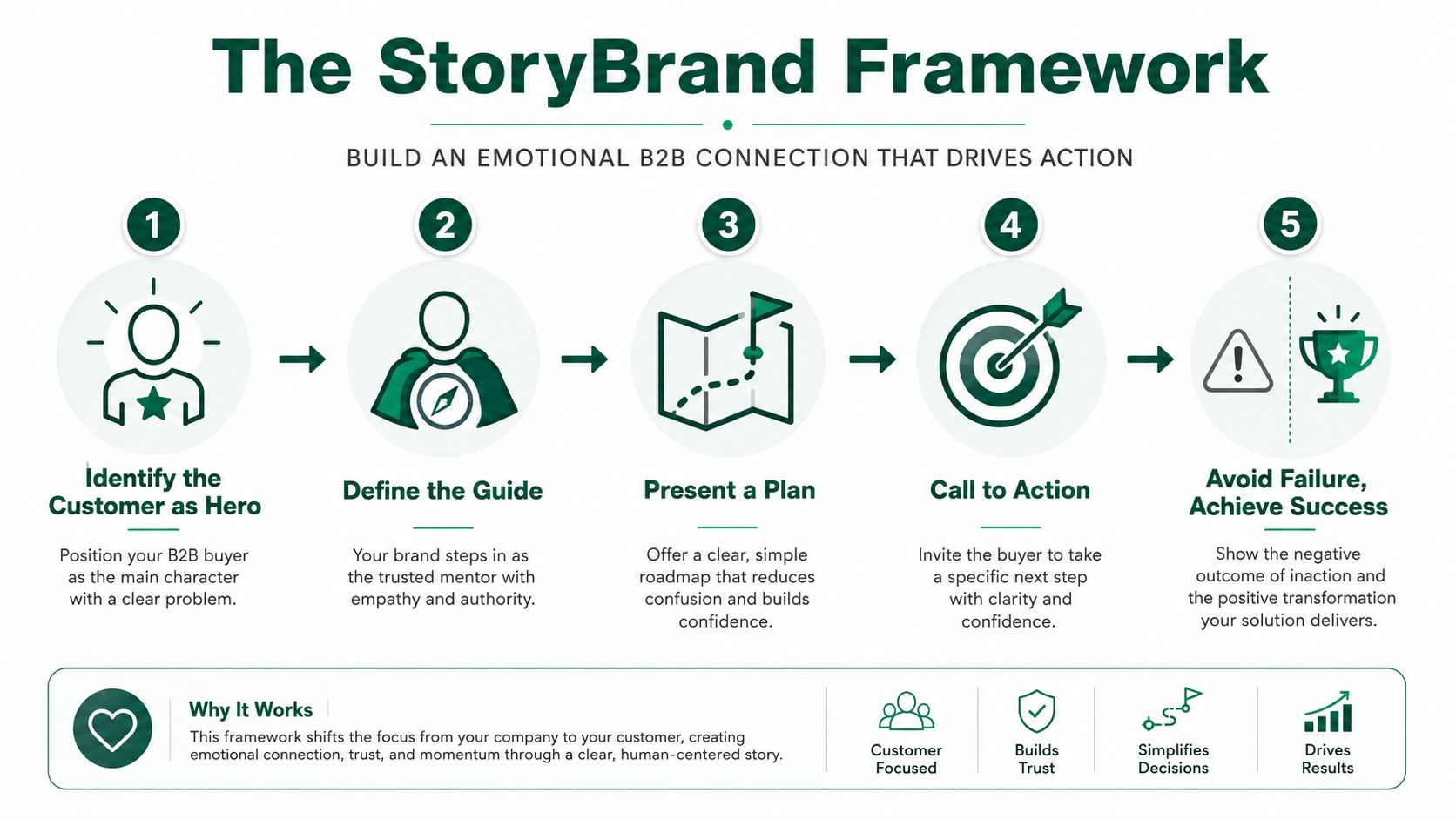
Donald Miller's StoryBrand Framework - Applied to B2B companies
Let's imagine a fictional AI-powered CPQ (Configure, Price, Quote) tool called QuoteSphere AI.
When to Use It: StoryBrand is one of the most powerful messaging framework examples for B2B companies with a complex or intangible product. If you find yourself explaining what your software does instead of what problem it solves, this framework is your solution. It’s perfect for clarifying your message on websites, in pitch decks, and across marketing campaigns.
How to Adapt It:
While narrative frameworks excel at emotional connection, the Messaging Matrix brings discipline and consistency to complex B2B organizations. This framework is a strategic grid that organizes your core messages, value propositions, and proof points by audience segment, product, and buyer persona. It’s the single source of truth that ensures your sales team, partner marketers, and content creators are all speaking the same language.
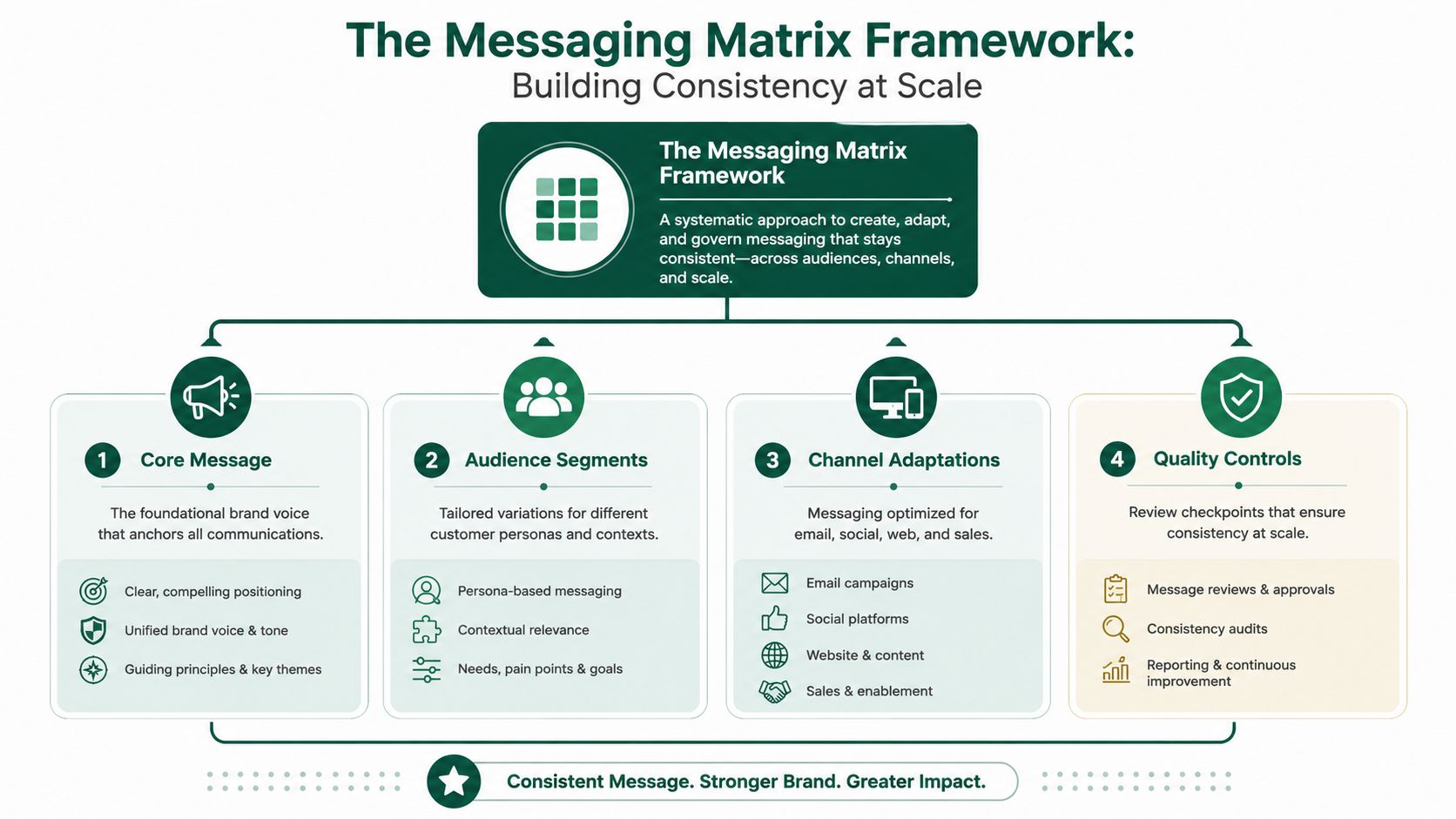
B2B Messaging Matrix Framework
For B2B SaaS companies with multiple products or diverse customer bases, this is the key to clarity. It prevents message fragmentation and ensures that the VP of Finance in the enterprise segment hears a different, more relevant value proposition than the Head of HR in a mid-market company, even when they are talking about the same core platform.
A messaging matrix is typically a spreadsheet or document with columns and rows that map messages to specific contexts.
Let's imagine a fictional data analytics platform called NexusFlow Analytics that serves both technical data scientists and business-focused marketing leaders.
When to Use It: The Messaging Matrix is one of the most essential messaging framework examples for companies hitting a growth inflection point. Use it when you are scaling your team, entering new markets, or launching multiple products. It’s a foundational tool for maintaining brand integrity and message discipline across all channels.
How to Adapt It:
The Jobs to Be Done (JTBD) framework, rooted in Clayton Christensen's innovation theory, is a profound shift in marketing perspective. It posits that customers don't buy products; they "hire" them to do a specific "job." This job is the progress they are trying to make in a given circumstance, encompassing functional, social, and emotional dimensions. For B2B companies, this means you stop selling software and start selling a better way of working.
Instead of focusing on features, JTBD forces you to uncover the deep-seated motivations behind a purchase. It moves beyond personas to understand the causality of why a buyer chooses one solution over another, or even over doing nothing at all. For a SaaS business, this unlocks messaging that speaks directly to a prospect's core struggle and desired outcome.
Genially has a editable Jobs to Be Done template but you can create or find many variations of the JTBD framework applied as a messaging model online.
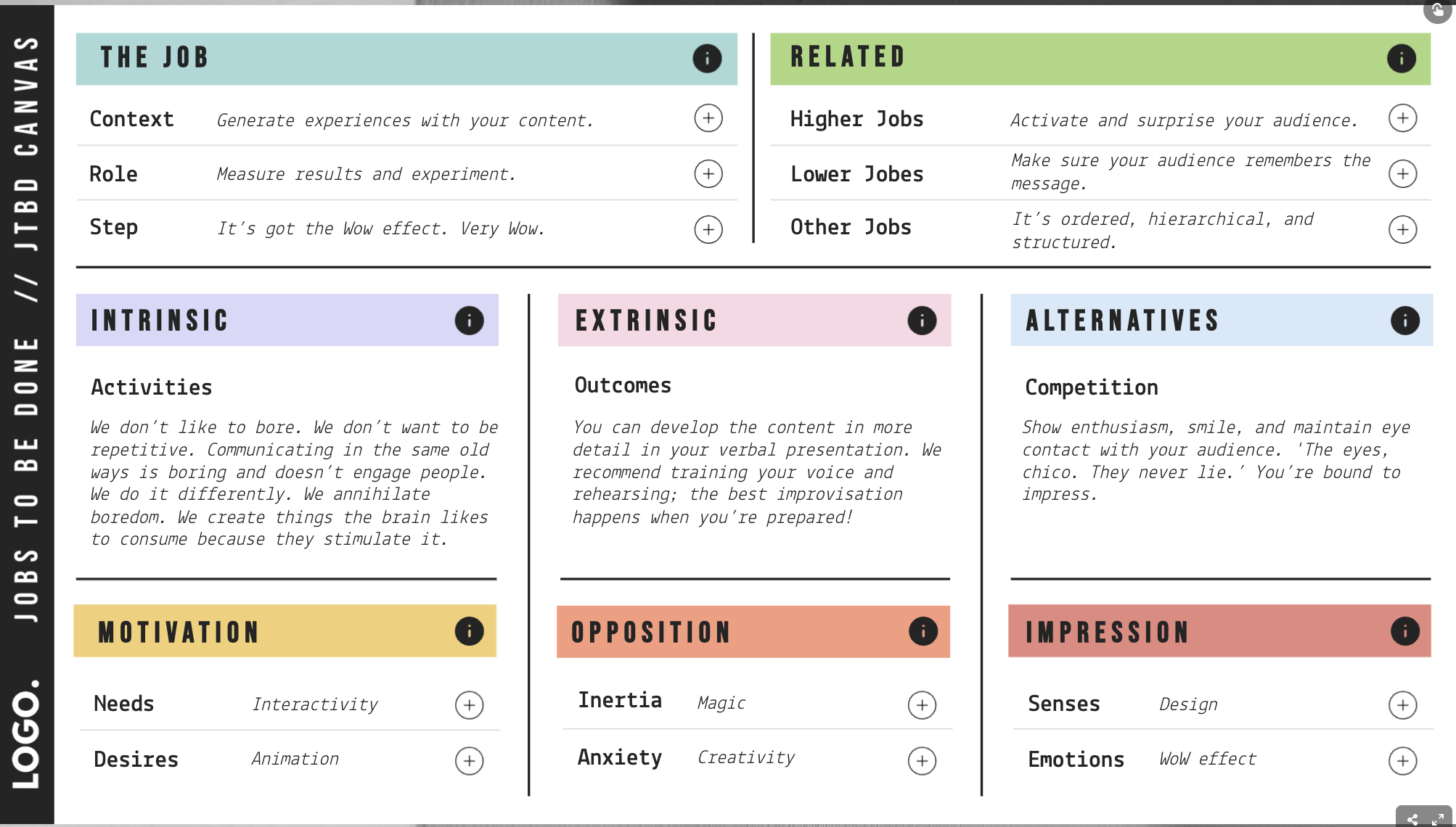
Genially's editable Jobs to Be Done template
A common way to articulate the "job" is through a "Job Story," which provides context and motivation, unlike a typical user story.
Let's imagine a fictional AI tool that records, transcribes, and summarizes business meetings called SyncUp Meetings.
When to Use It: JTBD is an exceptional messaging framework example when you are creating a new category or challenging an established way of doing things. It's perfect for innovators who need to understand the practical context of their customers to achieve product-market fit. For a deeper look into this process, explore this guide on finding product-market fit for B2B founders.
How to Adapt It:
The Value Proposition Canvas, developed by Alexander Osterwalder, is less of a narrative formula and more of a strategic blueprint for message-market fit. It forces B2B companies to rigorously map their product’s value directly to the explicit needs of a specific customer segment. It’s a visual tool that prevents you from building and talking about features nobody wants.
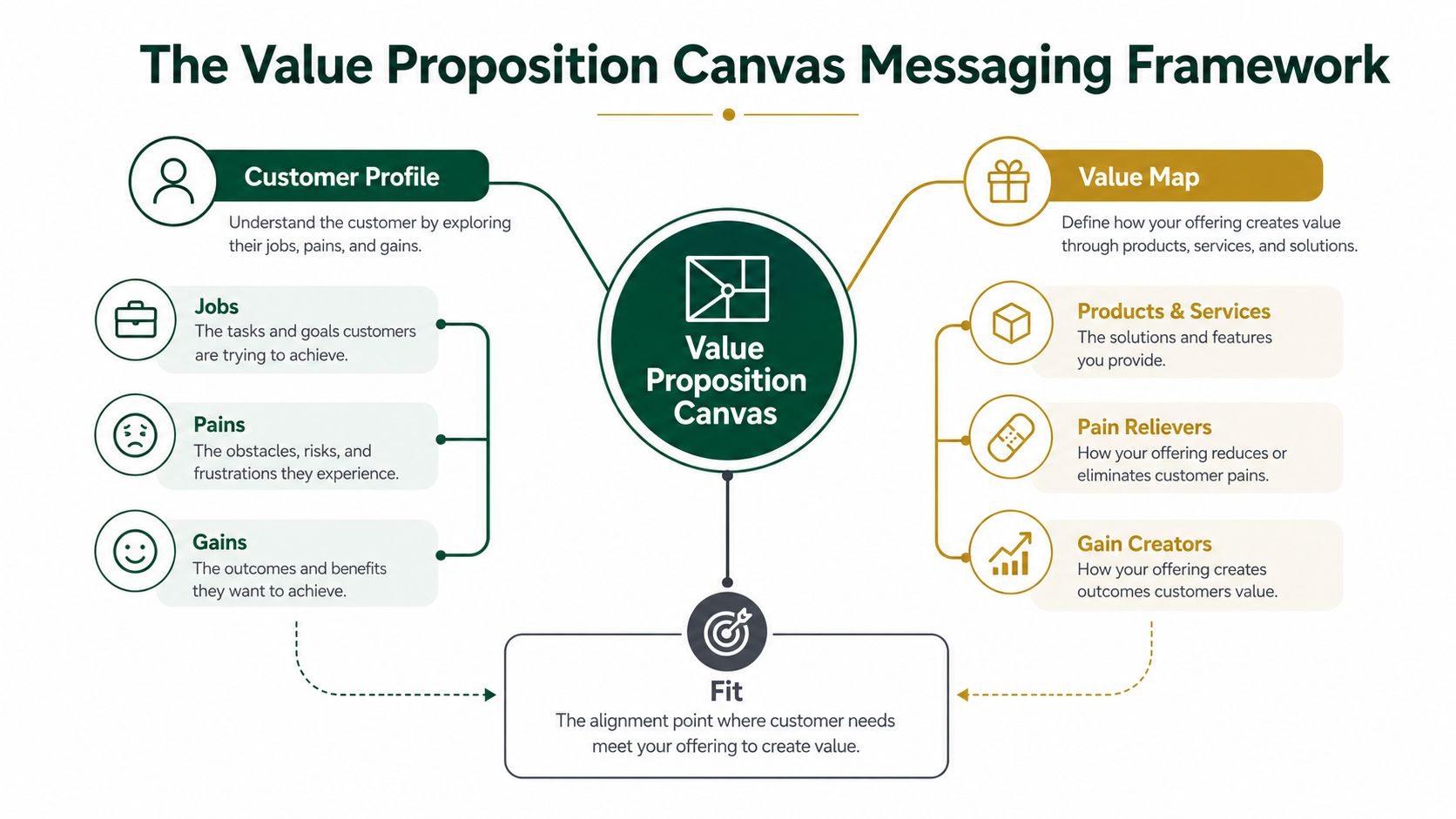
For B2B SaaS, this framework is the antidote to the "feature factory" mindset. It ensures that every line of code and every piece of marketing copy is grounded in solving a real customer problem, relieving a specific pain, or creating a tangible gain. You stop guessing what matters and start building your messaging on a foundation of customer truth.
Value Proposition Canvas Messaging Framework: Systematically Aligning Product with Customer Needs
The canvas is split into two sides: the Customer Profile (their world) and the Value Map (your product). The goal is to create a perfect fit between them.
Customer Profile (The Circle):
Value Map (The Square):
Let's picture CyberSecure AI, an AI-powered platform that detects and remediates security threats for mid-market tech companies.
When to Use It: The Value Proposition Canvas is one of the most fundamental messaging framework examples for early-stage B2B startups trying to find product-market fit. It's also invaluable for established companies launching a new product or entering a new market segment. Use it to align your product, marketing, and sales teams around a shared understanding of the customer.
How to Adapt It:
In a world of information overload, brevity is a superpower. The Three-Message Framework forces you to distill your entire value proposition into a potent, memorable, and easily repeatable soundbite. It's the ultimate elevator pitch, designed for absolute clarity when you have only a moment to capture attention. This approach strips away jargon and complexity, focusing on the core essence of your B2B solution.
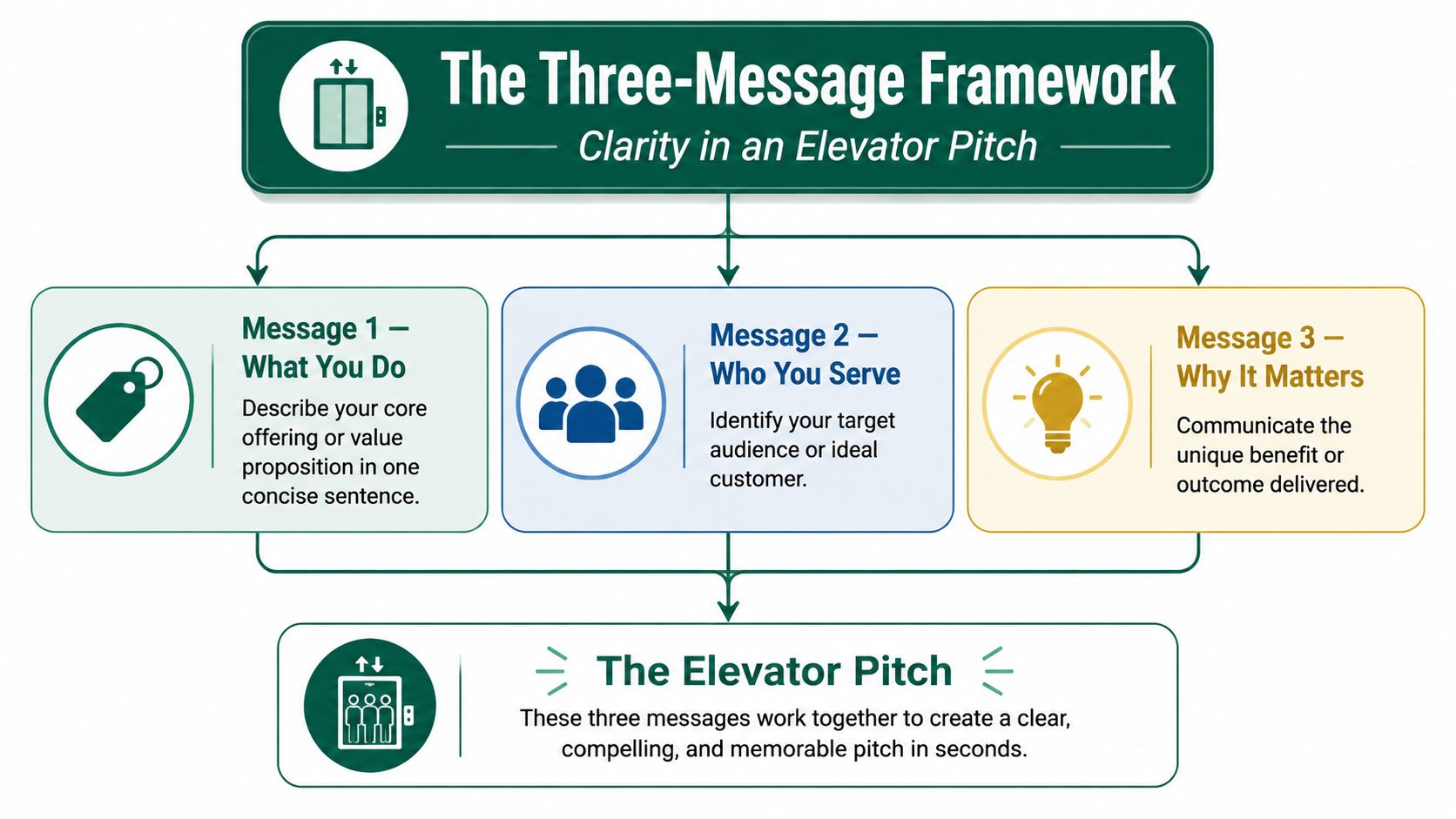
For B2B SaaS, this is the key to cutting through the noise. It forces you to answer three critical questions instantly: What do you do? Why should I care? And what's next? It's a disciplined exercise in simplification that ensures anyone, from a CEO to a new intern, can understand and communicate your value.
Let's imagine a fictional AI tool called SyncUp Meetings that summarizes and organizes meeting action items.
When to Use It: This is one of the most versatile messaging framework examples for almost any communication channel. It’s perfect for LinkedIn bios, conference name tags, email signatures, and the first sentence on your homepage. Use it when you need to explain your product in 30 seconds and leave a lasting impression.
How to Adapt It:
The Hero’s Journey, based on Joseph Campbell’s monomyth, is a powerful framework for telling stories of profound transformation. It can be an effective tool for B2B marketers who want to connect on an emotional level. This framework positions the customer as a hero on a quest for growth, facing immense challenges along the way. Your brand is the mentor or magical aid that equips them for the journey and helps them return victorious.
For a B2B SaaS company, this means you're not just selling a tool; you're facilitating a fundamental business transformation. You’re helping a Head of Engineering become a legendary innovator or a CFO become a strategic visionary. This framework elevates your product from a simple solution to an essential part of your customer’s professional saga.
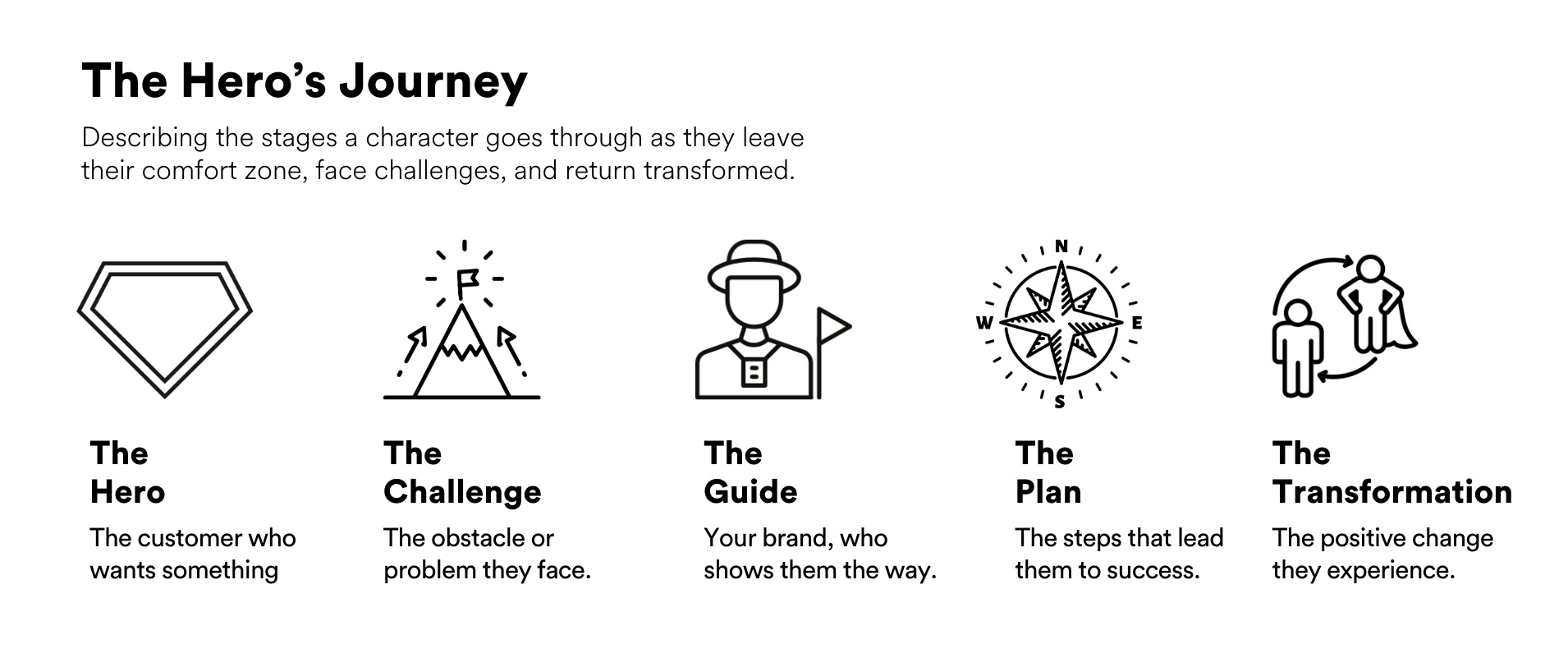
The Hero’s Journey: Crafting a Transformational B2B Narrative
Let’s invent a fictional platform called DevVelocity that streamlines complex software development cycles.
When to Use It: The Hero's Journey is one of the most compelling messaging framework examples for products that enable a significant "before and after" transformation. Use it when your solution doesn't just offer an incremental improvement but changes how a team or business operates. It’s ideal for high-value B2B SaaS, especially in categories like DevOps, data analytics, or business intelligence where the impact is profound.
How to Adapt It:
Neil Rackham's SPIN Selling isn't just a sales technique; it's a powerful messaging framework that transforms your conversations from a pitch into a guided discovery. It’s built on the idea that telling a B2B buyer they have a problem is far less effective than helping them realize it for themselves. SPIN provides a structure for your messaging that uncovers pain and connects your solution to a buyer's self-realized needs.
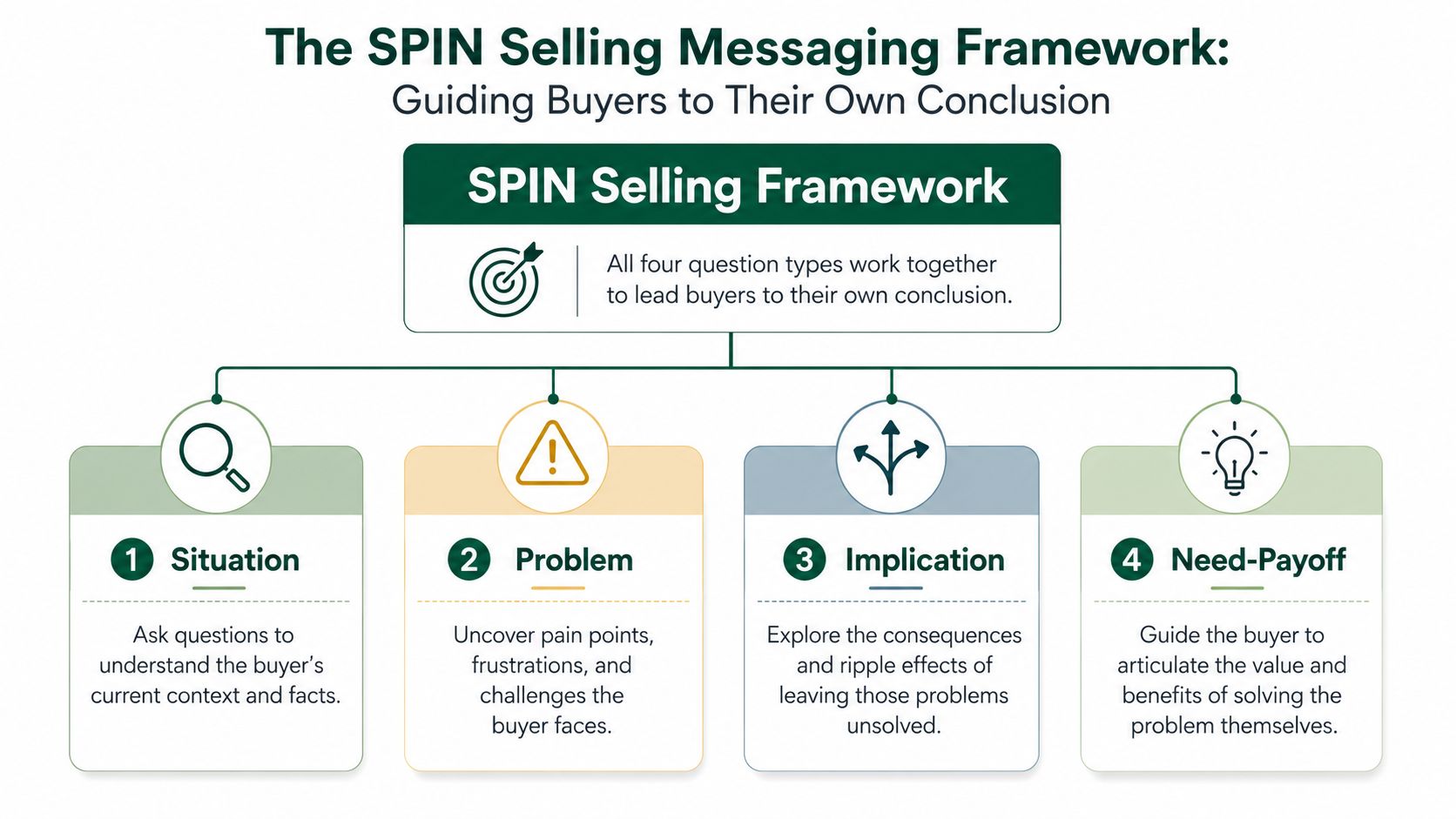
Hubspot has published a cool visual showing the SPIN selling messaging framework (copied below):
Hubspot - SPIN Selling Messaging Framework
For B2B SaaS, especially in complex enterprise sales, this shifts the focus. It moves the conversation away from feature demonstrations and toward a consultative partnership. Instead of pushing a product, your messaging guides prospects through their own business reality, making the value of your solution an inevitable conclusion.
Let's imagine a fictional marketing attribution platform called AttributionOS, designed for enterprise B2B marketing teams.
When to Use It: The SPIN framework is one of the most effective messaging framework examples for high-value, complex B2B sales cycles where trust and consultation are paramount. If your product requires a significant investment or solves a deep, systemic problem, SPIN helps build the business case from the buyer's perspective. It's ideal for sales conversations, discovery calls, and demo scripts.
How to Adapt It:
The Awareness-Consideration-Decision framework, often called the marketing funnel, is a foundational model for B2B SaaS. It organizes your messaging to match the buyer's mindset at each stage of their journey, ensuring you deliver the right information at the right time. Instead of a one-size-fits-all message, this approach nurtures prospects from initial problem recognition to a confident purchase decision.
For a complex B2B sale, this is critical. A prospect who just realized they have a data security problem doesn't need a pricing sheet; they need to understand the threat. This framework prevents you from pushing a demo too early and instead builds trust by guiding, educating, and then converting.

Let's imagine a fictional AI-powered data compliance and security platform called DataSecure AI.
When to Use It: This is one of the most essential messaging framework examples for any B2B company with a considered purchase process. If your sales cycle is longer than a week and involves multiple stakeholders, you absolutely need to map your messaging to the buyer's journey. It’s the blueprint for a scalable content and demand generation strategy.
How to Adapt It:
If you only need one answer before building anything, start here. Teams often do not fail because they chose a bad framework; they fail because they picked one that did not match the job. A Series A SaaS company with an unclear homepage needs a different tool than an enterprise sales org trying to improve discovery calls.
| Situation | Best framework to start with | Why it fits |
|---|---|---|
| Early-stage SaaS still sharpening core value | Value Proposition Canvas | Forces direct alignment between pains, gains, and product value |
| SaaS with homepage confusion but solid product | StoryBrand | Clarifies the narrative buyers need to understand quickly |
| B2B team with several personas and products | Messaging Matrix | Creates one source of truth across segments and channels |
| Enterprise sales with consultative discovery | SPIN Selling | Helps reps build urgency and buyer-owned business cases |
| Technical founders explaining complex infrastructure | Jobs to Be Done | Shifts the message from features to progress and outcomes |
| Strong category story, weak internal repeatability | Three-Message Framework | Distills the message into a memorable core everyone can use |
| Multi-stage demand generation and content operations | Awareness-Consideration-Decision | Aligns content and proof to buyer stage |
My bias: if a team is under 30 people, I would usually rather see one strong framework used consistently than four frameworks used halfway. Clarity compounds faster than sophistication.
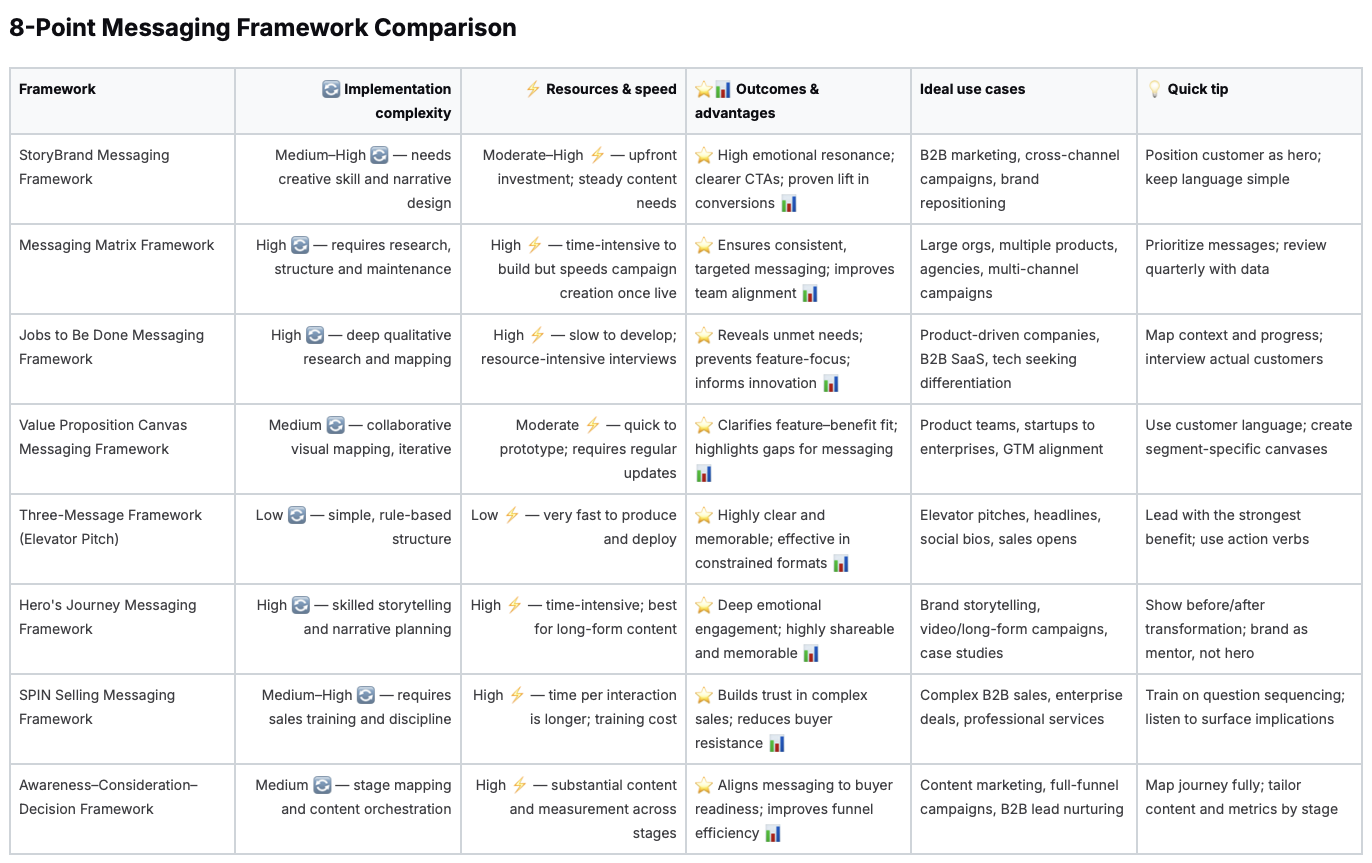
8-Point Messaging Framework Comparison
Before choosing, ask a simpler question than “Which framework is best?” Ask, “What kind of messaging problem do we have?” In practice, I see teams over-index on creative language when the main issue is evidence, persona alignment, or stage mismatch.
| Framework | Best for | Ideal company stage | Strongest channel or use case | Weakness or risk | Evidence needed to make it credible |
|---|---|---|---|---|---|
| StoryBrand | Clarifying a confusing product story | Seed to Series B | Homepage, landing pages, pitch deck opening | Can become too dramatic or vague if proof is thin | Customer outcomes, testimonials, a simple implementation plan |
| Messaging Matrix | Multi-persona and multi-product consistency | Series A to growth stage | Sales enablement, product marketing, website copy systems | Can become a spreadsheet graveyard if nobody maintains it | Persona insights, proof by segment, objection handling, competitive context |
| Jobs to Be Done | Understanding why customers switch | Early-stage to category challengers | Positioning, customer research, founder narrative | Easy to oversimplify into generic “progress” language | Win-loss interviews, switching stories, status-quo alternatives |
| Value Proposition Canvas | Tightening product-message fit | Pre-PMF through expansion | Homepage, new product launch, vertical messaging | Can stay theoretical if not validated externally | Interview quotes, pains/gains by segment, product usage patterns |
| Three-Message Framework | Fast clarity and repeatability | Any stage | Elevator pitch, outbound intros, social bios, demo openers | Too shallow for complex buying committees on its own | One primary promise, one key proof, one low-friction CTA |
| Hero’s Journey | High-transformation narratives | Growth-stage or premium categories | Case studies, brand campaigns, keynote narratives | Can feel inflated for modest products | Strong before/after stories, implementation reality, champion quotes |
| SPIN Selling | Consultative enterprise messaging | Growth to enterprise | Discovery calls, sales scripts, demo flow | Weak if reps ask questions mechanically | Problem economics, implications, buyer language, quantified consequences |
| Awareness-Consideration-Decision | Full-funnel message orchestration | Any company with a longer cycle | Content strategy, nurture, lifecycle messaging | Can produce generic funnel content if personas are weak | Stage-specific proof, content engagement data, buyer journey insights |
A few practical matches matter more than the full list. If I were helping a Series A SaaS team whose homepage was not converting because visitors still could not explain the product back to us, I would start with StoryBrand or Value Proposition Canvas. If the problem were six personas and a sales team improvising every deck, I would move straight to a Messaging Matrix. If the company sold into enterprise with a long committee-driven motion, SPIN would carry more weight than any brand narrative alone.
A framework is only useful when it changes what your team says in the market. The jump from workshop output to revenue impact happens when you turn one model into a repeatable operating system: customer inputs in, message pillars out, and market feedback back into the system.
From Framework to Action: Building Your B2B Messaging Engine
The business case is stronger than many teams assume. Buyers reward relevance: 89% are more likely to buy when companies show they understand their goals, and 65% want easy access to relevant content on a provider’s website, according to Ironpaper’s B2B marketing statistics. That lines up with what I see in messaging work: clearer language does not just improve brand perception; it reduces friction during evaluation.
Start with raw material, not copywriting. Pull five sources into one place: customer interviews, lost-deal notes, call recordings, support tickets, and sales objections. The goal is to hear how buyers describe the problem, what they tried before, what finally pushed them to act, and what proof they needed before trusting a vendor.
A practical baseline is 8 to 12 recent conversations across wins, losses, and active opportunities. I would rather have ten honest buyer quotes than a hundred internal opinions. Customer research expert Bob Moesta has long emphasized purchase moments, struggling moments, and forces of progress in his Jobs to Be Done work, and that mindset is useful even if you do not choose JTBD as your final framework.
Pick one framework based on the specific bottleneck, not because it feels strategic. If the problem is message sprawl, use a Messaging Matrix. If the problem is weak narrative clarity, use StoryBrand. If the problem is low-conviction discovery calls, use SPIN. If the problem is product-value mismatch, use Value Proposition Canvas. For tactical execution after strategy is clear, it can also help to review practical ad copy frameworks so your core message translates cleanly into campaign language.
In our review, the biggest implementation mistake was stacking frameworks too early. Teams would run a positioning sprint, a messaging sprint, a brand sprint, and a homepage rewrite at the same time. The result was usually more language, not more clarity. One framework, applied consistently, tends to outperform a blended model assembled too fast.
Turn the framework output into 3 to 5 message pillars your whole team can reuse. A solid pillar set usually includes:
Then adapt those pillars into assets: homepage hero, product page intro, sales deck narrative, demo opener, outbound email angle, and objection-handling language. A B2B brand messaging framework becomes operational instead of aspirational.
Do not wait for a full rebrand to learn whether the messaging works. Test it in places where buyer response is visible: homepage headlines, email replies, call quality, and demo progression. The market gives cleaner feedback than internal review meetings.
Messaging testing does not need to be complicated. The CXL guide to message testing is a useful reminder that the point is not just preference testing; it is learning which claims buyers understand, believe, and act on. I look for changes in the quality of replies, how quickly prospects grasp the use case, and whether sales calls spend less time untangling basic confusion.
B2B SaaS teams have a few high-impact testing surfaces:
For SaaS specifically, I like testing the same core pillar across the homepage, outbound, and demo intro at the same time. When one phrase consistently survives across all three, it usually belongs in the permanent framework.
You do not need perfect attribution to know messaging improved. Look for:
When messaging gets stronger, the whole go-to-market system usually gets simpler. The homepage does more work before the call. Sales spends less time translating. Product marketing stops rebuilding the same story for every launch. That is the main goal: not prettier copy, but a message your market understands quickly and your team can use repeatedly.
Struggling to translate these frameworks into a message that drives revenue? At Big Moves Marketing, we specialize in building powerful messaging engines for B2B SaaS and AI startups. Visit Big Moves Marketing to see how our fractional CMO services can help you find the clarity you need to scale.
Explore Big Moves Marketing services and resources:

%20-%20white.svg)