%20png%20copy.avif)

Most founders ask, “How much traffic does this competitor get?” That's usually the wrong first question. Third-party tools can disagree substantially, and independent comparisons have found average overestimates of 17% for Similarweb, underestimates of 17% for Ahrefs, and underestimates of 30% for Semrush, while one comparison reported a 49.52% median deviation for Ahrefs on search traffic. (Screaming Frog's analysis of traffic-estimator accuracy)
The useful question is harder: which channels attract their audience, which pages capture intent, and what does that reveal about their go-to-market strategy? If you treat estimated visits as directional evidence rather than audited analytics, competitor research becomes a decision tool instead of a vanity-metric exercise.
A competitor's traffic number is not a fact you can inspect. It's a model. You can't access their Google Analytics or Search Console unless they give you permission, so every external platform estimates performance from its own blend of signals and assumptions.
That doesn't make the data useless. It changes how you should use it.
Similarweb, Semrush, Ahrefs, and SE Ranking can help you compare estimated visits, traffic sources, top pages, keywords, and country-level trends. None provides a definitive count of another company's sessions. Independent guidance on competitor website traffic analysis recommends comparing several competitors over time instead of trusting one isolated snapshot.

Suppose a rival appears to attract more visitors than you. That fact alone doesn't tell you whether they're winning your market. Their audience might come from broad informational searches, an international audience outside your ICP, paid campaigns with weak intent, or branded demand built over years.
A smaller competitor can create more pipeline if its pages attract buyers with a clear problem, a defined use case, or a product-comparison intent. Raw volume hides that distinction.
Look for directional answers:
Practical rule: Use traffic estimates to form a hypothesis. Use channel mix, keywords, top pages, and trends to decide whether the hypothesis deserves action.
Your internal model should record the competitor, tool used, date checked, estimated traffic direction, channel pattern, top landing pages, relevant keywords, and your interpretation. A structured competitor analysis template will keep research connected to decisions rather than leaving it scattered across browser tabs.
A useful competitor list can also include adjacent players, not just direct product rivals. For example, a SaaS company studying ad intelligence may need to examine meme ad platform competitors because search competitors and product competitors often differ. The market you compete for in search is usually wider than the set of companies your sales team names.
Don't pick a tool because its dashboard looks authoritative. Pick tools based on the question you need to answer, then keep the sources separate enough to expose disagreement.
Use one platform as your baseline for repeated comparisons. Similarweb is designed for broad directional benchmarking across traffic sources, geographies, engagement signals, and top pages. Its published methodology combines four signal classes, including direct measurement from participating sites and apps, an anonymous device-data network, digital-signal partnerships, and public-data extraction processed by algorithms. (Similarweb's data methodology)
That breadth makes it useful for understanding total acquisition patterns. It still doesn't turn estimates into server logs.
Semrush is valuable when you need to connect traffic analysis to organic and paid search visibility. Ahrefs is particularly useful for organic keywords, page-level search estimates, and the pages that appear to drive a competitor's search footprint. SE Ranking can add another perspective across organic and paid snapshots.
You don't need every platform. You need at least two materially different views for important decisions.
For each competitor, capture the same fields on the same schedule:
Do not average conflicting estimates into a fake precision. If one tool suggests a rival is materially larger and another suggests the gap is narrow, record the disagreement. Then inspect the proxies that matter, such as ranking coverage, branded search interest, top-page visibility, and referring-domain patterns.
A practical overview of top competitor analysis tools for 2026 can help you compare capabilities before committing to a research stack. But the stack should remain subordinate to the decision. A founder doesn't need a larger dashboard. They need to know whether to invest in category SEO, comparison pages, paid search, partnerships, or a positioning change.
For teams evaluating how platform changes affect the market, Big Moves Marketing also discusses the impact of Adobe acquiring Semrush on B2B marketing and SEO. Treat vendor context as a reason to review your process, not as a substitute for validating the underlying signals.
Traffic quality starts with source composition. A competitor with high estimated visits from broad social distribution is solving a different acquisition problem from a rival whose traffic comes mainly from organic category searches and direct brand demand.
Similarweb's interface separates sources such as search engines, social media, display networks, other websites, and email. It also distinguishes direct traffic cases such as typed URLs and bookmarks. (Similarweb's explanation of traffic analysis)
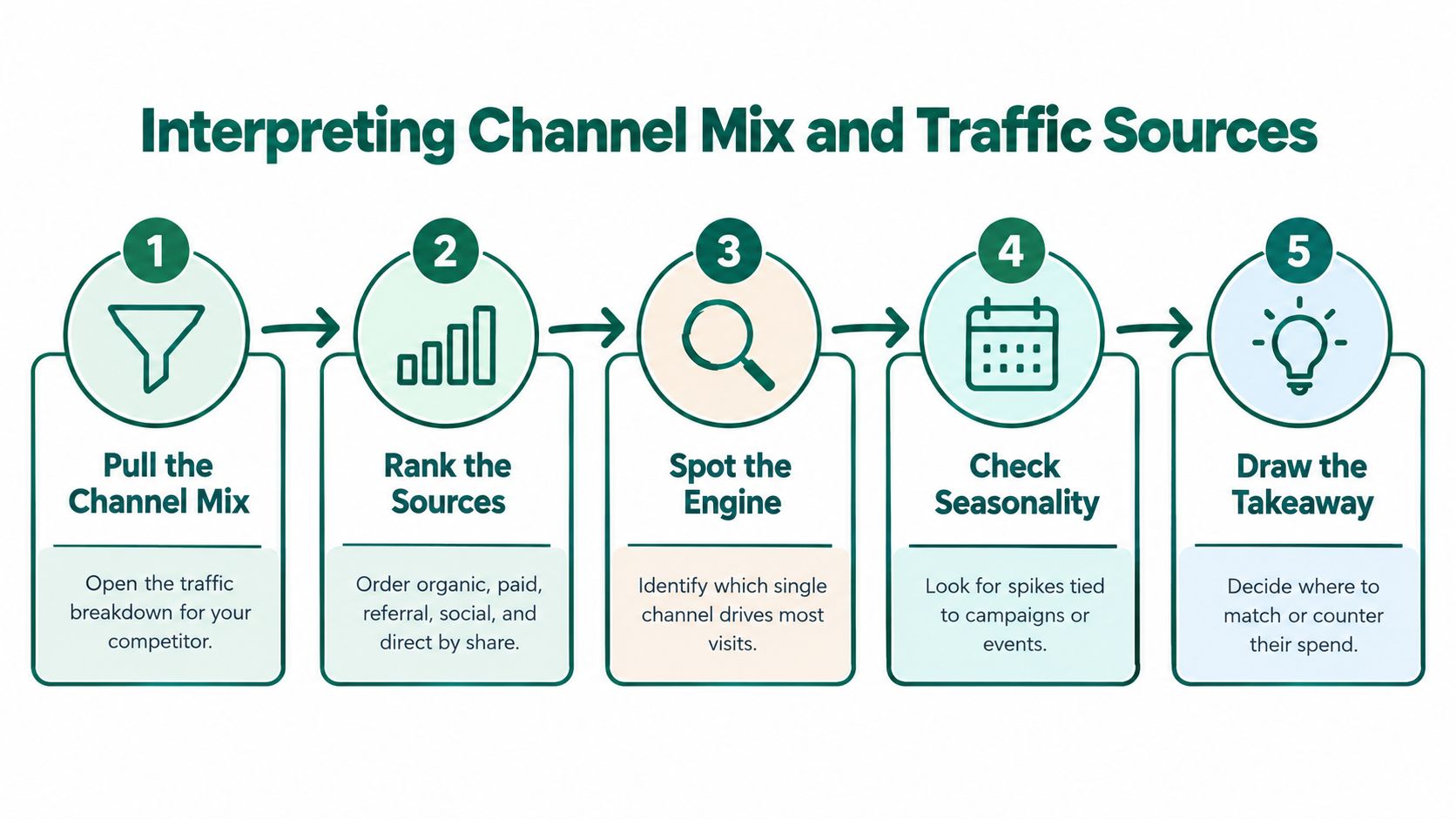
Organic search suggests a competitor has created discoverability around topics people actively research. But organic traffic still needs intent analysis. A large educational footprint may generate awareness without creating qualified conversations, while a smaller set of integration and comparison pages may attract buyers closer to selection.
Paid search tells you where the company is willing to spend for attention. It can reveal commercial priorities, launch support, or gaps in organic coverage. Don't assume paid traffic is automatically lower quality. Inspect the landing pages and messaging. If the ads consistently point to tightly matched product pages, the competitor may be protecting valuable demand.
Referral traffic can expose distribution advantages that SEO tools miss. Partner ecosystems, software directories, communities, industry publications, and integration pages can all introduce buyers with context already established.
Direct traffic deserves careful interpretation. It may reflect brand familiarity, repeat users, bookmarks, offline activity, or unattributed campaigns. It can signal demand, but it doesn't explain the cause by itself.
Use this working interpretation:
| Pattern | What it may indicate | What to inspect next |
|---|---|---|
| High estimated traffic, weak commercial page visibility | Broad awareness or informational reach | Top pages, keyword intent, conversion paths |
| Strong organic footprint, limited paid presence | Search-led acquisition and content investment | Category pages, comparison content, backlinks |
| Strong paid presence, modest organic reach | Campaign-led demand capture | Ad themes, landing pages, offer structure |
| Strong direct and referral patterns | Brand, partners, or established distribution | Referring domains, branded queries, ecosystem pages |
These are hypotheses, not verdicts. Third-party tools model both visits and engagement, so you shouldn't treat estimated bounce rate or visit duration as observed customer behavior. The more valuable move is to compare the source pattern with visible page strategy.
If the competitor receives substantial traffic but ranks mainly for low-intent educational terms, don't copy its publishing volume. Find the point where the buyer's problem becomes commercially specific. That might be a comparison page, a migration guide, an integration page, or a use-case landing page.
Your own attribution model should then connect acquisition source to pipeline stages, not just sessions. The principles in multi-touch attribution are useful here because competitor research only becomes valuable when it changes how you judge your own channels.
A single traffic estimate tells you where a competitor appears to be. A time series tells you what they may be doing.
Check the same domains repeatedly in the same tools, using the same geography and device filters where possible. Record changes in estimated traffic, channel share, top pages, keyword positions, new landing pages, and visible messaging. Consistency matters more than frequency.
A sudden spike might reflect a campaign, product launch, press attention, seasonality, a site migration, or a change in the estimator. Don't turn one unusual point into a strategic conclusion.
Cross-check the anomaly against public evidence:
The point isn't to reconstruct their analytics perfectly. It's to identify a plausible cause with enough confidence to investigate.
Traffic growth becomes actionable when you can connect it to a page type or keyword group. A competitor may be gaining from comparison pages, a new integration hub, product-led templates, an industry segment, or a shift in messaging. The page tells you what they're choosing to make visible. The keyword set tells you what demand they're capturing.
Don't copy the page mechanically. Ask what buyer problem it resolves and what proof it uses. Then decide whether your product has a stronger answer, a narrower audience, or a more credible point of view.
A drop can be equally informative. It may expose a failed redesign, decaying content, a lost ranking cluster, or dependence on a channel they no longer support. Use marketing effectiveness measurement to apply the same discipline internally. If your team can't connect a competitor insight to a measurable decision, the research is still descriptive rather than strategic.
A trend is not a growth lever until you can name the page, audience, channel, and decision it changes.
Competitive analysis becomes expensive when it produces admiration instead of action. Your objective isn't to imitate the company with the largest estimated audience. It's to identify where its acquisition system is strong, where its intent coverage is weak, and where your product can make a more credible promise.

Use your findings to choose a specific experiment:
The right response is rarely “publish more.” A sales-led SaaS company may need sharper qualification and proof on a few high-intent pages. A product-led company may need to reduce friction between educational content and product activation. A pre-PMF team may need to stop expanding content coverage until its audience and message are stable.
Give each experiment a clear hypothesis, owner, launch condition, and success measure tied to pipeline or qualified demand. Traffic can be an early signal, but it shouldn't be the final outcome.
The legal and ethical boundary is straightforward. Use publicly available information, respect site terms and privacy requirements, and don't attempt to access private analytics, restricted systems, or confidential customer data. Competitive intelligence should improve your judgment, not create security or compliance exposure.
Here's a short visual reminder of the strategic sequence:
A disciplined go-to-market strategy for SaaS connects the market signal to positioning, channel choice, sales enablement, and measurement. If your research doesn't alter one of those decisions, it hasn't earned a place in the operating plan.
No. Only the company's internal analytics can provide that level of accuracy. Similarweb, Semrush, Ahrefs, and other platforms offer modeled estimates, so use them for directional benchmarking and cross-check their patterns against keywords, top pages, geography, and visible distribution signals.
Start with a broad estimator such as Similarweb when you need a view of total traffic and channel mix. Add Semrush or Ahrefs when you need to understand organic and paid search, page-level visibility, and keyword intent. The right stack depends on the decision, not on owning every subscription.
Each provider uses different datasets and modeling methods. Their figures aren't directly comparable as if they came from one shared measurement system. Compare trends within the same tool, then use a second provider to test whether the direction and strategic pattern hold.
Direct traffic can be useful, but it isn't automatically the most accurate or the clearest. It may include typed visits, bookmarks, repeat users, brand demand, and traffic that external systems couldn't classify. Treat it as a clue about demand and return behavior, then examine branded search, page paths, and other sources.
Present ranges or directional labels, not false precision. Show the competitor's channel mix, strongest pages, relevant intent clusters, trend direction, confidence level, and the decision you recommend. Leaders need to know whether to change positioning, content priorities, paid tests, or market focus.
Choose one or two experiments that respond to the strongest signal. A competitor's estimated traffic isn't your strategy. It's evidence you can use to sharpen your ICP, improve a commercial page, test a channel, or challenge an assumption in your go-to-market plan.
Big Moves Marketing helps B2B SaaS leaders connect competitor intelligence to positioning, go-to-market choices, and measurable pipeline systems. Visit Big Moves Marketing to discuss where your traffic analysis is creating clarity and where it's still producing noise.




%20-%20white.svg)