%20png%20copy.avif)
Most competitor analysis is a waste of founder-level time. The templates are broken. They push your team to catalogue competitor features in a spreadsheet, creating a detailed map of the wrong landscape. This is a defensive, resource-draining game you can’t win.
It produces a dead document—disconnected from sales, marketing, and product. It creates the illusion of diligence while leading your go-to-market strategy into a ditch.
This guide provides a different model. It’s built around a free competitor analysis template designed for B2B SaaS leaders who need leverage, not just data.
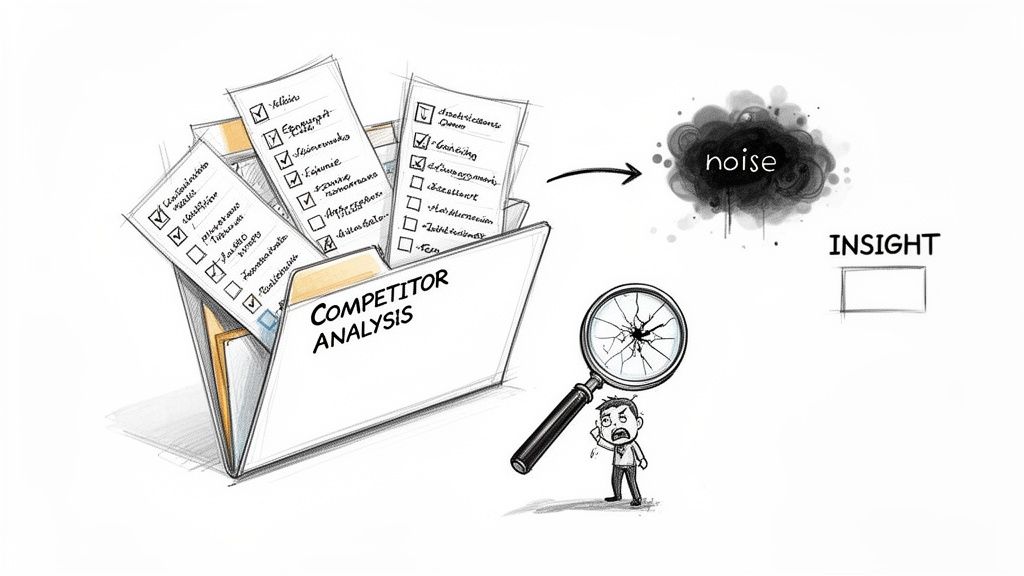
The problem isn’t a lack of data. It’s a flood of useless information that creates a dangerous, false sense of security. Standard templates push you toward a shallow, feature-for-feature deathmatch. You spend hours meticulously filling out a spreadsheet, ticking boxes for API access, reporting capabilities, and integrations.
The final report looks impressive and feels like progress. In reality, it tells you nothing about market dynamics, customer perception, or how to win.
I’ve seen this pattern play out across dozens of B2B SaaS companies, from early-stage to Series C. Teams burn weeks on analysis that produces a detailed catalog of what their competitors do, but offers zero insight into why it matters or how to respond.
Here's where the process consistently breaks:
A bad template is worse than no template. It gives you the illusion of diligence while leading your strategy astray.
The purpose of competitor analysis isn't to create an encyclopedia of rival products. The goal is to find leverage.
This requires shifting focus from cataloging features to dissecting go-to-market strategy. The questions must change. Instead of asking, "What features do they have?" you must ask:
Answering these questions demands a more sophisticated competitive analysis framework that moves beyond surface-level data. This is how you shift from information gathering to insight generation—the kind that creates a genuine market edge.
The standard feature-comparison grid is where strategic analysis goes to die. It's a technical audit masquerading as a business strategy. It tells you what your competitor built, but nothing about how they sell it, who they sell it to, or why customers actually choose them.
That's inventory, not insight.
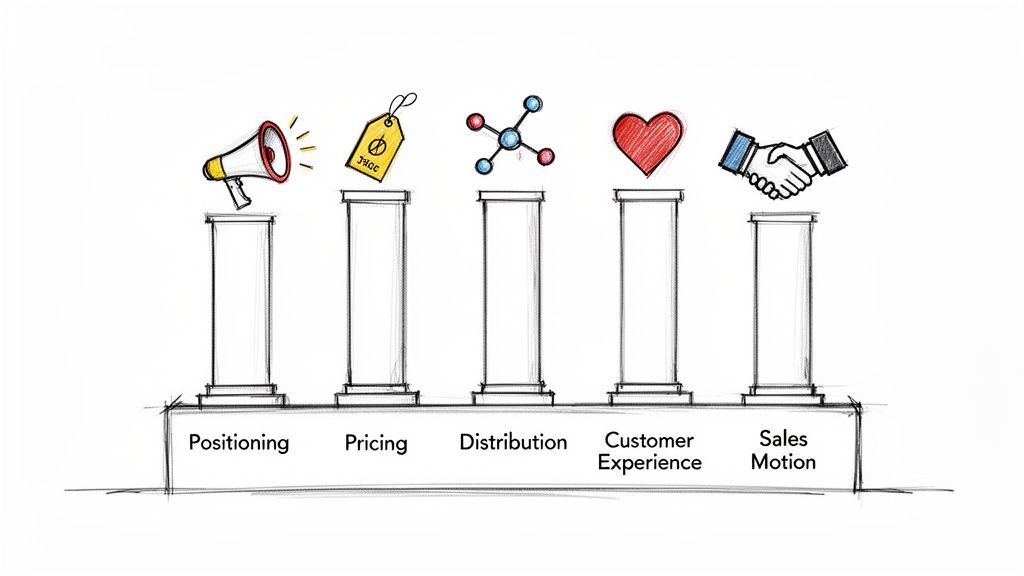
To find real leverage, you must dissect their entire go-to-market engine. This means analyzing the five core pillars that expose their true market strategy, opportunities, and weaknesses. Our competitor analysis template free to download is built around this exact GTM-focused framework.
For those who want to build an evidence-based foundation, borrowing principles from a systematic literature review methodology can provide structural discipline.
But the core model is simple. This framework outlines the five pillars to investigate, the questions each answers, and the intel required.
This framework moves you from listing features to understanding the complete business system you're up against. It’s about seeing the whole board, not just the pieces.
This is the foundation. It’s not just their homepage tagline; it’s about reverse-engineering the core argument they make to the market. You must map their messaging hierarchy to uncover their strategic bets.
A competitor’s messaging is a direct signal of strategic intent. To go deeper, see our guide on what competitive positioning in marketing is.
Pricing is strategy made visible. It is the clearest signal of who a company believes it serves and the value it thinks it delivers. Do not just look at the numbers; dissect the structure.
How a competitor gets in front of their market reveals their customer acquisition cost (CAC) assumptions and operational strengths. A company built on SEO has a different DNA than one built on enterprise field sales.
A competitor's GTM strategy isn't what they say in a press release. It's the sum of their hiring patterns, ad spend, and sales compensation plan.
This pillar covers the entire journey, from first ad impression to onboarding and support. It is where brand promises meet operational reality. Every point of friction in a competitor’s customer experience is a direct opportunity for you.
Understanding how a competitor sells is as important as knowing what they sell. Is their motion product-led (PLG), sales-led, or a hybrid? This choice dictates their sales cycle length, average deal size, and the type of buyer they can effectively close.
This five-pillar framework turns competitor analysis from a passive data-entry exercise into an active strategic investigation. It forces you to look beyond the product to the entire business system you are up against.
A competitor analysis can easily become a black hole of research. You pull one thread, and suddenly you're three weeks deep in a spreadsheet maze with no clear insights. This is analysis paralysis.
It doesn’t have to be this way.
The key is to impose strict constraints. Focus on your top two direct rivals and one indirect competitor. That’s it. A tight scope allows a small team—a founder and a marketing lead—to produce meaningful insights in under 10 hours per competitor.
Before opening a single browser tab, define what you need to learn. Vague goals lead to wasted time.
Are you trying to determine…
Nailing down objectives keeps your research focused and productive.
To see a competitor's strategy before they announce it, look at who they're hiring. Job postings are a goldmine, revealing where a company is scaling product, pushing into new markets, or doubling down on R&D.
A surge in "Enterprise Account Executive" roles? They're moving upmarket. A new "Director of APAC Sales"? They're expanding geographically.
Hiring patterns often signal strategy changes weeks before public announcements.
Review sites like G2 and TrustRadius are where you find unfiltered truth. Don't just skim the 1-star and 5-star ratings. The real insights are in the middle.
These recurring complaints highlight your competitor’s biggest weaknesses and your biggest opportunities.
A company's content—blog posts, webinars, white papers—is a direct reflection of who they're trying to sell to.
This audit exposes their GTM strategy, showing you exactly where to attack. For a deeper look at the SEO component, Outrank has a practical guide to competitor analysis in SEO.
This isn't a solo mission. A duo, like a founder and a marketer, can divide the work. This creates momentum and allows for real-time gut checks.
A simple process:
Brief, daily check-ins keep the project from stalling.
You don't need an expensive tech stack. Too many tools slow you down. Stick to a handful of platforms.
The goal is to reduce friction, not add another tool that requires training.
This is where most teams get bogged down. Avoid creating dozens of categories. As soon as you finish gathering data for a pillar, score it on a 1–5 scale.
Use simple color-coding (red, yellow, green) in your spreadsheet to make strengths and weaknesses pop.
Do not let your analysis exist in a silo. Once you have initial scores, pull in leaders from sales, product, and customer success for a rapid-fire alignment session.
Keep it tight:
This quick workshop turns a spreadsheet into a shared strategic vision.
Your analysis will reveal a mix of long-term shifts and short-term opportunities. Focus on quick wins first to build momentum.
If you find a competitor has slow support, make your response times the hero of your next ad campaign. If they're missing a key integration that you have, hammer that message on your website and in sales calls.
This sounds tedious but saves hours later. For every key insight, paste the source link next to it.
This simple habit prevents re-doing research three months from now when someone asks, "Where did we get that data?"
Once you've synthesized these findings, the next step is to turn them into assets your sales team can use. Our guide on the competitive battlecard template shows you how.
Analysis under tight deadlines forces clarity. Endless research creates paralysis.
This disciplined process extracts signals quickly. It ensures you turn raw data into strategic leverage, not just another spreadsheet that gathers dust.
An empty template is useless. A filled one is a collection of facts. The value is in translating that information into a clear strategic advantage.
Data collection feels productive. But without a disciplined interpretation, your analysis is just a catalog of trivia. The goal isn't to know everything about your competitors; it's to know the specific things that give you an edge.
This workflow is the mental model I use to move from unstructured data to focused, actionable strategy.
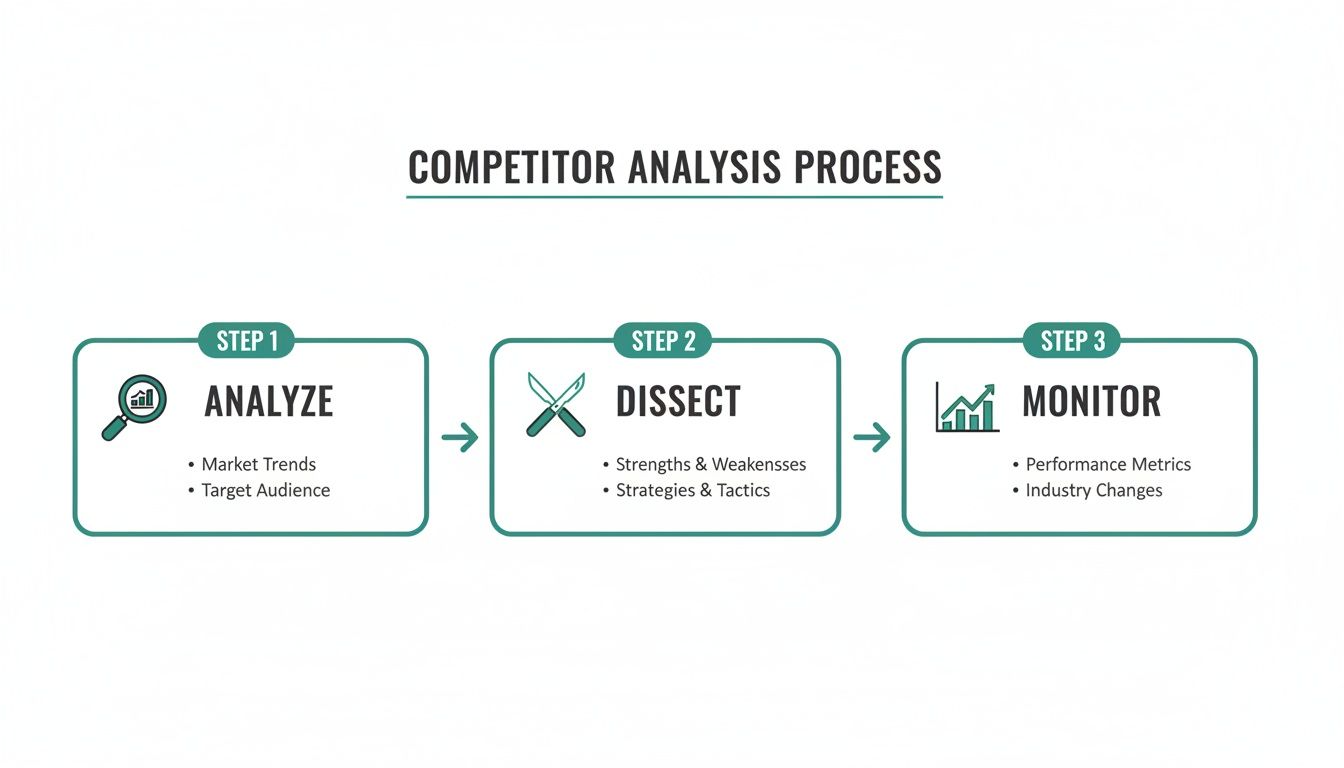
It’s about moving past observation to actively dissecting what rivals are doing and watching for high-signal changes.
The fastest way to spot patterns is to get visual. A simple 1-5 scoring system for each GTM pillar—Positioning, Pricing, Distribution, Customer Experience, and Sales Motion—forces a judgment call. It shifts you from passive note-taking to active evaluation.
Here's how I break it down:
Assign a score to each pillar for every competitor. Trust your gut.
Once scored, color-code them. Red for 1s and 2s, green for 4s and 5s. The competitive landscape will snap into focus.
With your scored analysis, you can answer the only questions that move your GTM strategy.
1. Where are they strong? (These are the fights to avoid.)
These are their "5s." If a competitor has dominant brand recognition or a massive partnership ecosystem, trying to beat them at their own game is a surefire way to burn cash. The insight here is strategic avoidance. Acknowledge their fortress and plan your attack elsewhere.
2. Where are they weak? (This is where you create your opening.)
Look for the "1s" and "2s." A competitor with muddy messaging is vulnerable to a sharply positioned rival. A company with a bad onboarding experience is leaking customers you can capture. These weaknesses become the foundation of your offensive strategy. To visualize these openings, build a positioning map template.
3. Where is the entire market blind? (Here’s where you find the blue ocean.)
This is the highest-leverage insight. Sometimes, your analysis reveals that every competitor is making the same flawed assumption. Maybe they all target the enterprise buyer, ignoring a massive, underserved mid-market need. Perhaps they all use a per-seat pricing model that punishes growing teams.
This market-level blindness is where true category disruption is born. It’s not about being slightly better; it’s about changing the game.
This process transforms a folder of notes into a strategic compass. It gives you the clarity to stop reacting and start making your own moves, aimed at the weakest points in their armor.
The analysis is done. The spreadsheet is filled. You have a clear picture of the competitive landscape. Now what?
Analysis that lives in a spreadsheet is an academic exercise. It doesn’t generate pipeline or close deals.
The final, critical step is turning strategic insight into revenue-generating assets. This is the bridge between knowing and doing. Without this, your analysis is well-organized trivia. The point is to equip your sales and marketing teams with the tools they need to win. If your analysis can't arm a sales rep for a competitive call, it has failed.
Think of your filled-out template as raw material. Now, forge it into weapons for your commercial teams. This isn’t about creating a lengthy report that gathers digital dust. It’s about building three specific, high-leverage sales enablement tools.
These three assets are the minimum viable output:
This ensures intelligence flows directly into revenue-generating conversations.
Your analysis uncovered exactly where competitors are vulnerable. Maybe their messaging is generic, their support is slow, or their pricing model punishes growth. This is gold.
Go back to your own value proposition. Does it directly attack their biggest weakness? If not, sharpen it.
For example, if your main competitor’s G2 reviews are littered with complaints about difficult implementation, your primary messaging must scream “The fastest time-to-value in the industry.”
This isn't a rebrand. It's a strategic refocusing of your message onto the area where you have a clear, defensible advantage. Update your homepage hero section, your ad copy, and the first slide of your sales deck.
A battlecard is a one-page brief that gives your sales team the intel they need to win against a specific competitor. This is not a feature-by-feature comparison. It’s a tactical guide for live sales calls.
A great battlecard tells a rep not just what to say, but why it will work. It’s built on solid intelligence about the competitor's known weaknesses.
Every battlecard needs:
Keep it brutally concise. A rep should be able to glance at it mid-call and find what they need in seconds. For a deeper source of proof points, a win-loss analysis template can provide the raw data to make these battlecards unstoppable.
This is your sales team's secret weapon. Landmines are carefully crafted discovery questions designed to expose a competitor's known weakness. You teach the prospect to ask them.
You’re coaching your champion to audit your competitor’s weak spots. It is devastatingly effective.
If your analysis shows a rival has poor integration capabilities, a perfect landmine question would be: "Could you walk me through the exact steps—and the typical timeline—to connect your platform with our existing CRM?"
This question forces the competitor to reveal their own weakness, which is more credible than your rep just saying, "Their integrations are bad."
Arm your team with three to five targeted questions for each key competitor.
This final step is non-negotiable. It transforms your competitor analysis from a research project into a core driver of your revenue engine. It ensures your intelligence doesn't just sit there—it goes out and sells.
Actionable answers to the questions B2B SaaS leaders are actually asking about competitor analysis.
This isn’t a one-and-done project. Your initial deep dive is the baseline. After that, you need a rhythm. A quarterly lightweight refresh is the sweet spot.
A quarterly check-in is frequent enough to catch major strategic shifts, like a pricing model change or a significant new product line, without creating analysis fatigue. For your top rivals, you might want to track hiring patterns monthly. The goal is continuous intelligence, not a massive annual report that’s instantly stale.
Obsessing over feature parity. It’s a classic trap for product-strong founders. They create a feature-for-feature checklist and convince themselves the path to victory is building everything the incumbent has, plus one more thing.
This is a losing game. It puts you in a defensive, reactive posture and bleeds engineering resources while you chase their roadmap. The real mistake isn't analyzing what they build, but failing to understand why their customers buy it and where that experience falls short. Your focus should be on their go-to-market gaps, not their feature list.
Don't boil the ocean. Taking on a behemoth like Salesforce or HubSpot in their entirety is impossible and useless for a startup. Narrow your focus surgically.
Pinpoint the one specific product or "job-to-be-done" that directly competes with your core offering. For example, if your tool competes with HubSpot's marketing automation features, ignore their CRM, sales hub, and service hub. Treat that single product line as its own competitor. Analyze its specific pricing, messaging, and the user complaints you find in G2 reviews. This focused approach delivers actionable insights, not a mountain of irrelevant data.
The most effective analysis of a large competitor is ruthlessly focused. You aren't competing against the entire company; you're competing against the one part of their product that solves the same problem as yours.
If sales isn't using your battlecards, the problem is the battlecards. Most are dense, academic documents filled with useless trivia like the competitor's founding date. A rep on a live call needs instant, tactical ammunition, not a history lesson.
The secret to adoption is co-creation. Build the battlecards with your top sales reps. Ask what objections they hear daily. Structure the cards around just three or four "landmine" questions they can ask prospects, specific talk tracks to counter claims, and hard proof points that are easy to drop into a conversation. When they see the assets directly helping them win deals, adoption will take care of itself.
At Big Moves Marketing, we help B2B SaaS founders move from analysis paralysis to decisive action. We build the positioning, messaging, and sales enablement tools that give your team the clarity and leverage to win.
Find out how we can help you sharpen your competitive edge at https://www.bigmoves.marketing.
Explore Big Moves Marketing services and resources:




%20-%20white.svg)