%20png%20copy.avif)
Most advice about Google's Quality Score starts with the wrong objective: raise the number, lower CPC, and assume the account is healthier. That turns a diagnostic into a target and gives SaaS teams a polished way to optimize activity instead of pipeline.
For B2B SaaS, the useful question isn't whether a keyword has reached an impressive score. It's whether the score is revealing a problem in message fit, search intent, or post-click experience that is restricting qualified demand. A keyword can look healthy in the interface while attracting the wrong buyers. Another can show a weaker diagnostic while producing valuable opportunities because the market is narrow, the deal size is strong, or the search intent is unusually specific.
Google's Quality Score has value when leaders treat it as evidence, not as a lever. The score helps you decide where to investigate. It doesn't replace conversion data, sales feedback, account quality, or pipeline analysis.
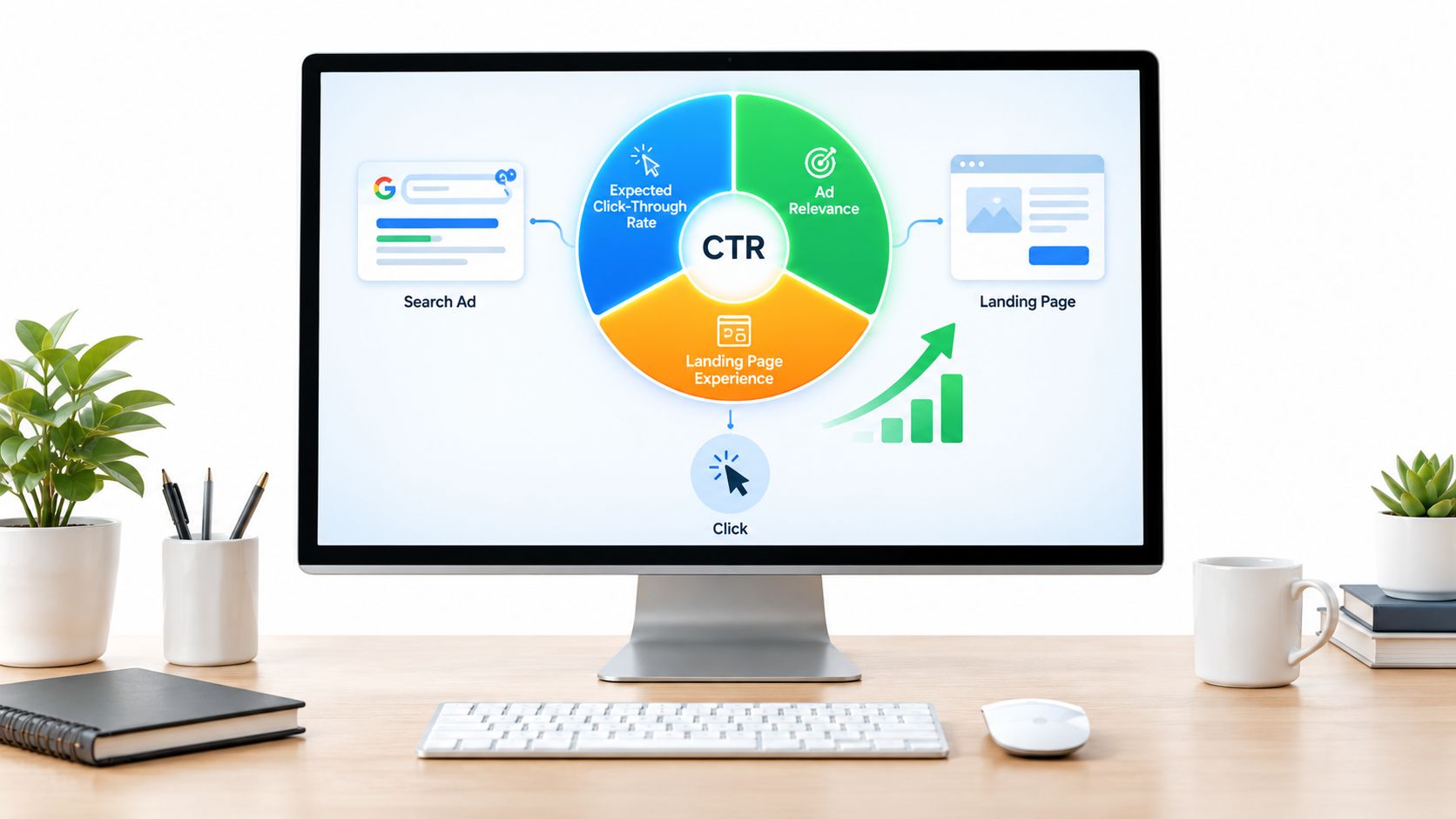
Quality Score is not a control panel for auction performance. It is a keyword-level diagnostic that Google reports on a 1–10 scale, based on expected clickthrough rate, ad relevance, and landing page experience. The component assessments compare your performance with advertisers whose ads appeared for the same search over the prior 90 days. That makes the score comparative and time-sensitive, not a permanent grade. Google's explanation of Quality Score and its components is more useful than the standard promise that a few copy edits will automatically reduce acquisition costs.
B2B SaaS teams need to read that diagnostic against the commercial reality of each keyword. Broad search categories, complex buying committees, and pages serving multiple use cases create plenty of room for misleading improvements. An ad for an “enterprise platform” can attract researchers, practitioners, consultants, and executives, even when sales only wants a narrow account profile. Making the ad broadly clickable may raise its diagnostic while sending more unsuitable prospects into the funnel.
That is the uncomfortable part. A higher score can accompany worse pipeline quality.
Google describes Quality Score as a diagnostic tool, not a factor used at auction time to determine Ad Rank. It can show where an experience is weaker than comparable advertisers, but it does not define the outcome your team should maximize. Google's guidance on how Quality Score should be used makes that operating distinction clear.
A weak component status gives your team a specific place to investigate:
The score identifies a possible constraint. It does not choose the commercial response. Review qualified conversion rate, sales feedback, account quality, and pipeline before approving a change.
Practical rule: Do not approve a Quality Score project until you define the business outcome it should influence.
A founder or CMO should apply the same discipline to this metric as to any other diagnostic. Improving the number does not prove that the underlying friction affected revenue. Messaging should begin with buyer reality, a point reinforced by this perspective on B2B buyers choosing authenticity over advertising, rather than platform-facing polish.
Google assigns Quality Score to individual keywords on a 1–10 scale. It isn't an account-wide health grade, and it shouldn't be read as a universal measure of brand strength. The score condenses three component assessments into a visible diagnostic that helps marketers inspect the relationship between the search, the ad, and the landing page.
Expected clickthrough rate estimates how likely the ad is to receive a click in the relevant context. It reflects predicted click behavior in relation to competing ads and recent performance conditions. It isn't a guarantee that a particular impression will generate a click.
Ad relevance evaluates how closely the ad matches the user's search. A keyword can be commercially important to your company and still be poorly represented in the ad if the copy uses internal product language instead of the buyer's language.
Landing page experience reflects whether the destination provides a relevant and useful continuation of the search. For SaaS, that means the page needs to make the use case clear, establish trust, support evaluation, and remove unnecessary friction. A polished homepage can still be a weak destination for a specific paid query.
| Component | What Google Measures | B2B SaaS Example Signal |
|---|---|---|
| Expected CTR | The predicted likelihood that the ad will receive a click in its search context | A query for “SOC 2 compliance software” sees an ad that speaks directly to audit automation |
| Ad relevance | The relationship between the keyword and the language used in the ad | The ad references evidence collection rather than making a generic platform claim |
| Landing page experience | The quality and usefulness of the destination reached after the click | The page continues the compliance message with relevant proof, clear evaluation details, and an obvious next step |
Take “SOC 2 compliance software.” An ad that says “Automate SOC 2 Evidence Collection” gives the searcher a reason to believe the result fits the task. An ad that says “Modernize Your Security Operations” may describe the company accurately, but it forces the buyer to translate the offer.
The same logic applies to the page. If the ad promises evidence collection and the landing page opens with an abstract category statement, the user has to reconstruct the connection. That gap can weaken the diagnostic even when the product itself is strong.
Google's components are estimates, not absolute judgments. The relevant comparison is the quality of the ad and destination in the context of the query, competing ads, and recent auction conditions. Use this B2B SaaS Google Ads checklist when the account needs an operational review, but don't mistake checklist completion for proof of commercial efficiency.
Standard explanations become misleading. Many marketers repeat a simplified formula that treats Quality Score as a direct auction input, then build forecasts around it. Google says Quality Score is not used at auction time to determine Ad Rank, so leaders should not present it as a literal multiplier in budget models.
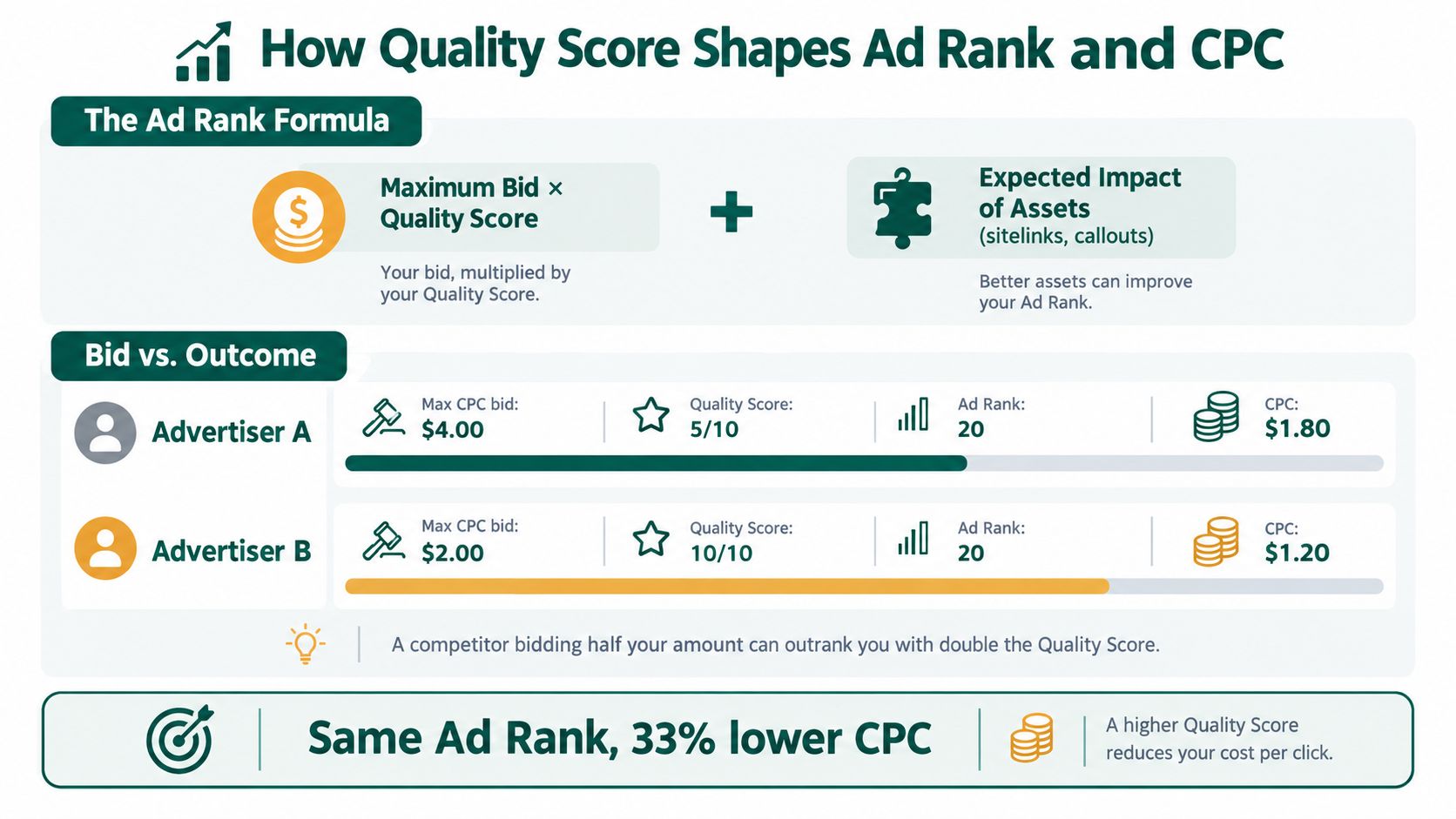
Google does state that higher-quality ads can lead to lower prices and better ad positions. The underlying auction evaluates expected performance and relevance, including the expected impact of assets such as sitelinks and callouts. Quality Score provides a reporting view into some of the quality dimensions that influence how Google assesses the ad experience, but the visible score isn't the complete auction mechanism.
A competitor with a lower bid can sometimes achieve a stronger outcome because Google expects that advertiser's result to be more useful for the searcher. The commercial principle is sound, but the simplistic calculation is not. You can't reliably take a bid, multiply it by the displayed Quality Score, and infer a final position or CPC.
That matters in crowded categories such as security, analytics, infrastructure, and developer tooling. Two companies may bid aggressively for the same category term, yet one may produce a more specific answer to the search. The more specific ad can earn stronger engagement and a better auction result without the team treating the displayed score as a control knob.
For a SaaS team with a strict CAC ceiling, a lower CPC is useful only if the traffic remains commercially relevant. A cheaper click from a broad category audience can create more sales work, weaker qualification, and less pipeline. A more expensive click from a precise use-case query may be the healthier acquisition source if it produces better opportunities.
Use Quality Score to investigate why an ad may be struggling to earn attention or satisfy the query. Then judge the change through qualified conversion rate, opportunity creation, sales acceptance, and pipeline contribution. Google's own explanation that higher-quality ads can lead to lower prices and better positions is a reason to improve the underlying experience, not a reason to worship the displayed number. Google's guidance on ad quality and pricing provides the right directional principle without turning the diagnostic into a fake formula.
The interface becomes useful when you stop looking at Quality Score as a single column. Add the visible component fields for Expected CTR, Ad Relevance, and Landing Page Experience, then inspect them at the keyword level. The objective is to identify the constraint affecting a cluster of related searches.
Google also exposes historical columns for Quality Score, landing page experience, ad relevance, and expected CTR. Those fields allow a team to compare the current diagnostic with the selected historical period and identify movement instead of relying on a point-in-time snapshot. Treat the historical view as context, not as a substitute for current campaign and pipeline data.
The labels Below Average, Average, and Above Average are not performance tiers for the business. They are pointers toward the part of the ad journey that needs attention.
| Component | Below Average Means | Average Means | Above Average Means |
|---|---|---|---|
| Expected CTR | The ad may not be compelling or specific enough for the search context | The ad is broadly competitive but may have room for sharper intent matching | The message is earning strong predicted click behavior for its context |
| Ad Relevance | The keyword and ad promise are not tightly aligned | The ad addresses the theme but may use generic or diluted language | The ad language closely reflects the searcher's problem |
| Landing Page Experience | The destination may not continue the search promise clearly | The page is usable but may lack specificity or persuasive continuity | The destination provides a strong, relevant continuation of the ad |
Consider two keywords in the same ad group. “SOC 2 compliance software” expresses a defined buying problem. “Enterprise security platform” describes a much wider category and can represent different jobs, roles, and stages of evaluation. The same ad may show stronger relevance for the first keyword and weaker relevance for the second, even though both terms appear to belong to the same product category.
Export the keyword data with current and historical component columns. Group the rows by intent, not only by campaign or ad group. Then ask:
A high score with poor opportunity quality is not a success. A weak score on a strategically valuable cluster is not automatically a reason to pause it. This view of the B2B SaaS website as the center of growth is relevant here because paid search quality often exposes a positioning problem on the destination page, not merely an advertising problem.
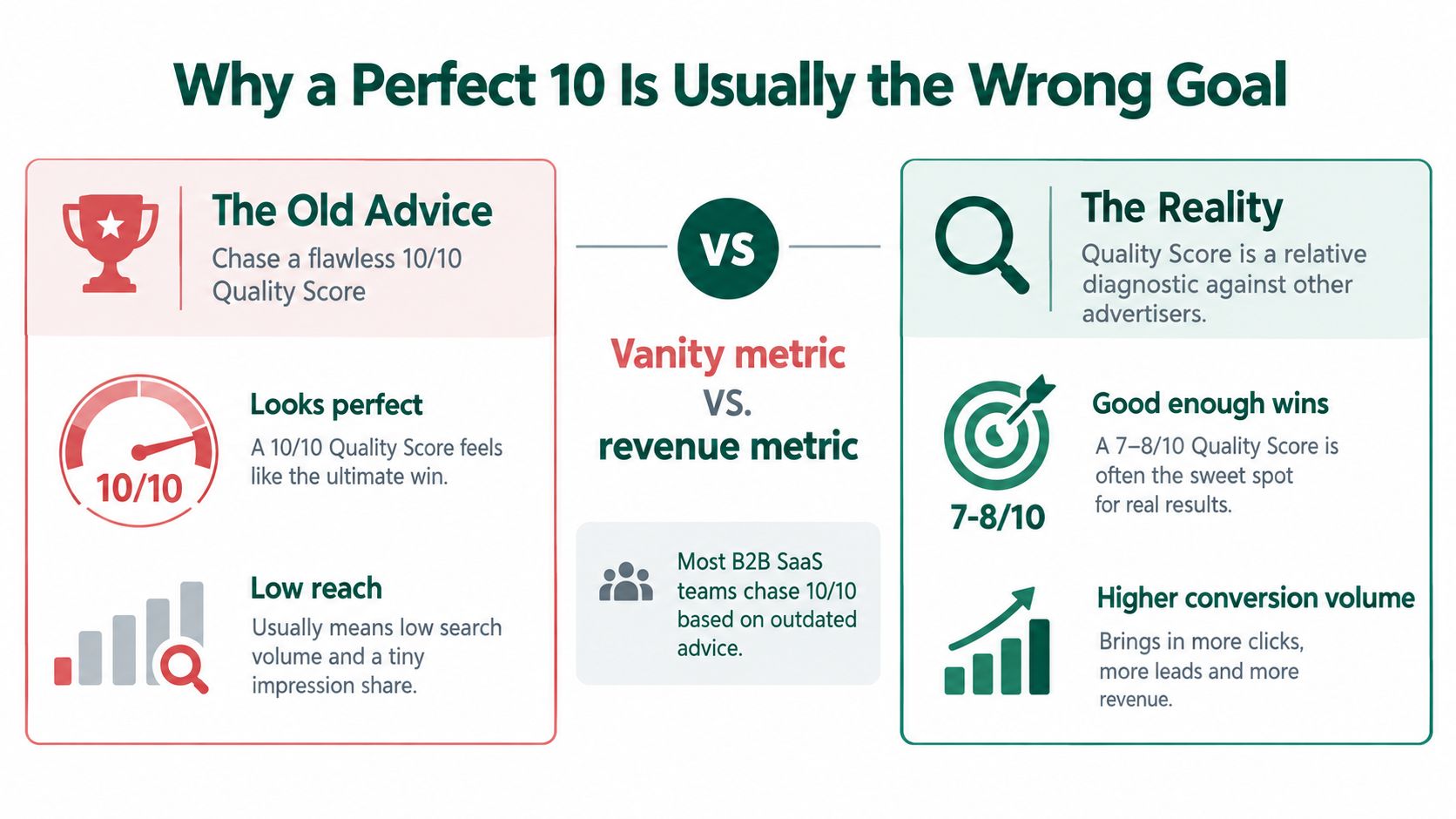
A perfect Quality Score is a tidy internal target, not a reliable growth objective. It gives leadership one number to report and paid media managers a visible finish line. For B2B SaaS, that finish line can pull attention away from qualified pipeline.
Quality Score is comparative. Google benchmarks its component statuses against other advertisers whose ads appeared for the same search during the prior 90 days. The result is not an absolute certificate of quality. It shows how a keyword and its experience compare with competing ads in a recent auction context. Google's documentation on the comparative nature of Quality Score makes this especially important in narrow categories, where the competitive set and search behavior can shift.
Treat the score as a diagnostic signal. Use it to identify a constraint, then judge that constraint against account-level business outcomes.
A keyword with a middling diagnostic can still deserve investment if it reaches the right accounts and produces qualified opportunities. A keyword with a stronger diagnostic can waste budget when it attracts low-intent traffic, the wrong company size, or leads that sales cannot progress.
The leadership calculation is:
Cost per qualified opportunity, opportunity quality, sales acceptance, and pipeline contribution matter more than the displayed score in isolation.
A 10/10 keyword that creates no qualified demand is a polished failure.
The same discipline applies to conversion rates and CPC. A lower click cost does not automatically improve acquisition economics. Measure whether the traffic becomes opportunities your sales team can win at a sustainable cost.
Pursue a Quality Score improvement only when three conditions hold:
Do not rebuild a campaign merely to raise a score that has no relationship to account quality. Do not replace precise language with generic benefit claims to attract more clicks. B2B SaaS buyers do not reward an elegant dashboard. They decide whether the result understands the problem behind their search.
Use the score to prioritize investigation, not to declare success. A seven or eight can be the right operating range when the keyword produces strong accounts, accepted opportunities, and pipeline. A ten can still signal the wrong audience or weak commercial fit.
Improvement starts with the query, not the dashboard. B2B SaaS teams often write ads from the product outward, using terms such as “all-in-one,” “enterprise-ready,” and “modern platform.” Buyers search from the problem inward. Your ad needs to close that distance.
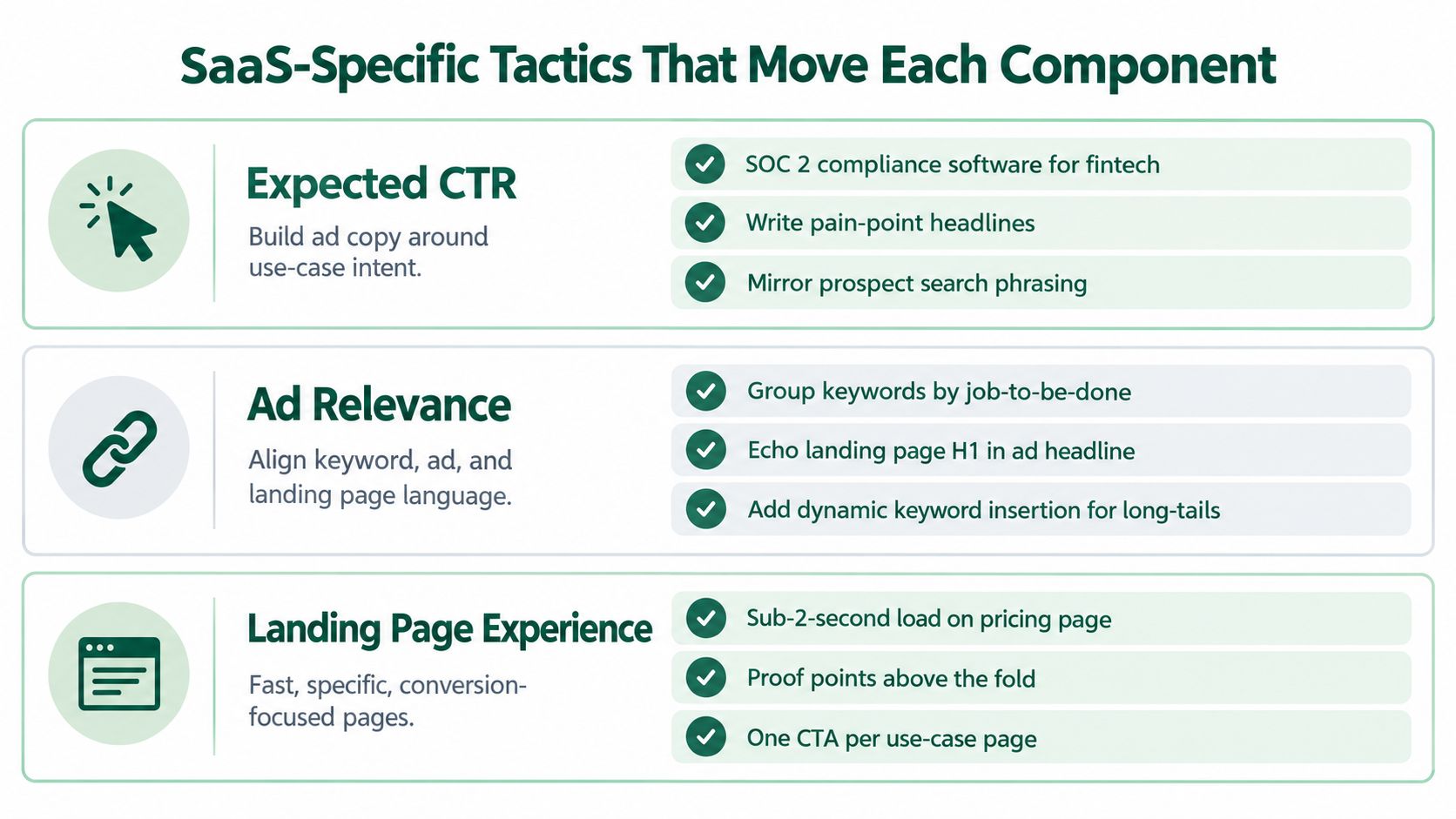
Use-case intent should shape the ad. “SOC 2 compliance software for fintech” gives you more useful direction than a broad compliance category. The ad can speak to evidence collection, audit preparation, or framework mapping, depending on the actual job behind the search.
Organize keyword groups around meaningful buyer intent and, where the volume supports it, buyer role. A CISO may care about control visibility, a CTO may care about engineering workload, and a VP of Engineering may care about implementation effort. Don't force every role into one generic headline.
Make the ad language echo the searcher's language without making the copy mechanical. Pinning selected headlines can help preserve the message hierarchy when a particular query needs a specific promise, but don't use pinning to freeze weak copy permanently.
Test category language against problem language:
The winning message isn't the one that sounds most polished internally. It's the one that makes the searcher recognize the job they need done.
Send each intent cluster to a page that continues the promise. A generic product page forces the buyer to search for relevance after the click. A dedicated page can make the use case, audience, proof, evaluation path, and next step visible without requiring translation.
For teams rebuilding this layer, this landing page optimization guide offers a useful framework for making the destination more specific and conversion-ready.
A focused sprint can cover the following actions:
For practical ad language examples, use these B2B ad copy examples as a source of patterns, then adapt them to the specific market and buyer rather than copying their surface wording.
Quality Score improves as a byproduct of disciplined message and experience reviews. It deteriorates when teams react to isolated movements, rewrite ads without a hypothesis, or let campaign structure drift as the product expands.
A lean SaaS team needs a repeatable operating cadence. The review should be short enough to happen consistently and serious enough to connect platform diagnostics with commercial evidence.
Pull keyword-level Quality Score and the three component statuses. Segment the findings into three operating buckets:
Don't let the meeting become a score-reading exercise. Every flagged cluster should have an owner, a hypothesis, and a business metric. If nobody can explain what the team expects to improve, the review is reporting theater.
Compare Quality Score movement with cost per lead, qualified lead volume, sales acceptance, and pipeline contribution by campaign theme. Campaign themes are more informative than ad groups alone because they connect the searcher's problem with the product narrative and sales motion.
A compliance automation campaign and a broad security software campaign may both contain relevant keywords, but they can attract different buying committees and sales cycles. Aggregate reporting can hide that distinction. Keep the diagnostic close to the commercial context.
Review whether high-quality keywords are converting into the accounts the company wants. If pipeline lags while the diagnostics look strong, the score is detached from revenue. That usually points to a positioning, qualification, offer, or sales follow-up issue rather than a need for more copy edits.
Use a sustained decline in a keyword's score as a trigger for investigation, not as an automatic pause rule. Investigate changes in query mix, competitors, message relevance, landing page continuity, and account targeting before deciding what to change.
The operating model is simple: diagnose weekly, connect to pipeline monthly, and question the metric quarterly.
This is the broader discipline behind measuring marketing effectiveness. Quality Score belongs in the evidence layer of your operating system. It should help the team decide faster, but it shouldn't decide the budget by itself.
Big Moves Marketing helps B2B SaaS leaders clarify positioning, align paid search with buyer intent, and connect campaign diagnostics to qualified pipeline. Visit Big Moves Marketing to discuss where your Quality Score data is exposing a real growth constraint, and where it is distracting the team.




%20-%20white.svg)