%20png%20copy.avif)
If you run conversation intelligence as a strategic revenue engine, test Gong first. If Chorus already rides inside your ZoomInfo bundle, test Chorus first. Both handle recording and coaching well. The real split lies in budget structure and how much AI-driven forecasting you actually need.
TL;DR:
- Transcription accuracy and speaker separation are critical, as errors directly impact coaching quality and AI summaries.
- Running a matched-call test with both platforms reveals key differences in risk detection and deal insights within minutes.
- The three-year total cost of ownership depends heavily on whether Chorus is bundled into ZoomInfo or purchased separately, affecting true affordability.
- Strong integrations, automated data writebacks, and transparent export limits are vital, especially if switching vendors later.
- A preliminary call archive analysis can identify whether conversation intelligence addresses your team’s actual coaching and forecasting needs.
Gong and Chorus share a foundation: call recording, transcription, coaching dashboards, CRM sync. The gap opens in depth, automation, and how the invoice actually looks. Gong sells as a standalone platform with a separate platform fee layered on top of per-seat pricing. Chorus, now part of ZoomInfo, frequently ships bundled inside ZoomInfo enterprise contracts, which changes the real math for buyers who already pay for ZoomInfo data.
| Dimension | Gong | Chorus |
|---|---|---|
| Pricing / TCO signal | Per-seat plus platform fee, sold standalone | Often bundled into ZoomInfo enterprise plans |
| Best for | Teams needing deep deal intelligence and forecasting | Orgs already on ZoomInfo wanting bundled CI |
| Standout features | Deal boards, AI “ask anything” across calls, forecast inspection | Tight ZoomInfo data integration |
| AI capabilities | Higher feature velocity, more standalone AI investment | Prioritizes integration depth over new AI ships |
| CRM integrations | Deep Salesforce/HubSpot sync with field writebacks | Strong when paired with ZoomInfo’s data layer |
| Ease of use | Praised for search and UI in G2 reviews | Solid but secondary to ZoomInfo workflow |
Before you sign anything, run these two tests:
Multiple market analyses describe Gong as the category leader on features and AI depth, while Chorus’s clearest edge is what it saves you if you’re already a ZoomInfo customer.
Transcription quality is the foundation everything else sits on. If the transcript misreads a competitor name or drops a pricing objection, your coaching and your AI summaries inherit that error. Reviewers on G2 consistently flag transcription accuracy and speaker separation as the thing that made or broke adoption for their teams, and Gong’s search and UI come up often as a reason reps actually open the tool instead of ignoring it.
Deal intelligence is where the two products diverge hardest. Gong’s deal boards flag stalled opportunities, missing stakeholders, and risk signals pulled straight from call content. Then, they let managers ask a question across an entire call library and get a synthesized answer back. Market write-ups from 2026 describe Gong shipping AI features faster than Chorus, which has spent more of its engineering budget on integration depth inside the ZoomInfo stack than on new standalone AI capability.
Here’s what actually changes outcomes for managers:
Pro Tip: Before you compare feature lists, pull ten calls where your team lost a deal it should have won. Run those exact calls through both platforms. The gap in risk-flagging shows up in minutes, not slide decks.
Data writebacks matter more than most buyers realize going in. Both platforms can extract structured fields (next steps, MEDDIC criteria, competitor mentions) and push them to Salesforce or HubSpot. But the feature category breakdown from SoftwareReviews shows the shared fundamentals are wide. The differences live in automation depth and how easily you can export your own data if you switch vendors later. Ask about export limits before you sign, not after.
List price is a decoy. The number that matters is three-year total cost of ownership, and that means adding the platform fee, storage, implementation, admin hours, and exit costs to the sticker price. A proper normalized TCO calculation stacks subscription cost, platform or bundle fees, storage, implementation, admin time, enablement, migration, and support, then subtracts whatever tools you’ll retire.
Gong typically prices per seat with a separate platform fee on top, sold as a standalone product. Chorus is commonly bundled into ZoomInfo enterprise contracts, which can lower your effective per-seat cost dramatically if you’re already paying for ZoomInfo data. But bundled pricing hides the real number. Ask for a standalone Chorus quote and compare it to what you’re paying inside the bundle. Sometimes the bundle math only works because you’re overpaying for ZoomInfo seats you don’t use.
Run the TCO math in four steps:
Salesforce and HubSpot sync matters more than the demo makes it look. Ask each vendor to write a completed call’s MEDDIC fields directly into a test opportunity record and watch what actually lands versus what gets summarized generically.
Gong’s AI feature velocity tends to outpace Chorus here, while Chorus leans on ZoomInfo’s existing data layer for firmographic context Gong doesn’t natively carry.
Set hard gates before you look at a single demo. If a vendor fails one, walk away regardless of the pitch.
Design the pilot around a matched-call corpus, meaning the same 20 to 30 calls run through both tools in an identical CRM sandbox, over 30 to 90 days. The strongest single procurement test is verifying transcript-to-CRM field accuracy before you commit budget. Track manager review rate, clip creation frequency, CRM field accuracy, and any shift in forecast variance during the pilot window.
Pro Tip: Ask both vendors, in writing, exactly what they do with your call audio for AI model training and whether you can opt out. Vague answers here predict vague answers on everything else.
Choosing between Gong and Chorus without first assessing company size, pipeline sophistication, and manager coaching cadence is how teams end up paying for software nobody opens. The best procurement teams tie tool selection to a measurable KPI, usually forecast accuracy or coaching consistency, before they sign.
Platform depth wins when your managers already coach weekly and your CRM data is clean. Bundling wins when your ZoomInfo spend is large enough that Chorus becomes nearly free at the margin. Neither wins if nobody reviews a single call after week two.
If your CRM hygiene is weak or your managers haven’t run a consistent coaching cadence yet, a short diagnostic on your existing call archive, paired with a look at your broader go-to-market strategy, often reveals more than a new subscription will.
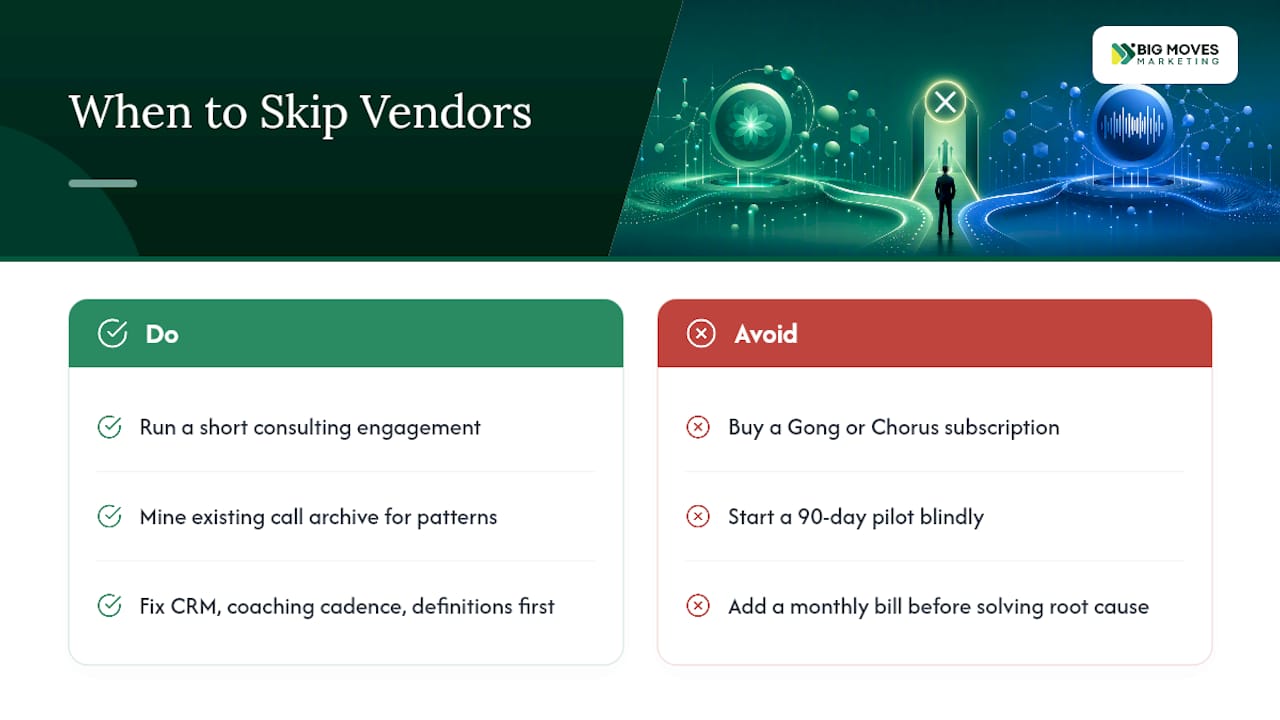
Some teams aren’t ready for either platform. If your CRM data is messy, your managers don’t coach on a fixed cadence, or nobody has defined what “good” looks like on a call, a new subscription won’t fix that. It just adds a monthly bill to an unsolved problem.
In that situation, a short consulting engagement to mine your existing call archive for patterns, before you buy anything, tells you more than a 90-day pilot with either vendor will.
— Veb
There’s a real cost to running a 90-day pilot with Gong or Chorus before you know whether your team’s problem is even a tooling problem. A focused engagement can mine your existing call archive first, matched against a procurement checklist and an adoption plan, so you know what a conversation intelligence platform would actually surface before you commit to a contract.
The output is concrete: a matched-corpus analysis of calls you already have, a scored procurement checklist you can hand to either vendor, and an adoption plan built around your managers’ real coaching cadence, not a generic rollout template. If your team also needs the go-to-market website to support the sales process these tools feed into, that’s built into the same engagement. Consider booking a discovery call to explore insights from your call archive.
Gong was founded in Israel and built its early engineering base there, though it now operates as a global company with major operations in the United States.
Chorus by ZoomInfo is Gong’s most-cited direct competitor, alongside other conversation intelligence tools in the same category tracked by SoftwareReviews.
For teams that tie coaching and forecasting directly to a measurable KPI, reviewers consistently cite Gong’s search, UI, and deal intelligence as worth the platform fee. For teams without a coaching cadence in place, the value drops fast regardless of the platform chosen.
Chorus is commonly bundled into ZoomInfo enterprise contracts rather than priced as a clean standalone number, so the real cost depends on your existing ZoomInfo seat count and contract terms. Always request a standalone quote to compare against the bundled price.



%20-%20white.svg)