%20png%20copy.avif)

Most advice on fractional marketing is too shallow to be useful. It frames the model as a cheaper substitute for a full-time hire. That is the wrong lens.
If you are a B2B SaaS founder, the key question is not whether you can save on headcount. The question is whether you need senior marketing judgment before you need a permanent marketing department. Those are not the same thing. One buys direction. The other buys payroll.
A strong fractional engagement gives you temporary access to executive-level GTM thinking at the moment your company is too complex for founder instinct alone, but not mature enough to justify a full in-house leadership layer. A weak one gives you expensive advice detached from execution, or channel activity detached from strategy. That is why some founders swear by fractional marketing and others think it is a dressed-up consulting retainer. Both are reacting to real outcomes.
The difference is usually not the model. It is the fit, the scope, and the operator.
The standard B2B SaaS hiring playbook breaks earlier than founders admit.
It pushes you toward two expensive mistakes. Hire a full-time marketing executive before the company has earned that level of specialization, or buy execution capacity before the company has made the core strategic choices that make execution useful.
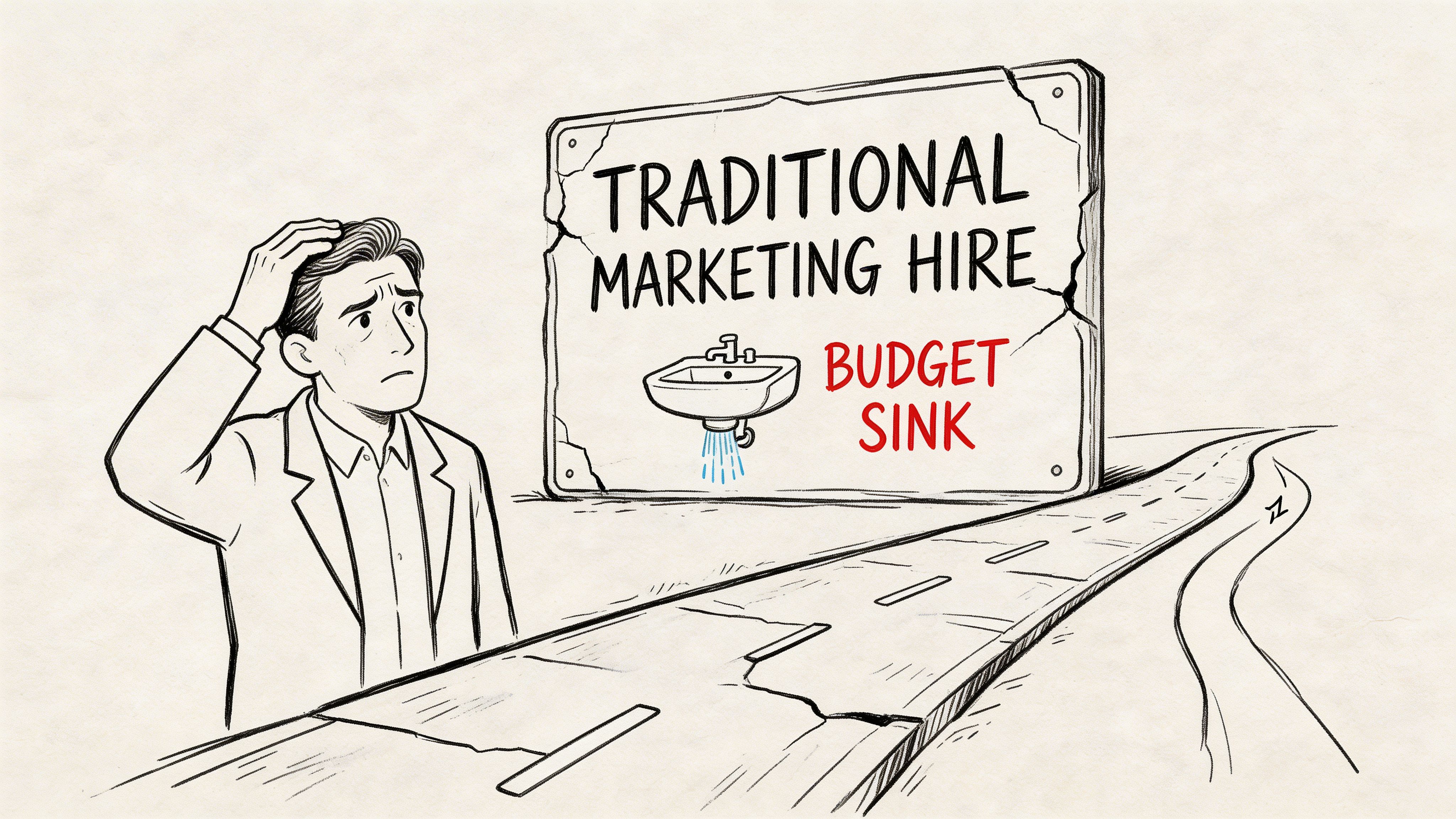
A full-time CMO looks disciplined on an org chart. In an early-stage SaaS company, it often means the founder is trying to solve uncertainty with seniority.
That is a poor trade.
A full-time CMO commands an average salary of $316,000 in 2025, and the total cost can rise to over $455,000 with benefits and equity, according to this breakdown of fractional CMO costs and ROI.
The significant cost lies not in compensation. It is lock-in. You are committing to a senior leader before you have clear answers on positioning, ICP priority, sales and marketing handoff, channel focus, and whether the actual constraint sits in demand creation, conversion, or pipeline progression.
That setup creates a bad job for the executive and a worse outcome for the company. The CMO either operates above the mess and produces strategy that cannot stick, or drops into day-to-day execution to keep the machine running. Neither outcome justifies executive-level cost.
The agency decision usually comes from the same flawed logic. Activity feels safer than diagnosis because it looks like progress.
Founders say they need more content, more paid acquisition, more outbound support, more campaigns. In many cases, they need sharper choices first. If you have not decided who matters most, what problem you win on, which motion fits the product, and what marketing is responsible for in the revenue path, added capacity just accelerates waste.
That is why broad agency scopes disappoint so often in B2B SaaS. You get output. You do not get prioritization. You get channel management. You do not get a founder-level point of view on where the next dollar and hour should go.
If your ICP is muddy, your message is generic, and your go-to-market motion is unstable, more execution increases the cost of being wrong.
Early marketing problems rarely start with missing hands. They start with a function that has not been designed yet.
Before you hire anyone, decide what marketing is supposed to do in this stage of the company. Should it clarify positioning, support founder-led sales, build a repeatable demand gen engine, tighten conversion, or help recruit and manage specialists? Those are different mandates. They require different leadership and different team structures.
This is the founder mistake that matters. You hire by title before you hire for the actual decision set in front of you.
If you need help structuring those decisions, use a B2B marketing team structure framework for growth stage and function design. The sequencing matters more than the title. A lot of underperforming marketing teams are just expensive answers to the wrong question.
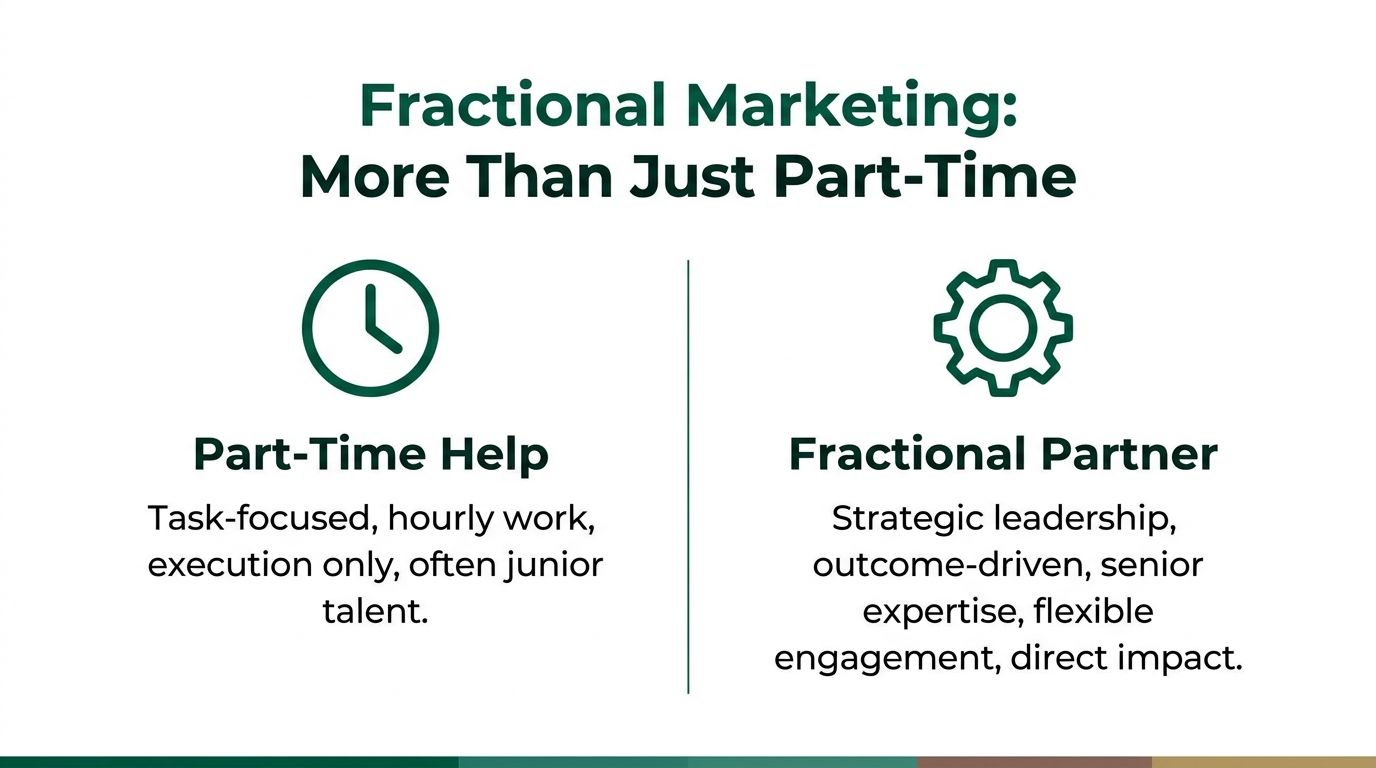
Fractional marketing is not part-time help. That definition is too small to matter.
The useful definition is this: you are buying senior decision-making on a constrained basis. Not because you want less marketing, but because you want better judgment before you commit to a permanent structure.
The model has grown because the need is real. The fractional leadership market is no longer niche. 25% of US companies already use fractional executives, with projections reaching 35% by 2025, and technology at 51.6% and SaaS at 34.8% among the primary adopters, according to Fractionus market data on fractional work statistics.
That adoption matters for one reason. It tells you founders and operators are no longer treating this as a stopgap. They are using it as a deliberate operating choice.
If you think fractional means “someone works fewer hours,” you will hire badly.
A true fractional partner does not just complete tasks across fewer days per week. They set priorities, challenge assumptions, create operating logic, and force trade-offs that internal teams often avoid. They should affect what the company does not do just as much as what it does.
That distinction matters because many founders are not choosing between full-time and part-time. They are choosing between:
Those are different purchases.
A founder should separate these options clearly.
| Model | What you are really buying | Best use case | Common failure mode |
|---|---|---|---|
| Fractional CMO | Strategy, prioritization, leadership, GTM diagnosis | Post-product, pre-repeatable growth | Too much advising, not enough operating clarity |
| Specialist contractor | Deep execution in one area like paid search, lifecycle, SEO, or content | You already know the problem and need focused delivery | Excellent work on the wrong problem |
| Agency | A packaged execution system across multiple services | You have clear strategy and need output at scale | Activity without accountability to revenue |
Founders often get sloppy at this point. They hire an agency when they need diagnosis. They hire a contractor when they need orchestration. They hire a fractional CMO when they really need a demand gen operator with clear constraints.
The right question is not “Do we need fractional marketing?”
It is “Which decisions are currently too expensive for us to keep making badly?”
For B2B SaaS teams weighing external support, this comparison often sits next to a broader build-vs-buy question. This article on agency options for B2B marketing is useful if you are trying to sort leadership needs from execution needs.
A good fractional setup should feel like temporary executive infrastructure. Not freelance overflow. Not outsourced busywork.
Yes, fractional marketing can cost less than a full-time executive. That is not the main reason to do it.
If lower spend is your whole thesis, you will optimize for rate instead of outcome. That is how founders end up with cheap help and expensive drift.
The core value is strategic compression. A strong operator shortens the time between “we know something is off” and “we know exactly what to fix.”
Founders routinely overvalue output and undervalue diagnosis.
You can launch paid search, rewrite the homepage, publish comparison pages, and tighten SDR sequences. None of that matters if the company is pushing the wrong message to the wrong buyer through the wrong motion.
Experienced leadership earns its keep in this area. Experienced fractional CMOs achieve an average ROMI of 589%, according to Breakthrough3x’s KPI analysis for fractional CMOs. The important part is not just the number. It is the mechanism behind it. The outperformance comes from better KPI selection, tighter alignment to revenue, and attention to customer lifetime value instead of vanity metrics.
That is exactly what early-stage SaaS teams need. Not more dashboards. Better judgment about what should be on the dashboard.
A strong fractional partner usually changes the conversation fast. The discussion moves from “Which channel should we try next?” to questions like:
Those are higher-value questions than “should we post more on LinkedIn?”
Fractional marketing is also a way to test strategic hypotheses without locking the company into a full executive buildout.
That matters when you are still resolving issues like:
You do not need permanent headcount to answer those questions. You need someone who knows how to structure the test, define the signal, and stop bad experiments quickly.
This is why the model works well for companies in motion. New category story. Product repositioning. Demand gen restart. Pricing shift. Sales enablement rebuild. The value is not “someone helps with marketing.” The value is that someone senior narrows uncertainty.
A weak external partner creates dependency. A strong one raises the level of the internal team.
That usually shows up in simple but important ways. A content marketer starts working from sharper messaging. A growth lead learns how to tie channel metrics to pipeline quality. The founder stops serving as informal reviewer of every landing page and campaign brief.
This is one reason I prefer the model when the internal team has energy but lacks a system. You do not always need to replace people. You often need to give them a clearer operating frame.
If you are in that position, this perspective on consulting services for startups is relevant because it treats outside support as a decision accelerator, not a bolt-on vendor category.
Cost matters. Clarity matters more. Founders who understand that tend to get far more from fractional marketing than founders who treat it like discounted headcount.
Fractional marketing is powerful in the right company and wasteful in the wrong one.
That sounds obvious, but most bad engagements fail for predictable reasons. The founder wants senior outcomes without organizational readiness. Or they want one operator to fix problems that start with product, sales, or basic market understanding.
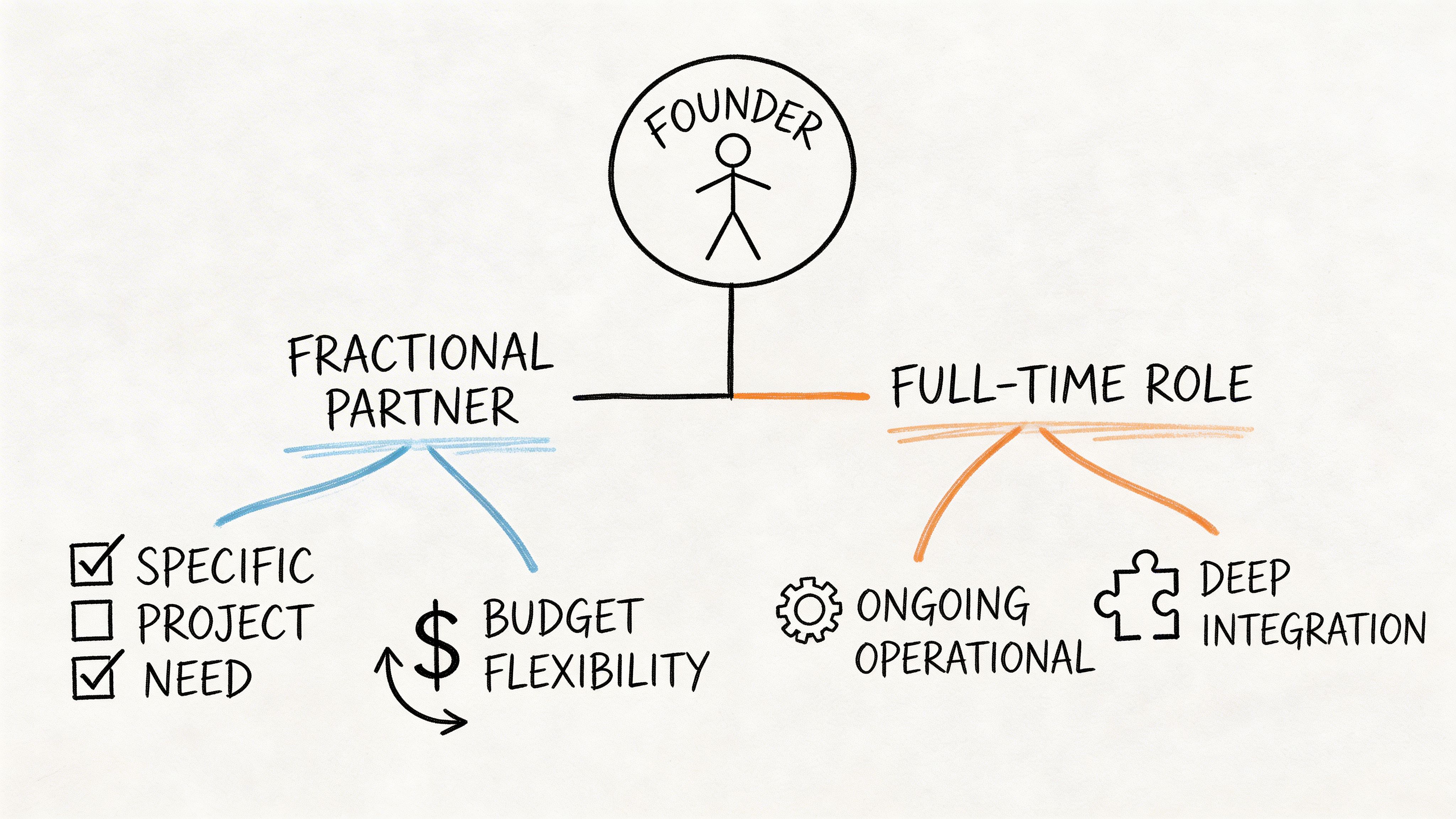
The readiness threshold is not a soft consideration. It is a hard filter. B2B SaaS companies under $1M ARR that lack basic foundations like initial messaging or a functional website show a 35-45% failure rate in fractional marketing engagements, while the sweet spot is between $1M and $15M in revenue, based on OtterHalf’s analysis of when fractional marketing works.
That lines up with what I see in practice. The model works best when there is already something to shape, focus, and scale.
A fractional partner usually makes sense in a few specific situations.
For distributed startups, hiring patterns can blur signal. Founders often compare marketers from agencies, in-house backgrounds, and contractor ecosystems without a clean benchmark. A practical way to calibrate expectations is to review how serious remote-first businesses structure senior talent. Lists like top remote companies help because they show how mature distributed teams think about specialized leadership and operating discipline.
This model is wrong for a lot of companies.
A lot of founders would benefit from reading this practical take on the fractional CMO role before they start interviews, because the title attracts very different kinds of operators.
Here is the simpler version. Hire a fractional partner when you need better decisions. Do not hire one when you are still avoiding the decisions that matter.
A useful reality check sits below.
The worst fractional engagements produce advice. The better ones produce assets. The best ones produce assets tied to operating decisions.
That distinction matters because founders do not need more marketing documents. They need outputs that change how the company goes to market.
A high-impact engagement should usually create three concrete deliverables.
First, a positioning and messaging framework. Not a wordsmithing exercise. A real operating document built from customer language, competitive context, and sales reality. It should clarify who the ICP is, what pain is urgent enough to convert, what alternatives buyers compare you against, and how your product earns the right to win.
Second, a 90-day GTM plan. This should not read like a wish list. It should identify the few channel bets worth running now, the assumptions behind them, what success means, and what gets deprioritized. If a team says yes to paid LinkedIn, lifecycle email, webinars, SEO, partner motions, outbound support, and website rebuild all at once, they do not have a plan. They have avoidance by volume.
Third, a sales enablement kit. That usually includes a sharper pitch deck, one-pagers, objection handling, and message alignment between marketing and sales. In B2B SaaS, many pipeline problems are handoff problems. Marketing says one thing. Sales says another. The buyer hears both and trusts neither.
A strong fractional partner reduces interpretation gaps across the funnel. That alone can change conversion quality.
Deliverables only matter if someone owns the system behind them.
A useful structure is a fractional CMO plus a performance marketing specialist, with the work centered on an attributable funnel and channel campaigns targeting a minimum 3x ROAS. According to Fractionus on marketing team structure, this model can be 50% more cost-effective and productive than a traditional agency model when the roles are clear.
That is the part founders miss. The value is not just the document. It is the combination of strategic ownership and focused execution.
In practical terms, good output should answer questions like:
If you need a reference point for how those plans connect to pipeline creation, this piece on demand gen strategy is a useful complement.
Big Moves Marketing is one example of this kind of work for B2B SaaS and Shopify app teams. The focus is on positioning, messaging, websites, and GTM pilots rather than generic campaign outsourcing.
A founder should know what they are buying before the engagement starts. If the deliverables are vague, the outcome usually is too.
Most founders evaluate fractional marketers the wrong way.
They ask about channels, not diagnosis. They ask about tactics, not sequencing. They ask whether someone has “done SaaS” instead of asking whether they can identify the constraint inside a messy SaaS business.

You are not hiring someone to sound informed on a call. You are hiring them to reduce strategic waste.
Good interviews force the candidate to think in public.
Ask questions like these:
I also look for whether they can explain trade-offs without hiding behind jargon. If every answer sounds smooth but noncommittal, keep moving.
The strongest candidates make your problem feel clearer before the contract is signed.
Bad onboarding kills momentum.
The first month should not disappear into vague discovery. It should create a sharp baseline, early decisions, and one visible win.
Use a checklist.
Define the business objective
Pick the near-term priority. Pipeline quality, repositioning, a new segment, website conversion, launch readiness, sales enablement. Not all of them.
Grant access early
Give access to CRM, analytics, ad accounts, call recordings, customer research, previous messaging, and current plans. Hidden data produces slow diagnosis.
Name decision-makers
Founders create confusion when everyone can comment but nobody can decide. Clarify who approves messaging, spend, scope, and priorities.
Set a communication cadence
Weekly working session. Fast async feedback. A clear owner on your side. Fractional marketing fails when the partner floats outside the operating rhythm.
Agree on first-wave outputs
That might be a messaging reset, funnel audit, 90-day plan, website narrative, or sales deck rebuild. Make the first phase visible.
A good onboarding process should feel disciplined, not ceremonial. If the kickoff is heavy on enthusiasm and light on operating detail, that is a warning sign.
Founders make a mistake when they treat fractional marketing as a budgeting trick.
That mindset pushes them toward the wrong questions. “Can we get senior help for less?” is a weaker question than “What kind of marketing leadership does this stage require?” The first optimizes a line item. The second improves company decisions.
That is the primary use of the model.
Fractional marketing works when your company has enough traction, complexity, and urgency to need senior judgment, but not enough clarity to justify building the full leadership layer around it. In that window, permanent hiring is often premature and broad outsourcing is often too blunt. What you need is someone who can tighten narrative, choose the right GTM bets, impose priorities, and create a system your future team can inherit.
That is why I push founders to evaluate impact, not spend.
Ask:
If the answer is yes, the model can be effective.
If the answer is no, it does not matter how flexible the retainer looks.
The strongest outcome of a fractional engagement is not outsourced marketing. It is a sharper company. Clearer message. Better priorities. Fewer bad bets. A cleaner path to the full-time leader you eventually hire.
That is the edge.
If your team needs sharper positioning, a credible go-to-market plan, or founder-level marketing guidance before making a full-time hire, Big Moves Marketing works with B2B SaaS and technology companies as a fractional CMO and GTM partner. The goal is simple: help you make better growth decisions faster, then turn them into a system your team can run.
Explore Big Moves Marketing services and resources:




%20-%20white.svg)