%20png%20copy.avif)
Most advice on fractional CMO meaning is shallow. It treats the role like a cheaper CMO or a dressed-up consultant.
That’s wrong.
A fractional CMO is a part-time senior marketing leader brought in to own direction, priorities, and accountability without adding a full-time executive salary before the business is ready. For B2B SaaS founders, that distinction matters. The problem usually isn’t “we need more marketing.” The problem is that nobody is making hard strategic decisions across positioning, pipeline, team structure, and sales alignment.
That’s why the model has moved from edge case to standard option. The fractional CMO market reached $1.27 billion in 2026 and is projected to reach $2.68 billion by 2031, a signal that companies are changing how they buy executive leadership, not just cutting costs (gtm8020 market data).
If you’re a founder, the useful question isn’t “what does a fractional CMO do?” It’s this: Do we need strategic marketing leadership right now, or do we need another person to ship tasks? Those are different hires. Confusing them is how companies burn a year and call marketing “unpredictable.”
The default startup advice is backward. Once growth gets messy, people say, “hire a CMO.”
Usually, you shouldn’t.
Early-stage B2B SaaS companies rarely fail because they lacked a senior title. They fail because they hired executive overhead before they had a clear ICP, stable messaging, channel discipline, or a team that could absorb strategic leadership. A full-time CMO dropped into that environment often becomes either underutilized or forced into work that doesn’t match the job.
Founders usually think they need “someone to run marketing.” That’s too vague to be useful.
What they often need is one of three things:
A full-time CMO can do that. But if the company isn’t ready for a permanent executive layer, the hire becomes expensive confusion.
Early companies tend to overestimate how much senior leadership they can use and underestimate how much messy execution still sits ahead of them.
A seasoned CMO is valuable when there’s enough complexity to justify deep organizational integration. If you still have founder-led sales, uneven positioning, and a thin marketing bench, you don’t need maximum hierarchy. You need sharp judgment applied to the few decisions that change growth.
Most startups don’t need a CMO first. They need someone who can decide what marketing should stop doing.
This is why the fractional model has become normal, not novel. As noted earlier, the market shift is real. Companies are buying executive marketing leadership in smaller, more precise units because that fits the stage problem better than a permanent hire.
If you’re sorting out your org design, this breakdown on how to build your B2B marketing team structure is the right place to start. Team design should follow strategy. Not the other way around.
Don’t ask, “Should we hire a marketer or a CMO?”
Ask this instead:
| Question | If the answer is yes | What it suggests |
|---|---|---|
| Do we need executive-level judgment, but not full-time capacity? | Yes | Consider fractional leadership |
| Do we already have a functioning team that needs permanent leadership? | Yes | Full-time CMO may fit |
| Are we really missing execution in one narrow area? | Yes | You probably need a specialist, not a CMO |
That’s the core of fractional CMO meaning in practice. It’s not a downgraded title. It’s a stage-appropriate leadership model.
Founders mix these roles up constantly. Then they’re surprised when the outcome is wrong.
A consultant gives advice. A full-time CMO builds long-term executive infrastructure. A fractional CMO sits in the middle. They own strategy and leadership inside the company, but on a part-time basis.
That middle ground is exactly why the model works for many SaaS teams.
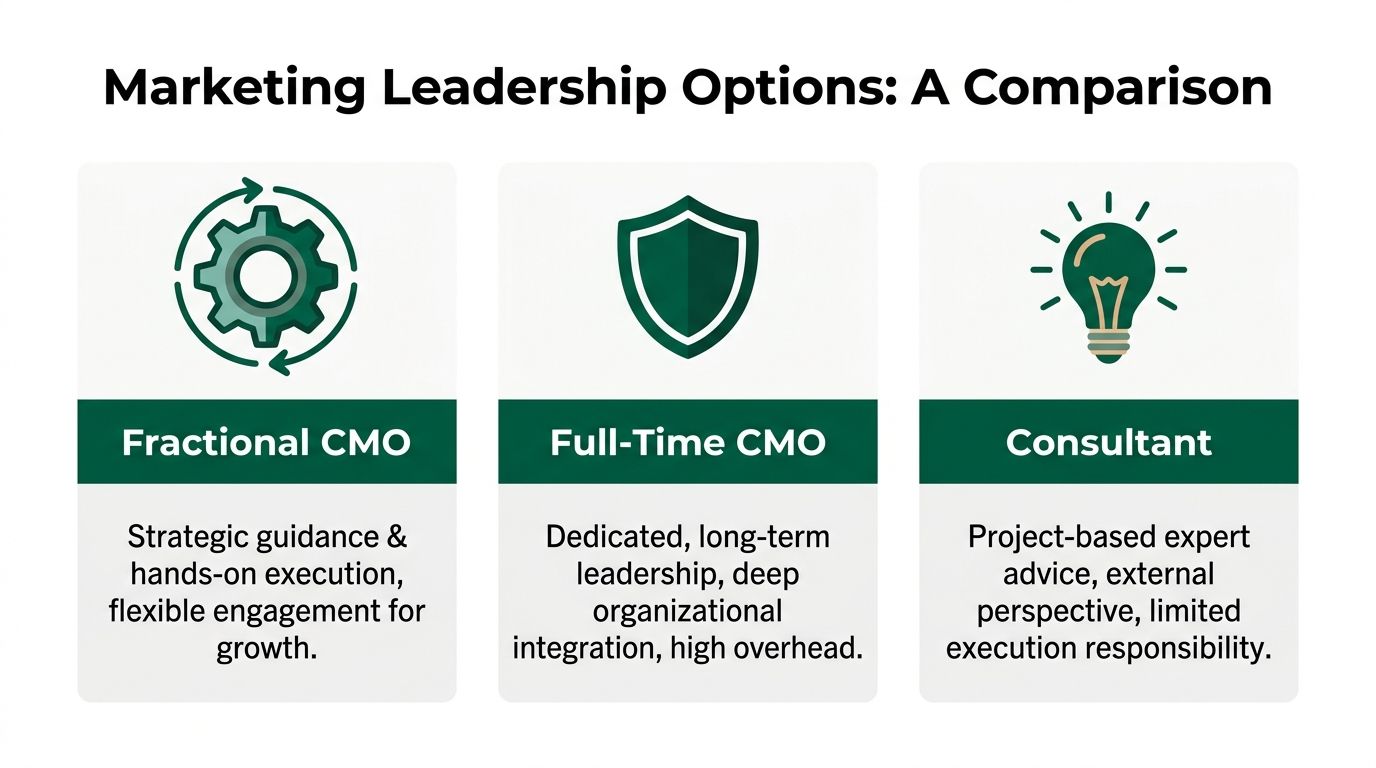
Fractional CMOs typically work 10 to 20 hours per week, and the model can deliver 50 to 70 percent cost savings versus a full-time hire while helping startups reach 3 to 5 times faster marketing maturity through experienced pattern recognition (Graph Digital on the fractional model). That’s useful when the company needs judgment more than headcount.
Here’s the comparison founders need.
| Attribute | Fractional CMO | Full-Time CMO | Marketing Consultant / Agency |
|---|---|---|---|
| Primary role | Embedded strategic leader | Permanent executive owner | External advisor or delivery partner |
| Time commitment | Part-time, recurring | Full-time | Project-based or scoped retainer |
| Strategic ownership | High | Very high | Usually limited or partial |
| Execution oversight | Directs team, vendors, priorities | Builds full org and operating cadence | Often recommends or executes within scope |
| Cross-functional influence | Strong if positioned correctly | Deep across company | Usually weaker outside project boundaries |
| Best fit | Growth-stage teams that need senior direction without full-time overhead | Companies with enough scale, complexity, and budget to support a permanent CMO | Teams with a narrow problem and clear internal ownership |
| Common failure mode | Too little internal execution support | Overhire for the stage | Strategy without ownership, or activity without business alignment |
A full-time CMO makes sense when marketing is already a major function inside the company. There’s enough team complexity, board visibility, and cross-functional coordination to justify a permanent executive seat.
A consultant or agency fits when the business already knows what it needs. Maybe the issue is paid search, product marketing, content production, website conversion, or lifecycle work. In that case, narrow expertise is fine because the strategic layer already exists somewhere inside the company.
A fractional CMO fits when nobody currently owns the whole picture. That includes:
Practical rule: If you need someone to challenge your roadmap, manage trade-offs, and report against pipeline, you’re not looking for a consultant.
They hire for comfort. Not for the constraint.
A consultant feels safer because it sounds reversible. A full-time CMO feels serious because it sounds mature. Neither matters if the role doesn’t match the company’s bottleneck.
If you want a sharper read on where consulting fits versus embedded leadership, this piece on a B2B marketing consultant is worth reviewing.
The cleanest way to think about fractional CMO meaning is this:
That’s not semantics. That’s the difference between useful marketing leadership and expensive drift.
A real fractional CMO does not exist to “support marketing.” They exist to build the operating system behind it.
If the role is working, you should see clearer choices, tighter execution, and better coordination between product, sales, and demand generation. If all you got was a strategy deck and some feedback on campaigns, you didn’t hire a fractional CMO. You hired an expensive commentator.
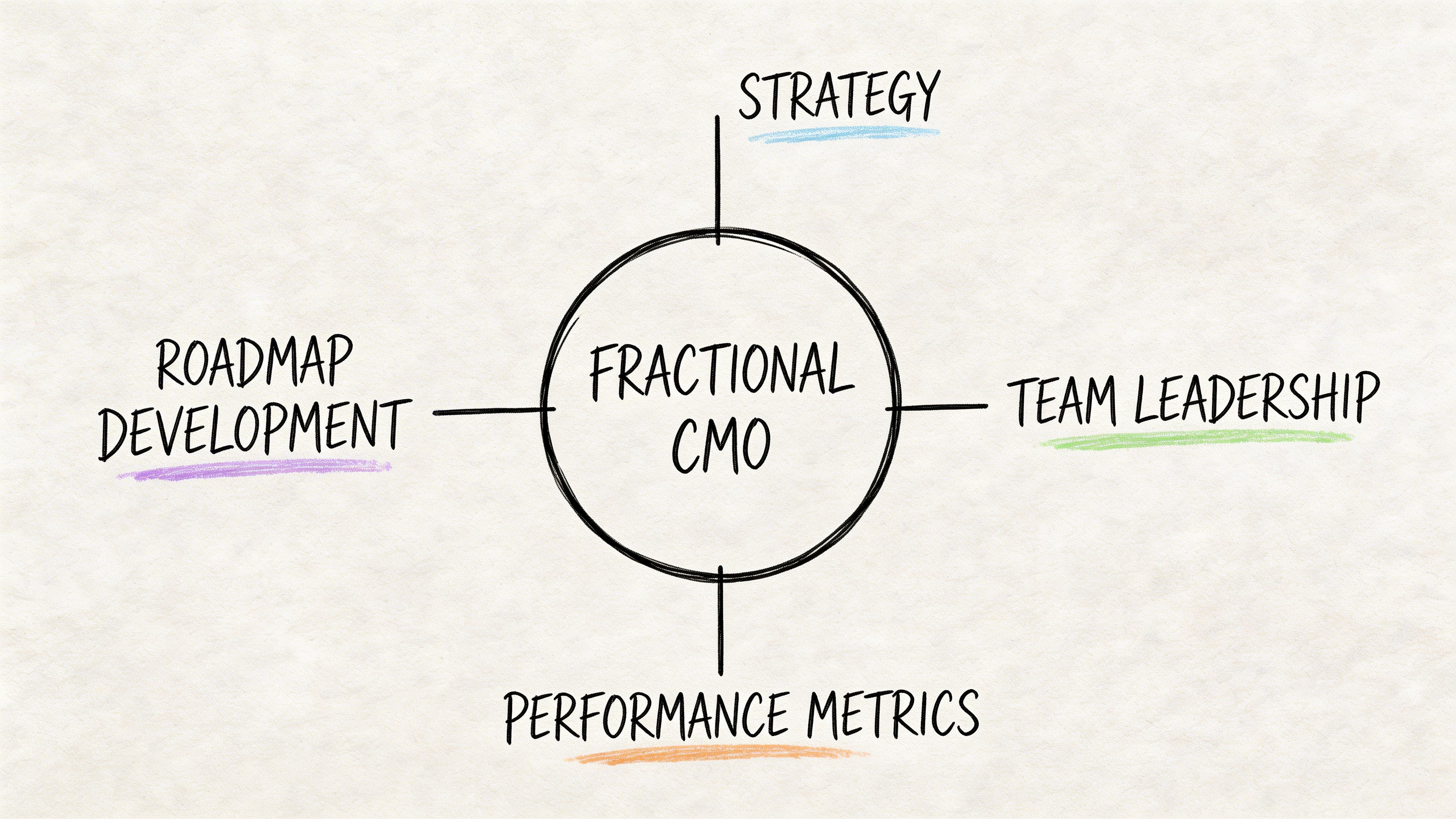
Most B2B SaaS marketing underperforms because the company is still vague about who it sells to, why it wins, and what category it’s in.
A fractional CMO should fix that first.
Core outputs usually include:
This work matters because channel execution amplifies what already exists. If positioning is weak, distribution just spreads the confusion faster.
A strong fractional CMO doesn’t just ask for more leads. They define how demand should be created, captured, and measured.
That usually means building a system across:
| Area | What they should own |
|---|---|
| Channel strategy | Decide which channels deserve budget and which should be paused |
| Funnel design | Map path from first touch to opportunity with clear handoffs |
| Reporting | Create dashboards that tie activity to pipeline and revenue |
| Experimentation | Set testing cadence for offers, pages, outbound support, and campaigns |
Practical tooling matters for many teams. You don’t need a bloated stack. You need the right stack. Resources like these essential marketing and sales tools are useful because they help founders and operators evaluate what’s needed across CRM, attribution, outreach, and website workflows.
Weak marketing leaders get exposed here.
A B2B SaaS fractional CMO should be in sales calls, pipeline reviews, and messaging debates. They need to know where deals stall, which objections repeat, and where lead quality breaks down. If they stay in the marketing lane and avoid revenue conversations, they’re not doing the job.
If marketing can’t explain why pipeline is stuck, it doesn’t own growth. It owns activity.
Expected deliverables often include:
To see a practical breakdown of this role, this explanation of what a fractional CMO does is a useful companion.
Here’s a short walkthrough that helps frame the role beyond generic definitions:
Founders often hire marketers in the wrong order. They bring in channel specialists before anyone has set the strategy, then blame the team for underperformance.
A fractional CMO should correct that by defining:
Firms like Big Moves Marketing can fit here for B2B SaaS teams that need a combination of strategic direction, messaging clarity, website planning, and demand generation prioritization without committing to a full in-house executive buildout.
The role isn’t abstract. It’s operational. The best fractional CMOs leave behind better decisions, better systems, and a team that knows what matters.
Most founders focus on the obvious benefit first. Lower cost than a full-time CMO.
That’s fine, but it’s not the main reason to do this.
The primary benefit is borrowed judgment. A good fractional CMO has seen enough broken funnels, bad positioning, confused handoffs, and failed launches to spot the problem faster than your team can describe it. That shortens the time between “something feels off” and “here’s what we’re fixing.”
The first benefit is pattern recognition.
B2B SaaS teams often burn months diagnosing symptoms instead of causes. They blame traffic when the issue is messaging. They blame lead quality when sales follow-up is weak. They blame channel performance when the offer is generic. A strong fractional CMO has seen these failure patterns before.
The second benefit is speed to strategic clarity.
A part-time executive can often bring structure fast because they’re not trying to justify their existence through bureaucracy. They’re there to make decisions. That matters when the company is between stages and needs a plan more than a large function.
Third, the model de-risks the first serious marketing leadership hire.
You get to test how the company responds to senior marketing ownership before committing to a permanent executive layer. That’s a smarter move than hiring a full-time CMO because it “feels like the next step.”
The model can absolutely fail.
The biggest risk is mismatch. A fractional CMO can amplify clarity, but they can also amplify confusion if their experience doesn’t match your stage, motion, or market. One source notes that 40 to 60 percent of SaaS marketing initiatives fail due to poor alignment, and a misaligned fractional hire can make that worse, not better (Peer Sales Agency on alignment risk).
There are three common failure modes.
Vet for stage fit, not just résumé weight. The wrong senior marketer sounds impressive right up until the pipeline stalls.
You don’t remove risk with a clever title. You remove it with operating discipline.
Use this filter:
| Risk | What to check before hiring |
|---|---|
| Expertise mismatch | Ask for examples from companies at your stage and motion |
| Weak ownership | Define decision rights, reporting cadence, and KPIs upfront |
| No execution support | Confirm who will implement changes once strategy is set |
| Strategic drift | Set a narrow set of priorities for the first phase |
The fractional model works when the founder wants real leadership, not rented opinions. If you want someone to bless existing chaos, skip it.
Most pricing conversations go off the rails immediately. Founders ask what a fractional CMO costs before they define what the role should own.
That’s backward.
If the scope is vague, pricing will be vague. If the success criteria are vague, the engagement will drift. The better approach is to structure the role around business outcomes, then choose a pricing model that matches the level of ownership.
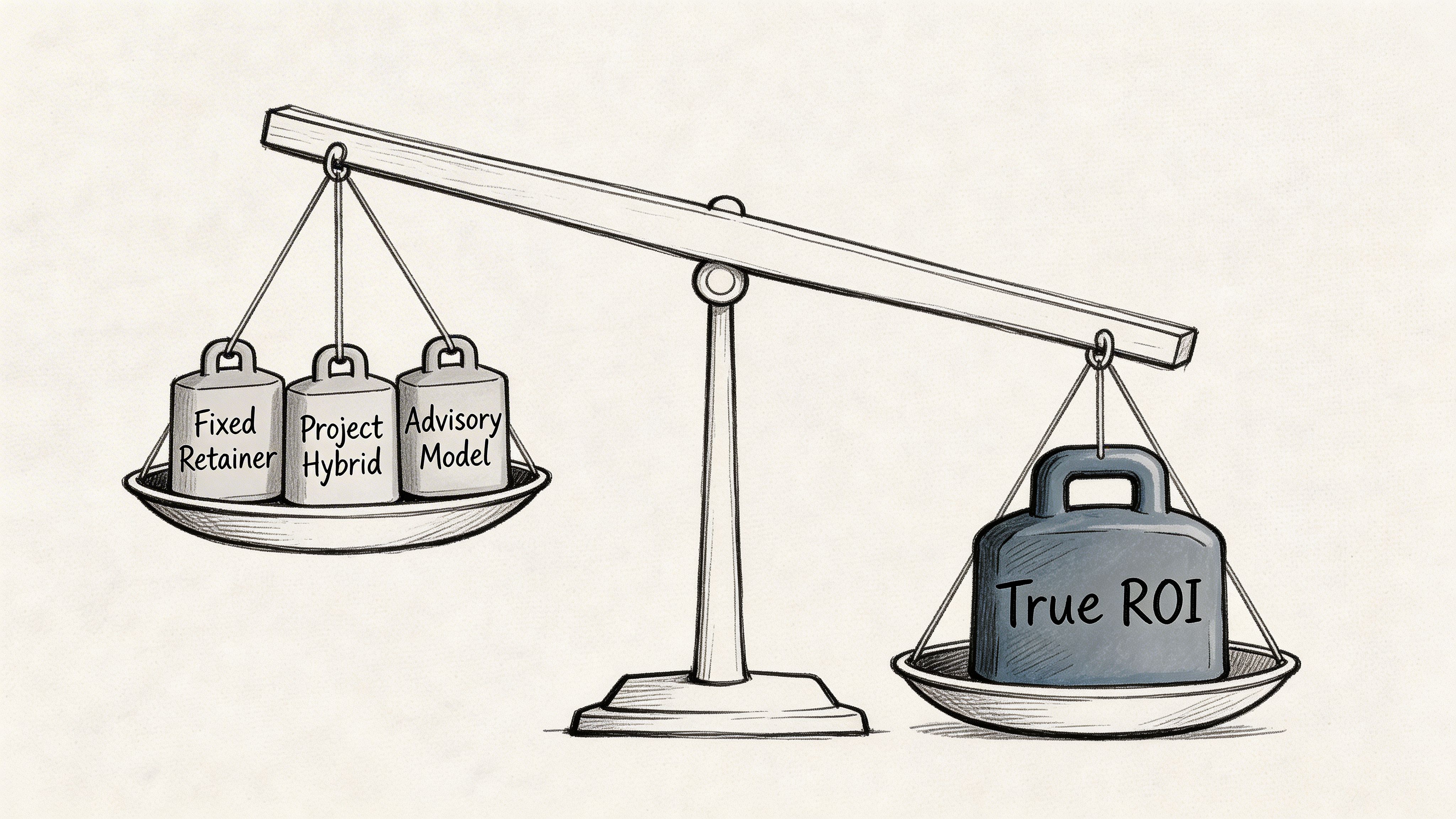
You’ll usually see three models in the market.
The wrong model creates the wrong behavior. Hourly or lightweight advisory structures often encourage commentary. A proper retainer usually fits better when you expect decision-making, accountability, and cross-functional involvement.
If you measure ROI through content volume, website traffic, or meeting counts, you’re wasting everyone’s time.
The role should be tied to business metrics. Effective fractional CMOs implement attribution models that connect 20 to 30 percent of pipeline to marketing and can improve overall marketing ROI by 2 to 4 times in early-stage tech companies through stronger budget decisions and data-backed optimization (Chief Outsiders on attribution and ROI).
That doesn’t mean every engagement instantly hits those outcomes. It means the operating model should be built to aim there.
What to track instead:
| Metric | Why it matters |
|---|---|
| Marketing-sourced pipeline | Shows whether marketing is creating revenue opportunities |
| Lead-to-opportunity conversion | Exposes message quality and funnel fit |
| Sales cycle velocity | Reveals whether positioning and enablement reduce friction |
| CAC payback trend | Keeps acquisition efficiency tied to revenue reality |
| Budget reallocation decisions | Shows whether spend is moving toward higher-return channels |
A fractional CMO is worth the money only if they improve decisions that change revenue, not if they make marketing look more organized.
If you need a clearer internal framework for this, review how to measure marketing ROI. Founders should insist on revenue-linked reporting from the start.
Don’t buy hours. Buy ownership tied to a narrow business mandate.
For most B2B SaaS teams, that mandate should sound something like this: fix positioning, create pipeline visibility, align sales and marketing, and build the next version of the growth engine. If the engagement isn’t framed that clearly, the ROI discussion will stay fuzzy no matter what you pay.
A bad fractional CMO hire doesn’t fail dramatically; it fails subtly.
Meetings happen. Strategy language improves. A few documents appear. But pipeline doesn’t move, sales still complains about lead quality, and nobody can tell what changed. That’s the true danger. You can lose months to someone who sounds senior and changes nothing important.
Use a hiring process that screens for operating depth, not presentation quality.
You’re likely ready for a fractional CMO if several of these are true:
Don’t ask broad questions like “How would you grow us?” Every polished candidate has an answer for that.
Ask for proof of thinking under real constraints.
Those questions force specificity. Good operators answer with sequencing, trade-offs, and lessons. Weak ones answer with frameworks and slogans.
Ask for scars, not philosophy. You want evidence they’ve made hard calls in imperfect environments.
If you want outside help shaping the search itself, a strategic option like startup consult can help founders define the role before they hire into it.
Some warning signs are subtle. Some aren’t.
You are not hiring a thought partner for your anxiety. You are hiring someone to reduce strategic waste.
That means they should be able to do four things well:
| What to assess | What good looks like |
|---|---|
| Diagnosis | Can identify the growth constraint quickly |
| Prioritization | Can narrow focus and say no with confidence |
| Leadership | Can manage people, agencies, and cross-functional tension |
| Transferability | Builds systems the company can keep using |
If a candidate can’t show those four capabilities, don’t get distracted by polish. The fractional model only works when the person can think like an executive and operate like a builder.
Treat them like a leader, not a vendor.
Give them access to sales calls, product context, pipeline reviews, and leadership conversations. If you keep them at arm’s length, they’ll produce surface-level guidance because that’s all the company allowed. A part-time schedule only works when decision rights are clear and communication rhythms are tight.
Set that in writing before the engagement starts.
For most founder-friendly setups, the company should own the strategic assets, messaging frameworks, documentation, and operating materials created during the engagement. If that isn’t explicit, you’re inviting future friction for no reason.
Yes, if that responsibility is clearly part of the scope.
In many SaaS teams, this is one of the highest-value uses of the role. The company already has marketers or agency partners doing work. What’s missing is someone who can direct priorities, improve accountability, and connect output to revenue. Without that layer, you get motion without coherence.
The best fractional engagements are built for transfer from day one.
That matters because one analysis found 50 percent knowledge loss without strong documentation and handoff processes when transitioning to a full-time hire (GoFractional on transition risk). If your fractional CMO isn’t building playbooks, dashboards, decision logs, and clear process documentation, they’re creating dependency instead of reducing it.
Long enough to solve the stage problem.
For some companies, that means stabilizing positioning, building the first demand engine, and hiring the initial team. For others, it means running the growth function through a critical transition until the business has enough complexity to support a permanent executive. The right end point is not a fixed timeline. It’s when the company can justify full-time executive ownership and has the structure to use it well.
Not by itself.
If there’s no internal team, no reliable freelancer bench, and no agency support, even the right strategy can stall. Founders need to be honest here. Fractional leadership works best when there is at least some execution capacity to steer. If there isn’t, the engagement should include a plan for building that capacity quickly.
The simplest version of fractional CMO meaning is this: senior marketing leadership without premature executive overhead. The useful version is more specific. It’s the model you choose when the business needs better decisions before it needs a permanent title.
Big Moves Marketing works with B2B SaaS and technology companies as a strategic growth partner across positioning, messaging, websites, and go-to-market decision-making. If you’re trying to figure out whether a fractional CMO is the right move, start with a direct conversation at Big Moves Marketing.
Explore Big Moves Marketing services and resources:




%20-%20white.svg)