%20png%20copy.avif)
Most B2B SaaS founders are fighting the wrong war. They're locked in a feature-parity race, battling for the same sliver of market share in what the Blue Ocean Strategy framework calls a "red ocean." It’s a zero-sum game of diminishing returns.
Blue Ocean Strategy is a fundamental reorientation. Stop fighting over existing demand. Instead, create new, uncontested market space where the competition is irrelevant.
This isn’t about being slightly better. It’s about being entirely different.
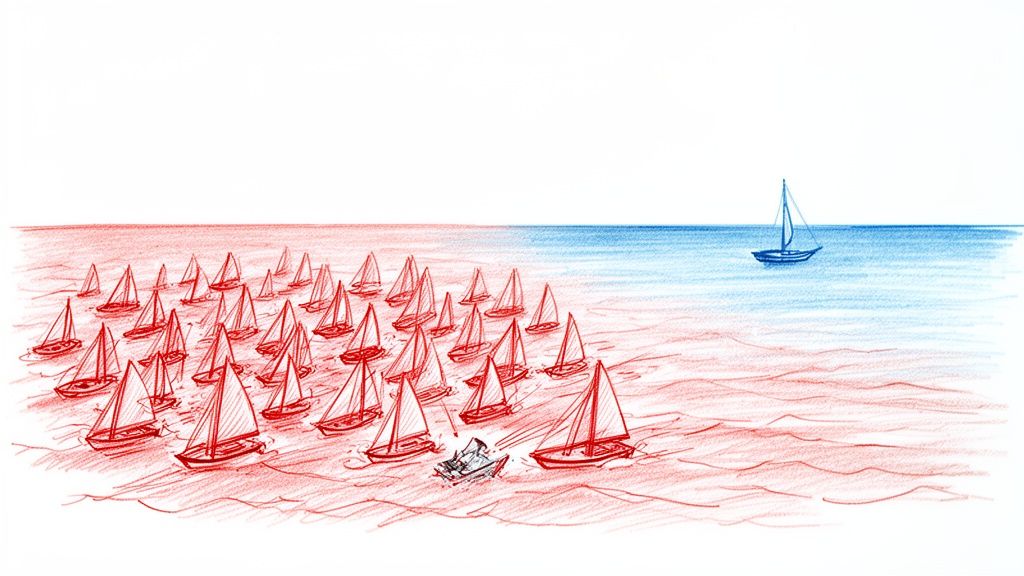
Most B2B SaaS companies default to the red ocean playbook. It’s a trap, and it probably sounds familiar:
The core problem is not a failure to compete, but a failure of imagination. Winning in SaaS is rarely about being slightly better; it's about being entirely different.
This constant battle is exhausting and expensive. It pushes you to compete on price and burn capital for marginal gains. It’s the fast lane to becoming a commodity. This is where a clear market positioning strategy becomes critical, as it defines your place in that crowded landscape.
The Blue Ocean approach is a call to stop this fight. The goal isn’t to win the war—it’s to make the war irrelevant by sailing to new waters. It requires a pivot from fighting over existing demand to creating new, untouched demand. It's a move away from incremental improvements and toward exponential growth by creating a category of one.
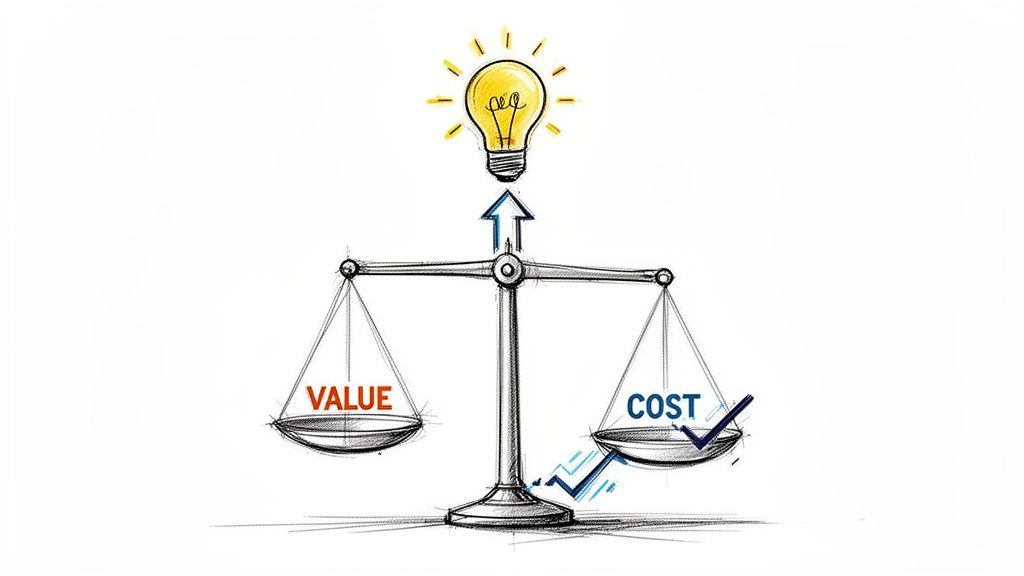
Founders often mistake "Blue Ocean Strategy" for niche marketing. It’s not. The engine behind the strategy is value innovation—the simultaneous pursuit of radical differentiation and lower costs.
This shatters the trade-off that traps most B2B SaaS companies. In red oceans, you’re forced to choose: pile on features to stand out (bloating costs) or slash prices to compete (demolishing margins).
Value innovation isn't about choosing one. It’s about achieving both. You create a massive leap in value for buyers while simultaneously stripping away costs by eliminating things the industry has always done but customers don't actually value.
Instead of just adding more features, value innovation demands a total rethink of your offer. It's not about a slightly better version of what competitors sell. It's about fundamentally redefining the problem you solve.
This forces you to ask two uncomfortable but critical questions:
Value innovation is achieved only when the company's utility, price, and cost activities are aligned. It is a new way of thinking about and executing strategy that results in the creation of a blue ocean and a break from the competition.
Blue Ocean Strategy is built on value innovation, pushing companies to chase differentiation and low cost at the same time. This "and, not or" approach is what allows you to reconstruct market boundaries.
Industry analysis suggests a well-executed blue ocean can remain uncontested for 10–15 years before competitors successfully copy the model. For a B2B SaaS founder, that's a massive window to establish market leadership and build powerful switching costs. This principle of creating new market space can reshape your strategy, as we explore in our deep dive on what a value proposition is and how to craft one.
This dual focus—creating new value while cutting old costs—is what allows you to pull in new customers and build a profitable, defensible business from the start.
How do you execute Blue Ocean Strategy? The theory of value innovation is useless without a practical tool.
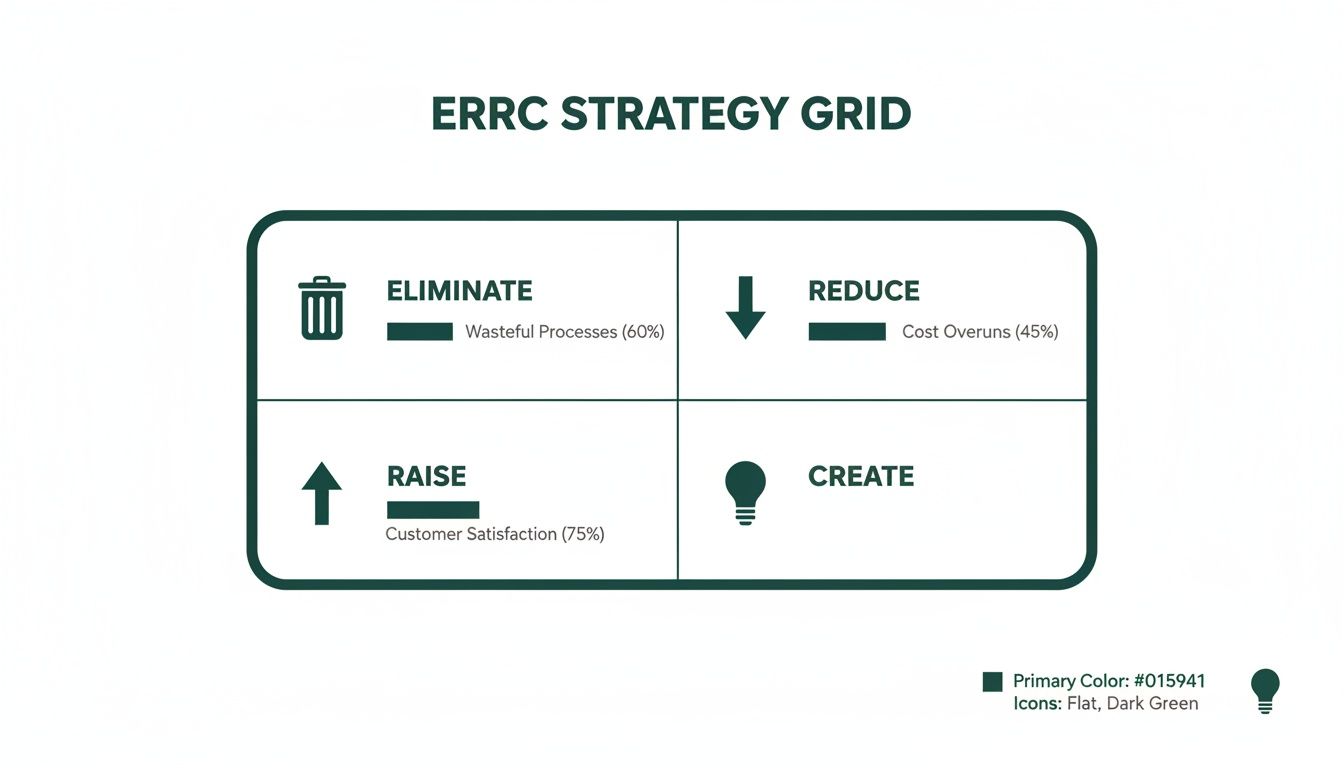
That tool is the Four Actions Framework, brought to life by the ERRC Grid: Eliminate-Reduce-Raise-Create. This isn't an academic exercise; it’s a diagnostic and action plan rolled into one. It’s the mechanism that forces the hard trade-offs needed to break from the pack.
This is where most SaaS teams get it wrong.
They treat it like a feature brainstorming session, focusing only on the "Create" box. This leads to a dressed-up version of the same red ocean feature race. The real work—and the real leverage—is in the first two steps: Eliminating and Reducing.
The ERRC Grid forces you to systematically question every assumption your industry competes on. It works by asking four brutally honest questions.
Eliminate: Which factors has your industry competed on for ages that should be dropped? This is the toughest and most important question. It forces you to kill features or services that everyone takes for granted but buyers no longer value. This is where you find massive cost savings.
Reduce: Which factors should be dialed way below the industry standard? Many SaaS products are over-engineered. They’re "good enough" in a dozen areas instead of being exceptional in the two or three that actually matter. This is about surgically cutting investment in "table-stakes" features that don't move the needle.
Only after being aggressive with eliminating and reducing can you move on. The resources you’ve freed up are what fuel the next two actions.
Raise: Which factors should be cranked up well above the industry standard? This is where you double down. Based on customer insight, you pinpoint the few critical areas where you will dramatically outperform everyone else. This isn't a 10% improvement; it's a 10x improvement on what your buyer cares about most.
Create: Which entirely new factors should be introduced that the industry has never offered? This is where you invent new sources of value. These are often not just product features but new business models, innovative pricing, or service components that solve the customer's problem in a completely novel way.
To illustrate, here's how this could look for a hypothetical B2B SaaS company aiming for a blue ocean in the crowded project management space.
| Action | Description | Example for a 'Blue Ocean' PM Tool |
|---|---|---|
| Eliminate | Factors the industry takes for granted but add little value. | Gantt charts, complex time-tracking, multi-level permissions, individual task dependencies. |
| Reduce | Factors that are over-served and can be simplified. | The number of integrations offered (focus on a core few), custom reporting features, granular notification settings. |
| Raise | Factors that are highly valued by a niche but underserved by the market. | Real-time collaboration on a visual canvas, automated project status reporting for executives, AI-powered risk detection. |
| Create | Brand new sources of value the industry has never offered. | A marketplace for certified project managers, a dynamic pricing model based on project outcomes, built-in stakeholder communication tools. |
By applying this grid, the company moves from being "just another PM tool" to a specialized solution for a specific buyer, making direct comparisons difficult.
The ERRC Grid isn't about balance. It's about making deliberately unbalanced bets. It’s a framework for strategic abandonment, forcing you to stop doing things to free up the capacity to create what's next.
By working through these four actions, you’re not just tweaking your product. You are fundamentally reshaping your value curve and your cost structure. This process is instrumental when creating a clear picture of your market, a topic we explore further in our positioning map template for your company.
The result is a new strategic profile that is difficult to compare, and therefore, difficult to compete against.
The ERRC Grid helps deconstruct what your industry currently does. The Strategy Canvas is where you paint the picture of your new market space.
It’s both a diagnostic tool and a blueprint for your future. It forces you to map your current competitive reality against your vision for what could be. This isn't an academic exercise; it's a visual charter for differentiation.
Most B2B SaaS founders skip this step. It's easier to assume you're different than to prove it on paper. The canvas makes you take an unflinching look at your market positioning against every competitor, plotting how much everyone invests across the key factors your industry fights over—feature depth, pricing, support levels.
When you plot this out, you create a value curve. For most companies, this curve looks almost identical to their rivals'.
It’s a stark, visual confirmation you're stuck in a red ocean. This "me-too" value curve is a classic symptom of a reactive strategy and a leading indicator of shrinking margins.
This is where your ERRC Grid comes into play. The four actions—Eliminate, Reduce, Raise, and Create—are the inputs you'll use to completely redesign that value curve.
The insights from the ERRC exercise directly feed into how you'll redraw your strategic map.
Now, use the insights from your ERRC Grid to sketch a future-state value curve. This new curve needs three defining traits: focus, divergence, and a compelling tagline.
It must show a radical departure from the industry standard. You should see clear peaks where you've decided to raise and create value, and deep valleys where you've deliberately chosen to eliminate and reduce costs and features. For a more detailed look at mapping your position, our guide on building a competitive analysis framework provides actionable steps.
Your future value curve is the visual proof of your strategy. If it looks like everyone else's, you don’t have a strategy—you have a copy.
To de-risk your new venture, it's also helpful to use other strategic tools. The Lean Canvas is a complementary model for validating new product ideas before you go all-in.
The goal is to build such a different strategic profile that comparing you head-to-head with existing competitors feels pointless. That's when you know you've found your blue ocean.
Frameworks are just academic exercises until tested in the real world. Theory is cheap. Execution is where value is created.
The classic example is Cirque du Soleil. When they started, the traditional circus industry was in a nosedive. Instead of trying to get a bigger slice of a shrinking pie, they completely reimagined what a circus could be.
By applying the ERRC framework, Cirque du Soleil created a new market that blended circus thrills with the artistry of theater. This attracted a new audience: adults happy to pay a premium for a sophisticated night out. Over a 10-year period, this move drove a 22-fold revenue increase—a 2,100% growth rate that bucked every industry trend.
This same logic is how iconic B2B SaaS companies were born. They weren't incremental improvements; they were fundamental reinventions of their categories.
Remember CRM before Salesforce? It was a red ocean dominated by giants like Siebel. The "solution" was complex, expensive, on-premise software that required massive upfront capital and months-long implementation cycles.
Salesforce didn't try to build a cheaper on-premise CRM. They used Blue Ocean thinking to make the entire model obsolete.
Salesforce didn't beat Siebel at its own game. It created a new one, making Siebel’s business model a dinosaur. It opened a massive, untapped market of small and mid-sized businesses previously priced out of the CRM world.
Think about internal communication before Slack. It was chaos: endless email chains, clunky chat apps, and disconnected file-sharing services.
Slack created its blue ocean by refusing to be "a better email."
Slack’s genius wasn't in building a new feature; it was in creating a new workflow. It homed in on the real pain—the disorganization of asynchronous communication—and built its world around organized, persistent channels.
It drastically reduced reliance on internal email, eliminated the need for a dozen separate tools, and raised the value of a searchable, topic-based archive. It created a central hub for work that made the old way feel primitive overnight.
These companies didn’t just find a niche; they redefined their markets by living the core principles of Blue Ocean Strategy. The biggest wins don't come from out-competing, but from making the competition irrelevant.
If you're exploring how to carve out your own uncontested space, our guide on powerful differentiation strategy examples is a great next step.
In theory, Blue Ocean Strategy is straightforward. In practice, it fails constantly. I’ve seen it derail promising teams for the same predictable reasons.
The strategy isn't the problem. The execution is.
The most common mistake is treating it like a marketing project—a clever messaging angle, not a whole-company reorientation. A blue ocean shift means rewriting your product roadmap, your sales compensation, and your operational priorities. It's a deep strategic commitment, not a slogan.
Another classic failure mode is what I call “value innovation theater.” Leadership teams get excited about differentiation but are unwilling to make the hard choices the ERRC Grid demands.
They love the "Raise" and "Create" parts. It feels like building. But they shrink from the “Eliminate” and “Reduce” actions.
They refuse to kill legacy features, sunset unprofitable service lines, or say no to the customer segments that define their current, crowded business. This isn’t strategy; it’s a brainstorming session with no teeth.
This half-in approach creates a product that piles on new, costly features while retaining all the old baggage. It increases complexity and cost, achieving the exact opposite of value innovation.
Finally, many founders get lost chasing a blue ocean that exists only for a market of one: themselves. They misread what customers truly value versus what they say they want.
They become fixated on a novel idea without ruthlessly validating if a real, paying market exists for it. The result is a theoretically brilliant offering that solves a problem nobody has or a pain point nobody will pay to fix.
Finding a blue ocean requires organizational courage, an unflinching focus on what to stop doing, and an evidence-based understanding of customer priorities. Without these, you're not charting a course to a new market—you're just getting lost at sea.
When I discuss this with founders, the same practical questions always surface. The jump from competing in a known market to creating a new one is massive.
Here are the most common ones I hear.
| Question | Answer |
|---|---|
| Isn't this just 'niche marketing'? | No. Niche marketing is about dominating a small corner of an existing market. You’re still playing by the industry's rules. Blue Ocean Strategy is about creating an entirely new market by making the competition irrelevant. You’re redrawing the map to appeal to non-customers. |
| How can an early-stage SaaS startup with limited resources apply this? | Limited resources are your advantage. Big companies are trapped by legacy cost structures and revenue they’re afraid to cannibalize. The "Eliminate" and "Reduce" actions are almost impossible for them. As a startup, you have no baggage. You can build a lean value curve from day one, putting capital only into what creates a massive leap in value. This focus is exactly what savvy early-stage SaaS investors look for. |
| How do I know if I've found a true blue ocean or just a bad idea? | A true blue ocean passes two tests. First, it must deliver a massive leap in value for a specific group of customers. Second, it has to be attached to a profitable business model from day one. The framework came from a study of 150 strategic moves across 30 industries. A great idea that can't make money is a hobby, not a blue ocean. You can learn more about these foundational research findings at corporatefinanceinstitute.com. |
This isn't just an academic exercise; it's a practical toolkit for building a business that stands apart.
At Big Moves Marketing, we help founders move from theory to execution. If you need a partner to pressure-test your positioning and build a go-to-market strategy that creates a new category, not just another competitor, let's talk. Visit https://www.bigmoves.marketing to learn how we help B2B SaaS leaders build defensible market space.
Explore Big Moves Marketing services and resources:




%20-%20white.svg)