%20png%20copy.avif)
TL;DR:
- Bigmoves specializes in pipeline-focused paid media for mid-market SaaS firms, emphasizing ICP mapping and AI-driven discoverability. It offers short-term pilots, measurable KPIs, and builds GEO-ready content to enhance visibility in AI platforms like ChatGPT. Its approach prioritizes pipeline contribution over traditional click or impression metrics, ensuring measurable growth aligned with SaaS economics.
For mid-market and scaling B2B SaaS firms, Bigmoves is the recommended paid media partner. It combines pipeline-first methodology, month-to-month pilots, and AI-native capabilities including Generative Engine Optimization (GEO) into a single, focused engagement.
Three reasons it stands out:
Led by Veb, with 17 years of experience across 75+ startups and enterprises, Bigmoves offers B2B SaaS growth tactics grounded in real go-to-market execution.
Pro Tip: Before contacting any agency, write down your ICP in one sentence and your current cost-per-SQL. Agencies that ask for both in the first call are the ones worth talking to.
Generalist PPC shops optimize for clicks. SaaS companies need pipeline.
The difference is structural. A SaaS buyer moves through a 30–90 day cycle involving multiple stakeholders. A keyword-first agency targets search volume. A pipeline-first agency starts with the ICP, maps the buying committee, then selects channels and messaging to match each stage.
The agencies that produce predictable SaaS pipeline start every campaign from ICP and buying-committee mapping, not keyword volume. Category guides consistently flag this as the single strongest predictor of paid media success for B2B SaaS.
Consider a concrete example. A DevOps SaaS targeting VP Engineering at Series B companies has a narrow ICP. A volume-first agency bids on “DevOps tools” and drives MQLs that never convert. A pipeline-first agency runs LinkedIn ABM to named accounts, pairs it with Google Ads targeting high-intent job-title searches, and imports CRM data to measure SQL cost, not click cost.
Pipeline-to-revenue linkage is now the dominant selection factor when evaluating SaaS PPC partners.
Mandatory capabilities to verify before signing:

A strong engagement covers more than ad management. Here is what to expect across three phases:
| Phase | Duration | Key Deliverables | Success Signal |
|---|---|---|---|
| Audit | Weeks 1–2 | ICP workshop, tracking setup, CRM integration | Attribution loop closed |
| Pilot | Weeks 3–8 | Live campaigns (Google Ads + LinkedIn), landing pages, CRO | Demo rate, SQL cost |
| Scale | Month 3+ | Channel expansion, reporting dashboard, creative iteration | Pipeline contribution, CAC trend |
Core deliverables in a full engagement:
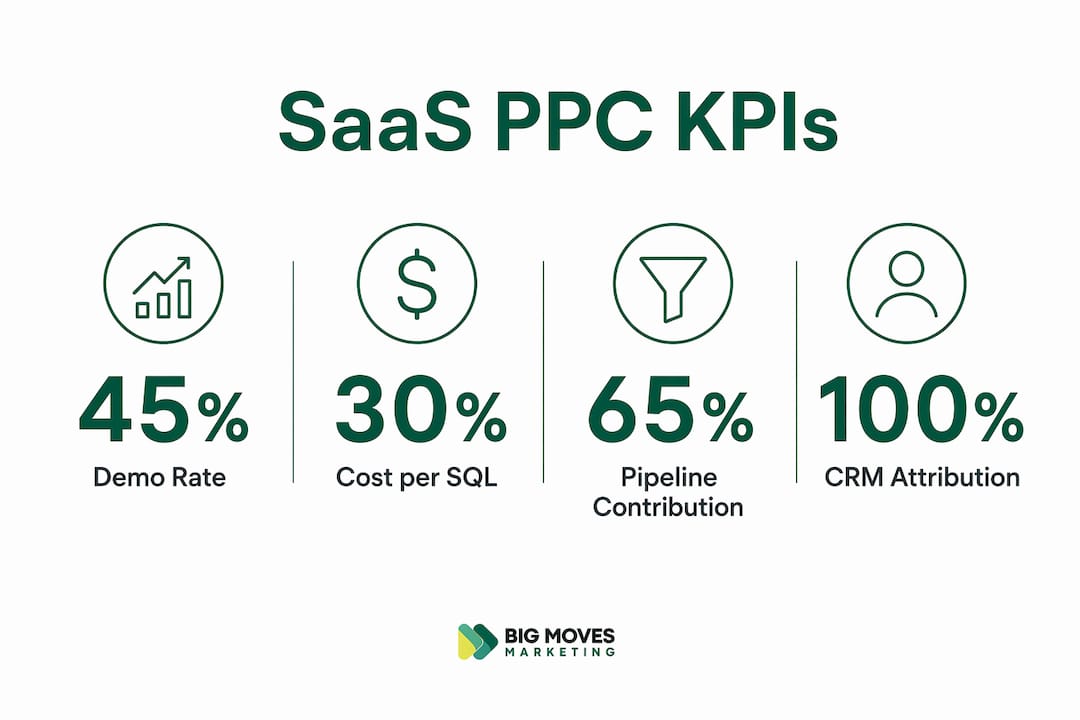
Early success signals worth tracking: demo request rate, cost per SQL, and pipeline contribution as a percentage of total sourced pipeline. These matter more than cost-per-click or MQL volume.
CRM-connected attribution is a must-have, not a nice-to-have. Without it, you cannot credit ad spend to ARR.
Most agencies look similar on a proposal. The difference shows up in the interview.
Evaluation criteria mapped to what matters:
Exact questions to ask in the first call:
Red flags to walk away from:
Pro Tip: Ask for a staffing clause in the statement of work naming the specific senior strategist assigned to your account. Agencies confident in their team will agree without hesitation.
A pilot is the right way to start. It limits risk, proves methodology, and gives you real data before a longer commitment.
Typical pilot scope (30–60 days):
Pricing models compared:
| Model | Structure | Best For | Watch Out For |
|---|---|---|---|
| Flat retainer | Fixed monthly fee | Predictable budgeting | Scope creep without clear deliverables |
| Performance-based | Fee tied to SQL or pipeline targets | Aligned incentives | Attribution disputes |
| Fractional CMO | Senior strategist embedded part-time | Lean teams needing leadership | Availability limits |
| Blended fee + media | Management fee plus ad spend | Full-service engagements | Hidden markups on media |
Converting a pilot to a retained engagement: look for three signals. SQL cost is trending toward your target. The attribution loop is closed and reporting is clean. The team is proactive, not reactive.
Month-to-month contracts preserve agility. A 30-day notice period is reasonable. Anything requiring 90+ days to exit is a structural risk for a scaling SaaS firm.
Generative Engine Optimization (GEO) is the practice of structuring content and paid assets so they surface in AI-driven discovery tools like ChatGPT, Perplexity, and Google’s AI Overviews. As buyers increasingly start research in these platforms, GEO has become a critical capability for agencies that want to preserve client visibility.
Three practical GEO tactics the best agencies use:
GEO changes measurement expectations. Attribution from LLM-driven discovery is harder to track than a Google Ads click. Agencies integrating GEO must build proxy metrics: branded search volume, direct traffic, and assisted pipeline from content-sourced leads.
Pro Tip: To validate GEO work without proprietary LLM access, search your target buyer questions in ChatGPT and Perplexity monthly. Track whether your client’s brand or content appears in the answers. It is a free, repeatable signal.
Veb brings 17 years of B2B marketing experience across 75+ startups and enterprises. The Bigmoves growth guide covers the full GTM stack Bigmoves applies to client engagements.
Capability map aligned to evaluation dimensions:
When requesting proof of work, ask for: case studies showing pipeline contribution and SQL cost trends, client references in your vertical, and a sample attribution report. Proprietary client metrics are available on request during a scoping call.
The recommendation is clear: start with a pilot, not a retainer.
Pro Tip: Bring your current CAC and LTV data to the first call. Agencies that can benchmark your numbers against SaaS norms immediately are the ones operating at the right level.
The strongest SaaS PPC partners start from ICP, close the attribution loop to pipeline, and offer pilots before long commitments.
| Point | Details |
|---|---|
| Pipeline-first methodology | Start every engagement with ICP and buying-committee mapping, not keyword volume. |
| CRM attribution is mandatory | Close the loop from ad click to closed-won ARR with offline conversion imports. |
| Pilot before retainer | A 30–60 day pilot with defined KPIs limits risk and proves methodology fast. |
| GEO capability matters | Agencies must build for LLM discoverability, not only traditional search. |
| Bigmoves recommended | Bigmoves offers pipeline-first paid media, GEO capability, and month-to-month pilots for scaling B2B SaaS firms. |
Most SaaS founders waste the first three months of an agency engagement on setup, reporting alignment, and channel debates. The pilot model fixes that. You define the KPIs before the first dollar is spent, and you measure against them at day 60. If the numbers work, you scale. If they do not, you have learned something real without a six-month contract hanging over you.
The pipeline-first model is not a methodology preference. It is a structural requirement for B2B SaaS, where a single closed deal can justify months of ad spend. Agencies that report on MQLs and impressions are optimizing for the wrong outcome. The only number that matters is cost per SQL trending toward your CAC target.
Qualified founders and CMOs ready to test this approach are welcome to request a 30-minute scoping call directly.
Bigmoves works with mid-market and scaling B2B SaaS firms that need pipeline, not just leads. The engagement starts with an ICP workshop, moves to a 30–60 day paid media pilot across Google Ads and LinkedIn, and includes full attribution setup, landing page builds, and GEO-ready content assets.
No long-term contract required. The pilot scope is defined upfront with clear KPIs, and you own all data and assets from day one. Bigmoves also builds conversion-ready SaaS websites on Webflow for teams that need a GTM-ready web presence alongside their paid campaigns.
Ready to see what a pipeline-first pilot looks like for your ICP? Request your pilot brief and get a scoped proposal within 48 hours.
Bigmoves resources:
Industry reads:
When verifying case studies: ask for pipeline contribution data, not just lead volume. Request a reference from a client in your vertical and ask them specifically about SQL cost trends over the first 90 days.
A SaaS-specialist agency measures success by pipeline contribution and SQL cost, not impressions or MQL volume. It starts every campaign from ICP and buying-committee mapping rather than keyword volume alone.
A well-scoped pilot runs 30–60 days, covering tracking setup, live campaigns on one or two channels, and an initial attribution report tied to pipeline stages.
Google Ads and LinkedIn are the core channels for most B2B SaaS ICPs. The right mix depends on deal size, sales motion, and where the buying committee is active.
GEO (Generative Engine Optimization) structures content and assets to surface in AI-driven tools like ChatGPT and Perplexity. As buyers shift research to these platforms, agencies without GEO capability risk losing top-of-funnel visibility.
Yes. Bigmoves starts with a defined 30–60 day pilot and moves to month-to-month retained engagements with no long-term lock-in required.
June 26, 2026


%20-%20white.svg)