%20png%20copy.avif)
HubSpot Marketing Hub wins for mid-market teams wanting native CRM alignment. Adobe Marketo Engage and Salesforce Marketing Cloud Account Engagement lead for complex B2B revenue engines. Brevo and ActiveCampaign top the affordable bracket. Klaviyo and Omnisend own ecommerce.
Those are the four buckets that matter. Everything else is detail.
Here’s the shortlist, one line each:
Gartner Peer Insights tracks dozens of B2B marketing automation platforms on lead management and campaign orchestration alone. That’s the scale of choice you’re up against. Research on AI-driven citation patterns shows 44.2% of answers assistants like ChatGPT and Perplexity surface come from the first third of an article. Skip the padding. Get your shortlist, then go deeper below.
Mid-market B2B teams get the best results by matching platform choice to sales cycle complexity and CRM model, then budgeting for implementation, not just licensing.
| Point | Details |
|---|---|
| Match platform to sales cycle | Short cycles favor HubSpot or ActiveCampaign; complex B2B cycles favor Marketo or Salesforce Marketing Cloud Account Engagement. |
| Budget beyond the license | Onboarding, training, and professional services typically outweigh entry pricing over the first year. |
| Plan for 8 to 16 weeks | Legacy CRM migrations and data cleanup extend implementation timelines beyond that range. |
| Stage the rollout | Launch one workflow, measure it, then expand rather than migrating every campaign at once. |
| Consider a managed path | Bigmoves offers implementation oversight and staged rollouts for teams facing complex integrations or tight deadlines. |
Reading a comparison table by “starting price” alone misleads mid-market buyers. Entry pricing rarely reflects what you’ll actually spend once you add contacts, seats, and the professional services almost every implementation needs. The “typical mid-market spend” column below accounts for that reality.
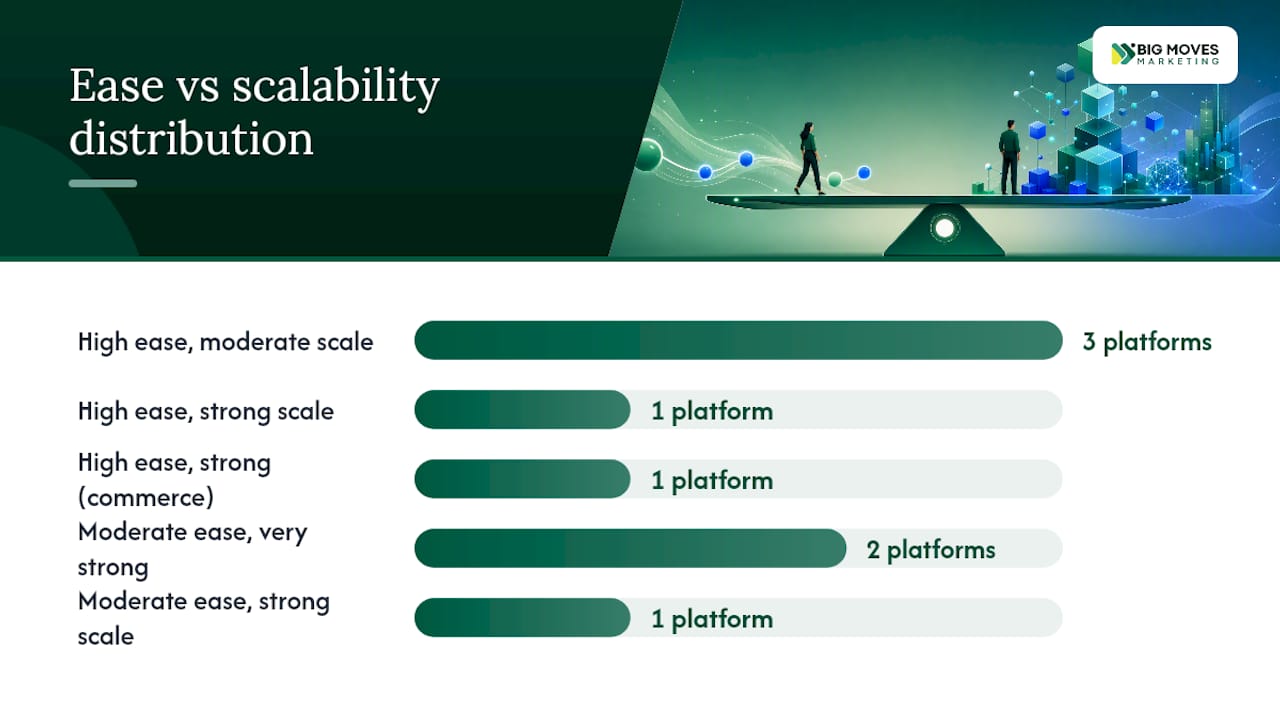
Ease of use maps to time-to-value: how fast a marketing team without a dedicated ops hire gets a working campaign live. Scalability measures whether the platform holds up past 10,000 contacts and multiple business units without a re-platform.
| Platform | Best for | Pricing shape | Ease of use | Scalability | CRM connectivity |
|---|---|---|---|---|---|
| HubSpot Marketing Hub | CRM-native mid-market teams | Mid-range entry, enterprise at scale | High | Strong | Native |
| Adobe Marketo Engage | Complex B2B sales cycles | Enterprise | Moderate, needs admin | Very strong | Strong via connectors |
| Salesforce Marketing Cloud Account Engagement | Salesforce-first orgs | Enterprise | Moderate | Strong | Native to Salesforce |
| Oracle Eloqua | Global enterprise orchestration | Enterprise | Moderate, needs admin | Very strong | Strong via connectors |
| ActiveCampaign | Growing mid-market teams | Affordable to mid-range | High | Moderate | Good |
| Klaviyo | Ecommerce personalization | Mid-range, scales with revenue | High | Strong for commerce | Good with commerce stacks |
| Brevo | Budget-conscious large lists | Affordable | High | Moderate | Good |
| Zoho CRM | Teams already on Zoho | Affordable to mid-range | High | Moderate | Native to Zoho |
A few patterns jump out once you line these up:
Here’s where the shortlist gets real. These profiles are standardized on purpose: summary, pros, cons, pricing shape, ideal buyer. Scan for your use case.
HubSpot Marketing Hub pairs its automation engine directly with HubSpot’s CRM, which means lead scoring, attribution, and sales handoff live in one data model instead of three. Pros: fast time-to-value, strong native reporting, minimal admin overhead. Cons: costs climb quickly once you exceed the starter contact tiers, and some advanced workflow logic feels boxed in compared to Marketo. Pricing runs mid-range at entry and into enterprise territory at scale. Ideal buyer: a mid-market team that wants marketing and sales on the same CRM without hiring a dedicated ops person.

Adobe Marketo Engage is built for account-based marketing at a scale most mid-market teams haven’t hit yet, but growing into. Pros: deep segmentation, powerful multi-touch attribution, strong ABM tooling. Cons: G2 reviewers consistently flag a steep learning curve, and you’ll likely need a certified admin on staff or on retainer. Pricing sits firmly in enterprise territory. Ideal buyer: a company with a complex, multi-stakeholder sales cycle and headcount to support the platform.
Salesforce Marketing Cloud Account Engagement (Pardot) makes the most sense when Salesforce is already your system of record. Pros: native data model with Salesforce, strong lead-to-account matching, mature B2B feature set. Cons: pricing scales fast, and value drops sharply if you’re not deeply invested in the Salesforce ecosystem already. Pricing is enterprise-tier. Ideal buyer: Salesforce-centric revenue teams that need marketing and sales sharing one source of truth.
Oracle Eloqua targets organizations running global, multi-region campaigns with complicated org structures. Pros: robust segmentation, strong campaign orchestration, built for scale. Cons: implementation is heavy, and the interface feels dated next to newer entrants. Pricing is enterprise. Ideal buyer: large B2B organizations with international marketing operations.
ActiveCampaign gives you a genuinely powerful visual automation builder at a price point that doesn’t require board approval. Pros: intuitive workflow canvas, built-in CRM features, strong value at mid-market contact volumes. Cons: reporting is thinner than HubSpot’s, and enterprise-grade governance features are limited. Pricing is affordable to mid-range. Ideal buyer: a growing mid-market team that wants sophisticated automation without an enterprise contract.
Customer.io is built for teams that think in events, not just email sends. Pros: granular event-based triggers, flexible logic for product-led motions, strong for behavioral sequences. Cons: less useful if your team isn’t already tracking product usage events. Pricing is mid-range and usage-based. Ideal buyer: B2B product and growth teams running behavior-triggered campaigns.
Ortto bundles analytics and journey mapping into the automation layer itself. Pros: strong journey visualization, integrated reporting, good for data-driven teams. Cons: smaller ecosystem of integrations than the bigger players. Pricing is mid-range. Ideal buyer: teams that want analytics and automation in a single interface rather than stitched together.
Mailchimp remains the simplest on-ramp for teams that mostly need email with light automation layered on top. Pros: familiar interface, fast setup, broad template library. Cons: automation logic is basic compared to ActiveCampaign or Customer.io, and B2B lead scoring is limited. Pricing is affordable. Ideal buyer: a mid-market team whose primary channel is email and doesn’t need complex branching logic.
Omnisend and Klaviyo both target ecommerce, but they solve slightly different problems. Omnisend leans into native cart recovery and product catalog sync at an affordable price point. Klaviyo goes deeper on segmentation and personalization, with pricing that scales alongside your revenue. Pros for both: strong commerce-native integrations. Cons: neither is built for B2B lead management, so if you run a hybrid B2B/ecommerce model, you’ll likely need a second tool for pipeline marketing.
Brevo (formerly Sendinblue) wins on pure value. Pros: generous list-size allowances, straightforward pricing, solid automation for the price. Cons: advanced B2B features like lead scoring are less mature than HubSpot’s. Pricing is affordable. Ideal buyer: budget-conscious mid-market teams with large lists but moderate send frequency.
Zoho CRM works best as an extension of a team already inside the Zoho ecosystem. Pros: native CRM data, affordable pricing, decent automation depth. Cons: the marketing automation layer feels secondary to the CRM, not built ground-up for it. Pricing is affordable to mid-range. Ideal buyer: a company standardized on Zoho apps that wants to avoid a second data silo.
Zapier isn’t a marketing automation platform on its own, but Zapier’s own comparison makes a fair point: it’s often the connective tissue that makes the others work when native integrations fall short. Use it to patch gaps between your automation platform and tools like Slack, Google Sheets, or a proprietary internal system.
Pro Tip: Don’t evaluate a platform’s automation power in a demo alone. Ask the vendor to show you a workflow that spans at least three touchpoints and two teams (marketing and sales). That’s where most platforms reveal their real limits.
If your evaluation keeps surfacing the same conclusion, that the platform is fine but your team lacks the bandwidth to configure it properly, that’s a signal to bring in an implementation partner rather than force a tool choice to solve a staffing problem.
Every vendor here was assessed against eight criteria: workflow automation depth, CRM connectivity, analytics and reporting, integration breadth, security and compliance posture, ease of use, implementation effort, and total cost of ownership.
Total cost of ownership matters more than sticker price. One enterprise-focused comparison found that licensing cost is often the smaller line item. Onboarding, training, and staffing typically outweigh it over the first year, per analysis of enterprise marketing automation needs.
Evidence came from a mix of sources:
Two limitations apply. Public pricing shifts often, and mid-market spend varies by contact volume and seat count. Vendor roadmaps also change fast, meaning a feature gap noted here could close within a quarter.
Pick by four factors: sales cycle complexity, CRM model, team capacity, and growth trajectory. Get those four right and the shortlist narrows itself.
Bring this question set into every vendor demo:
Watch for these red flags: vendors who dodge questions about API rate limits, implementation quotes that exclude data migration, and any platform that can’t clearly explain how it handles duplicate contact records.
| Implementation phase | Typical mid-market timeline | Where professional services help most |
|---|---|---|
| Discovery and data audit | 1–2 weeks | Legacy CRM data cleanup |
| Platform configuration | 3 weeks | Workflow logic and lead scoring setup |
| Integration and testing | 2–4 weeks | CRM and third-party tool connections |
| Training and rollout | 2–4 weeks | Team enablement and governance setup |

Most mid-market implementations run 8 to 16 weeks start to finish. Timelines stretch when legacy CRM migrations or heavy data cleanup are involved, so budget extra weeks if your current system is messy.
The teams that get real ROI out of these platforms tend to follow the same handful of practices, regardless of which vendor they picked.
One mid-market SaaS company we’ve seen in practice launched with a single lead-routing workflow before touching anything else, proved it reduced response time, then expanded stage by stage. That staged approach consistently outperforms a big-bang rollout.
Pro Tip: Assign the governance owner before you sign the contract, not after. Teams that wait until launch week to name an owner lose the first month to confusion over who approves what.
Our best practices guide for B2B SaaS teams covers this staging approach in more depth if you want the full playbook.
If your sales cycle is short and your team is lean, buy HubSpot or ActiveCampaign and run it yourselves. If you’re staring down a Salesforce migration, a multi-division rollout, or a launch deadline that doesn’t leave room for a learning curve, hiring an implementation partner is the faster, lower-risk path.
I’d rather see a mid-market team spend the first month getting the data model right with expert help than spend the first quarter fighting a platform they configured wrong. Our ROI analysis of marketing automation investments backs this up: the platforms themselves rarely fail. Implementations do.
Buying the right platform solves half the problem. Configuring it correctly, connecting it to your CRM without breaking your data model, and training your team to actually use it, that’s the half that stalls most mid-market rollouts.
Bigmoves exists for exactly that gap. When you’re running a complex CRM integration, rolling out across multiple business units, or working against a launch deadline that leaves no room for trial and error, a hands-on implementation partner gets you to value faster than a self-serve setup ever will. A typical engagement covers:
If your team is evaluating platforms right now and wants a faster, lower-risk path to launch, explore Bigmoves’ website and go-to-market services to see how a guided rollout could shorten your timeline.
HubSpot Marketing Hub fits most mid-market B2B teams best because it pairs native CRM data with automation, cutting implementation time compared to platforms requiring separate CRM integration.
Adobe Marketo Engage and Salesforce Marketing Cloud Account Engagement both handle multi-stakeholder, long-cycle B2B sales well, though both typically require a dedicated administrator.
Brevo and ActiveCampaign offer the strongest value for budget-conscious mid-market teams, with Brevo favoring large contact lists and ActiveCampaign favoring visual workflow depth.
Most mid-market implementations take 8 to 16 weeks, with timelines extending when legacy CRM migration or heavy data cleanup is involved.
Buy and self-implement if your sales cycle is simple and your team has bandwidth; hire a partner like Bigmoves when you’re facing complex CRM integrations, multi-division rollouts, or a tight launch deadline.




%20-%20white.svg)