%20png%20copy.avif)
More spend rarely fixes a value proposition buyers can't understand in seconds. It usually amplifies the confusion, sending more qualified and unqualified people to a message that doesn't explain why the product matters, who needs it, or why the decision deserves attention now.
A strong B2B value proposition is not website copy. It's a paid-media operating system. It determines which buyer tension you target, which channel can carry the message, what format earns attention, how much context the creative needs, what budget is justified, and which KPI proves the promise is working.
The right play depends on buyer urgency, decision risk, sales motion, proof burden, and channel context. A founder-led sales motion can support an ambitious strategic claim through education and direct conversation. A LinkedIn ad needs sharper compression. A Google Search campaign can capture existing demand, but it won't manufacture urgency where none exists.
Gartner's research makes the constraint clear. B2B buyers spend only 17% of total buying time with potential suppliers, while 75% prefer a rep-free buying experience. Gartner also describes six non-linear buying jobs, from problem identification and solution exploration through supplier selection, validation, and consensus creation. Your proposition has to survive those loops, not just win a sales pitch. Gartner's B2B buying journey research explains why.
The eight plays below are campaign blueprints for founders and senior SaaS marketers. Each connects the promise to channel, format, audience logic, creative direction, testing, and operating decisions. Big Moves Marketing approaches this work as a strategic growth partner, combining message clarity, website readiness, and disciplined go-to-market pilots instead of chasing channel volume.
The efficiency play works when the buyer already has a process, tool, or team in place, but the status quo creates visible waste. Your product must make the waste concrete. “Improve productivity” is not a proposition. “Remove repetitive reconciliation from the finance team's weekly workflow” gives the buyer something to recognize.
Zapier sells a familiar version of this logic by replacing manual copy-and-paste work with automation. Notion can replace fragmented documents, spreadsheets, and wikis with a more unified workspace. Figma changes the comparison from isolated design files to faster collaboration between design, product, and engineering. HubSpot's early positioning challenged an expensive incumbent model for smaller businesses. The specific products differ, but the buyer logic is consistent: show what disappears when the switch happens.
A paid campaign should target people already expressing dissatisfaction with the current workflow. Search ads can capture category and competitor intent. LinkedIn ads can target operations, revenue, marketing, or product leaders with a direct before-and-after message. Use short product videos, side-by-side workflow demonstrations, and self-serve calculators where the buyer can test the economic case without waiting for sales.
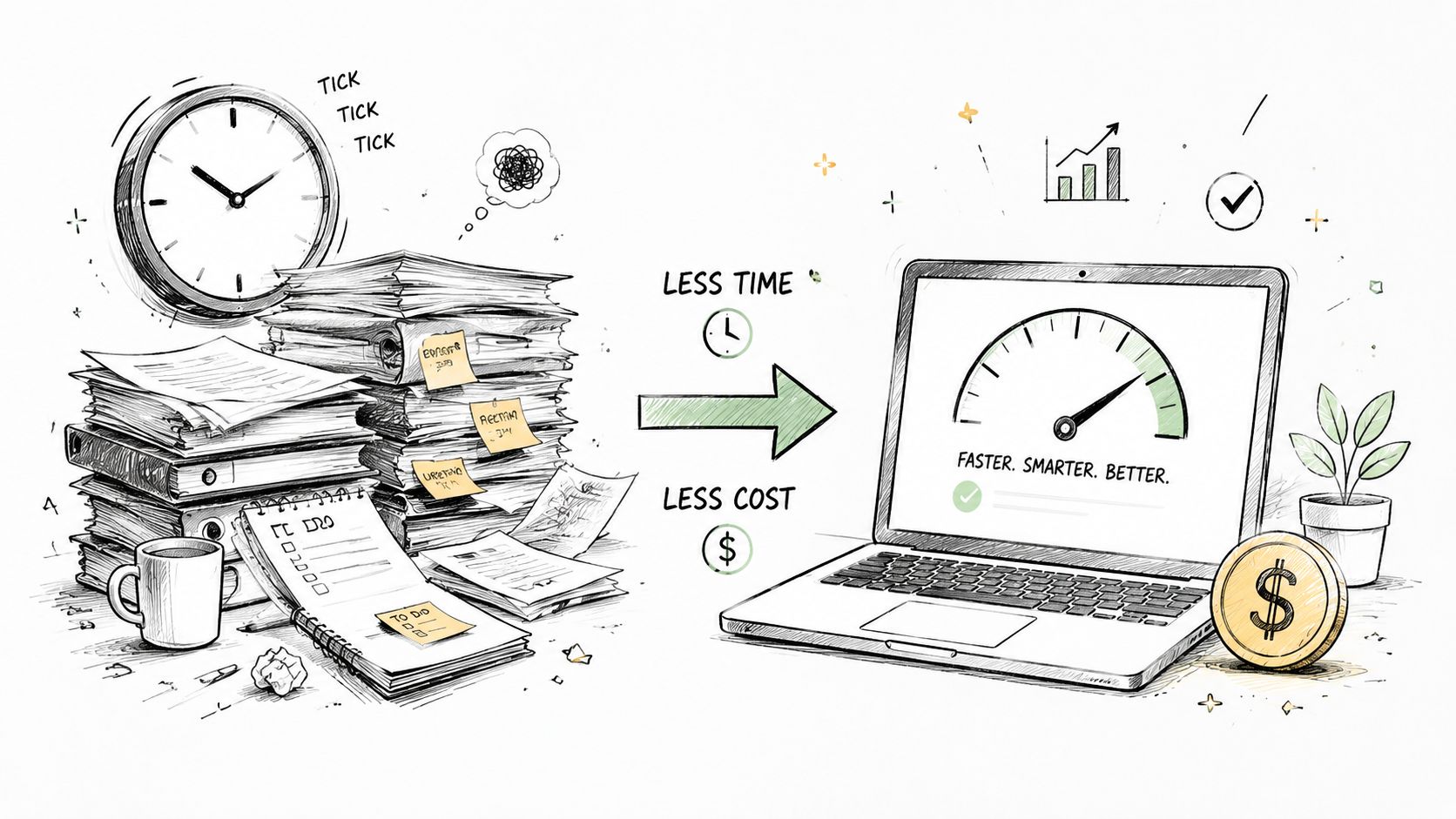
Lead with the measurable consequence, not the feature. A workflow comparison should show the current tool, the manual handoffs, the delay, and the new path. Then address the obvious objection. Buyers may agree that your product is faster while worrying that it isn't exactly equivalent to what they use today.
Build the campaign around three tests:
Practical rule: If the buyer can't compare your product with the current workflow, your efficiency claim is incomplete.
The KPI hierarchy should move from qualified engagement to workflow assessment completion, then to sales-accepted opportunities. Don't optimize for cheap clicks if the campaign attracts people without the authority or pain to switch. For a broader operating view, connect the campaign to B2B marketing automation strategy, especially when the product's value depends on removing repeated manual work.
Some SaaS products don't merely improve an existing task. They make a different business outcome possible. That's the strategic outcome play, and it requires more conviction than an efficiency message because the buyer must believe the company can operate differently after adopting the product.
Figma isn't just a design editor. Its strongest strategic story is what shared, browser-based collaboration enables across design, product, and engineering. Stripe is not only a payments API. Its strategic relevance comes from helping companies enter payment and financial-service opportunities without building every underlying capability themselves. Segment's value is not limited to data collection. It supports a more unified customer-data foundation that can shape retention and customer value decisions.
These claims belong in executive-grade campaigns, not feature carousels. Use LinkedIn thought-leadership ads, executive reports, customer operating-model narratives, and account-based landing pages. The audience is usually a leader responsible for a strategic gap, such as slower product launches, poor data coordination, or an inability to enter a new market.
The creative should lead with the outcome. “Reach market faster” has more strategic force than “connects to multiple systems,” provided the company can explain how the outcome is achieved and what proof supports it.
Build the campaign around a credible future state:
A strategic claim needs more education than an efficiency claim. The landing page should include the operating assumptions, implementation requirements, and evidence that helps finance, product, technology, and executive stakeholders evaluate the decision independently.
The strategic outcome is the promise. The product is the mechanism. Don't reverse those roles in the headline.
Use pipeline quality, senior stakeholder engagement, pilot progression, and expansion readiness as the KPI sequence. A click is only useful if it advances strategic conviction. This play is a poor fit for a product with no differentiated outcome, so don't inflate a feature improvement into a transformation story.

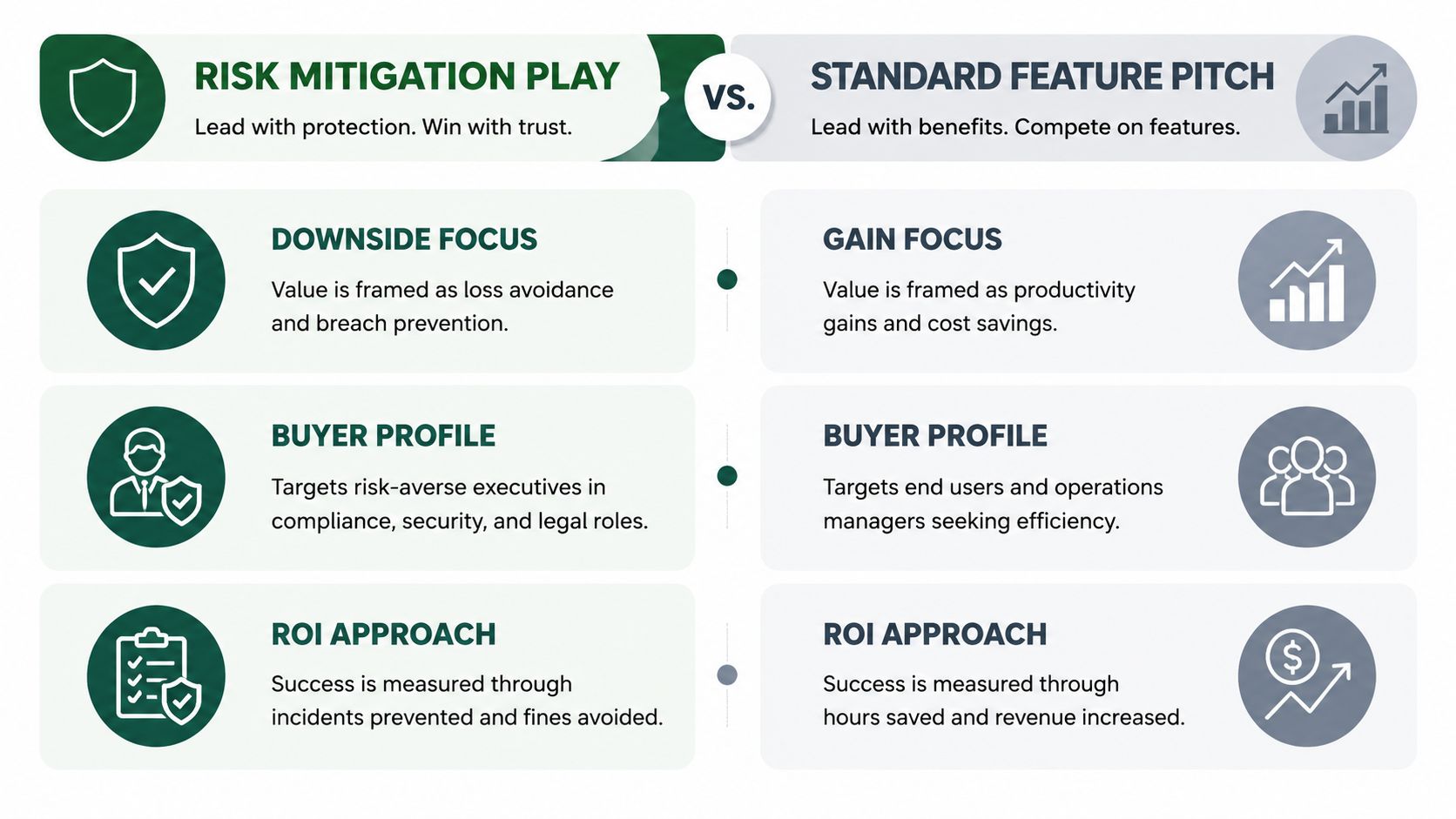
Risk mitigation sells by reducing downside. It's the right play when a buyer faces a material threat involving security, compliance, privacy, operational continuity, data quality, or customer trust. The proposition shouldn't pretend the product creates exciting new growth if the buyer's real motivation is avoiding an unacceptable failure.
Okta operates in the context of identity and unauthorized access risk. Vanta addresses the burden and uncertainty associated with SOC 2 compliance. OneTrust is associated with privacy governance, consent, and data mapping. Domo can be positioned around confidence in governed analytics and auditable decision-making. In each scenario, the buyer needs to understand what exposure exists, who owns it, and what action reduces it.
The audience logic differs from ordinary demand generation. Target security, compliance, legal, risk, and technology stakeholders, then build a path to the executive who controls the broader business decision. Google Search is useful for urgent compliance and security intent. LinkedIn can build awareness around a specific regulatory or operational exposure. Retargeting should answer implementation and proof questions, not repeat the fear message.

Your creative should make the risk assessable. Use a maturity assessment, control checklist, incident-readiness guide, or market-entry requirements document. Avoid dramatic claims that the product can't substantiate. Risk buyers are skeptical because overstatement increases the risk of choosing the wrong vendor.
Use peer evidence carefully. A case study from the same industry, regulatory environment, or operating model carries more weight than a generic logo wall. A practical guide to writing a B2B case study can help structure the narrative around the original exposure, the decision, the implementation, and the evidence of improved control.
The KPI hierarchy should prioritize assessment completion, qualified conversations, security review progression, and opportunity conversion. Don't use fear to force a low-quality lead. Use specificity to help the right buyer recognize a problem they already own.
A platform proposition is not a longer feature list. It's a claim about what other teams can build, automate, customize, or connect after adopting your product. Buyers accept the implementation burden because they believe the core platform will support multiple valuable use cases over time.
Webflow's platform logic extends beyond page creation. It gives designers and agencies a way to build and manage sites without depending on developers for every change. Zapier's platform story allows non-technical teams to assemble workflows across systems. Salesforce became strategically important because organizations could adapt CRM workflows to their own sales processes. HubSpot's platform narrative spans marketing, sales, and service operations.
This play needs a multi-stakeholder campaign. Technical buyers want extensibility and governance. Operational leaders want implementation confidence. Executives want evidence that adoption can expand without creating another disconnected system.
The strongest creative shows real downstream use cases. Use architecture explainers, customer-built workflow galleries, partner content, implementation guides, and technical demos. A platform campaign should make the future concrete without implying that every buyer gets value automatically.
Your landing page needs to answer four questions:
A platform can create more long-term value than a point solution, but it also creates a heavier proof burden. If onboarding is weak, flexibility becomes customer work. Treat implementation content and partner readiness as part of the proposition, not post-sale support.
The video below can support a broader explanation of how a platform story differs from a feature pitch.
Use account-based targeting for organizations with enough workflow complexity to justify a platform. Measure qualified account engagement, technical validation, first use-case activation, and expansion into additional workflows. A partnership motion can strengthen this play, especially when customers need implementation support. See how to build a partnership program for Shopify app growth for a channel perspective.
The capability play works when specialized work is expensive, scarce, or slow, and your product lets a broader group produce a useful result. Don't claim that non-experts become identical to specialists. Buyers can detect that exaggeration immediately. Position the product around speed, access, iteration, and the specific quality threshold the workflow requires.
Figma helps people outside traditional design roles contribute to visual work. Loom lets employees explain ideas through video without editing expertise. Jasper supports marketers who need to produce copy without starting from a blank page. Webflow enables designers to build and publish sites without waiting for developers to implement every change.
The proposition has two parts. First, the buyer gains a capability. Second, the organization reduces dependency on a constrained specialist resource. Paid creative should demonstrate the first part visually and explain the second in business terms.
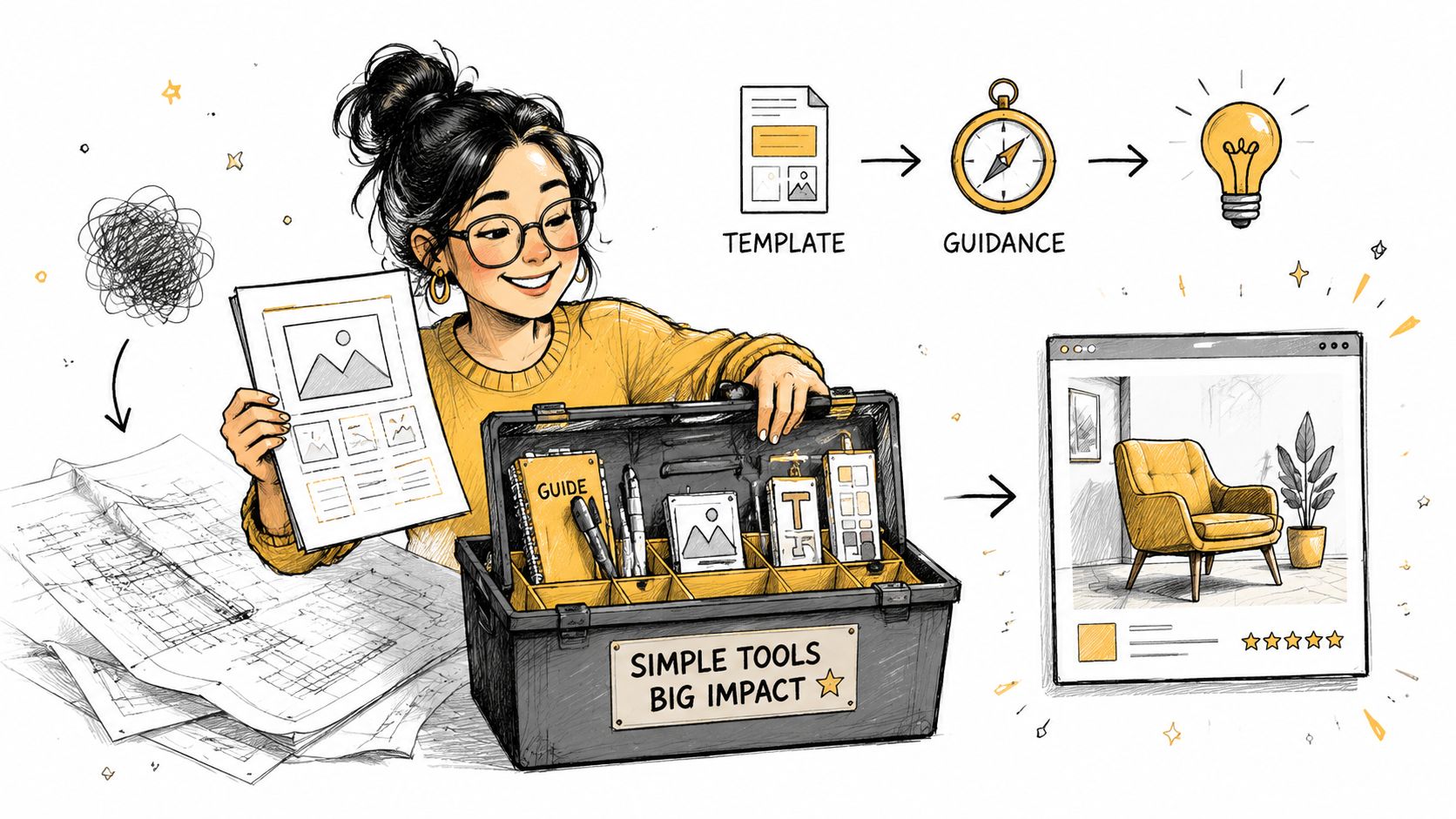
Templates, guardrails, workflows, and examples do more selling than a list of capabilities. They show buyers how the product carries expert judgment into the hands of a broader team. A campaign should demonstrate a real task from brief to usable output, including where specialist review still matters.
Use creative that compares the old dependency chain with the new workflow:
Your onboarding experience must match the promise. If the campaign says anyone can do the work but the product requires extensive training, the conversion may happen while retention suffers. Customer onboarding best practices should connect directly to the capability claim.
Measure activation around the first successful outcome, not account creation. Then track repeat usage, contribution from non-specialist roles, review cycles, and expansion into adjacent workflows. This play is strongest when the buyer values speed and access more than perfect equivalence with specialist work.
Talent problems create a different buying context. The buyer isn't asking whether the product improves a process. They're asking whether it helps retain critical people, make better hiring decisions, improve employee experience, or reduce the operational drag caused by vacancies and turnover.
Lattice is associated with performance management and employee development. Greenhouse focuses on structured hiring operations. Culture Amp helps organizations identify engagement problems. Workable supports hiring teams that need more efficient recruiting workflows. These products can all be described through features, but the stronger proposition connects the feature to a people outcome the leadership team already cares about.
The audience is rarely one person. People leaders may own the problem. Finance may challenge the cost. Functional executives may experience the impact first. Managers determine whether the process gets used. A campaign that targets only HR can generate interest without securing the internal adoption needed for value.
Start with the specific failure mode. “Improve employee engagement” is too broad. Is the company losing experienced engineers, struggling to identify weak management, missing qualified candidates, or failing to onboard new hires consistently? Each issue requires different evidence and creative.
Use a narrative that covers both attraction and retention where the product supports both. Demonstrate the manager workflow, employee experience, or hiring decision rather than showing a generic dashboard.
Do not make unsupported cost claims about replacing employees or filling roles. The financial case should use the buyer's own data, including hiring volume, vacancy duration, compensation, and productivity assumptions.
A talent proposition fails when it treats people as a reporting category. Show the behavior the product changes.
A practical campaign can begin with a diagnostic for leaders, followed by role-specific creative and a proof-oriented sales motion. B2B marketing team structure guidance can help clarify ownership between marketing, people operations, sales, and functional leaders.
Network products don't create value through software alone. They create value through access to relevant people, trusted knowledge, discovery, validation, or participation in a focused ecosystem. That makes the value proposition harder to sell early. A buyer wants evidence that the network is useful, but the network needs quality participants before that usefulness becomes obvious.
LinkedIn illustrates professional network value. Product Hunt connects makers and early adopters around discovery and validation. AngelList is valuable because of the relationships between founders, investors, and operators. Slack communities can serve concentrated professional groups when participation is curated and the conversations solve real problems.
The common mistake is to advertise membership volume without explaining the value of participation. A large but irrelevant audience doesn't create a durable proposition. Start with a dense beachhead community where the reason to join is specific and easy to articulate.
Paid media should target people who already identify with the community's problem or professional context. Use member stories, expert discussions, event recordings, curated insights, and specific invitations. Don't promise access to “everyone in the industry.” Explain who participates, what they exchange, and why the interaction is better than a public feed.
A network campaign needs operating discipline:
For a talent-focused network or screening workflow, a relevant resource is streamline applicant screening. The link is useful only when it supports a concrete hiring or talent-intelligence context, not as a generic community example.
Measure qualified member acquisition, activation, meaningful participation, referral behavior, and retention. Don't optimize for registrations if new members never reach a useful interaction. In network businesses, an empty experience is worse than a small, valuable one.
Transformation is the broadest and most expensive proposition, so it's also the easiest to misuse. A product doesn't become transformational because the homepage uses the word. Transformation means the buyer changes a business model, operating structure, cost base, distribution model, or fundamental way of serving customers.
Shopify enabled entrepreneurs to launch commerce businesses without building traditional retail infrastructure. Stripe helped companies create financial products and payment experiences. Amazon Web Services supported a shift from capital-intensive infrastructure toward cloud operating models. Salesforce helped establish software as a recurring service rather than a perpetual licensing model.
These examples describe structural change, not ordinary optimization. The buyer is usually a CEO, board member, business-unit leader, or executive sponsor with authority to coordinate multiple functions. The campaign must therefore support strategic evaluation, financial scrutiny, implementation planning, and resistance from people who benefit from the incumbent model.
Lead with the business-model outcome. “Move from services to a scalable platform” is stronger than “includes APIs,” but only if the product can support the operating transition. The campaign should show the roadmap, dependencies, decision gates, risks, and internal ownership.
Use executive content, board-ready briefs, strategic workshops, and account-based sequences. A transformation landing page should explain what changes first, what remains stable, and how the buyer can stop or adjust if early assumptions fail.
The KPI isn't immediate lead volume. Track engagement from the right executive accounts, workshop progression, business-case completion, pilot approval, and movement through decision gates. A transformation promise should produce fewer but more consequential opportunities.
If the buyer is still trying to define the market, a targeted resource such as Gritt's investor search tool may support broader ecosystem research, but it shouldn't replace a clear commercial case for the transformation.
| Play | 🔄 Implementation complexity | ⚡ Resource requirements | 📊 Expected outcomes | 💡 Ideal use cases | ⭐ Key advantages |
|---|---|---|---|---|---|
| The Efficiency Play: Faster/Better/Cheaper | Low, plug-and-play, minimal behavior change | Low, limited services, quick POC | Measurable efficiency gains (hours, $ saved) | Replace legacy/manual tools; PLG, bottom-up | Immediate ROI and fast adoption |
| The Strategic Outcome Play: New Competitive Advantage | High, requires mental-model shift and exec alignment | High, cross-functional investment, pilots | Strategic business outcomes (market speed, retention) | Executive-led growth, revenue differentiation | Premium pricing and durable defensibility |
| The Risk Mitigation Play: De-risk High-Stakes Decisions | Medium–High, procurement and legal reviews | Medium, security/compliance expertise, audits | Downside reduction (incidents prevented, fines avoided) | Regulated industries, risk-averse buyers | Strong retention and low price sensitivity |
| The Platform Play: Enable a Category of Use Cases | High, implementation, customization, ecosystem | High, engineering, PS, partner network | Compounding long-term value across use cases | Top-down GTM, companies needing extensibility | High lock-in and large TAM expansion |
| The Capability Unlocking Play: Non-Experts Do Expert Work | Medium, UX, templates, training required | Medium, productized guidance, support content | Democratized capability + cost savings | SMBs/mid-market, teams without specialists | Broad adoption; reduces need to hire experts |
| The Talent/Retention Play: Reduce Turnover / Improve Hiring | Medium–High, organizational change and adoption | Medium, HR integrations, change management | Improved people metrics (turnover, time-to-fill) | High-growth or talent-constrained companies | Existential value; multiplier impact on org health |
| The Network/Community Play: Value Through Ecosystem | High, build critical mass, curation, moderation | Medium–High, ongoing community management | Network effects, engagement-driven value | Professional networks, marketplaces, niche communities | Extremely defensible once critical mass reached |
| The Transformation Play: Large-Scale Business Shift | Very High, multi-year organizational transformation | Very High, executive sponsorship, capital, teams | Business-model change and market leadership | Board/C-suite initiatives, existential buyer situations | Maximum pricing power and game-changing impact |
A compelling value proposition is narrower than most leadership teams want. It doesn't describe every customer, every feature, or every possible benefit. It makes one economic promise to one buying context through one channel that can carry the required proof.
That constraint improves performance because it forces decisions. An efficiency play belongs where the status quo is visible and the buyer wants a better workflow. A risk play belongs where failure has clear consequences and trust matters more than novelty. A platform play needs implementation proof and a credible expansion path. A transformation play requires executive sponsorship, phase gates, and a business case that survives scrutiny.
Gartner's research shows why broad, sales-dependent messaging fails. Buyers spend only 17% of their total buying time with potential suppliers, and 75% prefer a rep-free buying experience. The buying process also includes six non-linear jobs, so the proposition must work during problem definition, solution exploration, requirements building, supplier selection, validation, and internal consensus creation. Gartner's buyer journey analysis gives the underlying context.
The committee problem makes clarity more valuable. Gartner reported in 2025 that 74% of B2B buyer teams demonstrated unhealthy conflict during the decision process. Its 2026 survey found that buyers used an average of seven information sources during a recent purchase, while 45% used generative AI to gather vendor and product information. These findings are summarized in the published buyer research announcement. Your claim must be easy for several stakeholders and systems to understand, verify, and repeat.
Run the final operating check before scaling spend:
The commercial case for this discipline is visible in controlled experiments. A B2B homepage test produced a 201% increase in lead capture rate after the page changed and the result was measured experimentally. MarketingExperiments' value proposition test shows why message clarity can change conversion on the same traffic base.
Another B2B success-story experiment recorded 8.40% conversion for the treatment page versus 4.06% for the control, a 106.8% relative lift. The result came from sharper proposition and page messaging, not additional traffic. The B2B success-story experiment provides the specific comparison.
The operating model extends beyond copy. Independent buyer research found that 84% of B2B buyers consider self-service tools critical when choosing a vendor. It also identified lack of pricing transparency as a top frustration for 39%, time-consuming reordering for 35%, and slow vendor response for 24%. The same research found 84% want suppliers to offer several sales channels, 97% want an online experience that is fast, simple, and accurate, and 27% are drawn to marketplaces for convenience, choice, and added services. Contentful's 2025 B2B buyer benchmark report supports a broader conclusion: the value proposition includes the buying experience, procurement path, and speed of information.
Purpose-led positioning needs the same commercial discipline. Independent B2B research summarized in 2025 found that economic benefits are more persuasive than ecological ones, benefit-oriented framing beats moral framing, and risk-reduction messages work especially well in dynamic markets. Research on sustainable B2B selling supports a direct recommendation: lead with ROI, risk, resilience, or compliance, then connect sustainability to the business case.
Clarity also has a top-line relationship. Bain's survey of more than 1,000 global B2B leaders found that companies with a value proposition that was clear and consistently understood grew revenue by 19% in 2025, compared with 12% for companies with limited or inconsistently communicated value propositions. The summarized Bain findings make the strategic implication difficult to ignore.
Big Moves Marketing's role is to help growth-stage teams clarify positioning, make faster channel decisions, and run disciplined pilots. It isn't to manufacture demand around a message buyers can't understand. The best growth teams treat the value proposition as the control system connecting audience, creative, landing page, sales motion, and budget.
Big Moves Marketing helps B2B SaaS teams turn unclear positioning into conversion-ready messaging, websites, and focused go-to-market pilots. If your paid campaigns are generating activity without enough qualified pipeline, visit Big Moves Marketing to discuss the value proposition and channel decisions that need to change.



%20-%20white.svg)