%20png%20copy.avif)
Most B2B SaaS pricing advice starts with the wrong question: Which pricing model should we choose? That framing turns pricing into a launch decision, then leaves the commercial system unattended while sales teams negotiate exceptions, customers renew on obsolete terms, and competitors reshape buyer expectations.
A stronger b2b pricing strategy treats pricing as operating infrastructure. It connects packaging, segmentation, discount governance, renewals, measurement, and experimentation. The model matters, but execution determines whether the model captures value or quietly gives it away.
The evidence points in that direction. A 2024 survey of 760 B2B SaaS pricing leaders found that 94% update pricing and packaging at least annually, 38% do so quarterly, and 98% had changed pricing or packaging since the prior year. Competitive analysis was the most common research input at 43%, followed by customer feedback at 34%. (Pricing and Packaging in B2B SaaS)
That isn't evidence of a market searching for a perfect price sheet. It's evidence of teams managing pricing as a living commercial system.
“Set it and forget it” is one of the most expensive assumptions in SaaS. Founders launch a pricing page, train sales on the packages, and move on to acquisition. Six months later, account executives are discounting differently, enterprise prospects are requesting custom bundles, and finance can't explain why realized price varies across similar accounts.
Pricing doesn't fail because the spreadsheet was wrong. It fails because nobody owns the system after launch.
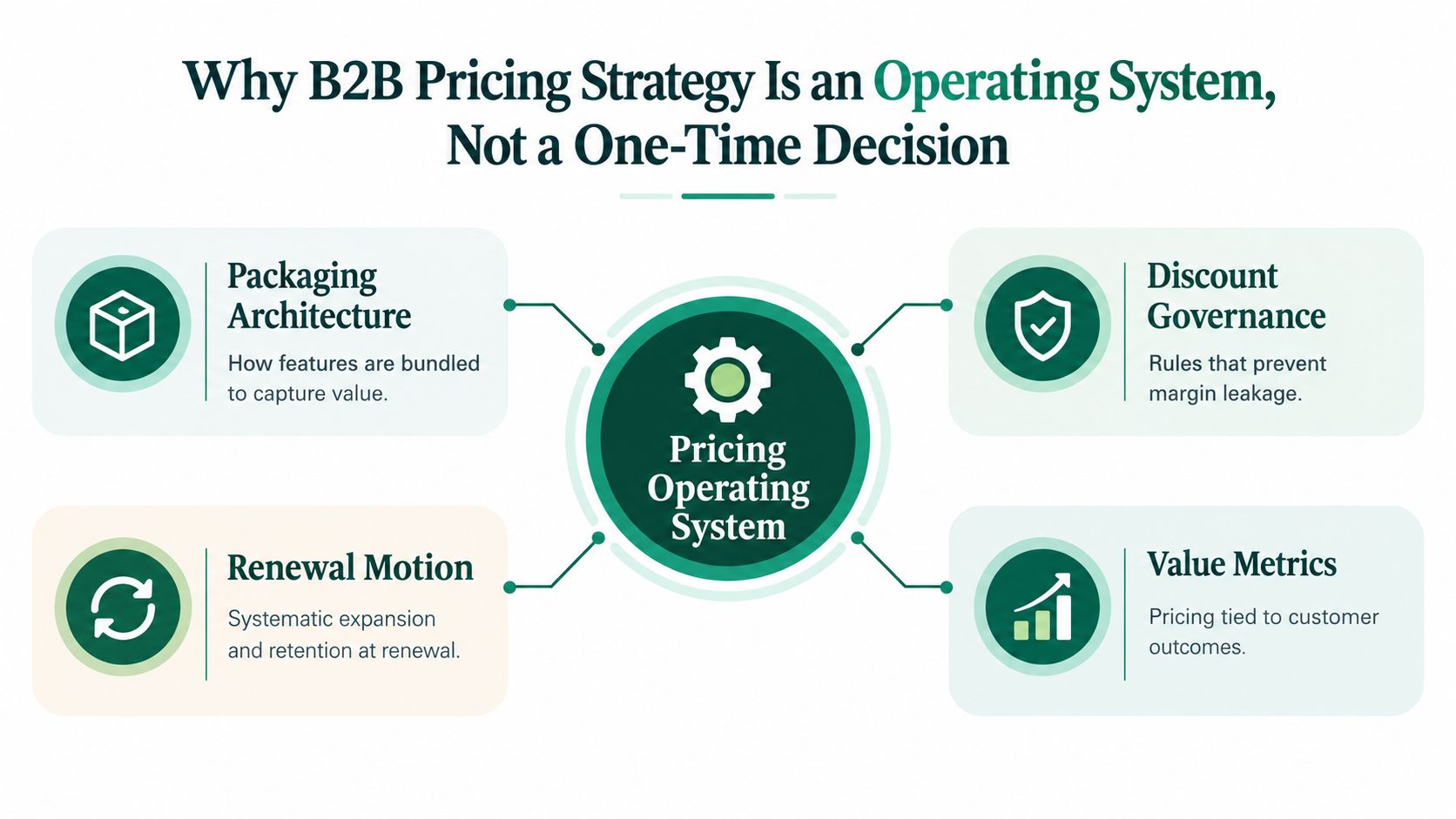
Packaging architecture determines how customers buy value. Discount governance determines how much of that value reaches your margin. Renewal motion determines whether the commercial relationship compounds or resets. Value metrics connect price to the customer's economic reality.
Those modules need explicit ownership and a regular cadence. A founder might own the initial architecture, while a revenue leader owns deal governance and finance owns realization reporting. The exact structure depends on stage, but the absence of ownership is never neutral.
A value-based approach is useful when your product creates measurable economic outcomes. Research on how to define value-based pricing describes the strategic shift away from cost alone, but value-based pricing only works when your team can quantify and defend the value. Otherwise, it becomes premium language attached to arbitrary pricing.
The same operating logic applies outside SaaS. A merchant managing payment disputes, for example, needs controls that sit inside day-to-day revenue operations, not a policy document filed away after launch. Resources such as affordable chargeback alerts for merchants illustrate the broader principle: commercial systems need timely signals and accountable workflows.
Practical rule: If pricing changes only when the founder starts a project, you don't have a pricing strategy. You have a neglected asset.
The rest of the system follows a clear sequence. Choose a model that fits the buyer and your finance capability. Segment the model around economic value. Roll it out without damaging renewals. Govern negotiation before discounting becomes culture. Then measure realization and use controlled experimentation to improve the system.
Growth-stage SaaS companies rarely operate a pure model. They choose a dominant logic, then add constraints and expansion mechanics around it. The useful comparison isn't theoretical elegance. It's whether the buyer understands the bill, sales can defend it, finance can forecast it, and the product can support expansion without creating resentment.
| Pricing Model | Best-Fit ICP | Expansion Revenue Potential | Forecast Accuracy | Sales Cycle Impact | Billing Complexity |
|---|---|---|---|---|---|
| Per-seat | Teams with predictable user counts | Moderate | High | Familiar, usually easier to explain | Low |
| Usage-based | Products where consumption tracks value | High | Lower | Requires buyer education | High |
| Tiered | Diverse segments with clear package fences | Moderate to high | High | Simplifies self-selection | Moderate |
| Value-based | Strategic accounts with measurable ROI | High | Variable | Longer discovery and approval | High |
| Hybrid | Mixed buying contexts and variable usage | High | Moderate | Requires clear commercial narrative | Moderate to high |
Per-seat pricing remains attractive because everyone understands it. The problem appears when usage, automation, or AI allows one person to produce the output previously requiring a larger team. Seat count then becomes a weak proxy for value and can punish adoption.
Usage-based pricing aligns revenue with consumption and gives expansion a natural path. It also makes forecasting harder for buyers and sellers. If usage is volatile, procurement may prefer a committed base, which is why many teams add a platform fee or usage commitment.
Tiered pricing works when each package represents a meaningful change in customer value. “Good, Better, Best” fails when the tiers are feature inventories with no clear reason to upgrade. A tier should make the buyer's decision easier, not force them to compare every checkbox.
Value-based pricing can capture more of the outcome, but only when the seller has credible value quantification. Research on value-based pricing in B2B markets links its effectiveness to value-quantification tools and notes that customer price sensitivity can reduce the gains.
Hybrid pricing is usually the practical answer for complex SaaS. A platform fee creates predictability, while consumption or overage captures growth. A per-seat base with usage beyond an included allowance can work when users are stable but activity varies.
Contract mechanics also matter. An overview of Master Service Agreements is useful context because pricing architecture eventually meets renewal rights, payment terms, service commitments, and change controls.
Decision rule: Choose the model your buyer can explain to a CFO in one sentence and your finance team can forecast within 8% accuracy next quarter. If either side fails, simplify the model before adding sophistication.
A pricing model should follow the customer's economic reality, not the org chart your CRM happens to contain. A 50-seat company and a 5,000-seat enterprise may use the same product, but they won't evaluate value, risk, procurement friction, or budget authority in the same way.
Start with two diagnostics.
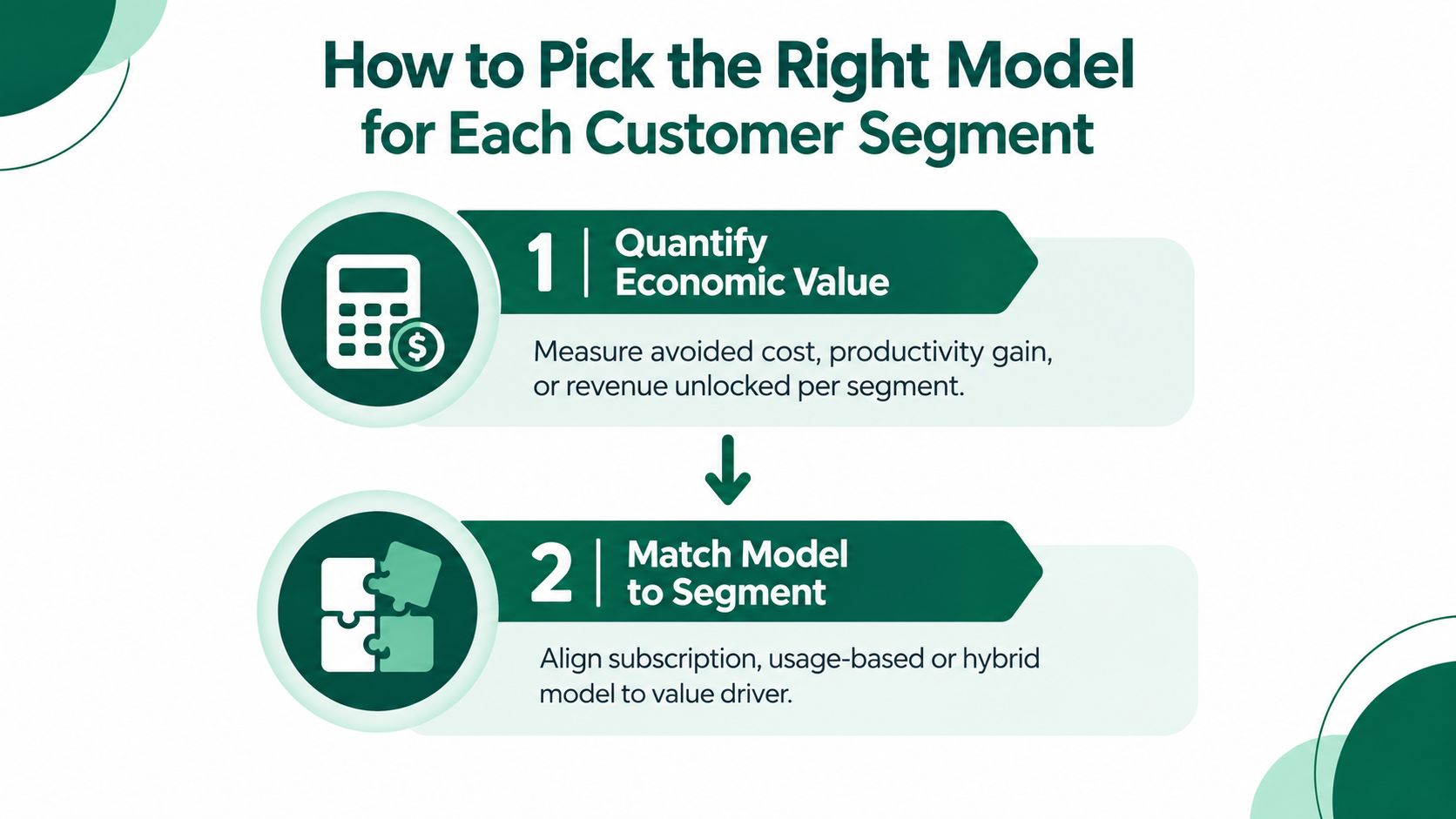
For each segment, identify the customer's avoided cost, productivity gain, or revenue generated. Don't accept “they save time” as a value case. Define whose time, which workflow, and what the organization does with the capacity released.
A developer platform might reduce incident investigation effort. A revenue tool might improve conversion or shorten response time. A compliance product might reduce exposure to costly manual work. The value metric should be observable enough for a buyer to recognize and defend internally.
A common SaaS heuristic places price at 10% to 30% of the value created, according to this value-based pricing framework. Treat that as a starting hypothesis, not a law. The right range depends on proof, switching costs, alternatives, and how directly your product controls the outcome.
Use customer interviews, Van Westendorp price-sensitivity research, or segmented MaxDiff surveys to understand how buyers trade price against features, service, risk, and alternatives. The sample must represent the ICP. A convenience sample of friendly users will produce comforting fiction.
Then segment by company size, use-case maturity, and procurement sophistication. These variables often predict pricing behavior better than industry labels.
A horizontal SaaS company might choose:
The point isn't to offer every model to every account. It's to create deliberate fences between cohorts, then monitor whether those fences produce the intended buying behavior. The B2B customer segmentation framework is useful when the current segments describe company attributes but not economic behavior.
Repricing existing customers is a change-management problem disguised as a pricing problem. The safest rollout separates new-logo testing from contract migration, protects signed agreements, and gives customer-facing teams a clear explanation before invoices change.
Use four phases.
Group accounts by current plan, contract date, usage profile, discount depth, renewal risk, and strategic importance. Don't migrate a high-value account just because its plan appears outdated. Its commercial context may matter more than package cleanliness.
Never retroactively reprice signed contracts. For annual customers, a 12-month grandfathering period gives the account a defined transition window and gives your team time to prove the new packaging. Enterprise agreements may also require explicit uplift language, renewal notice, or amendment procedures.
Test new packages on new logos first when churn risk is high. For existing accounts, offer a migration path that improves fit, not merely a forced invoice increase. A customer moving from per-seat to usage tiers should see included capacity, overage logic, forecast controls, and a clear reason to change.
Run Van Westendorp research to identify perceived price boundaries and Gabor-Granger testing to assess purchase likelihood at specific price points. These methods inform the hypothesis. Live holdouts, geographic splits, and account-level elasticity monitoring tell you what happens in market.
Use controlled sunset clauses with clear notice. A 90-day notice period gives procurement and finance time to respond, while your account team can explain the commercial rationale before the renewal conversation becomes a support ticket.
Communications should follow a T-90, T-60, and T-30 cadence. Each message should explain what changes, what stays protected, how the new model maps to value, and whom the customer can contact.
Use change-management guidance for pricing transitions to coordinate sales, customer success, finance, billing, and support. Pricing changes fail when each function tells a different story.
Before a renewal peak, test messaging, new-logo packaging, and low-risk add-ons. After the peak, migrate established cohorts with stronger evidence. The higher the customer concentration, contract complexity, or model change, the slower the rollout should be.
Discounting is not a sales skill. It's a pricing policy expressed through individual deals. If representatives can trade margin for speed without recording why, your list price becomes theatre and your forecast becomes unreliable.
McKinsey's B2B pricing analysis found that a 1% improvement in realized price can lift operating profit by 8%, roughly twice the benefit of a comparable improvement in market share, variable costs, or fixed-cost utilization. (The hidden power of pricing)
That shift changes the negotiation posture. The goal isn't to eliminate concessions. It's to make every concession buy something.
McKinsey's SaaS analysis found that deals with 10% to 30% discounts grew revenue per customer by 4% per quarter, while discounts of 30% or more produced faster annual customer growth, 50% versus 25%, but cut ARR growth per customer roughly in half compared with mid-discount deals. (B2B pricing research and discount trade-offs)
The implication is straightforward. Deep discounting can accelerate acquisition, but it weakens the account economics you need for expansion. Monitor ARR per customer, not just close rate.
| Discount Depth | Approver | Justification Required | Margin Impact |
|---|---|---|---|
| 0% to 10% | Account executive | Competitive context and deal stage | Usually contained |
| 11% to 20% | Sales manager | Buyer commitment and commercial trade | Requires review |
| 21% to 30% | VP Sales and deal desk lead | Documented strategic rationale | Material erosion risk |
| 30%+ or non-standard terms | CRO and CFO | Full economic case and precedent review | High erosion risk |
The matrix reflects a practical approval structure documented in this SaaS discount approval example. Adapt the titles to your company, but don't remove the thresholds.
When procurement says the budget is frozen, trade price for payment terms, a narrower scope, a reference, case-study rights, or a defined implementation commitment. When a buyer cites a competitor, ask what capability or risk makes the alternative comparable. When they request a multi-year commitment, trade duration for predictability rather than giving away every year upfront.
Useful language is plain:
A strategic logo isn't strategic if it teaches the market that your price is negotiable without limit.
Pricing becomes an operating system when the team can see what happened at the transaction level and decide what to test next. A weekly dashboard should connect list price, realized price, discounting, retention, and elasticity. CRM reports buried by deal stage won't do that.
Track four core measures:
Don't let AI turn into a black box. McKinsey reports that 65% to 85% of organizations expect to adopt generative AI or agentic AI in pricing within one to three years, compared with 10% to 30% today. (B2B pricing and the next phase of the AI revolution)
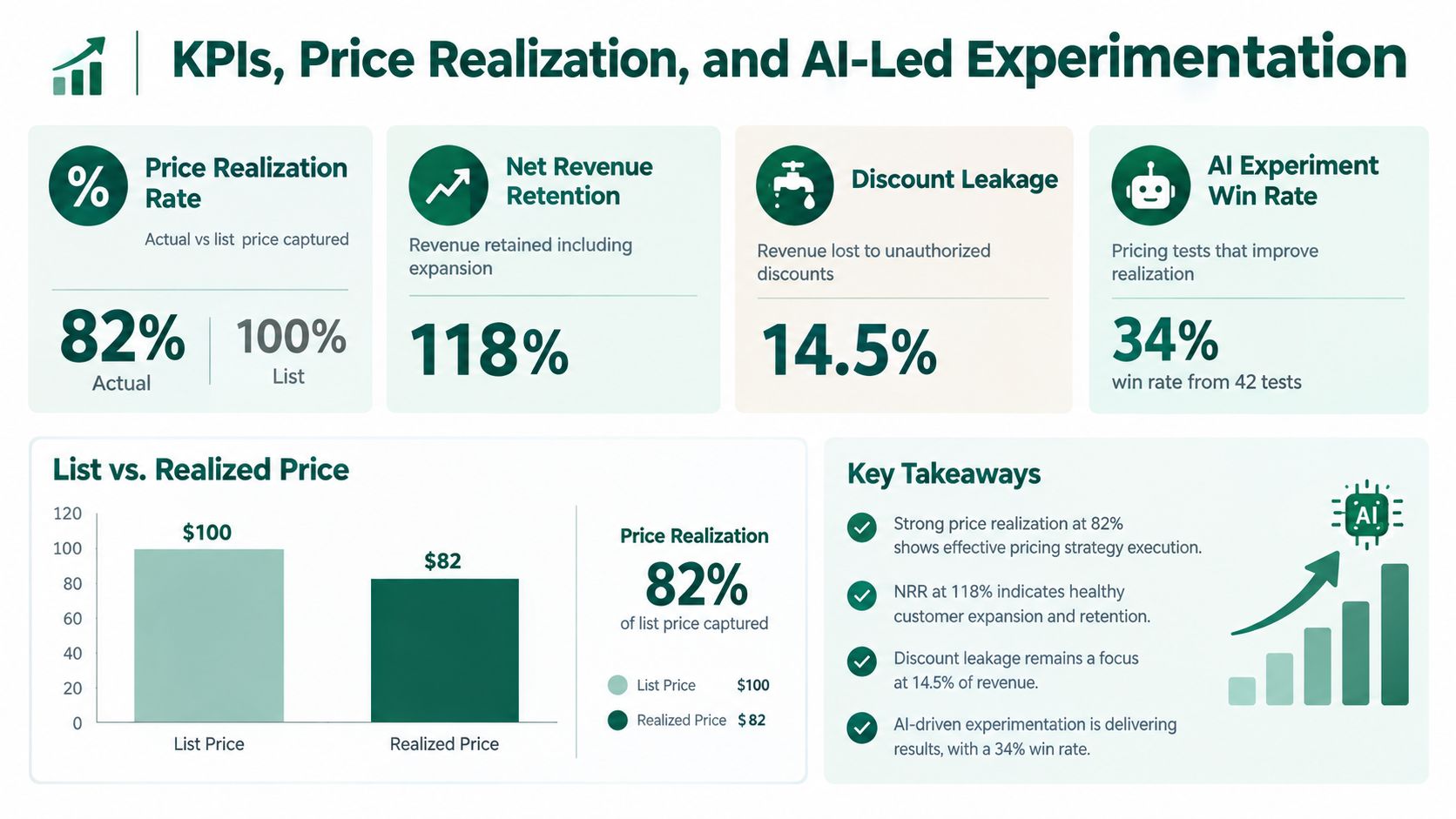
Use AI where it improves decision quality, not where it creates theatre. Uplift models can identify accounts likely to tolerate a proposed increase. Synthetic controls can compare tier migrations against similar accounts that stayed on the old structure. Language models can score deal-desk justifications for missing evidence, repeated exceptions, or hidden margin leakage.
The measurement design matters more than the model. Survivorship bias can make retained customers look price-insensitive because churned accounts disappeared from the sample. Simpson's paradox can make an overall trend contradict every segment-level trend. Optimizing ARPA alone can also hide logo loss.
A pricing council needs a cadence. Review realization and exceptions every 30 days. Reassess segment behavior and experiment results every 60 days. Revisit the model, packaging, and governance rules every 90 days. The council needs a named owner, a decision log, and authority to stop experiments that damage retention.
Pricing changes work when the commercial metric, customer behavior, and rollout decision stay connected. They fail when teams celebrate a higher headline price while ignoring adoption friction, sales-cycle drag, or renewal exposure.
Use three recognizable scenarios as operating patterns, not templates:
The pricing page should reflect those same decisions. Lead with the operational outcome, then explain the capabilities that produce it. A CFO needs commercial predictability. An end user needs to know whether the workflow fits. Neither wants a wall of feature checkboxes.
Replace “unlimited features” with a clear statement of who the plan serves and what outcome it supports. Show the boundary between tiers in language that reflects buying decisions, not internal product ownership. Use modular add-ons where customer needs vary, rather than hiding every difference behind a custom quote.
Keep "Contact us" for complex commitments, not as a substitute for pricing discipline. If the purchase requires a long procurement process or substantial implementation, a guided enterprise path makes sense. Otherwise, opaque pricing transfers uncertainty to the buyer and gives competitors an opening.
The case for showing pricing on B2B websites provides a useful test. Ask whether the page helps a qualified buyer self-select, build an internal case, and understand the next commercial step.
Don't start by redesigning every package. Start by making the current system visible.
Instrument price realization in the Monday revenue meeting. Pull list price, quoted price, final price, discount depth, payment terms, and non-standard concessions into one view. If finance, sales, and customer success use different definitions, resolve that before debating strategy.
Commission willingness-to-pay interviews with eight late-stage churned accounts and eight closed-won accounts before Friday. Ask what they compared, what they expected to pay, what nearly stopped the purchase, and which part of the offer created economic confidence. Don't ask whether they like the pricing page. Ask how they built the buying case.
Draft a three-tier discount matrix with named approvers. Every exception should capture the buyer request, competitive context, scope, term, and expected give-get. A discount without a reason is not a strategy. It's leakage.
Replace feature-led tier headlines with outcome-led language. Keep the feature detail, but subordinate it to the customer problem each package solves. Then launch one usage or value-metric test against the current per-seat anchor within 60 days, limited to a defined segment or new-logo cohort.
Schedule a quarterly pricing review tied to NRR and gross margin, not revenue alone. Revenue can grow while pricing quality deteriorates if acquisition depends on excessive concessions or expansion comes from a small number of unusually large accounts.
Create one source of truth for every quoted price, discount, payment term, and concession. The source can be a governed CRM workflow, CPQ system, or finance-controlled dataset. It can't be a collection of spreadsheets owned by different functions.
Pricing deserves the same operating discipline as demand generation and sales capacity. The difference is that a well-governed price change can compound without requiring linear headcount growth. Founders who treat pricing as an annual launch will keep rediscovering the same problems. Founders who staff it as a system will make better commercial decisions before competitors notice the shift.
Big Moves Marketing helps B2B SaaS leaders clarify positioning, packaging, pricing-page messaging, and the operating decisions that connect them to pipeline and revenue. Visit Big Moves Marketing to discuss a pricing system built for your stage, ICP, and go-to-market motion.





%20-%20white.svg)