%20png%20copy.avif)
Most B2B SaaS teams misunderstand the category. They assume an AI marketing agency is simply a traditional agency with a chatbot layered on top, then evaluate it by output volume, turnaround time, and the number of assets it can produce. That is the wrong standard, and it usually leads to the same outcome, more activity, weaker positioning, and pipeline optics that create the appearance of progress while the market moves on.
The distinction is more straightforward. A credible AI-enabled partner uses AI to productize repeatable work, shorten decision cycles, and improve execution quality, while experienced operators remain accountable for the brief, positioning, proof, and governance. For founders and revenue leaders, that is the framework that matters. More content will not correct a poor ICP. More automation will not repair a weak narrative. It will only scale the wrong motion faster.
The market context makes this difficult to ignore. The global artificial intelligence in marketing market was estimated at USD 20.44 billion in 2024 and is projected to reach USD 82.23 billion by 2030, with a 25.0% CAGR from 2025 to 2030, indicating that AI is becoming a core budget category rather than a novelty Grand View Research. At the same time, adoption has moved well beyond experimentation and into mainstream operations, with McKinsey reporting that 88% of respondents said their organizations used AI in at least one business function in 2025, up from 78% the prior year in McKinsey's State of AI. The relevant question is no longer whether to use AI. It is where AI belongs, and where senior human judgment remains essential.
The average SaaS team hears “AI marketing agency” and assumes it means faster content production. That is the wrong unit of analysis. Speed matters, but only after the agency has made sound strategic decisions about the buyer, the market narrative, and the motions most likely to generate pipeline.
In B2B SaaS, the pattern is familiar. A team with an imprecise ICP hires for output, asks for more blogs, more ads, more sequences, and more repurposed social posts, then wonders why conversion rates do not improve. The issue is not volume. The issue is that the narrative is not precise enough for the market to self-select.
That is why tool-first thinking fails. If the agency only accelerates production, it amplifies whatever the company already believes. If the brief is weak, the output becomes weaker at scale. More content aimed at the wrong account profile only creates a larger inventory of forgettable assets.
Practical rule: if the first conversation is about tools, the team is already framing the problem too narrowly.
A serious AI-enabled partner starts earlier. It uses AI to compress research, identify patterns across signals, and strengthen positioning work more efficiently, but it does not confuse automation with strategy. That distinction matters because buyers do not reward activity. They reward relevance, proof, and speed to clarity.
The strongest teams stop asking for “AI-powered marketing” and start asking what should be productized, what should be reviewed by a senior operator, and what should never be automated. That is the operating model that creates advantage. Everything else is packaging.
Across early-stage through Series C SaaS companies, the recurring issue is rarely a shortage of content capacity. It is decision friction. Founders know the product is strong, but the message drifts across sales, marketing, and the website. In-house teams attempt to compensate for it. Traditional agencies often continue executing around it.
A strong AI marketing agency changes the speed of learning. It does not merely ship assets. It helps the team identify which combination of message, segment, and channel is moving the market. That is why the more useful question is not “Can this agency use AI?” It is “Can this agency help us make better decisions faster without sacrificing narrative control?”
Big Moves Marketing's view on AI without strategic thinking is aligned with that reality. AI is not the strategy. It is a force multiplier for disciplined teams that are clear about what they need to prove.
A practical definition of AI marketing is straightforward. It combines artificial intelligence, machine learning, and automation to create personalized, data-driven campaigns, meaning the system informs targeting, optimization, and execution instead of merely assisting with copy generation. That is a materially different operating model from a traditional agency calendar built around weekly reviews and manual revision cycles.
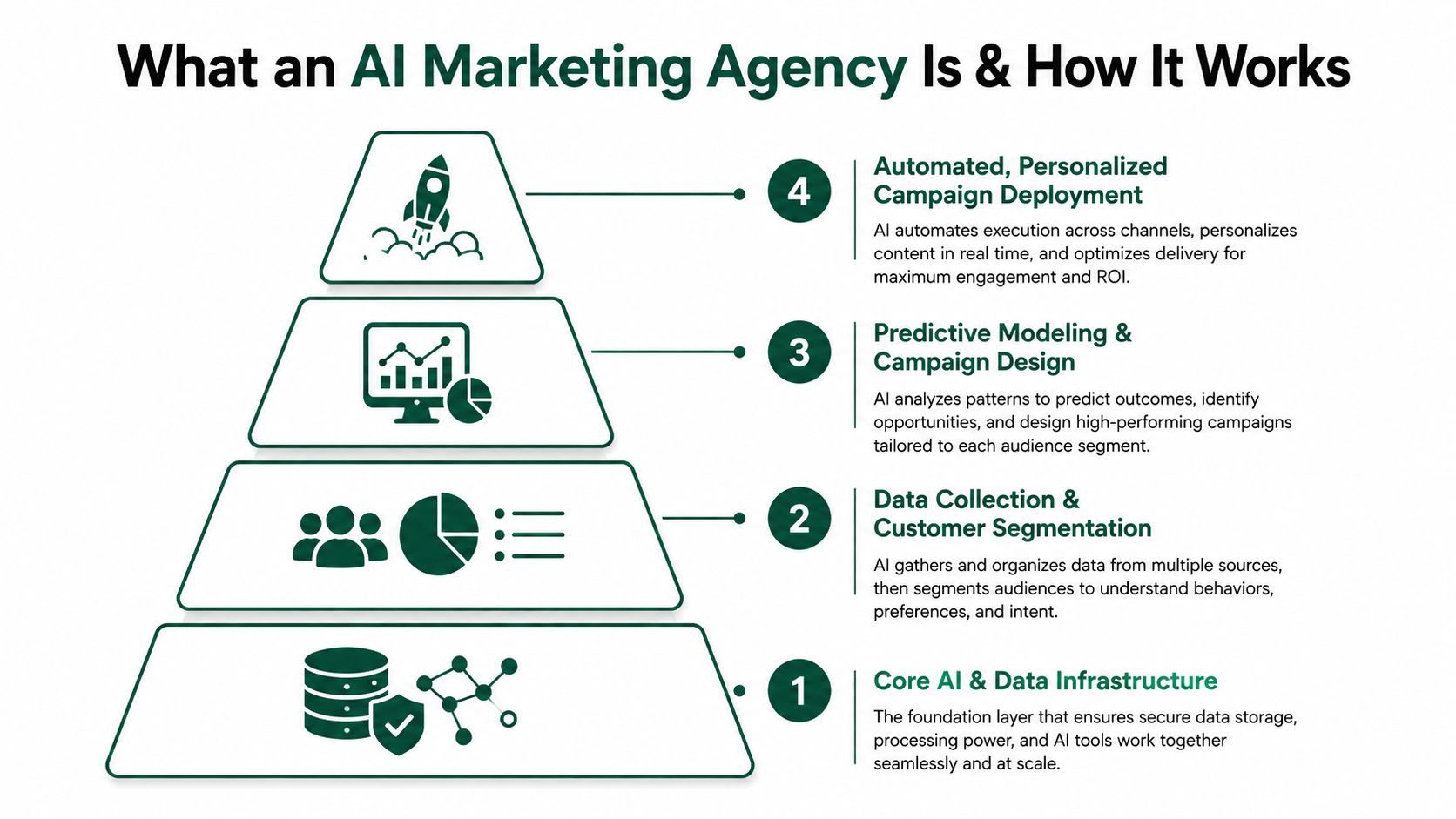
Traditional automation usually operates on fixed rules. If someone completes a form, move them into a sequence. If CTR declines, pause the ad. Those rules are useful, but they are static. An AI marketing agency replaces periodic, rule-based optimization with real-time, signal-driven decisioning, ingesting events such as web visits, email opens, ad interactions, CRM updates, and intent data, then updating targeting, personalization, and bid or creative decisions continuously rather than waiting for the next review cycle Demandbase.
That shorter control loop matters. When performance changes, the system can detect it from live behavior and adapt before wasted spend accumulates. A human team can do the same work, but it often does so later, after someone notices the pattern in a dashboard.
Cruise control maintains speed on a flat road. An autonomous system evaluates the road, traffic, and conditions, then decides what to do next. That is the distinction between basic automation and AI reasoning.
The deeper distinction is that AI marketing agents are designed to reason over context, not simply execute if-then rules. Independent guidance describes them as capable of normalizing data across platforms, surfacing anomalies, explaining variance in natural language, recommending actions with confidence scores, and learning from outcomes over time. That is what makes them valuable in B2B, where the signal is spread across multiple systems and the story often lives in the gaps between them.
AI is strongest where the work is repeatable, measurable, and noisy. Humans are strongest where the work requires judgment, proof, and accountability.
Big Moves Marketing's practical AI implementation perspective fits that model. The objective is not to automate everything. It is to automate the areas that should be machine-led so senior people can focus on positioning, message hierarchy, and pipeline logic. That is where the real value is created.
A credible AI marketing agency should not resemble a disconnected list of services. It should function as a growth system. For B2B SaaS, that usually means the work flows from strategy to messaging to demand capture, then into measurement and optimization. If the stack does not connect, the agency is likely selling activity rather than outcomes.
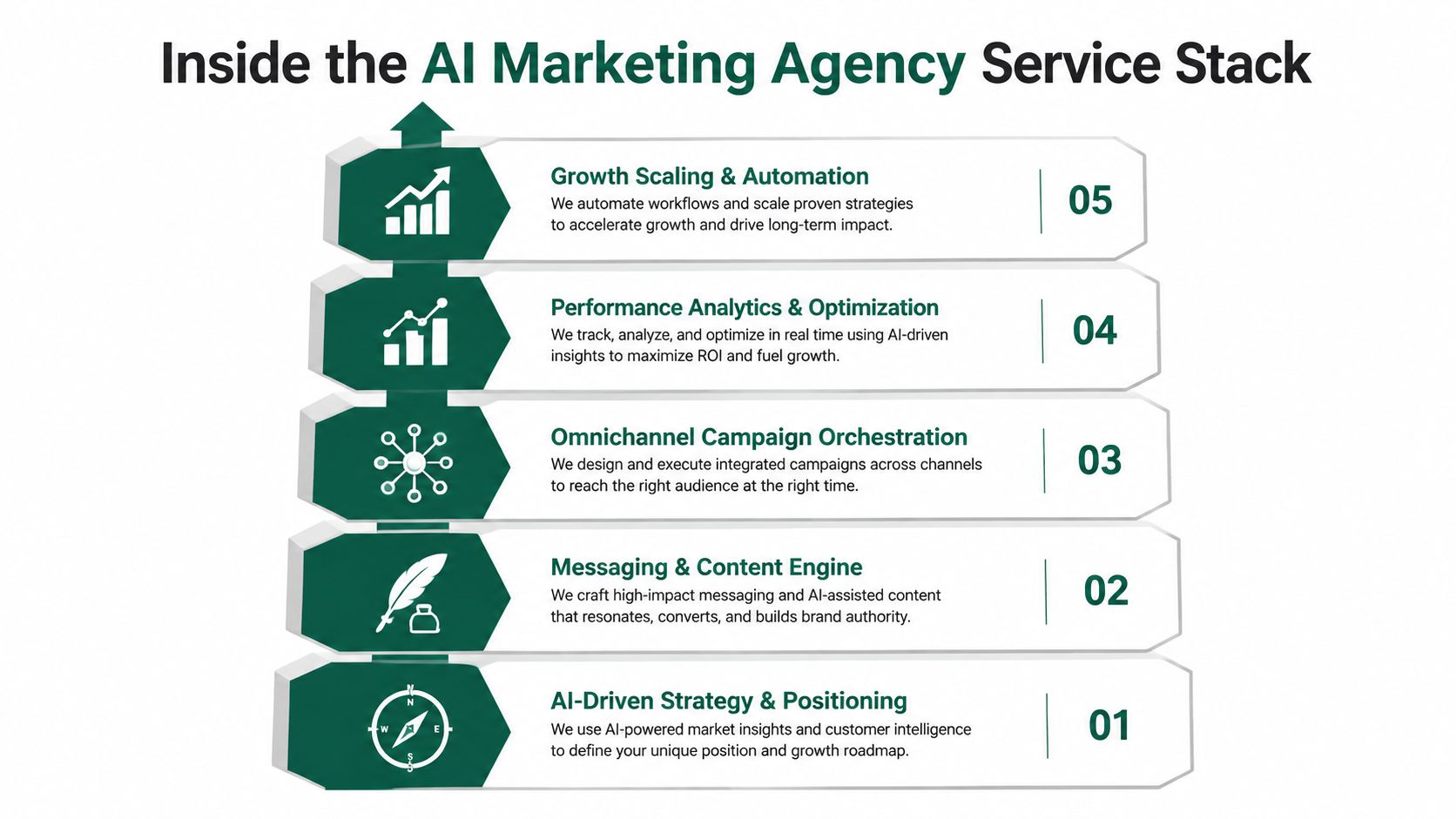
The first layer is AI-driven strategy and positioning. AI can accelerate audience research, competitor mapping, and pattern detection across customer language, but it cannot determine what the company should stand for. That is senior work. The human team must define the category angle, ICP boundaries, and proof standard.
Weak agencies lose the thread here. They move into execution before the market narrative is stable. A capable partner uses AI to compress the research phase, synthesize signals, and surface inconsistencies more quickly, then applies senior judgment to establish the message architecture. That is the difference between a system and a content factory.
The second and third layers are messaging and content plus omnichannel orchestration. AI performs well at repurposing, draft generation, versioning, and adapting one strong idea across the website, sales enablement, email, and social channels. It is also useful for dynamic personalization, where the same core proposition needs to be expressed differently across segments.
The limitation is obvious. AI cannot fix a weak angle. If the message does not resonate with the buyer, scaling it across channels only distributes the problem more widely. Strong execution means the agency has a reusable messaging framework, then uses AI to adapt it without compromising consistency.
The fourth and fifth layers are performance analytics and growth scaling automation. The agency should be interpreting the market in real time. AI can normalize messy data, detect anomalies, explain variance, and help the team understand why one sequence, landing page, or campaign is outperforming another. It can also automate repetitive workflow steps so senior people spend less time assembling reports and more time making decisions.
Big Moves Marketing's channel work fits here only if the strategy is already sound. Tools do not create the stack. They operate within it. That is the mistake many teams make, they purchase software before deciding how growth should function.
The wrong question is which model is least expensive. The more important question is which model helps a SaaS team learn faster without surrendering control of positioning, narrative, and pipeline logic. The answer varies by stage, but the trade-offs remain consistent.
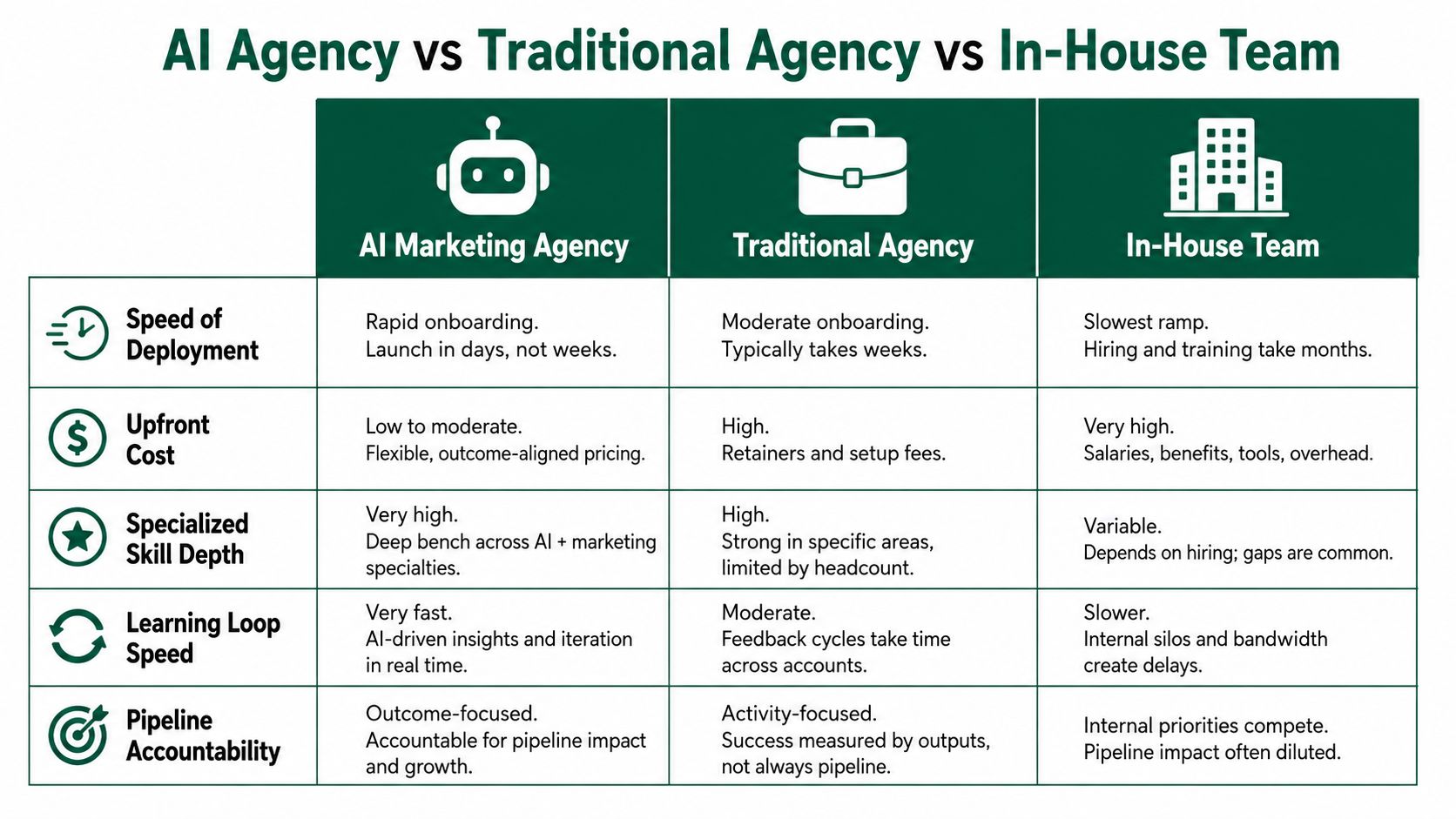
A traditional agency usually wins on familiarity. The playbook, people, and cadence are well understood. The weakness is straightforward. Work moves through manual review cycles, so learning slows when the market changes quickly. That model is acceptable for stable programs. It becomes less effective when the message, channel mix, or buyer behavior is shifting.
An in-house team wins on context. No outside vendor understands the product, customer, or internal constraints as well as the people inside the company. The trade-off is bandwidth and perspective. The same small team is often expected to handle pipeline pressure, hiring, launches, internal politics, and the need to remain current on AI workflows and changing discovery behavior. That burden is significant.
An AI marketing agency earns its role when it productizes repeatable work and keeps senior humans accountable for the difficult parts. The agency should compress experimentation, accelerate workflow, and introduce specialized systems without diluting the story. Big Moves Marketing's fractional CMO model fits that pattern because it puts strategy first, then adds execution capacity where repetition exists. The goal is not AI everywhere. It is selective automation around execution, with senior judgment protecting positioning and pipeline logic.
The right model is the one that shortens the time between signal and decision.
For pre-PMF companies, clarity matters more than scale. You need a partner that can sharpen positioning, tighten the website, and test channel assumptions without adding unnecessary process. Pure execution at that stage wastes budget because the message is not ready, and the market still needs to reveal what it wants.
For Series A to C companies, the question changes. There is enough traction to require repeatability, so AI becomes useful because it helps productize recurring work while senior people protect the narrative. That is where a fractional CMO-led partner can make sense, especially when the company needs a strategic owner who can connect message, site, and channel logic.
Too many teams buy software before they decide how growth should work. Tools can support the stack, but they do not define it. If the operating model is unclear, software only accelerates confusion.
Budget conversations around an AI marketing agency often go off course when leaders treat AI as a feature checklist. The better framing is capability design. As noted earlier, the market is already scaling in that direction, which is exactly why pricing should map to the type of work being removed from the team, not to a vague promise about “AI” Grand View Research.
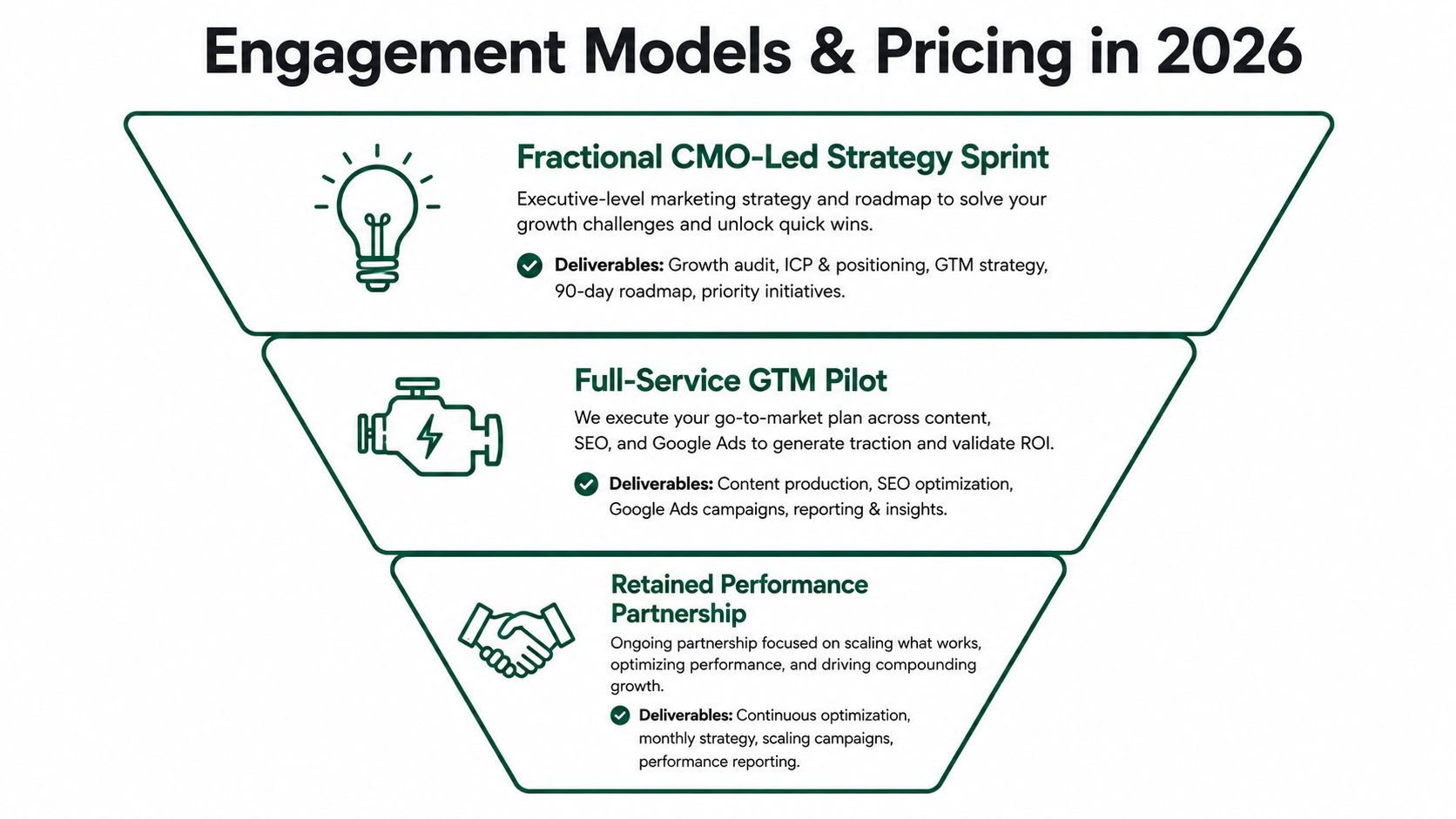
A strategy sprint fits when the company needs ICP clarity, sharper messaging, or a website reset. Keep it narrow, senior-led, and designed to make later execution less expensive. If positioning is still unclear, a large retainer only adds noise.
A GTM pilot fits when the team needs proof across a defined channel mix. That can include content and SEO, Google Ads, LinkedIn, email, or events. The objective is to test a motion against real demand and learn quickly whether the market responds. The pilot should produce evidence, not simply a stack of deliverables.
A retained performance partnership fits after the message has stabilized and the team wants ongoing optimization. AI is most useful here because the system can monitor, iterate, and route signals faster than a manual team. Senior people still need to own the narrative and the proof, because that is what keeps the work coherent.
The biggest measurement mistake in 2026 remains over-reliance on rankings and traffic. Those metrics matter, but they do not fully reflect how buyers discover vendors now. Discovery increasingly runs through AI answer surfaces, so agencies should be measured on prompts, entity clarity, and AI citation visibility alongside pipeline, CAC, and workflow productivity. A recent LinkedIn article on AI visibility growth for agencies makes the same point, content must be easy for AI systems to cite, not just easy for search engines to rank.
If the agency cannot explain how it appears in AI answers, it does not understand modern discovery.
That shift changes what strong reporting looks like. The right agency should show system behavior, not vanity output. It should explain what changed, why it changed, and how those changes connect to pipeline. Anything less is reporting theater.
The fastest way to evaluate an AI marketing agency is to examine what it does under real pressure. Launches and sales enablement are where the difference becomes visible quickly. If the agency cannot translate research into a usable narrative or convert that narrative into sales support, the AI story is largely cosmetic.
In a typical SaaS launch, the first step is audience and competitor mapping. AI can accelerate that process by identifying patterns in customer language, market alternatives, and category gaps, then turning those findings into a reusable messaging framework. The senior human layer then selects the angle, decides what should not be said, and ensures the site and pitch are aligned.
From there, a conversion-ready site rollout matters more than a flashy campaign. AI can help produce the draft structure, sections, and variants, but the founder or senior marketer must approve the proof hierarchy. Once the site is ready, channel experiments can begin, with content, search, and paid campaigns all drawing from the same message spine.
The outcome is not “more marketing.” It is fewer contradictory stories. That is what allows the market to recognize the product more quickly.
The second use case is sales enablement. AI should accelerate research, draft creation, and repurposing, especially for account-based messaging, follow-up sequences, and proposal support. Humans still own the story, the proof, and the disclosure. That is not optional, because credibility in B2B depends on judgment, not just output.
A frequently under-addressed question is: What does an AI marketing agency replace, and what still requires senior human judgment? Much of the public content either overstates automation or relies on vague “AI-powered” language, but credible guidance stresses that AI is best suited for low-risk, repeatable work while humans must still define the brief, choose the angle, fact-check claims, and own governance and disclosure Succeeding Small on what AI can't replace.
That is the boundary that matters. If the agency is using AI to make the team faster at research, drafting, and repurposing, that is useful. If it is using AI to replace judgment, that is a problem. Senior buyers should insist on that distinction.
If you want to avoid wasting a quarter, stop judging agencies by how effectively they sell themselves. Judge them by what they can demonstrate. The minimum standard is straightforward, and it should be non-negotiable.
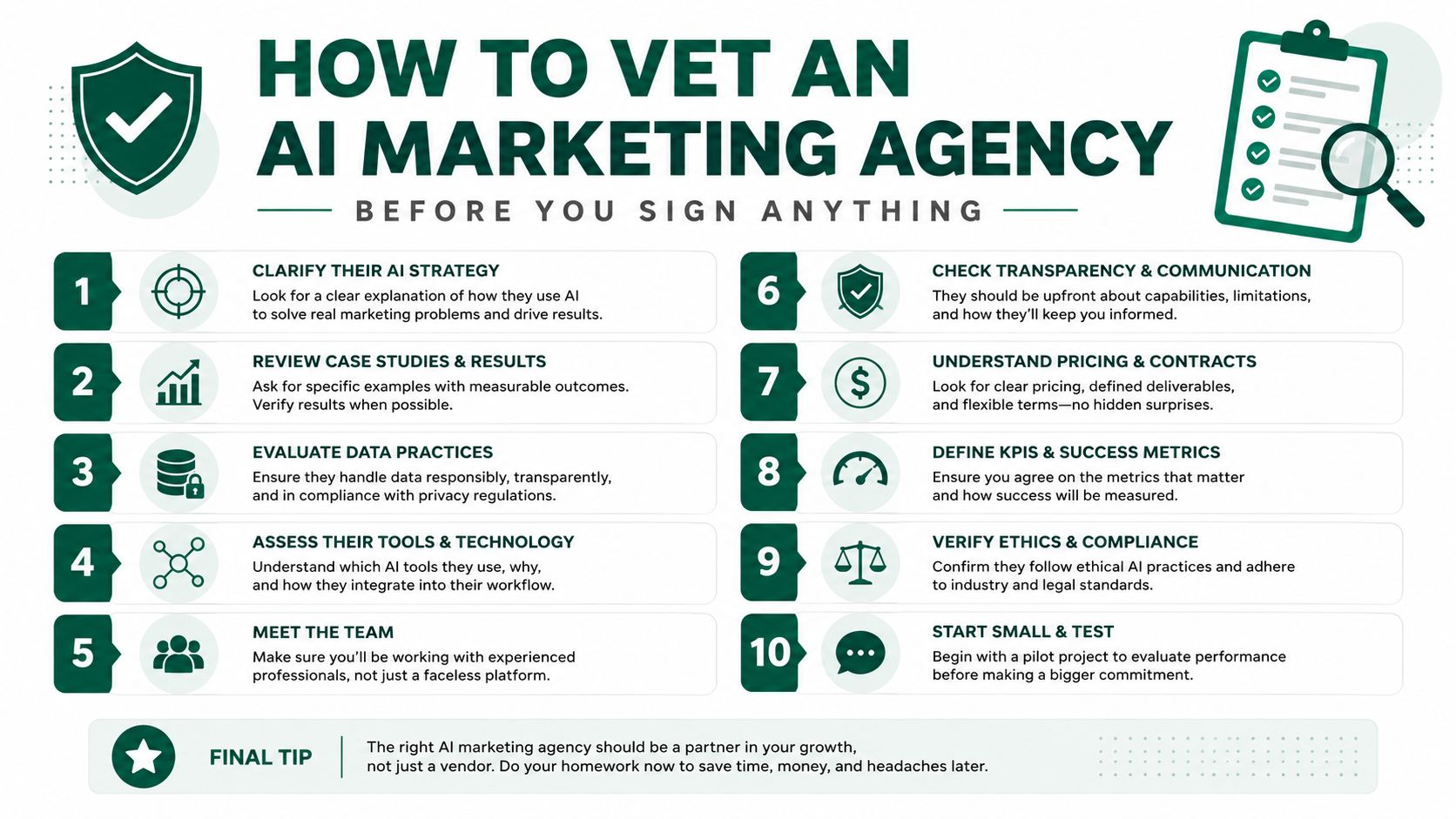
One additional filter matters. Independent industry summaries say 91% of marketing teams use AI and 88% of marketers use AI tools daily The STACC. That means AI should already be considered table stakes. The real difference is whether the agency has embedded it deeply into workflow or merely added it to positioning language.
Big Moves Marketing's agency evaluation lens belongs in that conversation because the company operates as a strategic growth partner rather than a commodity service provider. That is the appropriate standard for this category. Stop buying promises. Buy proof, process, and clarity.
If you are serious about using an AI marketing agency for B2B SaaS growth, talk to Big Moves Marketing. They focus on positioning, messaging, conversion-ready websites, and GTM pilots that connect message to pipeline, which is exactly where many AI-flavored agencies remain vague. Visit Big Moves Marketing if you want a strategic growth partner that treats AI as a system for better decisions, not a shortcut for weak thinking.

%20-%20white.svg)