%20png%20copy.avif)

SEO for startups is the practice of building organic search visibility through targeted keyword selection, technical site health, and content clusters designed to compound authority over time. Unlike enterprise SEO, startup SEO operates under tight budgets, low domain authority, and the need for early wins. The good news: organic traffic signals appear within 3 months, with meaningful revenue results following in 6–12 months. That timeline is faster than most founders expect. Google Search Console and GA4 are the two baseline tools every startup needs from day one, and they cost nothing.
Startup SEO is not a scaled-down version of enterprise SEO. It is a different discipline entirely. Enterprise teams chase head terms with massive link budgets. Startups win by targeting specific, high-intent queries where similarly sized companies already rank. The core components are technical site health, keyword targeting, content clusters, and authority signals. Get those four right in sequence, and organic growth becomes a compounding asset rather than a monthly expense.
Startups can run effective SEO on lean budgets: $0–$1,000 for initial setup and $250–$1,500 per month for ongoing execution. That cost avoids the 90–95% premium of a full-service agency. The tradeoff is time and focus, but the return is a traffic channel no competitor can buy out from under you.

Skipping foundational technical SEO to publish content results in lost SEO runway and delayed ranking gains. Fix the foundation before writing a single blog post.
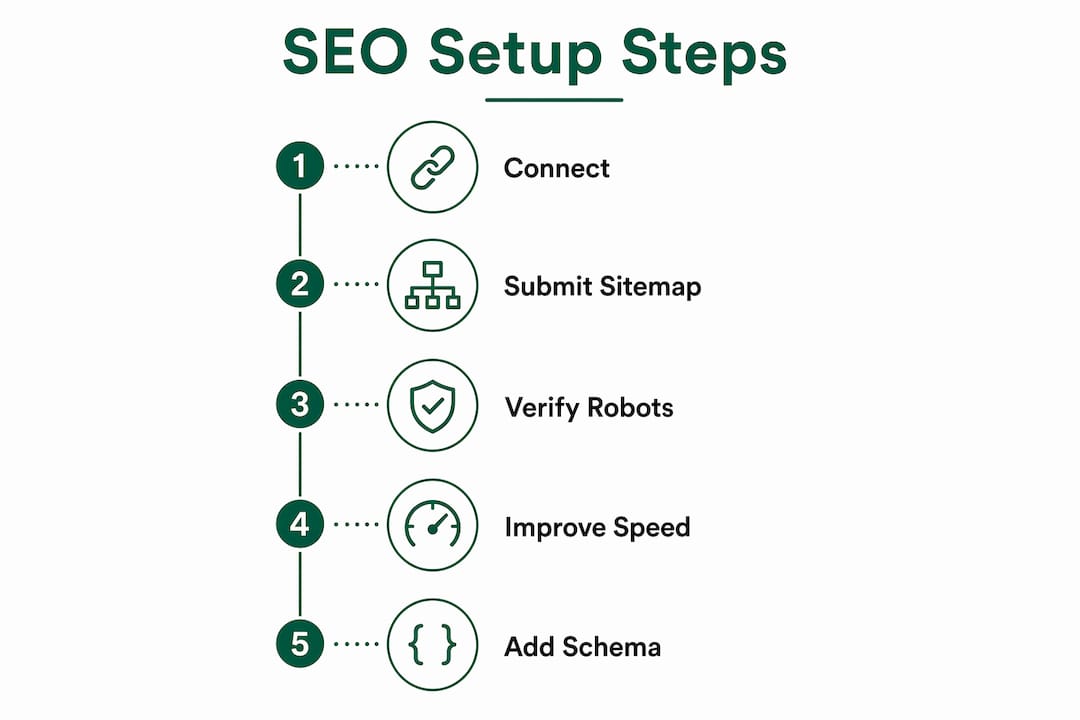
Start by connecting Google Search Console and GA4 to your site. Submit an XML sitemap and verify your robots.txt file allows crawling on all pages you want indexed. Set canonical URLs on every page to prevent duplicate content from splitting your authority. Then check Core Web Vitals inside Google Search Console. Pay close attention to Largest Contentful Paint and Cumulative Layout Shift.
Page speed is not optional. 53% of users leave sites that take more than 3 seconds to load. Reducing load time from 3.2 seconds to 1.1 seconds yields a 23% conversion gain. That is a technical fix that pays off in both rankings and revenue.
Structured data, also called schema markup, is the final layer. Entity clarity and schema markup enable AI-driven search engines to understand and cite your content. This matters more now than it did two years ago, because AI search surfaces like Perplexity and Google’s AI Overviews pull from structured, clearly labeled content.
| Technical element | Tool | Priority |
|---|---|---|
| Indexing and crawl verification | Google Search Console | Critical |
| Traffic and conversion tracking | Google Analytics 4 (GA4) | Critical |
| Core Web Vitals monitoring | Google Search Console / PageSpeed Insights | High |
| Schema markup implementation | Google’s Rich Results Test | High |
| Sitemap submission | Google Search Console | Critical |
| Mobile responsiveness check | Google Mobile-Friendly Test | High |
Pro Tip: Run a crawl simulation using Google Search Console’s URL Inspection tool on your five most important pages before publishing any content. Fix indexing errors there first.
Keyword research for startups is a targeting problem, not a volume problem. The goal is not to find the most searched terms. The goal is to find terms where you can win.
Target keywords where at least 3 results from similarly sized companies appear in the top 10 search results. If the top 10 is dominated by G2, Capterra, Forbes, and enterprise SaaS brands, skip that term. You will not rank there in the next 12 months.
Focus your early keyword targeting on these query types:
Targeting problem-aware and solution-aware queries captures users before they enter a competitor’s funnel. That timing advantage directly improves conversion rates.
For discovery, use Google’s “People Also Ask” boxes, Google Search Console’s query report, and free tiers of keyword tools. Paid tools add depth, but the free layer is enough to build your first 30 target keywords.
Pro Tip: Map every keyword to a stage in your buyer journey before writing. A keyword like “what is [category]” needs a different content format than “best [category] tool for enterprise teams.”
The pillar-and-cluster model is the most effective content structure for startups building topical authority. A pillar page covers a broad topic comprehensively. Supporting cluster pages cover specific subtopics and link back to the pillar. This structure signals to Google that your site owns a topic, not just a single article.
Here is how to build a content cluster from scratch:
Generative Engine Optimization, or GEO, extends this model into AI search. GEO focuses on becoming the go-to answer in AI recommendation layers by publishing long-form, structured content with clear entity definitions. Success in GEO is not measured by head-term rankings. It is measured by how often AI systems cite your content as a source.
Consistency over intensity drives compounding results. Publishing two well-structured posts per month beats publishing ten posts in one sprint and going quiet for three months. AI tools can generate SEO-ready drafts in 30–60 minutes, which makes a consistent cadence realistic even for lean teams.
Pro Tip: Write your pillar page before any cluster posts. The pillar defines the topical boundaries, which makes cluster post topics easier to identify and prevents content overlap.
Cold link outreach has poor ROI for most early-stage startups. The response rates are low, the links are often low quality, and the time cost is high. There are faster paths to authority.
Avoid paid link schemes, private blog networks, and any tactic that promises fast results through volume. Google’s spam policies are more aggressive than they were three years ago, and a manual penalty can set a startup back by six months or more.
Rankings alone are not a useful metric for startups. A keyword ranking on page two generates almost no traffic. Focus on metrics that connect to business outcomes.
Track these indicators weekly or monthly:
Long-tail keywords rank in 30–60 days after indexing. Head terms take 4–9 months or more. Set expectations with your team accordingly. A startup that publishes consistently for 6 months and tracks non-branded traffic growth is on the right path, even if rankings feel slow.
For a deeper look at how SEO fits into a broader B2B SaaS marketing strategy, the channel works best when paired with demand generation and content distribution, not run in isolation.
Startup SEO compounds when you fix technical foundations first, target winnable keywords, and publish content clusters consistently over 6–12 months.
| Point | Details |
|---|---|
| Fix technical SEO first | Set up Google Search Console, GA4, sitemaps, and schema before publishing content. |
| Target keywords you can win | Focus on long-tail, buyer-intent queries where similarly sized companies already rank. |
| Build pillar-and-cluster content | One comprehensive pillar page plus 4–6 cluster posts builds topical authority faster than scattered articles. |
| Authority comes from originality | Original research and founder-led content generate links and AI citations more effectively than outreach. |
| Measure what moves revenue | Track top-10 keyword count, non-branded traffic, and organic conversion rate, not total rankings. |
Most founders treat SEO as a content problem. They hire a writer, publish 10 posts, see no traffic in 30 days, and conclude SEO does not work for their category. That conclusion is almost always wrong, and almost always premature.
The real issue is sequence. Every startup I have worked with that skipped technical setup and went straight to content production wasted 3–4 months of potential compounding. The posts were indexed but not ranking, because the site had crawl errors, missing canonicals, or Core Web Vitals scores that signaled poor user experience to Google.
The second mistake I see constantly is targeting head terms too early. A seed-stage SaaS company trying to rank for “project management software” is competing against companies with domain authority scores 40 points higher and link profiles built over a decade. That is not a content quality problem. It is a targeting problem. Shift to long-tail, problem-aware queries and you will see ranking movement within 60 days.
The mindset shift that changes everything: SEO is a product feature, not a marketing expense. When you build topical authority in your category, you create a moat that paid ads cannot replicate. A competitor can outbid you on Google Ads tomorrow. They cannot outrank a content cluster you have been building for 18 months. That asymmetry is why I push every founder I work with to start SEO in month one, not month twelve.
For startups exploring scalable organic growth workflows, the sequencing of technical setup, keyword targeting, and content cadence is the difference between compounding results and spinning wheels.
— Veb
Bigmoves works with B2B SaaS and technology founders who need a clear go-to-market plan, not just a content calendar. Veb brings 17 years of experience across more than 75 startups and enterprises, covering positioning, messaging, demand generation, and website deployment.
If your startup needs a go-to-market strategy that integrates SEO with paid channels, LinkedIn, and email, Bigmoves builds that system from the ground up. The work covers brand positioning, website launch on Webflow, and pilot-led channel execution so you can test what works before scaling spend. For founders who want senior marketing leadership without a full-time hire, the fractional CMO model delivers strategic direction at a fraction of the cost. You can also explore B2B SEO agency insights to understand what good looks like before you commit to any approach.
Initial indexing signals appear within 24–72 hours. Long-tail keywords typically rank within 30–60 days, while competitive head terms take 4–9 months or more.
Startups can begin with $0–$1,000 for initial setup using free tools like Google Search Console and GA4, plus $250–$1,500 per month for ongoing content and technical work.
GEO is the practice of structuring content so AI-driven search engines like Perplexity and Google AI Overviews cite it as a source. It relies on entity clarity, schema markup, and long-form comprehensive content.
Fix technical SEO and publish a content cluster first. Original research and founder-led content generate natural backlinks more effectively than cold outreach at early startup stages.
Track top-10 keyword count, non-branded organic traffic, and organic conversion rate. These three metrics connect directly to business outcomes and avoid vanity ranking traps.




%20-%20white.svg)