%20png%20copy.avif)
This article was built using insights from LinkedIn Research: 6 B2B Marketing Insights for 2026: Creators Are Up Next in B2B
The numbers tell a story that's hard to ignore. In 2020, just 34% of B2B marketers were running influencer programs. Fast forward to 2024, and that figure jumped to 85%. This isn't a gradual shift—it's a fundamental restructuring of how B2B companies build trust, generate demand, and compete for attention in an increasingly crowded market.
The traditional B2B playbook is losing its effectiveness. Cold outreach feels more intrusive. Product-led content blends into the background. And buyers—who now control 83% of their purchase journey before ever speaking to sales—are looking for something different: authentic expertise from voices they trust.
This article examines why creator-led thought leadership has become essential for B2B growth, what the data reveals about its impact, and how to build a strategy that delivers measurable results. Whether you're running marketing for a startup or managing demand generation at an enterprise, the insights here are designed to help you compete more effectively in 2026 and beyond.
At any given moment, 95% of your potential buyers aren't actively shopping. They're not requesting demos, responding to outreach, or comparing vendors. They're simply not in-market.
Meanwhile, nearly 90% of global buyers report that their purchase process stalled in 2023, with economic uncertainty extending sales cycles to unprecedented lengths. Buyers have become more cautious, more skeptical, and more resistant to traditional marketing tactics.

In this environment, the companies that win aren't necessarily those with the best products—they're the ones that earn trust before buyers even start their formal evaluation process.
This is where thought leadership becomes critical. According to the 2024 Edelman-LinkedIn B2B Thought Leadership Impact Report, 75% of decision-makers say thought leadership content is a more trustworthy basis for assessing a company's capabilities than marketing materials or product sheets. It's no longer just about being visible—it's about being credible.
The data goes further. 90% of B2B decision-makers and C-suite executives say they're moderately or very likely to be more receptive to sales or marketing outreach from a company that consistently produces high-quality thought leadership. Translation: great content opens doors that cold emails can't.
But here's what makes the creator economy so powerful in B2B: thought leadership doesn't have to come exclusively from your brand. In fact, it's often more effective when it doesn't.
When industry experts, practitioners, and executives share insights—whether they're your employees, partners, or external creators—buyers listen differently. They perceive less bias. They see real-world experience rather than corporate positioning. And increasingly, they make decisions based on what these voices recommend.
Consider this: among buyers who say a piece of thought leadership content led them to research a product or service they weren't actively considering, 23% ultimately began buying from or working with the organization that published the content. That's not just awareness—that's demand creation.
B2B creators are often people with 10,000 to 50,000 connections who've built authority through consistent, valuable contributions to their industries.
They're the sales leaders sharing revenue operations frameworks on LinkedIn. The product managers breaking down roadmap prioritization on Twitter. The CFOs explaining financial modeling for growth-stage companies. The engineers publishing deep dives on system architecture. They have expertise, credibility, and audiences who trust them.
The B2B creator ecosystem operates differently from B2C. Follower count matters less than expertise. Virality matters less than consistency. And flashy content matters less than depth and practical value.
According to B2B International's 2024 Superpowers Index research, "being an active thought leader in the category/sector" jumped from 20th to 3rd place globally as a key decision driver. For Gen Z and Millennial buyers specifically, thought leadership ranks as the #2 decision factor. This generational shift signals that creator-driven content isn't a trend—it's the new baseline expectation.
Yet despite this importance, only 25% of B2B buyers believe the brands they engage with are doing thought leadership well—a statistic that has shown no improvement from 2023. That gap represents opportunity for companies willing to invest in authentic, high-quality content.
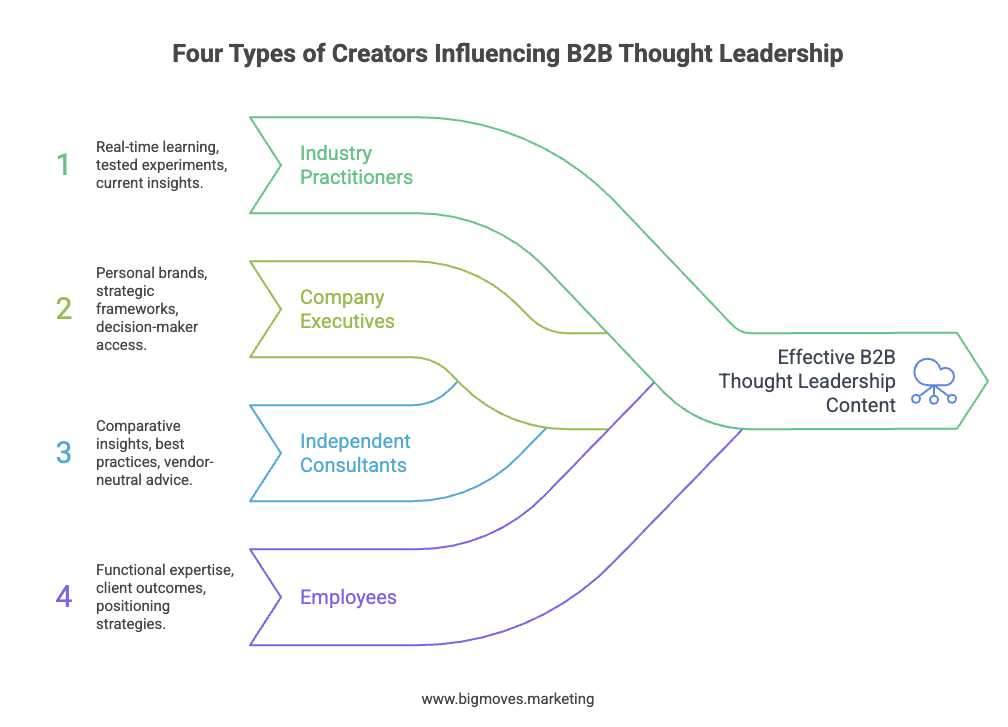
The most effective B2B creators fall into several categories:
Industry practitioners who share what they're learning in real-time. These are VPs of Marketing documenting their growth experiments, engineers explaining technical decisions, or operations leaders sharing process improvements. Their content feels current and tested.
Company executives who build personal brands around their expertise. Think founders explaining their go-to-market approach, or chief product officers sharing product strategy frameworks. Their platforms give them built-in credibility and access to decision-makers.
Independent consultants and advisors who've worked across multiple companies and can speak to patterns and best practices. Their comparative insights carry weight because they're not tied to a single vendor's approach.
Employees at all levels who have deep functional expertise. Sales engineers explaining implementation patterns. Customer success managers sharing how clients achieve outcomes. Product marketers breaking down positioning strategies.
What unites these creators is authenticity. They're not reading from corporate scripts. They're sharing what actually works, what doesn't, and what they're still figuring out. And buyers can tell the difference.
LinkedIn remains the dominant platform for B2B creator activity. The numbers back this up: LinkedIn accounted for nearly 95% of total conversions from employee advocacy posts, and while the platform earned 84% fewer shares than Facebook, it delivered 47 times the number of link clicks. Quality of engagement matters more than volume.

One of the most significant findings in recent B2B influencer research is the performance gap between always-on and campaign-based approaches.
The data is striking: 99% of teams using an always-on approach to influencer marketing rate their programs as effective. By contrast, marketers not using an always-on approach are 17 times more likely to report their program is ineffective.
So what's the difference?
Campaign-based influencer marketing treats creators as tactical execution partners. You identify a need, recruit relevant creators, brief them on campaign messaging, publish content during a defined window, measure results, and move on. The relationship is transactional.
Always-on influencer marketing builds ongoing relationships with creators. You invest in understanding their audiences, co-create content that serves both parties, maintain consistent communication, and integrate their voices across your marketing programs year-round. The relationship is strategic.
The performance difference stems from several factors:
Depth of relationship: When creators understand your business deeply, they produce better content. They know your customers, your competitive positioning, and your product capabilities. This knowledge translates to more authentic, more valuable content.
Consistency of presence: B2B buyers need multiple touchpoints before making decisions. When they see the same trusted voices consistently discussing your space or your solutions, it builds familiarity and credibility in a way that one-off campaigns cannot.
Quality of content: Rushed campaign content often feels forced. Always-on partnerships allow for better planning, deeper collaboration, and higher production values. The resulting content resonates more strongly with audiences.
Measurement accuracy: With ongoing programs, you can track how creator relationships influence the full customer journey—from initial awareness through closed deals. Campaign-based approaches make this attribution nearly impossible.
Currently, 58% of B2B marketing teams use an always-on approach, but that number jumps to 82% among marketers reporting the most success. The correlation is clear.
Implementation doesn't require massive budgets. Always-on can start with a small group of creators who you engage consistently—monthly content collaborations, quarterly webinars, regular participation in your podcast or newsletter. The key is consistency and genuine partnership rather than scope.
72% of the most advanced B2B influencer marketing teams now have a dedicated budget they expect to grow, and 53% of marketers plan to increase their influencer marketing budgets in 2025. Budget allocation signals strategic commitment, which enables always-on execution.

Thought leadership has become one of the most overused and least understood terms in B2B marketing. Every company claims to offer it. Few actually deliver it.
Real thought leadership requires three elements: original perspective, supporting evidence, and practical application. It challenges conventional thinking while providing frameworks readers can actually use. It's built on experience rather than aspiration.
The problem is that most B2B thought leadership fails on all three counts. It rehashes common knowledge, offers no data or proof points, and provides no actionable guidance. 30% of thought leadership producers say their organization doesn't really know how to use thought leadership as a sales or marketing tool, and 30% of respondents say the overall quality of thought leadership they read is of mediocre quality, with only 13% rating it as very good or excellent.
This quality crisis creates opportunity. When you produce genuinely valuable thought leadership, you stand out dramatically.
What works? The research points to three consistent attributes:
Strong research and data: Thought leadership that cites credible research, presents original data, or quantifies outcomes carries significantly more weight than opinion-based content. Buyers want evidence, not assertions.
Understanding of business challenges: The best thought leadership demonstrates deep understanding of the problems buyers face—not just surface-level pain points, but the underlying strategic challenges and trade-offs they're navigating.
Concrete guidance: Buyers are drowning in high-level strategy content. What they need are specific, actionable frameworks they can apply. The thought leadership that drives results provides clear steps, decision criteria, or implementation approaches.
Consider the impact when you get this right. 60% of global B2B decision-makers and C-suite leaders say they're willing to pay a premium for organizations that provide valuable thought leadership. That's not just a nice-to-have—it's a pricing lever.
Perhaps more importantly, thought leadership serves as both offense and defense in customer relationships.
On offense: 75% of decision-makers say a compelling thought leadership piece prompted them to research a product or service they weren't originally considering. This is demand creation at its purest—getting buyers to rethink their assumptions and expand their consideration sets.
On defense: 70% of C-suite leaders say a piece of thought leadership has at least occasionally led them to question whether they should continue working with an existing supplier. If you're not providing strong thought leadership to your existing customers, your competitors will use theirs to poach them.
In fact, among decision-makers who questioned their supplier relationships due to thought leadership content, 54% said the content made them realize there are other suppliers that had a better understanding of the challenges their organization was facing. 25% have ended or significantly reduced their relationship with a current supplier as a result.
The implication: thought leadership isn't just about winning new customers. It's about protecting the ones you have.

While external creators and influencers get significant attention, one of the most underutilized assets in B2B marketing sits right inside your organization: your employees.
The math is compelling. The combined networks of employees are about 12 times larger than a company's own following. When you activate employee voices, you're not just adding reach—you're fundamentally changing the nature of your distribution.
And the engagement difference is even more dramatic. Employee-generated content receives 8 times more engagement than branded content. When your product manager shares insights on LinkedIn, it resonates differently than when your corporate account posts the same information. People trust people over logos.
This isn't about turning employees into corporate mouthpieces. Effective employee advocacy programs empower people to share their authentic expertise and perspectives. The results benefit both the company and the individual.
On the company side, employee advocacy drives measurable business outcomes. According to research, companies with successful employee advocacy programs are 58% more likely to attract, and 20% more likely to retain, top talent. 79% of firms reported more online visibility after implementing formal employee advocacy programs, while 65% reported increased brand recognition.
For sales specifically, the impact can be transformative. Sales reps using social media as part of their sales techniques outsell 78% of their peers, and an employee advocacy program can drive 16% better win rates, 2x pipeline, and deliver 48% larger deals.
On the employee side, advocacy builds personal brands and opens career opportunities. 86% of employees participating in employee advocacy programs said it positively impacted their careers. When employees develop thought leadership voices, they become more valuable both to their current employers and to the broader market.
The challenge is activation. Only around 3% of employees share content about their company, yet they're responsible for driving 30% of the total engagement a company sees. The opportunity gap is massive.
What makes employee advocacy programs succeed?
Make sharing easy: Most employees aren't opposed to sharing company content—they just need it to be frictionless. Provide pre-approved content they can customize, make sharing one-click simple, and respect their time. 72% of engaged users would post about their company if content were written for them.
Empower authentic voices: The most effective employee advocacy doesn't ask people to broadcast corporate messaging. It encourages them to share their actual expertise, experiences, and perspectives. Give people frameworks and topics rather than scripts.
Recognize and reward participation: Public recognition, gamification, and tangible rewards all drive sustained participation. Make advocacy visible, celebrated, and career-beneficial.
Provide training and support: Not everyone is comfortable with social media or content creation. Training on platform best practices, content guidelines, and personal branding helps employees feel confident participating.
Measure what matters: Track not just shares and reach, but downstream impact—website traffic, lead generation, and ultimately revenue influence. This data helps secure ongoing investment and demonstrates ROI to participants.
Some companies have formalized these programs with dedicated platforms. Others maintain simpler approaches through Slack channels or email newsletters. Scale matters less than consistency and authenticity.
The key insight: your employees already have networks, expertise, and credibility. Employee advocacy simply amplifies what's already there.
One of the persistent challenges in B2B creator and thought leadership programs is measurement. Less than one-third of B2B companies can link sales leads back to specific pieces of thought leadership, and 42% simply look to increased website traffic to prove ROI.
This measurement gap creates a vicious cycle. Without clear ROI data, programs remain under-resourced. Without adequate resources, quality suffers. Without quality, results disappoint. And the cycle continues.
Breaking this cycle requires moving beyond vanity metrics to business outcomes.
Vanity metrics include impressions, reach, and follower counts. These numbers feel good but don't correlate strongly with revenue. A post with 50,000 impressions that generates zero qualified leads is less valuable than a post with 5,000 impressions that drives three enterprise deals.
Engagement metrics like comments, shares, and time-on-page indicate content resonance. They're more meaningful than vanity metrics but still don't directly connect to business outcomes. They're useful diagnostic indicators—if engagement is low, your content probably isn't resonating—but insufficient for proving ROI.
Pipeline metrics connect creator activity to sales results. These include:
The challenge with pipeline metrics is attribution. B2B buyers typically engage with dozens of touchpoints before converting. Did the creator webinar drive the deal, or was it one factor among many?
Multi-touch attribution models help here, assigning partial credit across the customer journey. First-touch and last-touch models oversimplify. Time-decay and position-based models provide more nuanced views.
Brand metrics measure longer-term impact:
These metrics require survey research and competitive benchmarking. They move slowly but indicate whether your thought leadership is actually shifting market perception.
Relationship metrics track creator partnership health:
The most sophisticated B2B marketing teams build dashboards that combine these metric categories. They track short-term performance indicators while monitoring longer-term brand and relationship health.
Benchmarks help contextualize performance. According to recent data, B2B influencer marketing programs have demonstrated an average ROI of 520%. That's a strong baseline for comparison.
If you're convinced that creator-led thought leadership deserves a place in your marketing mix, where do you start?
The first step is defining your objectives. Different goals require different creator strategies.
If you're focused on awareness, you need creators with reach in your target audience. If you're focused on credibility, you need creators with deep expertise and strong reputations. If you're focused on demand generation, you need creators whose audiences have high purchase intent and budget authority.
Most B2B programs need all three, but knowing your primary objective helps prioritize creator selection and content approach.
The second step is finding the right creators. This remains the #1 challenge B2B marketers face, with 48% citing "identifying, qualifying, and connecting with ideal influencers" as their top obstacle.
The challenge stems from B2B's unique dynamics. B2C creators are easy to find—they have large followings and visible engagement. B2B creators are often less obvious. The VP of Sales with 8,000 LinkedIn connections who posts thoughtful analysis twice a week might be more valuable than the keynote speaker with 100,000 followers who rarely engages.
Several approaches help:
Network mapping: Start with your existing relationships. Who already knows your space, respects your work, and has engaged audiences? Your customers, partners, advisors, and even friendly competitors all represent potential creator relationships.
Platform research: Use LinkedIn's search and filter functions to find people by role, company, and activity level. Look for consistent publishers rather than one-hit wonders.
Industry analysis: Identify who speaks at relevant conferences, gets quoted in trade publications, hosts podcasts, or writes newsletters. These are people who've already invested in building their voices.
Tool-based discovery: Platforms like BuzzSumo, Traackr, and LinkedIn's Creator Accelerator can help identify and qualify potential creator partners based on content performance and audience alignment.
Vetting requires looking beyond follower counts to:
The third step is structuring partnerships. Compensation models vary widely in B2B:
Paid partnerships can range from $500 for a LinkedIn post to $10,000+ for comprehensive campaign involvement. Performance-based compensation now leads as the most frequently used payment model at 53%, followed by product/service compensation at 47%, and pay-per-deliverable at 46%.
Product access works well for software and service companies. Give creators early access to new features, premium accounts, or implementation support in exchange for honest feedback and potential content.
Revenue sharing aligns incentives when creators can directly drive sales. Affiliate programs, reseller partnerships, or revenue share agreements work for specific business models.
Value exchange involves providing creators with something they value—data, research access, executive interviews, or platform to reach your audience—in exchange for their participation.
The model matters less than clarity. Be transparent about expectations, deliverables, timeline, and compensation. Formalize agreements even for unpaid collaborations.
The fourth step is content integration. Creator content shouldn't exist in isolation—it should integrate throughout your marketing programs:
This integration maximizes value from each creator collaboration while showing creators that you're invested in their success.
The fifth step is program management. As your creator program scales, you need systems for:
Early-stage programs can manage this through spreadsheets and email. Mature programs often require dedicated software platforms or at least robust project management tools.
Common pitfalls to avoid:
Treating creators as channels rather than partners. Creators have audiences because they've built trust. If you dictate messaging too heavily, you undermine that trust and diminish the partnership's value.
Focusing exclusively on reach. A creator with 100,000 followers who reaches the wrong audience delivers less value than one with 10,000 highly relevant connections.
Neglecting existing relationships. Your best creator partnerships often come from people who already know and respect your work—customers, advisors, employees, partners.
Expecting immediate results. Creator programs build over time. The most valuable outcomes—brand perception, market position, category ownership—take quarters or years to materialize.
Failing to nurture relationships. One-off collaborations rarely deliver maximum value. Invest in ongoing relationships that deepen over time.
The proliferation of AI-generated content has fundamentally changed B2B marketing's content landscape. According to Hootsuite's Social Media Trends 2025 report, marketers are doubling down on AI, with a 95% increase in using AI tools to revise or rewrite copy.
This creates both challenges and opportunities for creator-led thought leadership.
The challenge: as AI makes it easier to produce content at scale, the volume of B2B content has exploded. Feed algorithms struggle to differentiate quality from quantity. Buyers face overwhelming information overload. Standing out becomes harder.
The opportunity: AI-generated content tends toward the generic. It synthesizes existing information rather than creating new insights. It lacks the experiential depth, contrarian perspectives, and authentic voice that characterize great thought leadership.
This gap is where creators shine. Humans bring:
Experience-based insights: Real stories from actual implementations. Lessons learned from failures. Nuanced understanding of what works in specific contexts. AI can't replicate this because it hasn't lived it.
Original perspective: Challenging conventional wisdom requires judgment and courage. AI optimizes for consensus rather than contrarian thinking. Creators can stake out differentiated positions.
Authentic voice: The best creator content sounds like a real person wrote it—because they did. The quirks, humor, vulnerability, and personality that make content memorable and trustworthy don't come from language models.
Timely reaction: When industry news breaks or trends emerge, creators can respond in real-time with informed analysis. AI requires training on events before it can discuss them.
To compete effectively in an AI-saturated landscape, focus on what AI can't replicate:
Primary research and original data: Conduct surveys, analyze proprietary data, or interview practitioners. Original research provides differentiated insights that command attention.
Deep-dive case studies: Document specific implementations with unprecedented detail. Show the messy reality of execution, not just the polished outcome.
Contrarian analysis: Challenge prevailing assumptions with evidence and reasoning. Take positions that create productive debate.
Personality-driven content: Let creators' authentic voices shine through. The quirks and perspectives that make them interesting to follow are precisely what AI lacks.
Visual and multimedia formats: While AI is getting better at images and video, high-quality multimedia content that combines expertise with production value remains differentiating.
The broader principle: use AI as a tool to improve your content creation process—research, outlining, editing—but not as a substitute for genuine expertise and perspective.
Theory matters, but results matter more. Here are several examples of B2B companies using creator strategies effectively:
SAP's "Doing Good" Campaign: SAP, the enterprise software giant, launched a campaign during the COVID-19 pandemic focused on how businesses could make a positive impact during challenging times. Rather than product messaging, the campaign emphasized inspiration and community support. It featured stories from customers, employees, and industry leaders sharing how they were adapting and helping others. The campaign's success demonstrated that B2B marketing could be emotionally resonant while driving commercial results. It attracted multiple industry accolades while proving that purpose-driven content, amplified through authentic voices, creates lasting business impact.
Salesforce's "State of Sales" Report: Salesforce leveraged its massive customer data to create an annual "State of Sales" research report. The asset provided genuine insights into sales trends, buyer preferences, and technology adoption—insights that sales professionals needed regardless of whether they used Salesforce. The report positioned Salesforce as an industry authority while creating conversation starters for their sales team. By sharing data-driven insights rather than product pitches, Salesforce built trust and credibility that translated into commercial outcomes.
ADP's LinkedIn Strategy: ADP, the HR and payroll processing company, built a strong presence on LinkedIn by sharing thought leadership and having real conversations with its audience. Rather than broadcasting corporate messages, they engaged in meaningful dialogue about HR challenges, workforce trends, and business strategy. The result: LinkedIn became their number one social reference back to their website. This success came from treating the platform as a conversation venue rather than a broadcast channel.
Cisco's Conversation Ads Approach: Cisco faced a challenge common to complex B2B companies: connecting diverse solutions to specific buyer needs. Traditional data-driven marketing couldn't predict exact needs. Cisco and its agency DWA Media developed a Conversation Ads campaign that engaged directly with data center buyers to understand their specific requirements. By making the conversation personal and relevant, Cisco improved both engagement and conversion while gathering insights that informed broader marketing strategy.
These examples share common elements: they prioritize value delivery over product promotion, they engage in authentic dialogue rather than one-way broadcasting, and they leverage authentic voices—whether employees, customers, or external experts—rather than relying solely on corporate messaging.
If you're ready to build or expand your creator-led thought leadership program, here's a practical 90-day roadmap:
Days 1-30: Foundation and Planning
Days 31-60: Activation and Testing
Days 61-90: Optimization and Scaling
Quick wins you can implement immediately:
Long-term plays that build compounding value:
Getting executive buy-in requires connecting creator programs to business outcomes:
Scaling considerations by company size:
Startups (1-50 employees): Focus on founder and employee advocacy. Your team's personal networks and expertise are your best distribution assets. Invest in a few strategic external creator partnerships to supplement reach.
Growth-stage companies (51-500 employees): Formalize employee advocacy programs while building relationships with 10-20 external creators. Begin creating original research and proprietary data assets.
Enterprise companies (500+ employees): Build dedicated creator program teams, invest in technology platforms for scale, develop comprehensive creator ecosystems spanning employees, customers, and external experts.
The key principle regardless of size: start focused, measure rigorously, and scale what works.
The shift toward creator-led thought leadership in B2B represents more than a tactical evolution—it's a fundamental change in how companies build trust and create demand.
The traditional advantages—brand recognition, sales team size, advertising budget—matter less when buyers control their own research journeys and trust individual experts more than corporate entities.
The companies that thrive in this environment will be those that build authentic relationships with creators, consistently deliver genuine value through thought leadership, and empower their own employees to develop strong professional voices.
The data makes clear that this isn't optional. With thought leadership ranking as the #3 global decision driver (and #2 for younger buyers), 85% of B2B marketers already running creator programs, and 99% of always-on programs reporting effectiveness, the question isn't whether to invest in creator-led thought leadership—it's how to do it better than your competitors.
The opportunity remains significant. With only 25% of buyers believing brands do thought leadership well and 30% of companies not knowing how to use it effectively, there's substantial room for differentiation.
The companies that commit to authentic expertise, consistent value delivery, and genuine creator partnerships won't just compete more effectively—they'll help define what best-in-class B2B marketing looks like in 2026 and beyond.
Explore Big Moves Marketing services and resources:

%20-%20white.svg)