%20png%20copy.avif)

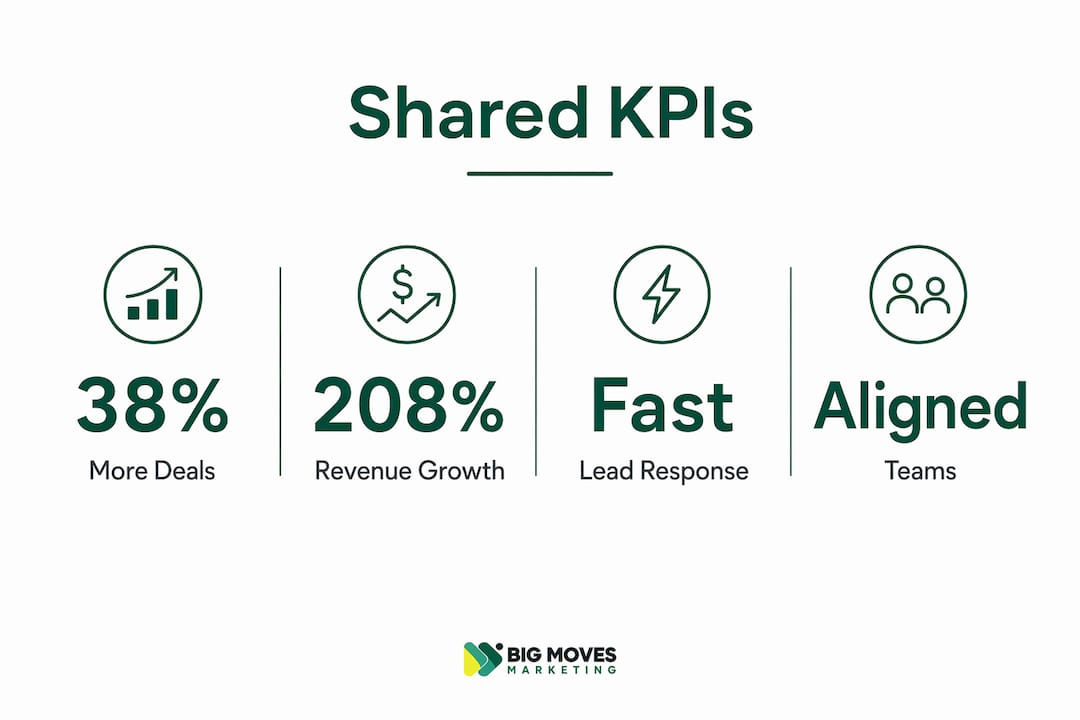
A sales and marketing team is two functions operating as one revenue engine. Marketing fills the funnel with the right accounts. Sales converts them. When both point at the same Ideal Customer Profile (ICP), share pipeline data, and commit to joint goals, the results are measurable: aligned teams close 38% more deals and generate 208% more revenue from marketing investment, according to Forrester.
Most B2B companies have a sales team and a marketing team. Few have a truly unified one.
The difference comes down to structure, not headcount. Here is what a high-performing integrated function actually looks like:
Sales and marketing cover distinct territory, but their outputs feed the same pipeline. Understanding each team’s core responsibilities makes alignment far easier to design.
Sales team roles:
Marketing team roles:
Pro Tip: Expecting one person to cover demand generation, content, product marketing, and marketing ops leads to burnout and inconsistent output. Gartner’s research on the marketing organization confirms these are distinct specialist roles, not one job.

Misaligned teams do not just underperform. They actively work against each other. Marketing chases MQL volume. Sales ignores the leads. Both teams blame the other, and the pipeline suffers.
The fix is shared accountability, not just shared tools. When sales and marketing commit to the same revenue number, their incentives align. Marketing stops optimizing for impressions. Sales stops dismissing leads without logging rejection reasons.
The business case is clear. Smarketing, the formal integration of sales and marketing around mutual revenue goals, replaces the traditional rivalry with joint accountability. Companies using this approach reduce friction, eliminate duplicated effort, and deliver a consistent brand experience from the first ad to the final handshake.
Misalignment also damages the customer experience. When marketing promises one thing and sales delivers another, prospects notice. Consistent messaging across every touchpoint builds trust faster and shortens sales cycles.
Alignment does not happen by accident. It requires deliberate structure, shared tools, and leadership commitment.
Pro Tip: AI tools and B2B marketing automation can automate lead routing, CRM updates, and pipeline reporting, freeing both teams to focus on selling and creating rather than manual data entry. Sales reps currently spend 60% of their time on non-selling tasks. Shared workflows cut that significantly.
Shared metrics create shared accountability. When both teams track the same numbers from the same data source, the finger-pointing stops.
Common KPIs for integrated sales and marketing functions include:
Using the same definitions and the same data source for every metric is as important as the metrics themselves. Two teams measuring “conversion rate” differently will always disagree on performance.
The concept of “smarketing,” a portmanteau of sales and marketing, captures the shift from siloed departments to a single revenue function. Salesforce describes it as a process that integrates both teams with common goals and formal business structures to improve revenue.
The data behind this shift is hard to ignore. Aligned teams generate substantially more revenue from marketing investment compared to siloed ones, per Forrester’s 2025 research. RevOps, the function that makes alignment the default operating state rather than a quarterly initiative, drives noticeably faster revenue growth and higher profitability.
The cultural dimension matters too. Google’s research on building future-ready marketing teams points to curiosity and cross-functional knowledge sharing as the traits that separate high-performing teams from average ones. Sales reps who shadow marketing campaigns and marketers who join sales demos develop a shared understanding that no OLA can fully replicate.
Alignment is the goal. Getting there requires navigating predictable obstacles.
Misaligned goals and metrics top the list. Marketing optimizes for lead volume. Sales optimizes for deal quality. Without a shared revenue target and agreed-upon lead definitions, both teams measure success differently and conflict is inevitable.
Data silos compound the problem. When marketing runs campaigns from one account list and sales prospects from another, both teams waste effort on duplicate outreach and miss accounts the other team has already warmed up. A single CRM with clean, shared data solves this at the source.
Poor lead handoffs create friction at the most critical moment in the funnel. If marketing passes leads without context and sales ignores them without logging reasons, the feedback loop breaks. An OLA with explicit handoff criteria and response time commitments fixes this structurally.
Inadequate communication is often the root cause behind all three. Teams that only interact during quarterly reviews cannot course-correct in real time. Weekly joint meetings and shared dashboards give both teams the visibility to adjust before problems compound.
Cultural resistance is the hardest challenge to solve with a tool. Sales teams that view marketing as a support function, and marketing teams that view sales as order-takers, will undermine alignment efforts regardless of the systems in place. Leadership has to model the unified revenue mindset before the teams will adopt it.
The clearest proof of alignment comes from what changes when it works.
Consistent messaging across the funnel: A B2B SaaS company running account-based marketing sees its best results when the ads a prospect sees on LinkedIn match the email sequence the SDR sends the next day, which matches the deck the AE presents on the discovery call. That consistency only happens when product marketing, demand generation, and sales all work from the same ICP and the same messaging framework.

Faster lead response: One of the most documented improvements from alignment is response speed. When marketing passes an inbound MQL and sales commits to a four-business-hour response window in the OLA, conversion rates from MQL to booked meeting improve. Leads go cold fast. Structure keeps them warm.
Feedback loops that improve campaigns: Sales reps hear objections every day that marketing never captures. When sales logs rejection reasons in the CRM and shares them in weekly joint meetings, marketing can adjust targeting, messaging, and content to address real buyer concerns. The result is higher MQL quality over time, not just higher volume.
RevOps as the connective tissue: Companies that build a RevOps function stop relitigating attribution and data ownership. RevOps owns the CRM architecture, defines the funnel stages, and produces the shared reporting both teams use. The alignment strategies that work in practice almost always have RevOps or a dedicated operations owner behind them.
Structure determines behavior. The way you organize sales and marketing either reinforces silos or breaks them down.
Separate but coordinated: Most early-stage companies keep sales and marketing as distinct teams under different leaders, connected by a shared OLA, joint meetings, and a unified CRM. This works well when both team heads are aligned on revenue goals and communicate regularly. The risk is that alignment depends on relationships rather than systems.
Unified revenue function: Some scaling companies place sales and marketing under a single Chief Revenue Officer (CRO). This removes the structural barrier entirely. Both teams report to the same leader, share the same budget conversation, and are measured against the same number. The tradeoff is that it requires a CRO with genuine depth in both disciplines.
RevOps as the integration layer: Whether sales and marketing report to the same leader or different ones, a RevOps function acts as the connective tissue. RevOps owns the shared CRM, funnel definitions, and reporting. It makes alignment structural rather than interpersonal. Companies with a dedicated RevOps function see measurably faster revenue growth, as noted earlier.
The five Cs framework: Zendesk’s research on sales and marketing alignment identifies five organizational habits that sustain integration: communication, consistency, coordination, clarity, and a core team. The core team, a small group of sales and marketing members with varying seniority, maintains shared resources and manages the ongoing alignment effort. Without it, alignment initiatives fade after the initial launch.
The right structure depends on company size and stage. A 10-person startup needs a shared ICP and a weekly meeting. A 200-person company needs RevOps, a CRO or equivalent, and a formal OLA. The principle stays the same at every size: shared goals, shared data, shared accountability.
Aligned sales and marketing teams close 38% more deals and generate 208% more revenue from marketing investment, making structural integration the highest-leverage growth decision for B2B companies.
| Point | Details |
|---|---|
| Alignment drives measurable growth | Aligned teams close 38% more deals and generate 208% more revenue from marketing investment, per Forrester 2025. |
| Shared ICP is the foundation | Both teams must target the same accounts using one written ICP as the source of truth. |
| OLA creates accountability | A formal Operating Level Agreement defines lead handoff criteria, response times, and shared revenue targets. |
| RevOps makes alignment structural | Companies with a RevOps function drive noticeably faster revenue growth and higher profitability. |
| Shared KPIs end the blame cycle | MQLs, SQLs, conversion rates, and quota attainment must use the same definitions and the same data source. |
Building an integrated sales and marketing function takes more than a shared spreadsheet. It takes clear positioning, a go-to-market plan both teams can execute from, and the right infrastructure to track what works.
Bigmoves works with B2B SaaS and technology companies to build exactly this. From ICP development and messaging to demand generation execution and go-to-market website launches, the work is designed to give sales and marketing a shared foundation they can actually use. If your teams are pulling in different directions, that is the starting point.






%20-%20white.svg)