%20png%20copy.avif)

In most B2B SaaS companies, marketing and finance operate in different universes. Marketing presents budget requests based on activities; finance allocates capital based on an arbitrary percentage of revenue.
This isn’t a simple misalignment. It’s a foundational flaw in the company’s operating system—a direct cause of wasted capital, strategic friction, and stalled growth.
The core problem is that the two teams speak entirely different languages.
Marketing lives in a world of channels, MQLs, and campaign pipelines. Finance is focused on CAC payback, LTV, and burn rate. This gap ensures that marketing investment decisions remain fundamentally disconnected from financial reality.
This is not a personality clash between a "creative" CMO and a "conservative" CFO. It is a systems failure, rooted in how most growth-stage companies approach budgeting.
The typical process is broken:
This dynamic forces marketing into a perpetually defensive posture, always justifying its existence as a cost center. It forces finance to make funding decisions with one hand tied behind its back, treating growth investments like any other operational expense. For more on this, our perspective on why founders must understand marketing to grow faster offers crucial insights.
This operating model is the single biggest—and most common—bottleneck to scalable growth. It creates friction, slows down decision-making, and guarantees capital will be misallocated.
The only way to fix this is to reframe the relationship.
Marketing is not a cost center. It is a capital allocation engine responsible for generating the company's future revenue streams.
This shift in perspective is the first and most critical step for any founder looking to build a durable go-to-market motion. It immediately changes the conversation from "how much can we afford to spend?" to "where can we deploy capital for the best possible return?"
Every process that follows—budgeting, forecasting, and reporting—has to be rebuilt on this core principle. Without it, you’re just getting better at running a broken system.
Your marketing funnel and your financial model should be two sides of the same coin. Yet in too many B2B SaaS companies, they’re separate documents, reviewed in separate meetings, by separate teams. This is a critical mistake.
The goal isn't just to have two sets of numbers; it's to build a single, unified model that mechanically links an input at the top of the funnel—like a click or a lead—to a financial outcome at the bottom.
This is how you move beyond vanity metrics. It forces a direct translation from marketing-speak ("leads," "traffic") into the language the business runs on ("pipeline," "net new ARR"). It’s the only way to make intelligent capital allocation decisions and get your CFO on board. Without it, you get this all-too-common scenario.
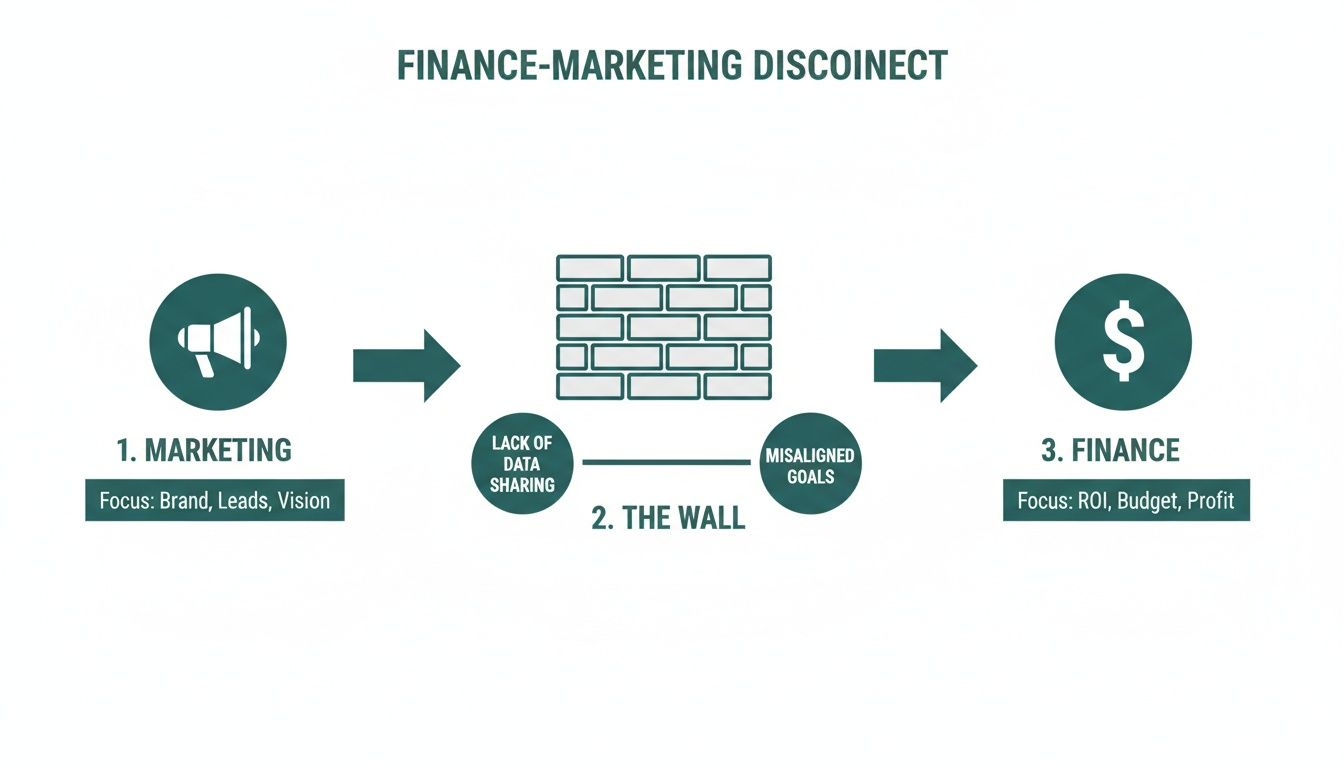
This visual nails the core problem: marketing is busy on one side of the wall, but their financial impact never makes it over to the finance team. This disconnect completely stalls smart, strategic investment in growth.
Let’s run through a real-world scenario. Imagine your Series A company needs to add $1M in new ARR next quarter. The founder turns to marketing and asks, "How much budget do you need?"
An amateur marketer says, "We need more budget for LinkedIn ads and content." This is a dead-end conversation.
A strategic marketer provides a reverse-engineered forecast. Here’s how you build it, working backward from the money:
Suddenly, marketing has a specific, quantifiable target—generate 200 MQLs. This isn't some vague request for "more leads." It's the direct input required to hit the company's revenue goal. The conversation about finance for marketing immediately shifts from spending to investing.
The final step is translating that marketing target into a dollar amount. If you know from past performance that your average Cost per MQL from paid search is $500, then generating 200 MQLs will require a $100,000 investment in that channel.
Now, the budget request isn't based on vague activities. It’s a direct calculation: a $100k investment is projected to produce $1M in ARR. That's a language any CFO or board member understands.
The discussion is no longer about cost. It’s about the expected return on capital. You can dive much deeper into this by learning how to measure marketing ROI in our related guide.
To make this connection seamless, both teams need a shared language. The table below shows how to translate common marketing metrics into the financial KPIs that matter to the business.
| Marketing Metric | Finance Counterpart | The Bridge (Shared KPI) |
|---|---|---|
| Cost per Click (CPC) | Operating Expense | Cost per MQL |
| Lead Volume | Aspirational Metric | MQL to SQL Conversion Rate |
| Website Traffic | Vanity Metric | Funnel Conversion Velocity |
| Ad Spend | Cost Line Item | Channel-Specific CAC Payback |
By reframing your activities this way, you create a common ground for discussing performance and planning future investments.
The job of a strategic marketer isn't just to generate leads. It's to build and maintain the model that proves how marketing investment turns into predictable revenue. Without this bridge, you'll always be stuck defending a cost center. With it, you're managing a growth portfolio.
Let's cut through the noise.
As a B2B SaaS leader, you’re drowning in data. Dashboards overflowing with vanity metrics, weekly reports packed with charts… but what actually moves the needle? When it comes down to building a business that can actually scale, only three financial metrics truly matter.
Get these right, and you have a capital-efficient growth engine. Get them wrong, and you’re just burning cash. The three pillars are Customer Acquisition Cost (CAC), Lifetime Value (LTV), and the CAC Payback Period.
Everything else is a supporting character. The problem is, most teams treat these as historical figures for a board deck. They aren't. They are your real-time levers for allocating capital and making smarter growth bets.

The mistakes I see are predictable. Teams proudly report a single, company-wide CAC that papers over the cracks of failing channels. They use a generic LTV calculation that ignores the messy reality of customer churn and cohort behavior. It gives a false sense of security right before the floor gives way.
Let's break down how to use these metrics the right way.
First rule: Blended CAC is a lie. A single, blended CAC that lumps all your marketing and sales channels together is worse than useless—it's actively misleading. It's like averaging the fuel efficiency of a Tesla and a 747; the number is meaningless.
This is non-negotiable. You must calculate CAC on a per-channel, per-segment basis. This forces you to answer the questions that actually matter:
Answering these questions shows you where your growth engine is humming and where it’s hemorrhaging cash. Without this level of detail, you’re flying blind, unable to double down on what’s working or cut what’s not.
When Pipedrive was scaling, they didn't just look at one CAC. They knew their SEO-driven content marketing had a 6-month payback, while their initial paid search campaigns had a 14-month payback. A blended number would have hidden this crucial insight, but by looking at each channel, they knew to pour fuel on their content engine while refining their paid strategy.
Want to get this granular? We have a full guide on how to calculate customer acquisition cost with the precision your business deserves.
Most founders can recite the basic LTV formula in their sleep: Average Revenue Per Account divided by Churn Rate. But this is where they stop, and it’s a critical mistake.
LTV is not one static number. It varies wildly across your business. A customer from a high-touch, sales-led motion might have a huge initial contract but churn faster, leading to a lower LTV than a self-service, product-led customer who starts small and expands steadily for years.
A single, company-wide LTV is a dangerous fiction. Your strategic decisions should be guided by cohort-specific LTV. This is the only way to accurately assess the long-term return on your channel investments.
The LTV:CAC ratio guides your investment strategy. A 3:1 ratio is the textbook benchmark, but the “right” ratio depends entirely on your business. A high-margin enterprise company like Snowflake might be thrilled with a 5:1 ratio from its sales-led efforts, while a lower-margin, high-volume PLG business like Calendly could be perfectly healthy at 2.5:1.
It’s the comparison of LTV:CAC ratios between channels that tells you where to put your next dollar.
The LTV:CAC ratio tells you if a channel is profitable in the long run. But for a startup managing a tight runway, the CAC Payback Period is the metric that governs your survival. It tells you how many months it takes to earn back the money you spent to acquire a customer.
Your payback period dictates your growth velocity. It's that simple.
A 24-month payback might be fine for a public company with deep pockets. But for a Series A startup with only 18 months of cash in the bank, it’s a death sentence. You're tying up precious capital for too long, choking your ability to reinvest and grow.
Your target payback period needs to be a conscious, strategic choice, not an accident of your model. Here are some real-world benchmarks:
The next time you're thinking about scaling a channel, don't just ask, "What's the CAC?" The first question should be, "What's the payback period?" This grounds the entire conversation in financial reality. To truly define and measure marketing's success, you have to get deliberate about your metrics and KPIs to boost ROI.
Let’s be honest: the traditional annual marketing budget is a relic. It’s an artifact from a slower, more predictable time, and for a modern B2B SaaS company, it's a strategic liability.
Locking yourself into a 12-month plan based on last year’s data is like navigating a racetrack with an old, folded map. By the time you make your first turn, the course has changed.
Growth doesn’t work on an annual schedule. It’s a constant, fluid process. Your budget needs to be just as dynamic.
This requires a fundamental mindset shift. You have to stop treating marketing as a cost center and start managing it like an investment portfolio. It’s not one big expense line; it's a collection of capital allocations, each with its own risk profile and expected return. This is the real secret to making finance for marketing a growth driver.

To get there, I structure marketing investments into three distinct buckets. This simple framework brings clarity and forces a level of discipline that annual budgets can't match.
Scale (60-70% of budget): These are your workhorses—the proven, high-conviction channels. You have solid data showing a predictable CAC Payback Period (ideally under 12 months). Think of your mature paid search campaigns or a high-performing content engine. The goal here isn't discovery; it's about efficient execution.
Test (10-20% of budget): This is your R&D lab for growth. These are time-boxed experiments designed to find your next scale channel. Each test has a clear hypothesis and kill criteria. Maybe you’re testing a new ad platform, a different content format, or a co-marketing model. Success means graduating a channel to the "Scale" bucket.
Foundation (10-20% of budget): This is the essential infrastructure that underpins everything. It covers your marketing automation platform, website CMS, core brand work, and the salaries of the team keeping the engine running. These aren't direct lead-gen activities, but without them, the entire system grinds to a halt.
This structure completely changes the conversation with your CFO. You’re no longer asking for a single, ambiguous lump sum. Instead, you're presenting a diversified portfolio of investments, each with a clear purpose and risk level.
For a more detailed breakdown of this framework, check out our complete guide on marketing budget planning for B2B SaaS startups.
A portfolio model is only as good as the process you use to manage it. This is where rolling forecasts and a disciplined review cadence come into play. Instead of one big annual plan, you operate in a continuous loop: analyze performance, then reallocate capital.
The cornerstone of this system is a monthly or quarterly Growth Review meeting, co-owned by marketing and finance.
This meeting isn't a post-mortem of last month’s MQLs. It’s a forward-looking, strategic discussion centered on one question: "Based on our most recent performance data, what is the highest and best use of our next marketing dollar?"
This is the moment of truth. A winning channel with a 6-month payback period should not have to wait for the next annual budget cycle to get more funding. In this system, marketing can confidently request more capital, backed by clear payback data, and finance can approve it immediately because it's a financially sound investment, not an expense.
This data-driven agility is non-negotiable. Global advertising and marketing spending was estimated to hit $1.87 trillion USD in 2025 and is projected to clear $2 trillion by 2026. This trend shows that businesses are doubling down on growth. As a startup, you're competing for attention and wallet share within this massive capital pool. You can see more on global marketing spend projections on Statista.com.
By building this nimble system, you turn your marketing budget from a static limitation into a dynamic weapon. It empowers you to double down on winners, cut losers quickly, and deploy capital with the speed and intelligence required to win your market. This isn't just better budgeting; it's how you build a genuine growth machine.
A brilliant strategy is worthless without execution. A perfectly aligned financial model is just a spreadsheet until it meets reality. What bridges the gap between your plan and your results? A disciplined, shared operating cadence between marketing and finance.
Most teams get this wrong. Their "system" is a mess of last-minute budget scrambles, ad-hoc data requests, and tense quarterly reviews where everyone is on the defensive. That’s not a cadence; it’s a constant state of reaction.
High-performance teams replace that chaos with a predictable rhythm. This isn't about adding more meetings. It's about having the right meetings, with the right data, and getting the right people in the room to make decisions.
The cornerstone of this system is the Monthly Growth P&L Review. Think of this not as a typical marketing meeting, but as a capital allocation session co-owned by the CMO and CFO.
The agenda is ruthlessly focused on investment performance, not activity. No one is presenting slide decks on campaign clicks or email open rates. The entire point is to review the marketing investment portfolio against the financial model you both agreed on.
Here’s what you cover:
This meeting is where your financial model comes to life. It shifts the conversation from justifying last month’s spend to making intelligent, forward-looking investment decisions for next month.
While the monthly review handles strategic allocation, you need a much tighter loop on the leading indicators that predict success. This is where a one-page Marketing Finance Dashboard comes in, reviewed weekly by the leadership team.
This document is all about velocity and momentum. It has to be brutally simple, focused on a handful of metrics that predict future revenue. Anything else is noise.
Your weekly dashboard should answer one question: "Are we on track to hit our number?" It should take less than five minutes to understand. If it needs a 20-minute explanation, it has already failed.
This dashboard must include a mix of forward-looking and backward-looking metrics:
Leading Indicators (What's coming):
Lagging Indicators (What just happened):
This constant, low-friction flow of information kills surprises. The CFO sees pipeline building in real-time, which builds confidence in the marketing budget. The CMO sees the payback period creeping up and can intervene before it becomes a quarterly problem. This is how you build the trust required for dynamic budgeting. Our guide on revenue forecasting methodologies provides a deeper look into building these predictive models.
To make this concrete, here’s a simple but effective operating cadence. This structure ensures a constant flow of information and keeps both teams locked in on the same goals.
| Cadence | Meeting/Report | Key Focus | Attendees |
|---|---|---|---|
| Weekly | Leadership Dashboard Review | Are we on track? Reviewing leading indicators (pipeline, velocity) and spotting red flags. | CMO, CFO, Marketing Leads |
| Weekly | Channel Performance Huddle | Tactical adjustments. What's working/not working this week? Optimizing campaigns. | Marketing Channel Owners |
| Monthly | Growth P&L Review | Strategic capital allocation. Reviewing ROI, payback, and re-allocating budget for next month. | CEO, CMO, CFO, Marketing Leads |
| Monthly | Finance Dashboard Update | Formal reporting of lagging indicators (CAC, LTV) into the main company financial model. | CFO, Finance Team, CMO |
This rhythm turns what used to be a series of stressful, one-off conversations into a smooth, continuous process. It's about proactive management, not reactive firefighting.
This level of discipline is more critical than ever. For instance, global M&A in financial services surged to $418.9 billion in 2025 as firms consolidated. For a SaaS founder selling into that vertical, this signals an urgent need for tech that drives efficiency. If you can prove the financial return with a clear payback model, you can unlock budget opportunities that others can't. You can read the full analysis on EY.com.
Ultimately, a shared operating cadence is what turns your marketing and finance teams from separate functions into a single, unified growth engine. It replaces ad-hoc fire drills with a system of continuous, forward-looking analysis that allows you to make smarter, faster decisions.
Theory is clean; execution is messy. Let's tackle the tough questions that always pop up when you try to connect marketing execution to financial accountability in a real B2B SaaS company.
This is a classic point of friction. I've seen it play out dozens of times. The key is to stop arguing about reporting preferences and start talking about risk management and capital efficiency—language your CFO understands.
A blended Customer Acquisition Cost (CAC) doesn't just obscure performance; it actively encourages waste. It lets your expensive, failing channels hide behind the efficient ones, which stops you from pouring gas on what's actually working.
Your move here is to show, not just tell.
Present a simple, side-by-side model. On one side, show the current state with the blended CAC and payback period. On the other, model a scenario where you reallocate budget from a high-payback channel to your best-performing one. The result? A better portfolio return and a de-risked marketing budget. That’s a conversation finance will want to have.
You can't—not with any real accuracy. And that’s perfectly fine.
At the pre-revenue or early-revenue stage, your goal isn't precision. It's about instilling the discipline of unit economic thinking from day one. You're building the right habits, even if the numbers are still fuzzy.
The model will be wrong, but the process is right. Focus on leading indicators and directional correctness, not a false sense of precision.
For CAC, start by tracking leading indicators like Cost-per-SQL. You can then project a hypothetical CAC based on your very early sales cycle data and conversion assumptions. For LTV, use market comparables from public companies or industry reports, combined with your pricing model, to build a justifiable assumption.
The most important part? Revisit and update these assumptions relentlessly as soon as real data starts trickling in.
The standard advice is 10-15% of your demand generation budget, but this is not a one-size-fits-all rule. It depends entirely on your company's stage and risk tolerance.
The most critical rule is to time-box every experiment. Define clear "kill criteria" upfront. An experiment that runs indefinitely without a clear outcome isn't an experiment; it's just a leaky budget. To truly understand the financial impact of these efforts, grasping how to calculate profit margin is a fundamental skill.
At Big Moves Marketing, we help B2B SaaS founders and leaders build the clarity and systems required to turn marketing into a predictable growth engine. If you're ready to stop guessing and start building, see how we partner with companies like yours at https://www.bigmoves.marketing.
Explore Big Moves Marketing services and resources:





%20-%20white.svg)