%20png%20copy.avif)
Marketing for SaaS isn't just about one-off sales—it's about building a growth engine that runs on the entire customer journey. The real goal is to consistently attract ideal customers, demonstrate undeniable value, and transform users into brand champions. Get this right, and you'll create lasting momentum and real business impact.
Welcome to your guide to marketing for SaaS. Let's be clear: this isn't abstract theory. It's a practical blueprint for building a growth engine that drives results for your B2B company.
Unlike traditional product sales that often end at the checkout, the SaaS journey is a long-term relationship. It starts with a prospect's first click and ideally continues until they become your biggest fan and best advocate. Your job as a marketer is to build a system that makes this happen again and again.
We're here to help you build a system that consistently draws in the right business clients, proves your solution is indispensable, and nurtures those relationships until customers become your most powerful marketing channel. Let's break down the pillars of a strategy that works.
To build a program that generates real, lasting momentum, you need to master three distinct phases of the customer relationship:
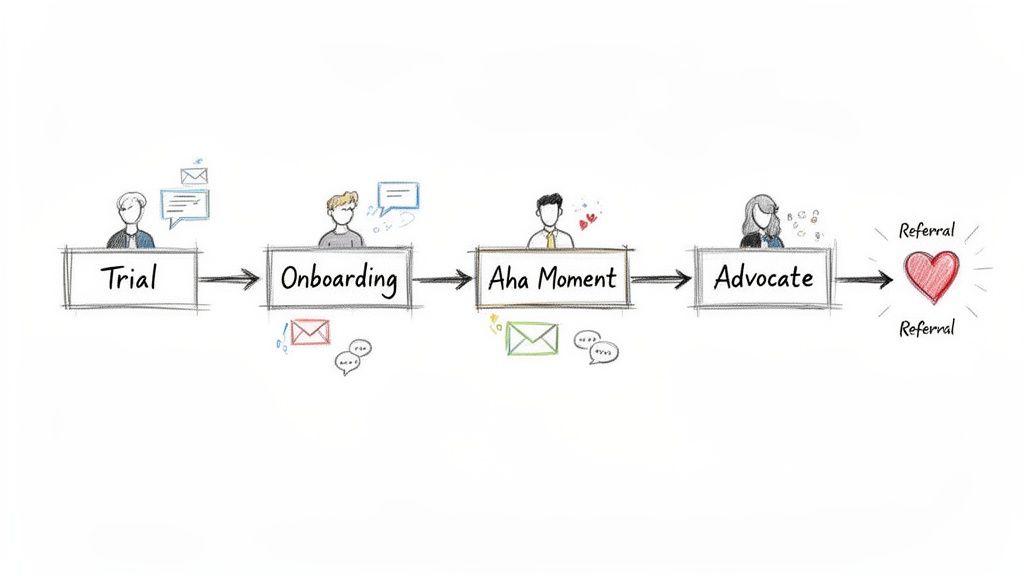
This simple visualization breaks down how these three pillars work together to create a true growth engine.
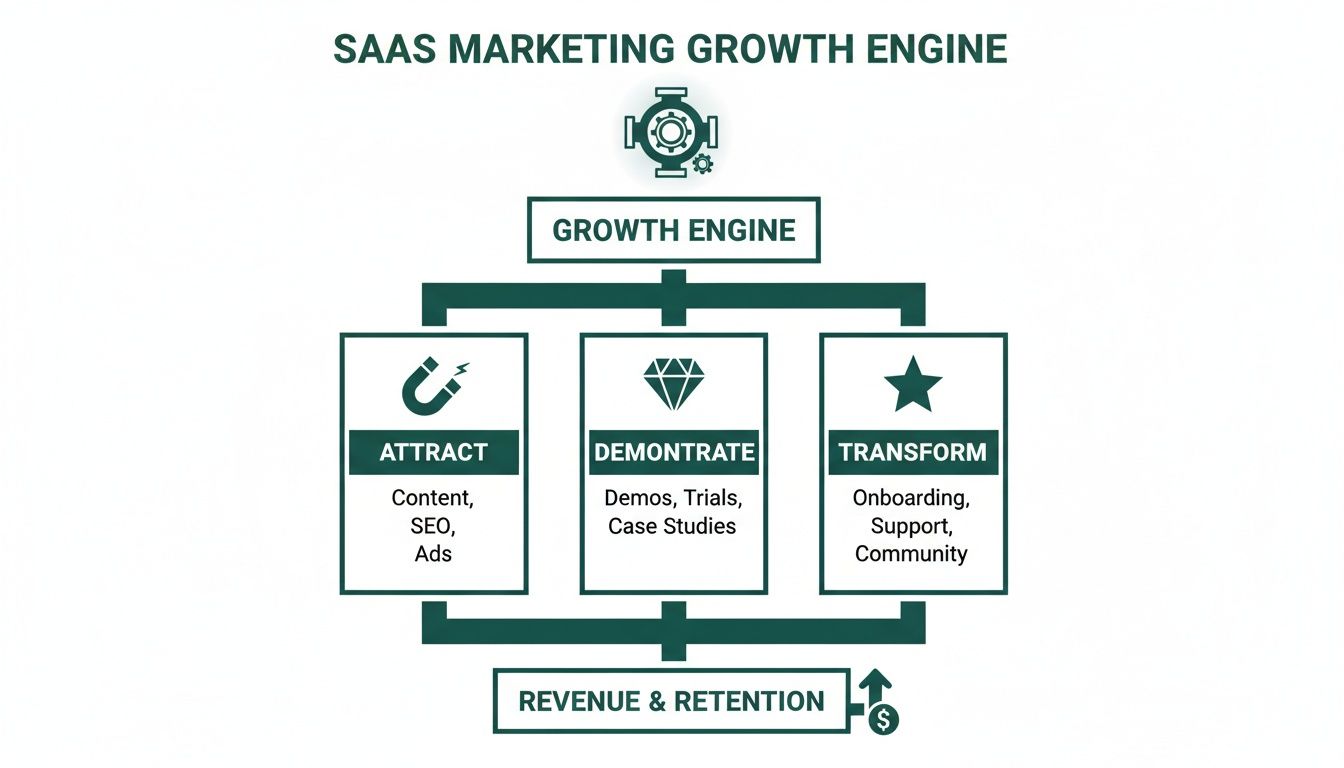
As the diagram shows, a sustainable strategy moves beyond just grabbing attention. It actively demonstrates value and transforms users into advocates, which is what really drives both revenue and retention.
This holistic approach is critical, especially as the global SaaS market is projected to hit nearly $300 billion by the end of 2025. You can dig deeper into what this explosive growth means for marketers, and our complete guide on B2B SaaS marketing offers even more context for navigating this field.
Before you even think about launching a campaign, you need to get your foundation right. Trying to market a SaaS product without a solid framework is like building a house on sand—it’s a recipe for disaster. You wouldn't pour concrete without a detailed blueprint, right?
In marketing, that blueprint is your Ideal Customer Profile (ICP), and your prime plot of land is your market positioning. Without both, every dollar you spend is a gamble.
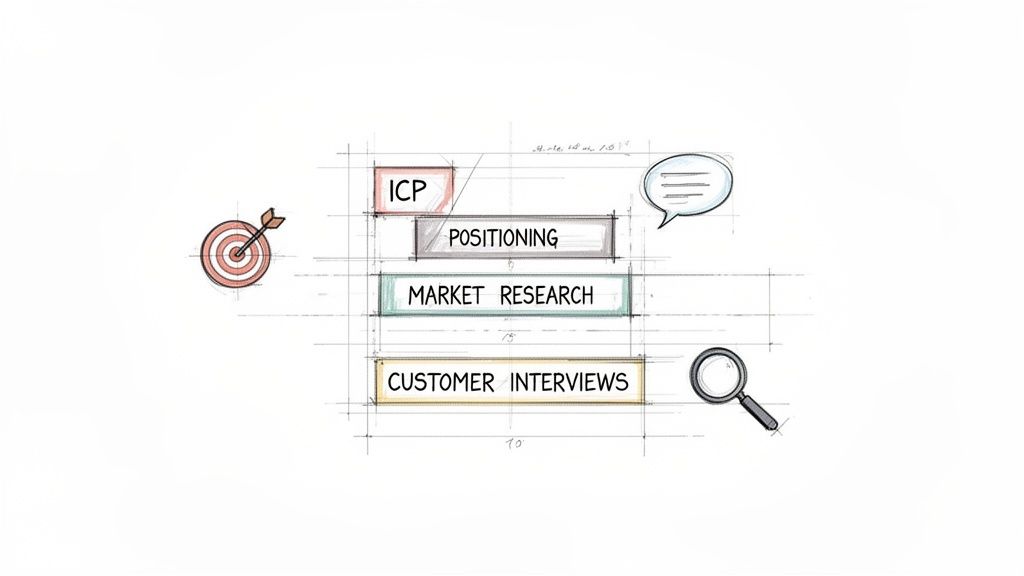
The goal here is to move past surface-level demographics. You need to build a data-backed ICP that digs deep into psychographics—the real motivations, challenges, and goals driving the businesses you want to sell to. This comes from getting on the phone, conducting insightful customer interviews, and doing the hard work of market research to understand not just who they are, but how they think.
Your ICP is a hyper-detailed portrait of the perfect company for your solution. This isn’t about just picking an industry or company size; it’s about identifying the specific, tell-tale attributes that signal a high-value, long-term partnership is on the horizon. A well-defined ICP is the compass that guides every single marketing decision you make.
Start by looking at your best current customers. Find the common threads:
This analysis is what keeps you focused on attracting businesses that are genuinely set up to succeed with your product. If you're ready to get started, our ideal customer profile template offers a structured way to build this out.
Once your ICP is crystal clear, the next step is to nail down your positioning. This isn't just a catchy tagline; it's a short, powerful declaration of your unique value and exactly how you stand out from other solutions. It answers the one question that matters most to your ideal business customer: "Why should I choose you?"
Your positioning statement is the core message that connects your product's unique strengths to the specific needs of your ideal customer. It’s the narrative that frames every piece of marketing material you create.
This entire framework—your ICP and your positioning—is brought to life through effective content. To really sharpen your approach, you'll want to dive into content creation best practices that can help you turn your strategy into assets that convert.
Getting this foundation right is especially critical when you consider the costs. The median Customer Acquisition Cost (CAC) for B2B SaaS companies hovers around $495. A precise ICP is what makes sure every one of those dollars is spent efficiently, not wasted on the wrong audience.
Let's stop thinking about your B2B SaaS marketing as a series of disconnected campaigns. Instead, picture it as a powerful engine. And the fuel for this engine? High-quality, problem-focused content. It’s the energy that powers your entire funnel, from getting on a prospect's radar to turning them into a loyal customer.
Your content isn't just a pile of blog posts. It’s an ecosystem you build piece by piece to establish authority and earn trust. This is especially true in B2B SaaS, where buying decisions often involve multiple stakeholders and months of deliberation. The goal is to become the go-to resource for your ideal customers long before they even think about making a purchase.
There's a reason content marketing is the second most common channel for SaaS companies, with 67% using it to drive growth. The data backs it up: an incredible 70% of SaaS buyers would rather learn about a company through articles than get hit with an ad, according to a recent SaaS marketing report. It's clear that education, not interruption, is how you win over modern business customers.
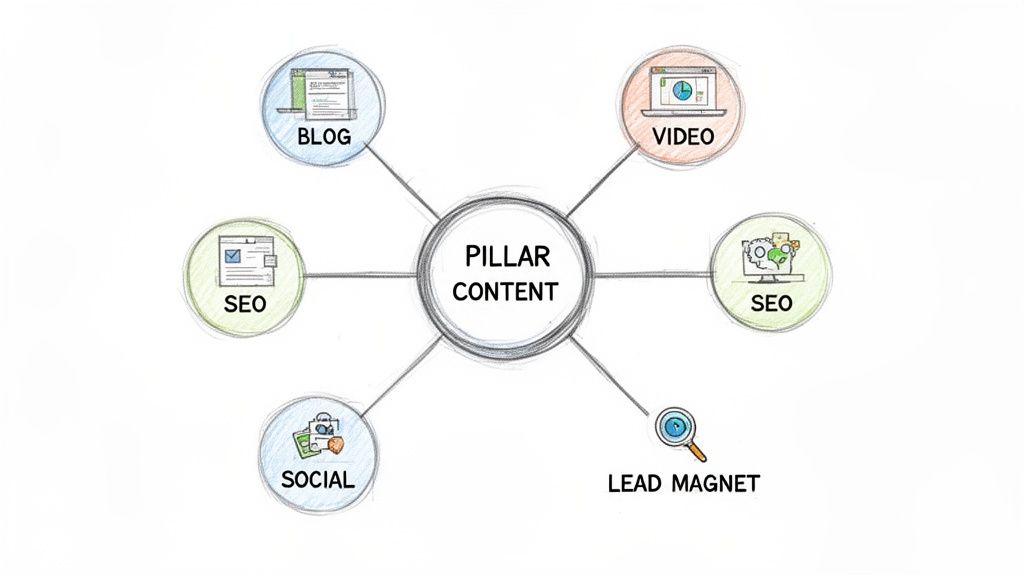
One of the most effective ways to build this content engine is the Hub and Spoke model. Picture a bicycle wheel. At the center is the hub—a massive piece of content like a definitive guide, an original research report, or a comprehensive webinar. This is your pillar content.
Radiating out from the hub are the spokes. These are smaller, related pieces of content that all link back to the central hub. Think blog posts, short videos, infographics, or social media threads, each digging into a subtopic from your main pillar. This creates a powerful network of internal links that boosts your SEO authority and keeps people clicking around your site.
The Hub and Spoke model transforms your content from a simple library into a strategic web. Each "spoke" captures traffic for specific, niche keywords while funneling authority and users back to your central, high-value "hub."
For this model to really fire on all cylinders, your content needs to hit on your Ideal Customer Profile's most urgent pain points. That means moving beyond generic topics and zeroing in on high-intent keywords—the kind of phrases that signal someone is actively looking for a solution right now.
Focus your efforts on creating content that answers the specific questions your ICP is typing into Google. This usually falls into a few key formats:
By consistently creating and sharing this kind of value-driven material, you build an ecosystem that establishes your company as the authority. This foundation doesn't just attract qualified leads; it nurtures them all the way through their decision-making process. For a deeper look at building this out, check out our guide on how to create a content marketing strategy that truly delivers.
With a strong content engine humming along, your next mission is to turn that output into a predictable flow of leads. This is the world of demand generation—it’s not about random acts of marketing, but a systematic process for creating genuine awareness and interest in your product.
The goal isn't just to generate any leads. It’s about building a reliable pipeline of high-quality prospects that your sales team will actually thank you for.
Think of your content as the fuel and your demand generation strategy as the distribution network. A multi-channel approach is the only way to ensure your message consistently reaches the right people, at the right time, wherever they are. We'll focus on three of the most powerful channels for any B2B SaaS company: SEO, paid media, and community engagement.
Search Engine Optimization (SEO) is the absolute cornerstone of a sustainable lead generation machine. It's all about capturing traffic from businesses that are actively searching for solutions to the exact problems you solve.
This inbound approach means the leads you attract already know they have a problem. That recognition makes them far more likely to convert.
It's no surprise that SEO reigns as the top marketing channel for SaaS, with 75% of companies using it. Organic search drives over half of all website traffic, making it a non-negotiable channel for any company serious about long-term growth. You can dig into more SaaS marketing statistics to see just how dominant this channel is.
A solid B2B SEO plan really boils down to two core components:
While SEO builds long-term, compounding momentum, paid media gives you immediate, laser-targeted reach. Platforms like LinkedIn and Google Ads are incredibly powerful, letting you place your solution directly in front of decision-makers with specific job titles, at companies of a certain size, or in particular industries.
But here’s the catch: the key to profitable paid campaigns is a ruthless focus on your unit economics. You have to maintain a healthy ratio between your Customer Lifetime Value (LTV) and your Customer Acquisition Cost (CAC).
A widely accepted benchmark for B2B SaaS is an LTV-to-CAC ratio of at least 3:1. This ensures that every new customer generates substantially more revenue than it cost to acquire them.
A disciplined approach to paid media isn't about spending more; it's about spending smarter. By constantly monitoring your LTV-to-CAC ratio, you can scale campaigns confidently and ensure your budget is driving profitable growth, not just vanity metrics.
Finally, we have one of the most powerful—and most overlooked—channels: community building. This isn't about broadcasting your message; it's about actively participating where your ideal customers already gather online.
Think niche forums, professional Slack groups, and relevant social media threads. The goal is simple: don't sell, just help.
By providing genuine value, answering questions, and sharing your expertise without expectation, you build trust and establish your brand as a true authority. This kind of authentic engagement creates a powerful flywheel effect, driving word-of-mouth referrals and attracting prospects who are already warm to your solution before they even hit your website.
To see how these channels fit together, check out our complete guide on building a powerful demand generation strategy.
Getting a customer to sign up isn’t the finish line; it’s the starting pistol firing.
For a B2B SaaS company, real, sustainable growth ignites after the initial sale. This is where your marketing focus has to evolve—moving beyond just acquiring customers to creating fierce loyalty. The ultimate goal is to turn your happy users into your most powerful and credible sales channel.
The entire mindset shifts from closing a one-time deal to delivering on an ongoing promise. This phase of SaaS marketing is all about ensuring customers actually achieve what they hoped to with your product. Get that right, and you’ll fuel retention, expansion, and the kind of word-of-mouth growth that money can't buy.
This is where the principles of product-led growth (PLG) really get to shine. PLG uses the product itself as the main driver of the entire customer journey, paving a smooth, intuitive path from a free trial to a paid plan. The idea is to let your product’s value do the talking, creating an almost frictionless sales process.
The first few minutes a new user spends with your software are absolutely critical. Your mission is to guide them to their "aha!" moment—that magical point where the lightbulb goes on and they see exactly how your product solves their problem.
This all comes down to a thoughtfully designed onboarding process. It’s not just about showing off features; it's about leading new users to a quick, meaningful win that validates their decision to sign up. A strong onboarding experience is your first and best defense against churn.
To nail this, savvy SaaS marketers use a few key tools:
The core of great onboarding is empathy. It means anticipating a user's questions and proactively giving them the answers, making them feel capable and successful from their very first login.
Once users are up and running, finding real value in your product, the final step is to mobilize them. This is the world of customer marketing, a discipline laser-focused on nurturing your existing customer base to drive retention, referrals, and advocacy.
Your happiest customers are a goldmine for growth, and you can’t afford to ignore them.
For B2B SaaS, the average churn rate is a relatively low 3.5%, which just goes to show how vital retention is in this space. The numbers don't lie: improving retention by just 5% can boost profits by an incredible 25% to 95%. It's one of the highest-impact areas you can possibly focus on. You can discover more insights about SaaS marketing statistics that really drive home the power of keeping your customers happy.
This creates a powerful growth loop where satisfied customers fuel new customer acquisition. Key tactics include:
If you want to build a growth engine that works like clockwork, you have to move past gut feelings. It's time to operate with data-backed precision. This is the big leap from being busy to being truly effective—turning your marketing team into an organization where every decision is informed by real, measurable results.
Think of it like flying a plane. A pilot doesn’t guess their altitude or speed; they have a dashboard packed with instruments guiding every move. Your SaaS marketing needs that same level of clarity. And it all starts with putting the right technology in place.
Your marketing tech stack is the central nervous system of your growth strategy. It’s what collects the data, automates the grunt work, and gives you the insights needed to scale intelligently. For most B2B SaaS companies, a few core components are simply non-negotiable.
This combination of tools creates a powerful feedback loop. It connects your marketing activities directly to sales outcomes, which is critical for proving the value of your work and making smarter decisions about where to put your budget. To keep a constant pulse on how your marketing efforts are shaping market perception, you can also bring in advanced solutions for AI Brand Tracking for SaaS Companies.
With your tech stack in place, your focus can shift to tracking the right metrics at each stage of the funnel. Chasing vanity metrics like social media likes is a massive distraction. You need data that connects directly to revenue.
This means you need a full-funnel view.
A great marketing dashboard doesn't just show you what happened; it tells you why it happened. It connects top-of-funnel activities like website visitors to bottom-of-funnel results like customer lifetime value, providing a clear line of sight to revenue.
Your dashboard should give you a real-time view of performance, helping you answer the most important questions instantly. For a deeper dive into building out this system, our guide on creating a data-driven marketing strategy offers a complete framework.
When you can connect every marketing action to a concrete business outcome, you're no longer just marketing. You're building a scalable system for long-term, predictable growth.
When you're deep in the trenches of B2B SaaS marketing, the same questions tend to pop up again and again. It's completely normal. Here are some straightforward answers to the strategic challenges I see marketing leaders wrestling with every single day.
While everyone keeps a close eye on Monthly Recurring Revenue (MRR) and churn, the one metric that truly tells you if the business is healthy is the LTV to CAC ratio. Think of it as your ultimate report card.
This single number cuts through the noise and answers the most important question: “Are we actually making money on the customers we bring in?”
A healthy ratio, which is generally considered 3:1 or higher, is proof that you have a sustainable growth engine. It means for every dollar you spend acquiring a customer, you’re getting at least three dollars back over their lifetime. That’s the green light you need to start pouring fuel on your marketing fire.
The honest answer? Every successful B2B SaaS company I've seen eventually lands on a hybrid model. The real question is where you should focus right now, because that changes depending on your stage.
Let's be clear: SEO is a marathon, not a sprint. Anyone who tells you otherwise is selling something.
While you might see some quick wins from technical fixes, you should plan for it to take 6 to 12 months to see a real, substantial increase in traffic from a consistent content marketing and link-building strategy.
The best way to think about it is like building a valuable asset. The work you put in today compounds over time, eventually creating a powerful source of organic traffic that pays you back for years to come.
Ready to build a B2B SaaS marketing strategy that drives real revenue and adoption? At Big Moves Marketing, I partner with founders to create the positioning, sales tools, and launch strategies that help great products win deals. Learn more and get in touch today.
Explore Big Moves Marketing services and resources:

%20-%20white.svg)