%20png%20copy.avif)
The winning approach is narrow: pick 3 to 5 content pillars, let executives write in their own voice, and post on a cadence you can sustain for a year, not a quarter. Expect early signals like comments and profile views within 30 days, but real pipeline movement takes 60 to 90 days of consistent execution. The framework below walks through exactly how to build it.
TL;DR:
- Focusing on three to five pillars tied to specific buyer questions increases engagement and pipeline, rather than broad or vague content.
- A consistent posting cadence of one to two times per week for executives and two to three times for founders produces better results than frequent, irregular posts.
- Mapping formats such as text, carousels, or videos to buyer journey stages ensures content moves prospects toward buying decisions.
- Tracking comments from target accounts and profile views from ICP companies offers more accurate pipeline indicators than follower count or impressions.
- A clear 12-week batching and review system, with reinforcement of authentic voice and real engagement, leads to sustained LinkedIn success.
A LinkedIn content strategy that works for B2B and SaaS companies is a five-part system: business-linked goals, a defined buyer, a small set of content pillars, a sustainable cadence, and a monthly measurement loop. Most companies skip straight to posting. That’s the mistake. Leading guides on LinkedIn content marketing agree the sequence matters. You start with goals and audience, then map pillars and formats on top. Skip that order and you get a content calendar full of posts nobody asked for.
Here’s the five-step build, in the order that actually works.
Set goals tied to buyer beliefs, not vanity metrics. Before writing a single post, name the belief you want a prospect to hold before they take a sales call. That might be “this vendor understands our compliance headache” or “this founder actually ships product, doesn’t just talk about it.” Every pillar and post should trace back to one of these beliefs. LinkedIn’s own guidance on strategic content planning backs this up: content that maps to a clear goal and audience outperforms content built around what feels timely.
Map your ICP to specific content needs. Your ideal customer profile isn’t a demographic slide, it’s a set of questions that buyer types into Google at 11pm before a renewal decision. Interview five recent customers and ask what almost stopped the deal. Those objections become your content backbone. A VP of RevOps worried about data hygiene needs different proof than a founder worried about runway. Write for one buyer persona per pillar, not a blended average.
Choose 3 to 5 pillars and own a point of view on each. This is where most B2B accounts go generic. Thought leadership isn’t a separate initiative, it’s what happens when you post consistent, specific, opinionated content inside a narrow set of topics, repeated for months. Pick pillars like “why most onboarding fails in month two” or “the pricing mistake every Series B SaaS company makes,” and take a real stance. Vague pillars like “sales tips” or “marketing insights” produce vague posts nobody remembers.
Set a cadence you can actually sustain. Executives who post once or twice a week consistently outperform those who post daily for three weeks and vanish. Multiple sources tracking executive posting cadence recommend one to two posts weekly for executives, two to three for founders in active growth mode. Mix formats: text posts for quick opinions, carousels for frameworks, native video for personality and trust. Consistency beats volume every time.
Build a monthly review loop with defined KPIs. Decide upfront what you’re measuring: comments from target accounts, meeting requests sourced from LinkedIn, profile views from named ICP companies. Review these numbers monthly, not weekly. Weekly reviews create noise. Monthly reviews reveal patterns. If a pillar isn’t generating comments or DMs after eight weeks, cut it or rework the angle.
This sequence works because each step constrains the next. Goals narrow your audience. Audience narrows your pillars. Pillars narrow your formats. By the time you’re picking what to post on Tuesday, the decision has mostly already been made for you. That’s the point. For teams building out a broader content marketing strategy beyond LinkedIn alone, this same goals-first sequence applies across channels, not just one platform.
Pillars only work when they’re tied to a stage in the buyer’s journey, not a department’s wish list. A pillar aimed at someone who’s never heard of your category needs a different format than a pillar aimed at someone comparing three vendors. Match the two and you get engagement that actually converts. Mismatch them and you get likes from people who will never buy.
Here’s how format maps to intent on LinkedIn:
Five templates cover most of what a B2B or SaaS executive needs to post consistently:
The POV post. Open with a contrarian claim in the first line (“Most onboarding fails because of a slide deck, not a product gap”), back it with one specific example, close with a question that invites disagreement.
The earned moment post. Share a real win or loss from the past week. “We lost a deal last quarter because our pricing page confused a buyer” builds more trust than any polished case study.
The checklist post. A tight, numbered list of steps or red flags related to your pillar. These perform well as text posts or simple carousels.
The micro case study. Three to five sentences: the problem, what changed, the result. No fluff, no “we’re thrilled to announce.”
The data insight post. Take one number from your own product usage or a market report, explain what it means for the buyer, and stop. Don’t pad it.
Here’s how one B2B/SaaS pillar might map across the month:
| Pillar | Format | Sample post angles |
|---|---|---|
| Onboarding failure points | Carousel | “5 onboarding mistakes we see in every failed SaaS rollout” |
| Pricing strategy | Text POV | “Why usage-based pricing kills your forecast accuracy” |
| Founder-led sales | Native video | “What I say on the first call that most reps skip” |
This kind of mapping keeps your calendar predictable without making every post feel like a template. Teams researching how to define pillar topics for a technical audience should also look at how B2B web marketing content gets structured for SaaS buyers specifically, since the same logic of narrow, buyer-specific themes applies there too.
Most executives treat their LinkedIn profile like a static resume. It should work more like a landing page: every section either builds trust or invites a next step. A profile view that ends without a click, a follow, or a DM is a wasted impression, and most companies bleed hundreds of these a month without noticing.
Start with the headline. Skip the job title alone. Use a formula that names who you help and the outcome you deliver: “Helping [buyer type] solve [specific problem] — [Title] at [Company].” A VP of Sales at a SaaS company might write “Helping RevOps teams cut ramp time in half — VP Sales at [Company]” instead of just their title. That single line shows up everywhere your name appears, including comments, so it’s doing work constantly.
The About section needs a structure aimed at buyers, not recruiters:
Pro Tip: Write your About section in second person, addressing the reader directly (“you’re probably dealing with…”) instead of third person (“I help companies…”). It reads less like a bio and more like the opening line of a sales call.
The Featured section is prime real estate that most executives waste on a company logo or an old press mention. Use it for your three best-performing posts, a case study, or a short video introduction. Update it every quarter. A stale Featured section signals a stale account.
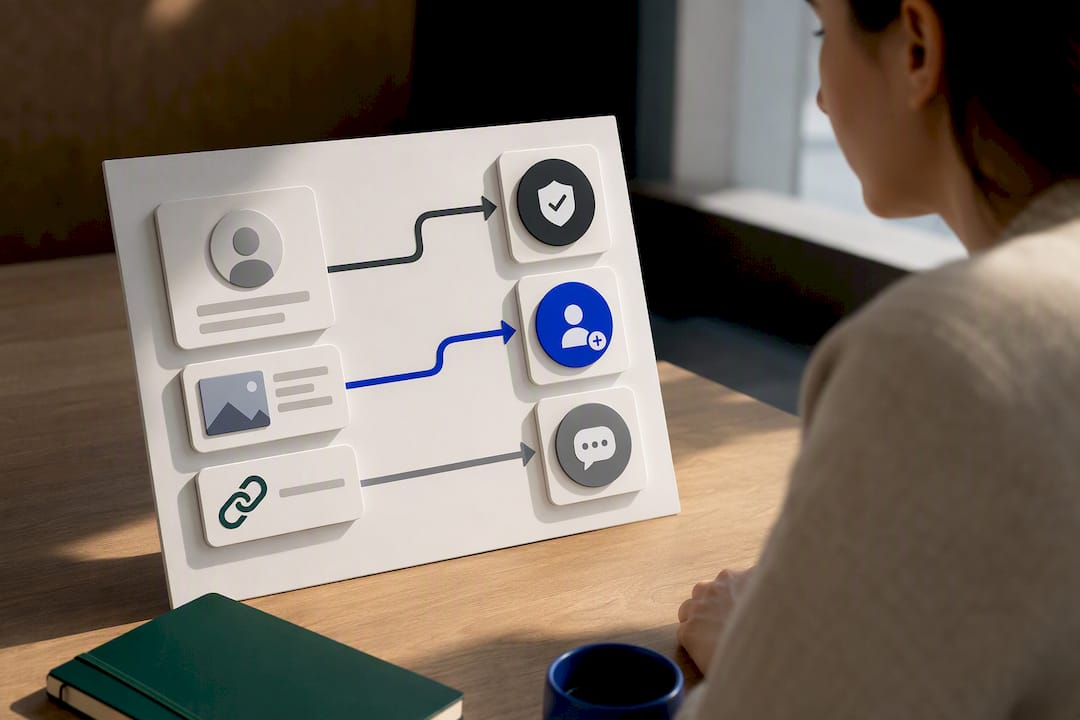
Profile hygiene matters more than people assume. A profile photo that’s five years old, a banner image that’s blank, and a contact info field with no email create small doubts that add up. Add your calendar link or contact email where LinkedIn allows it, so a warm reader can act without hunting for a way to reach you. For technical founders specifically building a personal brand from scratch, this guide on personal branding for technical leads covers the credibility gap that engineers and product leaders often face when they first start posting under their own name.
Company pages need the same attention, just at a smaller scale. Keep the tagline specific to what you sell, post consistently from the page in addition to executive profiles, and make sure the featured section links to your highest-intent page, not your homepage.
The first hour after you publish decides how far a post travels. LinkedIn’s distribution algorithm weighs early engagement velocity heavily, and substantive comments in that first window signal to the platform that a post deserves a wider push. A post with ten thoughtful comments in 60 minutes beats a post with 200 likes spread across two days.
Here’s a five-step workflow for building the right kind of engagement, not just more of it:
Pro Tip: Track which of your own comments on other people’s posts generate profile clicks back to you. That data tells you which niche voices your buyers are actually paying attention to, so you know where to spend your daily fifteen minutes.
Executives should never fully outsource their voice in this process. LinkedIn can detect generic corporate copy with real accuracy, and posts that read like a press release get quietly suppressed. Keep the executive’s actual words, even rough ones, and save the outside help for structure and editing.
A content calendar only works if the operational system behind it is boring and repeatable. The goal isn’t creative inspiration five days a week. It’s a system that produces enough good content on a schedule you won’t abandon after six weeks.
Start with a 90-minute weekly batching ritual:
Batching a week of content in a single 90-minute sitting removes the daily friction that kills most executive content plans. The executive isn’t starting from a blank page every Tuesday morning wondering what to post.
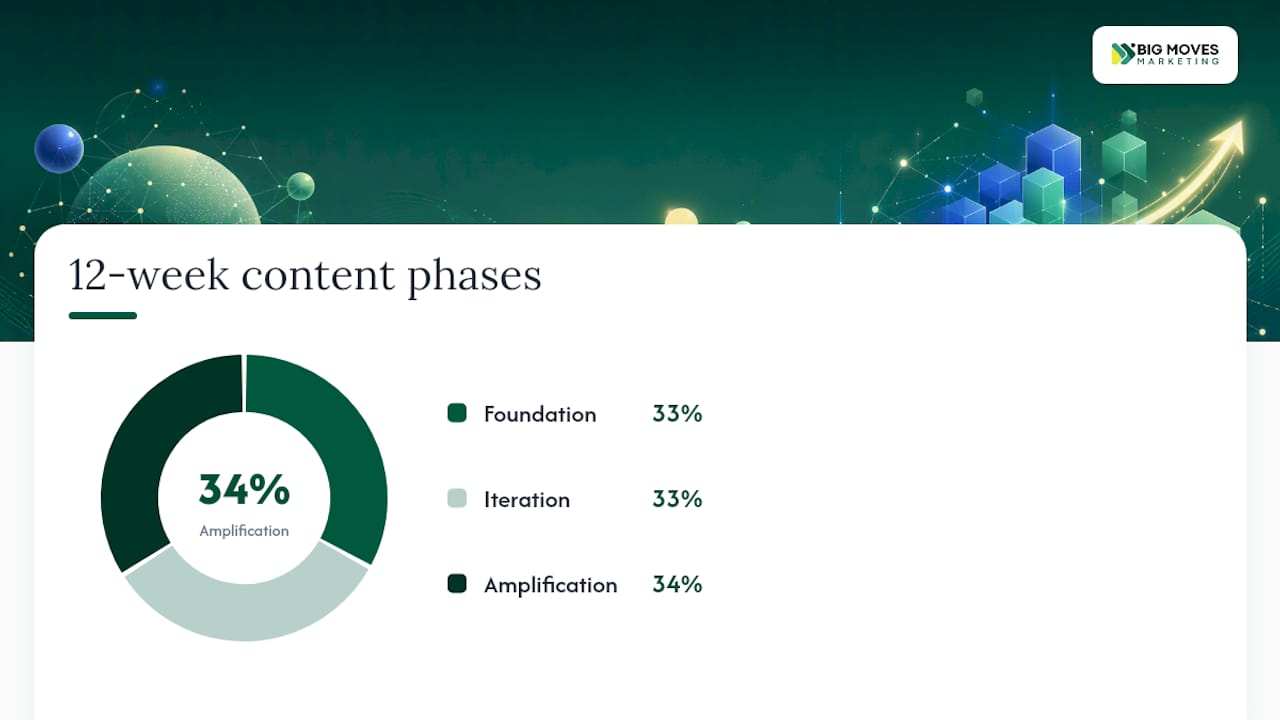
Structure your first quarter around a simple three-phase plan. Weeks 1 through 4 are foundation: post consistently, test all your pillars, and see which ones generate real comments. Weeks 5 through 8 are iteration: double down on the two or three pillars that worked, drop or rework the ones that didn’t, and start testing new formats. Weeks 9 through 12 are amplification: layer in employee engagement, target account outreach, and start tracking pipeline signals more closely. This 12-week structure mirrors how audiences and the algorithm both need time to learn who you are.
Repurposing is where most of your volume should come from, not fresh ideas. One customer call insight can become a text post, a carousel breaking down the framework, a video reacting to the objection, and a comment you leave on someone else’s related post, all inside the same week. You’re not manufacturing four ideas. You’re finding four angles on one.

Tooling stays simple at this stage. A shared document for draft ideas, a native scheduler or a basic third-party tool for queuing posts, and a spreadsheet tracking which pillar each post belongs to is enough. Don’t buy an enterprise platform before you’ve proven the system works by hand.
For companies that want to see this same batching logic applied to real B2B case examples, the breakdown of turning one customer insight into multiple LinkedIn assets walks through the repurposing math in more detail.
Follower count is the metric everyone tracks and the one that matters least. What actually predicts pipeline is a smaller set of signals, tracked consistently and reviewed on a schedule.
Track these on a daily and weekly basis:
Monthly, zoom out and look at:
Comments and named-account engagement are stronger pipeline signals than follower count or impressions for B2B and executive content. That distinction should shape your entire reporting rhythm. A post with 50,000 impressions and zero comments from anyone in your ICP is worth less than a post with 800 impressions and three comments from VPs at target accounts.
Build a monthly review template with three questions: which pillar produced the most named-account comments, which post format got the highest save or share rate, and which posts led to an actual meeting on the calendar. Answer those three consistently and you’ll know within a quarter which pillars deserve more investment and which need to be cut.
Capture engagement data directly in your CRM. When someone from a target account comments or DMs, log it against that account’s record the same day, even if it’s a single line. Six months later, when that account converts, you’ll be able to trace the LinkedIn touchpoint that started the relationship, and prove the channel’s value in a way follower growth never will.
Veb has spent 17 years building go-to-market and content systems for B2B and SaaS companies, working directly with more than 75 startups and enterprises on positioning, demand generation, and channel execution. Bigmoves applies that same operator experience to LinkedIn programs specifically, treating the platform as a pipeline channel to be measured, not a branding exercise to be admired.
A typical 12-week pilot engagement includes:
The firm ties every LinkedIn engagement to the same pipeline tracking used across other growth channels, including paid and email, so a comment from a target account on LinkedIn gets logged the same way a webinar signup would. That’s the difference between a content calendar and a growth system: one produces posts, the other produces a record you can point to when someone asks what the channel is actually worth.
Most executive LinkedIn accounts fail for a boring reason: someone else writes every word, and it shows. Authenticity is not a soft value here, it’s an algorithmic one. LinkedIn suppresses content that reads like corporate copy, so the moment you fully outsource an executive’s voice, you’re fighting the platform, not just the market.
The fix isn’t refusing help. It’s dividing the labor correctly. The executive supplies the raw opinion, a voice note, a rough draft, something with real texture. Everyone else handles structure, editing, and scheduling. That division preserves the one thing no ghostwriter can fake: a genuine point of view.
Governance matters more than most teams admit. Executive accounts need a light legal review process for anything touching pricing claims, competitor comparisons, or forward-looking statements, agreed upon before the posting cadence starts, not after a post causes a problem.
Success at 30 days looks like consistency and a handful of real comments from the right people. At 60 days, it looks like one or two DM conversations that started from a post. At 90 days, it looks like a named account showing up in your CRM with a LinkedIn touchpoint attached to it. Anyone promising faster is selling vanity, not pipeline.
— Veb
Bigmoves is the alternative to hiring a full-time content team or guessing your way through a posting schedule alone. If your growth team already knows the fundamentals but doesn’t have the hours to run discovery, build a pillar playbook, and manage a 12-week calendar, this is the shortcut: a firm that’s done it for more than 75 startups and enterprises already.
The offer fits mid-market and scaling B2B and SaaS growth teams who need a content system that ties to pipeline, not just a busier calendar. A typical first engagement covers discovery on your ICP and positioning, a pillar playbook with format assignments, and a 12-week execution plan with monthly reviews built in. If your website and LinkedIn presence need to work together as one system rather than two disconnected projects, start with a website built for go-to-market and bring your LinkedIn plan into the same conversation. Book a discovery call to scope what a 12-week pilot would look like for your team.
For readers who want to go deeper on the mechanics covered here, Sprout Social’s guide to LinkedIn content marketing covers strategy fundamentals in more depth. LinkedIn’s own planning guidance is worth reading directly from the platform’s perspective. For the algorithmic and cadence specifics referenced throughout, see the breakdowns on executive LinkedIn tactics and pipeline-focused CEO strategy.
The 5-3-2 rule is a content allocation heuristic: for every 10 posts, 5 should share others’ content with your own commentary, 3 should be original content tied to your expertise, and 2 can be personal or promotional. It’s a useful starting ratio, not a rigid formula.
Start with business goals and a defined buyer, then pick 3 to 5 content pillars, choose formats that match each buying stage, and post on a cadence you can sustain for months rather than weeks. Review named-account engagement monthly and adjust pillars based on what actually generates comments and conversations.
It’s a portfolio approach to reducing risk while still leaving room to test.
Expect early engagement signals like comments and profile views from target accounts within 30 days, with meaningful pipeline movement typically showing up between 60 and 90 days of consistent posting and engagement.




%20-%20white.svg)