%20png%20copy.avif)
LinkedIn wins when your deal size is high and your buyer pool is narrow. Google wins when buyers already search for what you sell. LinkedIn creates demand; Google captures it. For most mid-market B2B budgets, start with a hybrid split of roughly 50–70% Google and 30–50% LinkedIn, then shift weight toward LinkedIn as average contract value climbs and your ideal customer profile narrows.
TL;DR:
- Google Ads offers faster results with lower cost-per-lead and is more effective for broad, high-volume search queries with immediate buyer intent.
- LinkedIn’s higher cost per lead can be justified for high-value contracts and narrow target audiences, especially when the sales cycle exceeds 30 days.
- For low average contract values under $10,000 and broad ICPs, Google typically outperforms LinkedIn unless targeting high-ACV niche markets.
- Effective testing requires sufficient budgets, precise tracking, and creative tailored to each platform’s mindset, with LinkedIn needing 30 to 60 days for meaningful data.
- The ideal channel mix depends on search volume, ACV, ICP narrowness, sales cycle length, and testing budget, with a general emphasis on shifting toward LinkedIn for high-ACV, narrow audiences.
Google Ads captures demand. Someone types “contract management software,” and you show up at the exact moment they’re looking. LinkedIn Ads creates demand. You put your offer in front of a VP of Finance who wasn’t searching for anything, using their job title, seniority, and company size instead of their keyword. Search Engine Land’s framework draws this line clearly: map your channel choice to whether the buyer is actively searching or needs to be found and interrupted.
The raw cost numbers make Google look like the obvious winner. WordStream’s 2025 benchmarks put the median Google Search CPC around $4.66, with a median cost per lead near $66.69 across industries. LinkedIn, by comparison, commonly runs $75 to $150 or more per lead in B2B campaigns. On paper, Google wins every time.
But CPL is the wrong finish line. What matters is cost per opportunity and cost per customer, and that is where LinkedIn’s premium often gets justified.
Pro Tip: *Never compare channels on CPL alone. Pull both channels’ leads through your CRM stages and compare cost per closed-won deal.
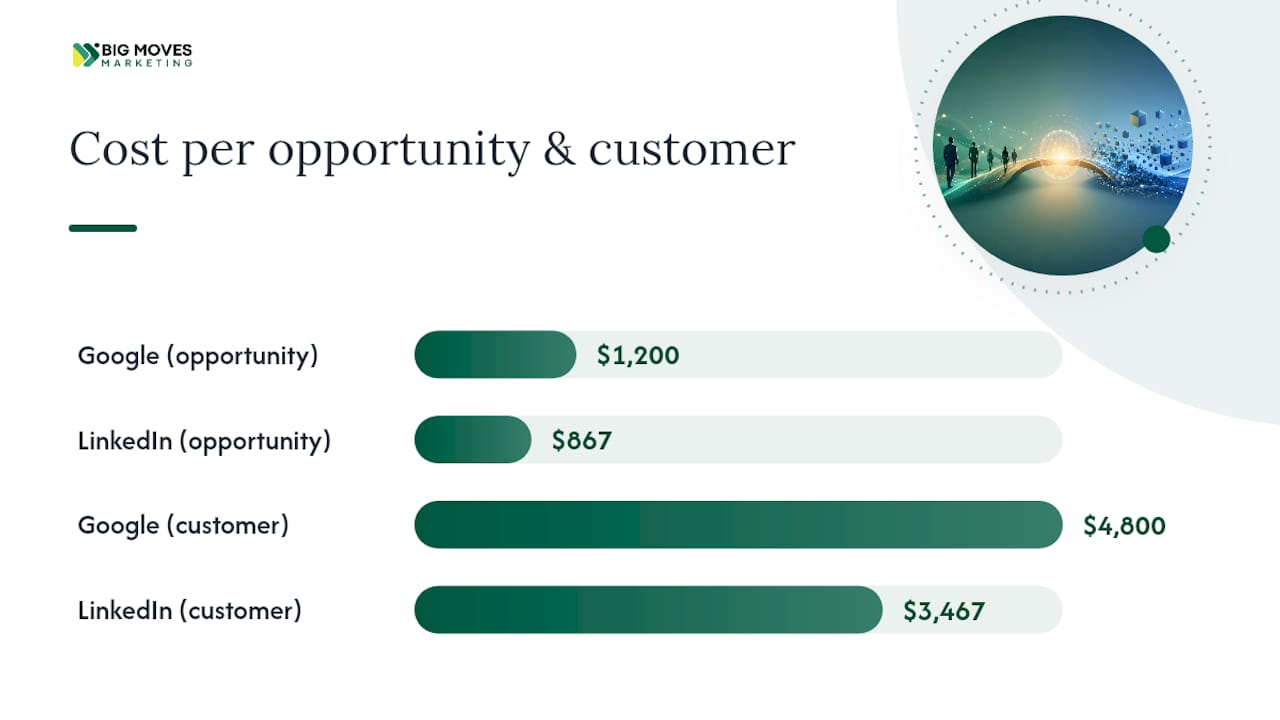
Here’s the math, worked through:
Same close rate, cheaper customer, because LinkedIn’s targeting handed you a better-qualified lead before the funnel even started. Higher pipeline-fit rates are exactly why narrow-ICP, high-ACV companies lean LinkedIn despite the sticker shock on CPL.
Time matters too, and the two platforms don’t move at the same speed. Google’s auction typically produces a usable read in 14 to 30 days because search volume, even at modest budgets, generates enough signal fast. LinkedIn needs longer, usually 30 to 60 days, because its algorithm requires volume to learn who converts. Judge a LinkedIn pilot at day 20 and you’re judging noise, not performance.
The quality advantage compounds hardest in two scenarios: when your ICP is genuinely narrow (think “VP of Revenue Operations at Series B SaaS companies with 50 to 200 employees”) and when ACV clears $20,000 to $30,000 annually. Below certain deal sizes, the higher targeting cost rarely justifies itself within typical sales cycles.
Skip the philosophical debate. Answer five questions and the channel choice mostly makes itself.
Map the answers, and a pattern emerges: high search volume plus lower ACV plus broad ICP points to Google-heavy allocation, closer to 70/30. Low search volume plus high ACV plus narrow ICP flips it toward LinkedIn, sometimes 50/50 or beyond.
Set your success criteria before you launch, not after. Over a 60 to 90 day initial test, track cost per opportunity (not cost per lead), pipeline generated, and, if the sales cycle allows it, early closed-won signal. A channel that produces cheap leads but no opportunities isn’t working, no matter what the CPL dashboard says.
Most first-time LinkedIn tests fail for a boring reason: underfunding. LinkedIn’s auction needs volume to learn, and a $1,500 monthly budget spread across cold prospecting rarely generates enough data in a month to mean anything. Google can start smaller because search volume, even modest, produces impressions and clicks fast enough to read results sooner.
Creative and offers need to match the channel’s mindset, not get copy-pasted between them.
Tracking is where most comparisons quietly break down. Without offline conversion imports and a CRM tie-in, Google’s Smart Bidding optimizes for form fills, not revenue, and you end up crediting the wrong channel for pipeline that actually closed somewhere else. Set up conversion value tracking and attribution fields before you spend a dollar, not after week six when you’re trying to explain the numbers to a CFO.
| Setup item | Google Ads | LinkedIn Ads |
|---|---|---|
| Minimum viable monthly budget | Lower, can start smaller for targeted capture | Higher, needs volume to learn |
| Typical learning window | 14 to 30 days | 30 to 60 days |
| Best offer type | Demo, pricing, direct response | Guide, report, lower-friction content |
| Tracking must-have | Offline conversion import tied to CRM | CRM-stage tie-in for opportunity credit |
For deeper setup detail, Bigmoves has covered platform-specific playbooks on running LinkedIn campaigns for B2B SaaS and a step-by-step Google Ads checklist for teams building their first tracking stack.
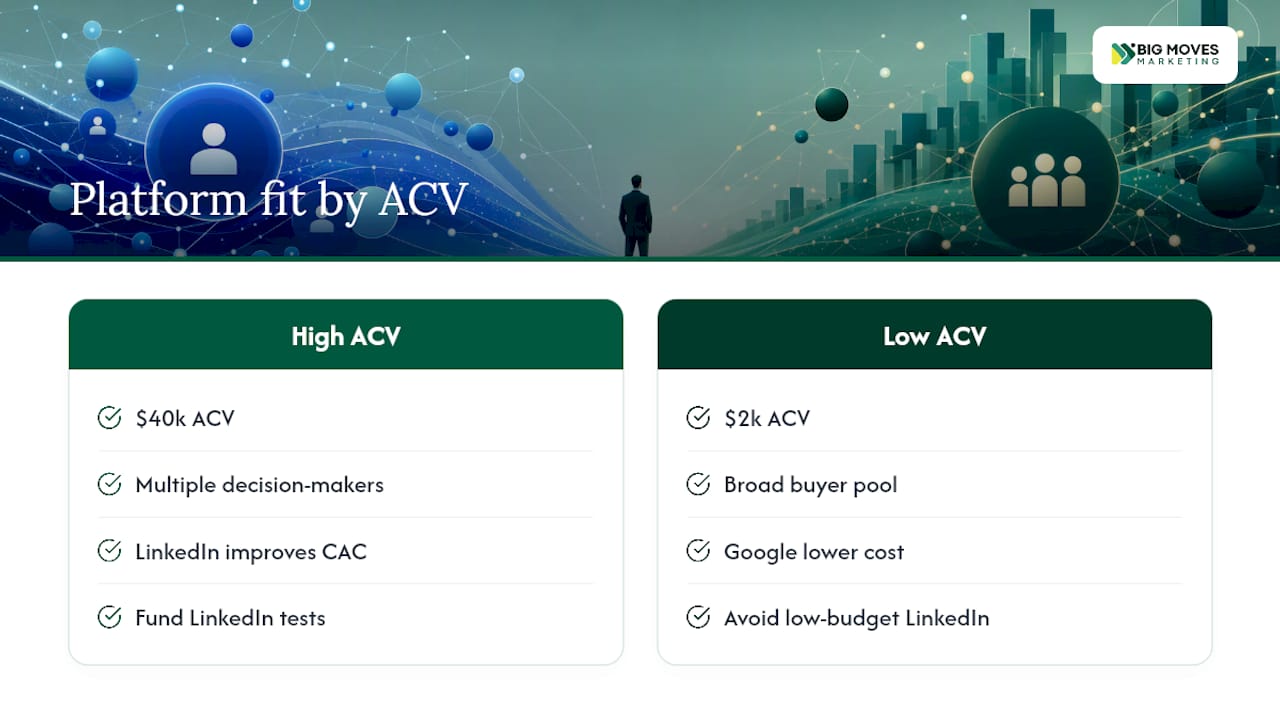
Across 75-plus SaaS and technology engagements, the pattern repeats: teams that fixate on which platform is “better” lose to teams that fixate on their own ACV and sales cycle. I’ve watched a company with a $40,000 ACV and a five-person buying committee cut its blended CAC by shifting spend from Google display to LinkedIn account-based targeting, simply because the right people finally saw the ad. I’ve also watched companies with $2,000 ACV burn budget on LinkedIn chasing a buyer pool Google could have captured for a third of the cost.
Three caveats hold across nearly every account: fund LinkedIn tests above the minimum needed to learn, fix your tracking before you argue about performance, and rotate creative every few weeks, because professional feeds fatigue fast.
— Veb
Choosing between LinkedIn and Google shouldn’t cost you a quarter of trial and error. Bigmoves runs pilot-led programs for B2B SaaS and technology companies that map your ACV and ICP to a real budget split, then build the tracking to prove which channel is actually earning its keep.
A typical pilot includes campaign strategy, landing page builds, conversion tracking setup, and a prioritized test roadmap so you’re not relying on raw CPL to make the call. Bigmoves also handles the website and landing page infrastructure that makes offline conversion tracking possible in the first place, so your Google and LinkedIn data actually reflects pipeline, not just form fills. If you’re ready to stop debating platforms and start measuring cost per opportunity, get in touch about a pilot engagement today.
It can work for narrow, low-competition keywords, but most B2B categories need more volume to generate meaningful data within a few weeks. Treat $10 a day as a floor for testing one tightly scoped campaign, not a full program.
Google Ads doesn’t pay advertisers per view. That model describes display or video monetization; on the advertiser side, you pay per click or conversion, with a median Search CPC around $4.66.
It’s worth it when your ACV is high and your buyer pool is narrow enough that job-title and firmographic targeting outperforms keyword search. Below that threshold, the higher CPL rarely pays back before the sales cycle drags on.
Definitions vary across practitioners, but the common version suggests running roughly three ad variations, testing two audience segments, and using one clear call to action per campaign to keep learning windows clean.



%20-%20white.svg)