%20png%20copy.avif)
Pick LinkedIn when your ideal customer is a named title at a named company and the deal size justifies a higher cost per lead. Pick Meta (Facebook and Instagram) when you need volume, frequency, and a lower cost per impression to build pipeline at scale. Most SaaS marketing teams end up running both, just for different jobs.
Choosing between LinkedIn and Meta comes down to matching platform strengths to your ICP, deal size, and funnel stage, then validating with a real pilot.
| Point | Details |
|---|---|
| LinkedIn wins on precision | Job title, seniority, and company targeting suit enterprise ABM and long sales cycles. |
| Meta wins on cost and scale | Lower CPM and CPC support volume lead gen and retargeting at lower cost per impression. |
| Budget rule of thumb | Allocate roughly 60 to 70% of pilot spend to the platform matching your sales motion. |
| Measure past 90 days | Track CRM pipeline and close rate, not just platform-reported leads, before judging a pilot. |
| Bigmoves runs pilots for both | Bigmoves executes pilot-led LinkedIn and Meta campaigns tied to go-to-market website infrastructure. |
LinkedIn wins when you’re selling to a specific job title at a specific type of company and the deal is worth a five-figure contract. Meta wins when you need scale, lower costs per impression, and a wider net for retargeting or brand awareness. Neither wins outright. Each earns a different job in your funnel.
| Dimension | LinkedIn Ads | Meta (Facebook + Instagram) Ads |
|---|---|---|
| Best-for / use case | ABM, enterprise lead gen, event promotion | Volume lead gen, retargeting, brand awareness |
| Audience targeting precision | High: job title, seniority, company, industry | Moderate: interests, behaviors, lookalikes |
| Ad types & creative format | Sponsored Content, Lead Gen Forms, Document Ads | Feed, Reels, Stories, Collection, Lead Ads |
| Cost (typical CPC/CPM) | Higher CPM and CPC | Lower CPM and CPC |
| Measurement & attribution | Native lead forms, CRM sync needed for pipeline | Strong platform analytics, CAPI for accuracy |
Meta typically wins on scale and CPM efficiency, while LinkedIn wins on B2B targeting precision and enterprise lead quality, which is exactly why most B2B teams end up splitting budget rather than picking one winner.
LinkedIn’s ad products are built around one fact: people are there in a work mindset. That changes what you can sell them and how.
Meta’s ad products lean into a different context: users scrolling for entertainment, not work.
Facebook offers more interactive ad formats and self-optimizing campaign behaviors, while LinkedIn emphasizes professional targeting and native lead forms. The difference in inventory reflects the difference in why people opened the app.
LinkedIn users are in a business brain. They expect longer copy, credibility signals, and a value proposition tied to their job. Meta users are in scroll-and-entertain mode. They need a visual hook before they read a single word.

That mindset gap shapes targeting, too.
| Targeting method | LinkedIn Ads | Meta Ads |
|---|---|---|
| Native primitives | Job title, seniority, company, industry, skills | Demographics, interests, behaviors |
| List-based matching | High match rate on verified profile data | Requires enrichment for B2B match quality |
| Expansion tool | Skill and title-based expansion | Lookalike audiences |
Facebook’s phase-out of certain third-party targeting data pushed advertisers toward first-party data and server-side tracking, which matters if your Meta targeting used to lean on interest categories built from third-party signals.
Pro Tip: Before launching on both platforms, enrich your CSV contact list with verified job titles and company domains. A cross-platform sync strategy with clean data raises match rates on Meta close to LinkedIn’s native precision, letting you retarget the same buyer committee everywhere they show up.
Creative that wins on LinkedIn rarely wins on Meta. Audience mindset and format expectations differ enough that copying one platform’s ad into the other usually falls flat.
For Meta:
For LinkedIn:
LinkedIn’s own video guidance recommends narrative, instructional formats over short entertainment cuts, which lines up with the platform’s business-brain audience.
Budgets fail pilots more often than strategy does. Here’s what to expect.
| Metric | LinkedIn Ads (typical range) | Meta Ads (typical range) |
|---|---|---|
| CPM | Higher, reflecting verified professional reach | Lower, reflecting broad audience scale |
| CPC | Higher, often several dollars per click | Lower, often under $2 per click |
| Minimum daily budget | Higher to exit the learning phase | Lower, more forgiving for small tests |
Meta consistently delivers lower CPM and CPC for broad targeting, while LinkedIn’s CPM and CPC run higher because you’re paying for verified professional targeting. That premium is the price of reaching a named title at a named company instead of a broad interest group.
For a six-week pilot, budget a higher amount on LinkedIn to gather enough data past the learning phase, and a lower amount on Meta to reach the same statistical confidence, given its lower cost per impression.
Platform dashboards tell you cost and clicks. They don’t tell you revenue. Track these on both platforms:
LinkedIn’s reporting stops at the lead. Real attribution happens when you tie ad-sourced leads to CRM stages, tracking a contact from click to closed deal. Meta’s Conversions API strengthens attribution accuracy now that browser-based tracking has weakened. For B2B pilots specifically, track contact-level uplift over a 90-day pipeline window. Deals close slowly. Judging a pilot at 30 days almost always underestimates LinkedIn’s real return.
Match the platform to the job, not the other way around.
Think of LinkedIn as the platform for building credibility with your exact buyer, and Meta as the platform for staying in front of that buyer everywhere else they scroll. Our LinkedIn B2B marketing guide covers funnel-stage mapping in more depth.
Red flags to stop a pilot early: cost per lead trending upward for three straight weeks with no CTR improvement, a form completion rate under 10%, or zero pipeline movement after 60 days on a platform built for slower sales cycles.
For enterprise ACV, split budget 70/30 toward LinkedIn. For SMB ACV, flip it to 70/30 toward Meta. Cross-platform contact syncing improves match rates and reach on both sides, which is worth setting up before week one, not after.
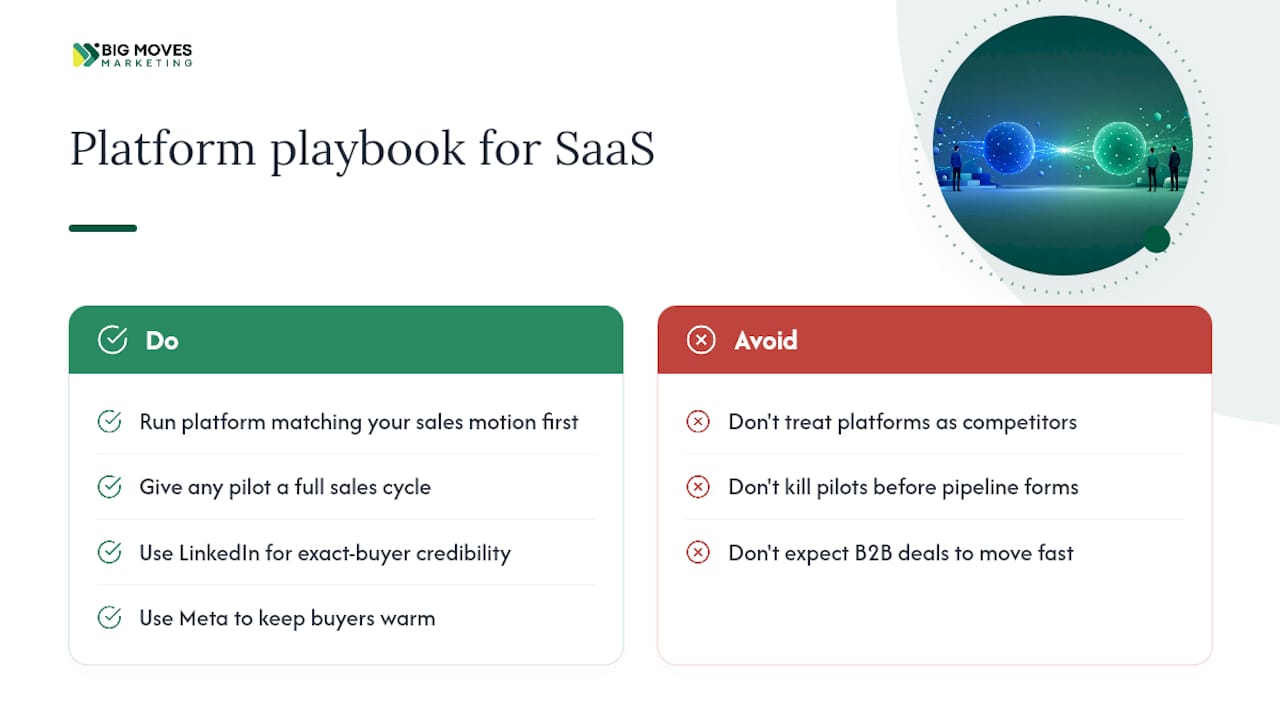
Most SaaS teams treat this as a competition between two platforms. It isn’t. It’s a division of labor. LinkedIn builds credibility with the exact buyer you need in the room. Meta keeps that buyer warm everywhere else they spend their day.
The mistake I see most often: teams judge a LinkedIn pilot on 30-day cost per lead and kill it before pipeline has time to form. B2B deals don’t move that fast. Give any pilot a full sales cycle before you call it.
If you’re a SaaS or tech marketing leader deciding where to start, run the platform that matches your current sales motion first, then layer the second one in.
Running a clean pilot across two ad platforms takes more setup than most in-house teams have time for: matched creative, CRM-tied attribution, and budget discipline across six weeks. Bigmoves runs pilot-led execution across LinkedIn, Meta, and Google Ads for B2B SaaS and technology companies, with go-to-market strategy behind every dollar spent.
Bigmoves also builds the website and landing page infrastructure that a paid pilot depends on, since traffic without a conversion-ready landing page wastes ad spend regardless of platform. Clients get a tested channel strategy, not a guess. If you’re weighing LinkedIn against Meta for your own funnel, book a conversation about launching your go-to-market website and pilot plan together.
For B2B lead gen, $10 a day rarely gathers enough data to exit Meta’s learning phase. Treat it as a floor for brand awareness tests, not lead generation.
CPM on Meta for B2B targeting typically runs lower than LinkedIn’s CPM, though exact rates shift with audience size and competition. Budget conservatively and treat any published range as a starting estimate, not a guarantee.
Definitions of this rule vary across marketers and platforms, so no single canonical version applies to LinkedIn ads specifically. Focus instead on documented fundamentals: job title and company targeting, native Lead Gen Forms, and value-first creative.
For enterprise B2B deals with a five-figure ACV, yes. LinkedIn’s higher CPM and CPC reflect verified professional targeting and native lead-form pre-fill that improve lead quality for named-account selling.
Most SaaS marketing teams benefit from running both: LinkedIn for precision and credibility, Meta for volume and retargeting. Bigmoves builds pilot plans that test both platforms against the same pipeline goals.


%20-%20white.svg)