%20png%20copy.avif)
HubSpot wins for most growing B2B SaaS and tech teams that need fast time-to-value and tight marketing-sales alignment. Salesforce wins when you need deep customization, complex approval chains, or industry-specific compliance. The gap between them isn’t features. It’s how much complexity your team can actually run day to day.
TL;DR:
- Small teams under 100 people with simple sales processes should choose HubSpot for fast deployment within two to six weeks and minimal configuration needs.
- Larger enterprises requiring extensive customization, complex approval workflows, or industry-specific compliance should select Salesforce, accepting longer implementation times of two to six months and higher setup costs.
- The long-term total cost of ownership heavily favors HubSpot for smaller teams with straightforward needs, while Salesforce’s higher initial and ongoing costs suit complex, regulated environments.
- Pilot projects using real sales reps should last four to six weeks to accurately assess adoption, and modeling three-year costs—including admin support—is crucial to avoid regrets.
- The decision should be based on current operational complexity, not future visions, with organizations emphasizing process mapping and real-world testing before making a commitment.
HubSpot builds for speed and offers several backup plugins for HubSpot CMS to help teams safeguard their data. It bundles CRM, marketing, sales, and service into one system that a small revenue team can stand up without hiring a specialist. Salesforce builds for depth. It’s a platform, not a product, engineered to bend around whatever sales process an enterprise throws at it.
Here’s how the two compare across the dimensions that actually change a buying decision:
HubSpot is best for teams that want one system running within a month. Salesforce is best for organizations that need a platform they can reshape for years without outgrowing it.
The sticker price is the least useful number in this whole decision. What actually separates HubSpot and Salesforce is what happens after you sign the contract.
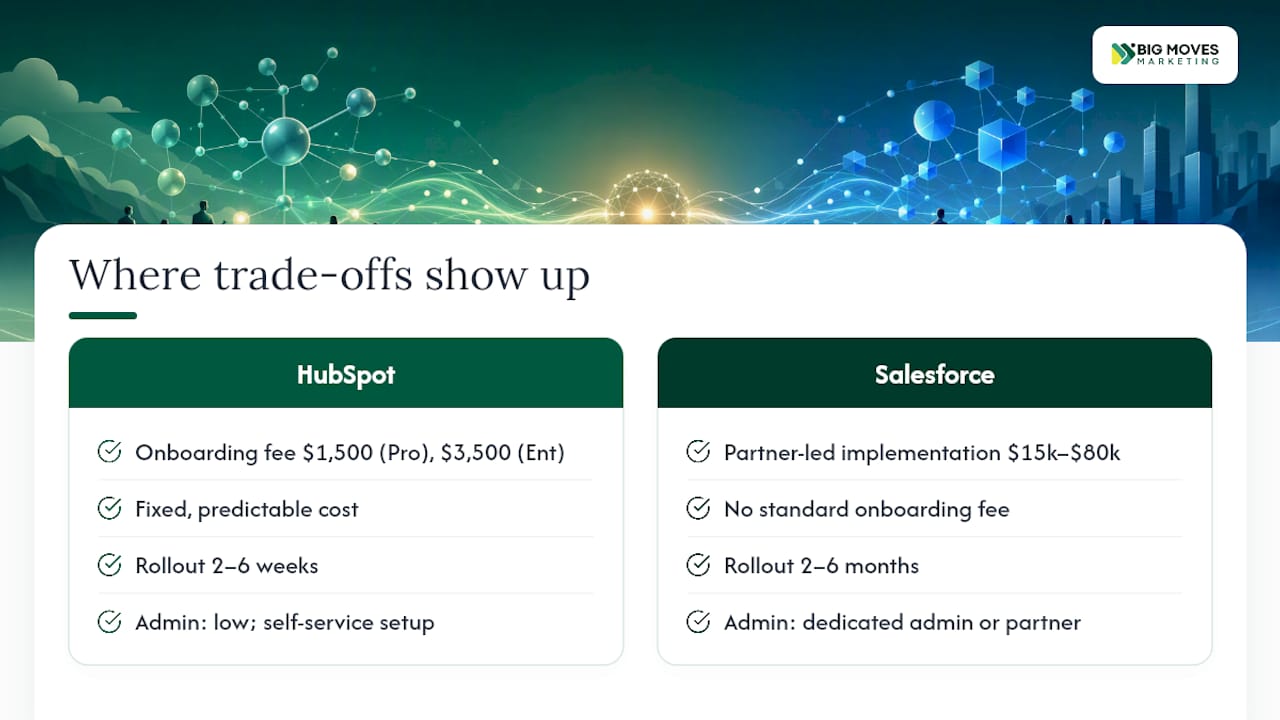
Pricing and total cost of ownership. HubSpot’s Professional tier carries a $1,500 onboarding fee, and Enterprise runs $3,500, according to WeekCRM’s 2026 breakdown. That’s a fixed, predictable cost. Salesforce doesn’t charge a standard onboarding fee, but nontrivial deployments almost always need a partner. Those partner-led implementations commonly run $15,000 to $80,000 depending on complexity, and that’s before you add Marketing Cloud, extra sandboxes, or premium support tiers. Model this over three years, not one, or the comparison lies to you.
Time-to-value and admin load. HubSpot rollouts for standard sales and marketing setups typically land in two to six weeks. Salesforce projects frequently stretch two to six months. That gap isn’t about software quality. It’s about configuration depth. Salesforce almost always needs a dedicated admin or a certified partner to manage workflows, permission sets, and integrations. HubSpot’s setup is closer to configuring a well-built SaaS tool than commissioning custom software.
Customization and scale. Here’s where Salesforce earns its reputation. Custom objects, complex approval hierarchies, and industry-specific clouds (financial services, healthcare, manufacturing) exist because enterprises need them. A 40-person SaaS company almost never does. Building that flexibility on HubSpot means fighting the platform; building it on Salesforce means hiring people who know how.
Marketing versus sales strength. HubSpot bundles marketing automation, landing pages, and email natively into the same record as sales and service data. Salesforce treats marketing as a separate product line. That split creates real reporting friction: marketing-attributed pipeline often lives in a different system than the deals themselves, which means someone has to stitch the data back together manually or via integration.
A common pattern among growing tech companies: run HubSpot for marketing and top-of-funnel work, and use Salesforce as the system of record once deals get complex or compliance-heavy. It’s not either-or for every company. It’s often both, at different layers of the funnel.
AI capabilities. HubSpot’s Breeze AI ships included across most paid tiers and covers content generation, lead scoring, and chatbot deployment out of the box. Salesforce’s Agentforce is a genuinely more powerful agent architecture, capable of autonomous multi-step actions across records, but it costs more and takes real configuration work to get running well. If your team wants AI now with minimal setup, that favors HubSpot. If you need AI agents wired into a complex, multi-department process, Salesforce’s ceiling is higher.
Integrations and ecosystem. Salesforce’s AppExchange dwarfs HubSpot’s marketplace in raw volume, and it includes acquired heavyweights like Slack, Tableau, and MuleSoft. That matters if you’re stitching together a data warehouse, a support desk, and a BI tool all at once. HubSpot’s ecosystem covers the tools most SMBs and mid-market SaaS companies already use: Slack, Gmail, Zoom, most ad platforms. Fewer options, but usually enough.
A marketing-led SaaS team of 30 people generating most pipeline through inbound content and paid ads gets more value per dollar from HubSpot. A 300-person enterprise software company with a multi-stage approval process and a compliance team gets more long-term value from Salesforce, even with the higher setup cost.
Skip the feature checklist. Decide based on what your team can operate today, not what you might need in three years.
Here’s the decision rule: if your sales process fits on one whiteboard and your team is under 100 people, start with HubSpot. If your process needs a flowchart and legal sign-off, start with Salesforce.
Weight your criteria before you look at either platform:
Pro Tip: During the pilot, track three numbers: rep adoption rate (are they logging activity without being told to?), time spent per task versus the old system, and lead-to-opportunity conversion. If adoption lags in week two, that’s your answer before week six even starts.
Marketing consultancies often work with many SaaS and tech companies on go-to-market builds, where CRM selection is a common topic. The pattern holds: teams that buy for their current operational reality outperform teams that buy for the roadmap they hope to have.

Two rules we apply every time. First, pilot with actual reps before signing anything. Second, model three-year TCO with admin costs included, not just license fees. Most CRM regret traces back to skipping one of those two steps.
If you’re scoping a pilot or building the go-to-market system around whichever CRM you pick, that’s exactly where we start with clients.
— Veb
Picking between HubSpot and Salesforce is only half the problem. The harder part is building the go-to-market system, from your website to your pipeline reporting, that actually runs on top of it. Some firms offer services to scope CRM pilots, model three-year costs, and build implementation plans to reduce uncertainty down the road.
Marketing consultants often work with founders, CMOs, and growth leaders at scaling B2B SaaS and tech companies who need effective revenue systems. That includes launching a website built for go-to-market that connects cleanly to whichever CRM you choose, so your marketing and sales data tell the same story from day one. If you are considering options, consulting with experts can help you map a pilot before committing budget.
Neither is universally better. HubSpot fits faster-moving, marketing-led teams that want speed and simplicity; Salesforce fits enterprises that need deep customization and can support a dedicated admin.
No. HubSpot is gaining ground with SMBs and mid-market SaaS companies, but Salesforce still dominates complex, large-scale enterprise deployments. Many companies now run both at different funnel stages.
HubSpot is Salesforce’s most commonly cited competitor in the SMB and mid-market segment, though Microsoft Dynamics also competes directly in enterprise accounts.
Salesforce’s implementation cost and complexity push some growing companies toward faster, simpler platforms like HubSpot, especially teams without a dedicated CRM admin on staff.
HubSpot’s onboarding runs $1,500 to $3,500 depending on tier, with rollout in weeks. Salesforce implementations often cost $15,000 to $80,000 through a partner and take months, so the three-year total cost of ownership matters more than sticker price.





%20-%20white.svg)