%20png%20copy.avif)
The single biggest mistake I see B2B SaaS founders make after raising their Seed or Series A is rushing to hire a full-time CMO.
It feels like the logical next step. You have capital, and your board demands a growth plan. The default playbook says, "hire a marketing executive." That playbook is broken. For most early-stage SaaS companies, a full-time CMO isn't a growth accelerant; it's a high-burn, low-leverage mistake that vaporizes runway.
There is a more capital-efficient path: the fractional CMO for SaaS. It provides the senior strategic leadership required to build a revenue engine without the six-figure fixed cost your balance sheet cannot justify.
Most founders equate raising capital with needing a full-time executive team. The logic seems sound: "We have capital, we need growth, so we need a CMO." This thinking is flawed because it treats marketing leadership as a monolithic, 40-hour-per-week function.
For a company on the path to its first $10M ARR, this is simply not the reality. You don’t need 40 hours of executive-level strategy every week. You need intense, focused bursts of high-level direction to solve specific, stage-appropriate problems—like nailing positioning, building a go-to-market plan, or designing a repeatable demand engine.
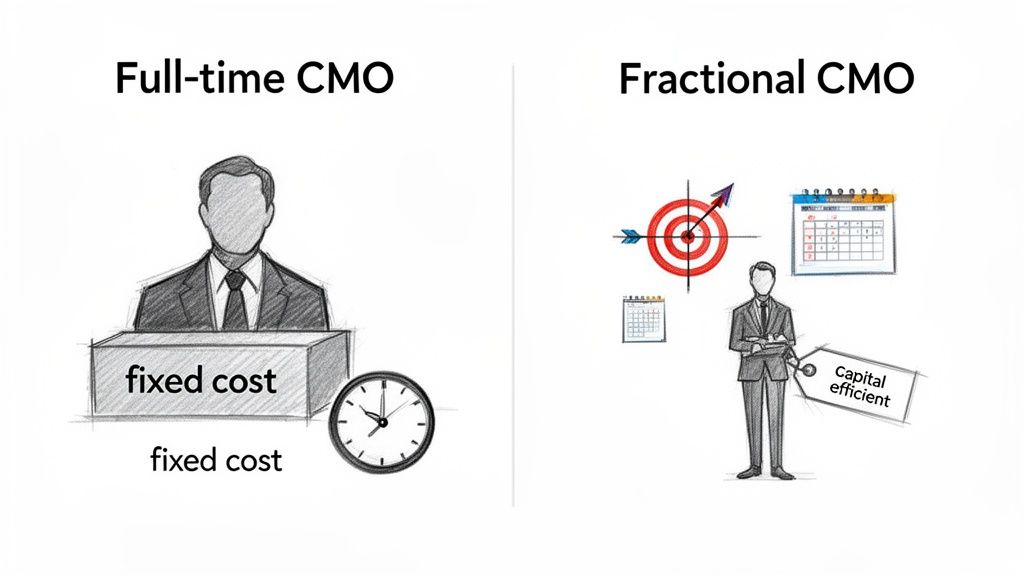
To make this concrete, let's break down the real-world implications for a typical Series A SaaS company.
| Factor | Full-Time CMO | Fractional CMO for SaaS |
|---|---|---|
| Annual Cost | $250k - $400k+ (salary, bonus, benefits, equity) | $60k - $144k+ (retainer-based, no overhead) |
| Commitment | Full-time, long-term contract, high severance risk | Flexible, month-to-month or quarterly, low commitment |
| Focus | Often spread across strategy, management, and tactics | Laser-focused on high-leverage strategic priorities |
| Time to Impact | 3-6 months to onboard and start delivering | 2-4 weeks to diagnose and begin execution |
| Experience Profile | Typically an "optimizer" of existing machines | A seasoned "builder" accustomed to 0-to-1 growth |
| Team Structure | Requires budget for a full team from day one | Builds the team you need, when you need it |
The contrast is stark. A full-time CMO represents a massive fixed cost before the revenue engine is properly designed. It's like hiring a five-star chef before you've built the kitchen.
Conventional wisdom about building an executive team ignores the capital efficiency required to survive the journey from product-market fit to scalable growth.
The core problem is a misalignment between cost structure and value delivery. You're paying for a full-time executive's presence when you only need their focused expertise for a fraction of that time.
This mismatch creates predictable—and painful—downstream issues:
The market has already adapted to this reality. The fractional CMO market is projected to become a $1.27 billion industry by 2026, a clear signal that startups are ditching the old, broken model.
This growth is fueled by B2B SaaS companies realizing they cannot afford the $250,000–$400,000 annual salaries for a CMO whose average tenure is a shockingly short 25 months, often because they were the wrong hire for the company's stage.
The intelligent question isn't whether to hire a CMO. It’s "What kind of marketing leadership does our current stage demand?" For most SaaS companies navigating the path to their first $10M ARR, the answer is not a full-time hire. It is a strategic partner who provides leverage, not overhead.
Founders are wired to think about cost. But the sharpest operators focus on return on invested capital. Evaluating a fractional CMO for your SaaS business requires moving past a simple cost-benefit analysis and into a real assessment of value, leverage, and risk.
The most immediate win is dodging the six-figure bullet of a bad full-time hire. A C-level mis-hire—someone with the wrong DNA for your stage—is far more than a lost salary. It's 6-12 months of vaporized momentum, wasted budget, and painful strategic U-turns. A seasoned fractional leader is an insurance policy against that common, expensive mistake.
A fractional CMO engagement is not a one-size-fits-all product. The structure must match your specific needs, capital reality, and strategic timeline. Most partnerships fall into two main buckets.
Monthly Retainer: This is the most common setup for ongoing strategic leadership. It’s built for founders who need a consistent, guiding hand to build and run their marketing engine, align the team, and report progress to the board.
Project-Based: This model is for high-stakes, specific initiatives with a clear beginning and end—a full go-to-market launch for a new product, a ground-up positioning and messaging overhaul, or designing your first sales enablement function.
A retainer provides a consistent strategic partner to steer the ship. A project delivers a concentrated blast of expertise to solve a critical, time-sensitive problem.
The real argument for a fractional CMO is not about pinching pennies; it is about investing capital more intelligently. The financial outlay must be directly tethered to business outcomes.
A top-tier fractional CMO is not an expense on your P&L. It is a direct investment in strategic leverage that should produce a multiple of its cost in pipeline, revenue, and ultimately, enterprise valuation.
Instead of staring at the monthly fee, consider the opportunity cost of not having that expertise. What is the real cost of a sales cycle that is three months too long? What is the revenue hit from an undifferentiated position in a crowded market? These are the problems a fractional CMO for SaaS is hired to fix.
The numbers tell a clear story. Engaging a fractional CMO for your SaaS startup can slash leadership costs by 70-80% compared to a full-time hire. A full-time CMO commands a total compensation package between $400,000–$725,000 annually. In contrast, fractional retainers for 10-20 strategic hours per week typically land between $6,000–$20,000 per month. That's a far more manageable $60,000–$210,000 yearly investment. You can find more details on how these pricing models translate to SaaS growth on saasconsult.co.
This is not just about direct savings. It's about reallocating the $200,000+ you just saved into the marketing programs that drive demand—the programs your fractional CMO is there to design and direct. For a deeper look at where to put those funds, see our guide on marketing budget planning for B2B SaaS startups.
The economics are undeniable. You get C-suite strategic thinking at a fraction of the cost, sidestep the catastrophic risk of a bad hire, and keep precious capital ready to deploy into growth initiatives. It transforms marketing leadership from a fixed liability into a flexible, high-leverage asset.
Theory is useless in a startup. A good fractional CMO for SaaS is not paid to philosophize. They are hired to build the bridge between high-level thinking and the real-world work that generates pipeline and revenue. Vague promises of "strategy" are a massive red flag.
You need a leader who translates vision into an executable plan your team can follow. Their job is not to run disconnected campaigns; it is to install a repeatable growth engine. This means moving past vanity metrics and focusing entirely on deliverables that directly impact the health of your sales funnel.
An experienced leader’s output is measured in clarity, leverage, and revenue—not activity.
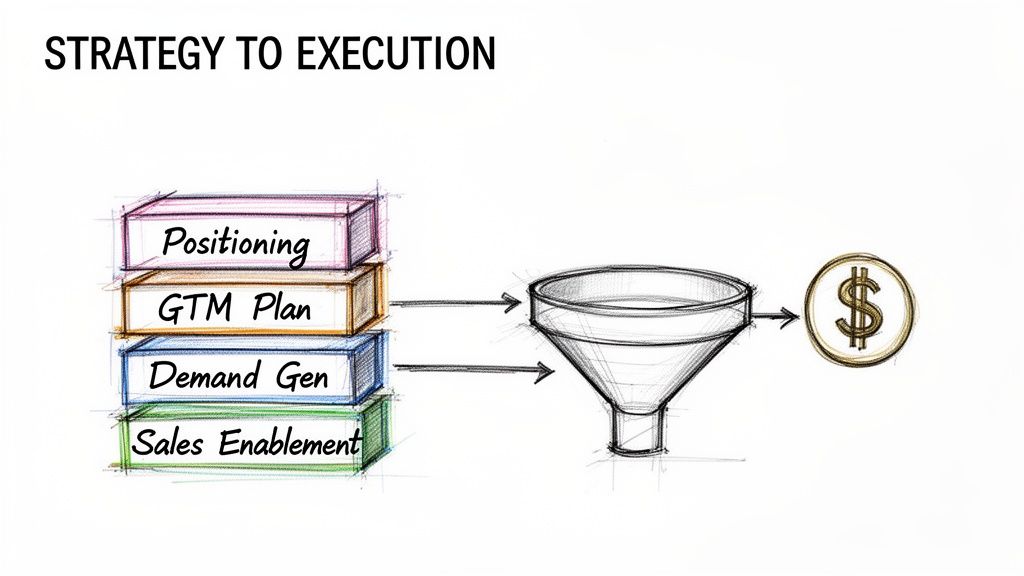
Before a single dollar of significant marketing budget is spent, a true strategist builds the foundation. This is not the glamorous part of marketing, but it is the most critical. It’s the difference between building your growth engine on bedrock versus sand.
Key foundational deliverables include:
Without this groundwork, any marketing spend is a gamble. A fractional CMO’s first job is to eliminate guesswork and install a system for predictable growth.
With the foundation set, the focus shifts to building the machine that generates demand and empowers your sales team to close it. This is where strategy becomes tangible action. A fractional leader owns the architecture of this engine, even if they delegate day-to-day execution to junior team members or agencies.
A fractional CMO doesn't just manage tasks; they build systems. Their primary output is a repeatable, scalable process for creating qualified pipeline that the sales team can reliably convert.
Developing and executing tailored SaaS growth strategies is the core deliverable to boost acquisition, retention, and revenue.
The outputs of this phase are the tangible assets that fuel your growth—the working parts of your revenue machine.
These are not academic exercises. They are the working parts of a revenue machine, designed and assembled by an expert who has built them many times before. For a deeper look at how we approach this, you can learn more about our strategic planning process.
The right fractional CMO does not just offer advice; they deliver the finished, working components of your growth strategy.
An analytical founder is not moved by fluffy anecdotes. You need to see the numbers—the hard, quantitative case that connects marketing leadership directly to your cap table. The right fractional CMO doesn't just make things feel better; their work appears in the SaaS metrics that investors live and die by.
The impact is not an abstract concept. It is a tangible improvement in your funnel velocity and unit economics. We are talking about measurable lift in the core numbers that define a healthy, high-growth SaaS business.
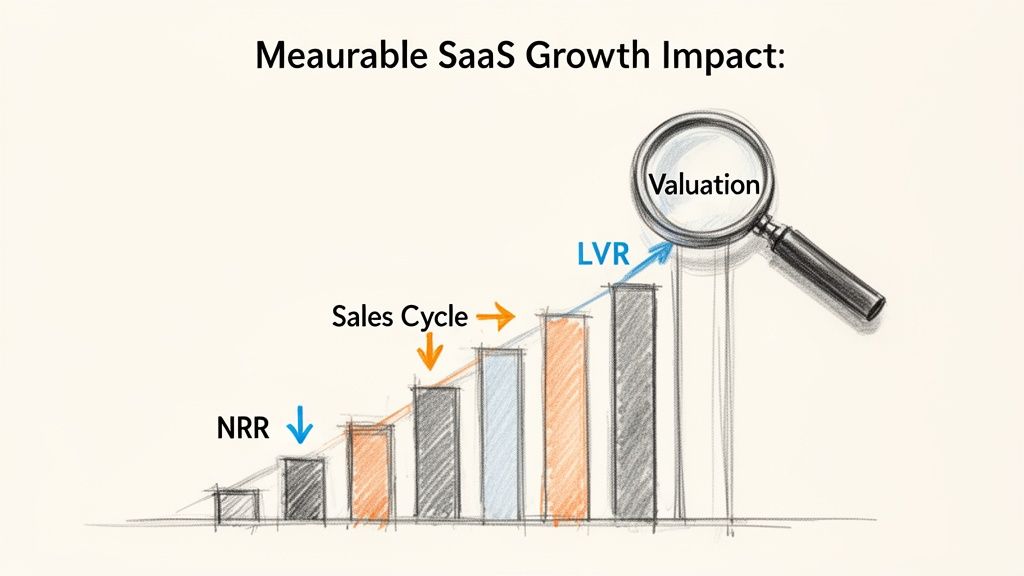
A great fractional CMO’s value is not measured in hours logged. It is measured by how they move the needle on your most important KPIs. Their strategic projects, like nailing positioning or rebuilding a go-to-market plan, are designed to do exactly that.
These are not vanity metrics. They are the engine of SaaS valuation.
Data backs up what experienced founders and VCs already know: senior marketing leadership is a growth multiplier. Research shows that SaaS companies working with a fractional CMO see an average revenue growth of 29%. That is 53% higher than the 19% average for companies without that senior guidance.
This performance gap is why the fractional market has exploded, with adoption jumping 245% in two years. For more on the trend, see the latest fractional CMO statistics on gtm8020.com.
A fractional CMO’s core job is to install the systems that turn marketing from a cost center into a predictable, scalable source of enterprise value. It’s about building a machine that investors will pay a premium for.
Ultimately, the impact is felt most during your next funding round or a potential exit. Investors do not back chaotic, founder-led marketing efforts. They invest in companies with a clear, documented, and repeatable process for acquiring customers profitably.
An experienced fractional CMO builds that exact system. They translate your product's potential into a compelling growth story backed by hard data, creating a massive advantage and justifying a higher valuation multiple. For a deeper look at connecting activities to outcomes, read our guide on how to measure marketing ROI.
Hiring a fractional CMO is not a task you delegate. It is a founder-level decision, and the vetting process looks nothing like hiring a full-time employee or an agency for your B2B needs.
You are not hiring a pair of hands to run campaigns. You are bringing on a strategic partner whose judgment will directly shape your growth trajectory for the next 12-24 months.
Generalist marketers with broad experience are a dime a dozen. True B2B SaaS strategists—those with deep pattern recognition from seeing dozens of companies like yours succeed or fail—are incredibly rare. Your job is to filter for the latter.
Forget résumés packed with big-name logos. Focus on the underlying DNA of the candidate. The best fractional leaders share a common set of traits that go far beyond marketing theory.
Bias for Diagnosis Over Prescription: A great fractional CMO asks far more questions than they answer in the first few calls. They will actively resist giving you a "plan" until they deeply understand your business, market, customers, and the broken parts of your current GTM motion.
Fluent in Sales: They must understand the realities of a B2B sales cycle, quota pressure, and what a salesperson actually needs to close a deal. If they cannot hold a credible conversation with your head of sales about pipeline quality and sales enablement, they are a liability.
Stage-Specific Experience: Marketing a $1M ARR company is fundamentally different from a $10M ARR one. Probe for specific, hands-on experience within your current stage. A leader who has only managed large, established teams will drown in the resource constraints and "0-to-1" building required in early-stage SaaS.
A Builder, Not a Manager: Look for hard evidence they have built marketing engines from the ground up, not just optimized existing ones. This means they have personally created positioning frameworks, launched products into new markets, and instrumented funnels when nothing existed before.
When evaluating candidates, your checklist might also branch into specialized roles. For instance, some founders find it powerful to hire the best fractional SEO consultant for startups to tackle specific organic growth objectives alongside the broader strategic work of a fractional CMO.
Your interview process must be designed to expose a candidate’s true thought process. Generic questions get generic, rehearsed answers. Use pointed questions grounded in real-world SaaS scenarios instead.
The goal of these questions is not to see if they have the 'right' answer. It's to see how they think. You are vetting their diagnostic process, strategic reasoning, and appetite for execution.
Use this framework to structure your interviews and separate true operators from talkers. These questions will quickly reveal whether you're talking to a generalist or a seasoned SaaS strategist.
| Question Category | Sample Question | What to Listen For |
|---|---|---|
| Diagnostic Acumen | "Walk me through your first 30 days. What specific information would you need, who would you talk to, and what would be your first deliverable?" | A structured discovery process. A focus on revenue and customer data, and a clear desire to speak with sales, product, and customers—not just marketing. |
| Strategic Trade-offs | "Our CAC is rising, and lead volume is flat. The board wants us to spend more on ads. What do you do?" | Immediate pushback against simplistic solutions. They should talk about diagnosing the why—is it a channel problem? A conversion problem? A positioning problem? |
| Sales Alignment | "Our sales team says the leads from marketing are junk. How would you solve this?" | A process-oriented answer. They should focus on creating a shared definition of a qualified lead (MQL/SQL), implementing lead scoring, and establishing a feedback loop. |
| Positioning & GTM | "We are launching a new product into a crowded market. Outline the key pillars of your go-to-market plan." | A clear emphasis on differentiation, defining a narrow ICP, and creating a messaging framework before discussing channels or tactics. |
Choosing a fractional CMO for your SaaS company is one of the highest-leverage decisions you can make. Use this checklist to ensure you are hiring a genuine strategic partner who will build long-term value, not just burn your budget.
The first 90 days will make or break your fractional CMO engagement. This is not a traditional employee ramp-up period. It is a high-stakes sprint where a strategic partner must diagnose your biggest growth blockers, land quick wins, and lay the groundwork for a scalable marketing engine. There is no time for a slow start.
A seasoned fractional CMO for SaaS will not show up asking for a to-do list. They arrive with a proven playbook designed to systematically deconstruct your go-to-market motion and pinpoint the exact levers to pull for maximum impact. This initial period is about building momentum—both in your marketing and in the partnership.
The first two weeks are a surgical deep dive. The goal is not to confirm your suspicions ("we need more leads"). It is to move from surface-level symptoms to a root-cause diagnosis ("our positioning is misaligned with our ICP, which is tanking conversion rates across the entire funnel").
This diagnostic sprint includes:
The output from this phase is a GTM Diagnostic Report: a blunt, evidence-backed assessment of where you stand and a prioritized list of problems to be solved.
With a clear diagnosis, the focus shifts to building a strategic plan while capturing low-hanging fruit. This is about translating initial insights into an actionable roadmap and delivering immediate, tangible value to build confidence.
Your fractional CMO shouldn't ask you to wait months for results. The goal is to fix glaring issues—like a broken lead handoff process or a confusing homepage message—while the long-term strategy is built in parallel.
This phase is a careful balancing act. The timeline below shows how the initial hiring process, a strategic sprint in its own right, leads directly into this critical 90-day engagement.
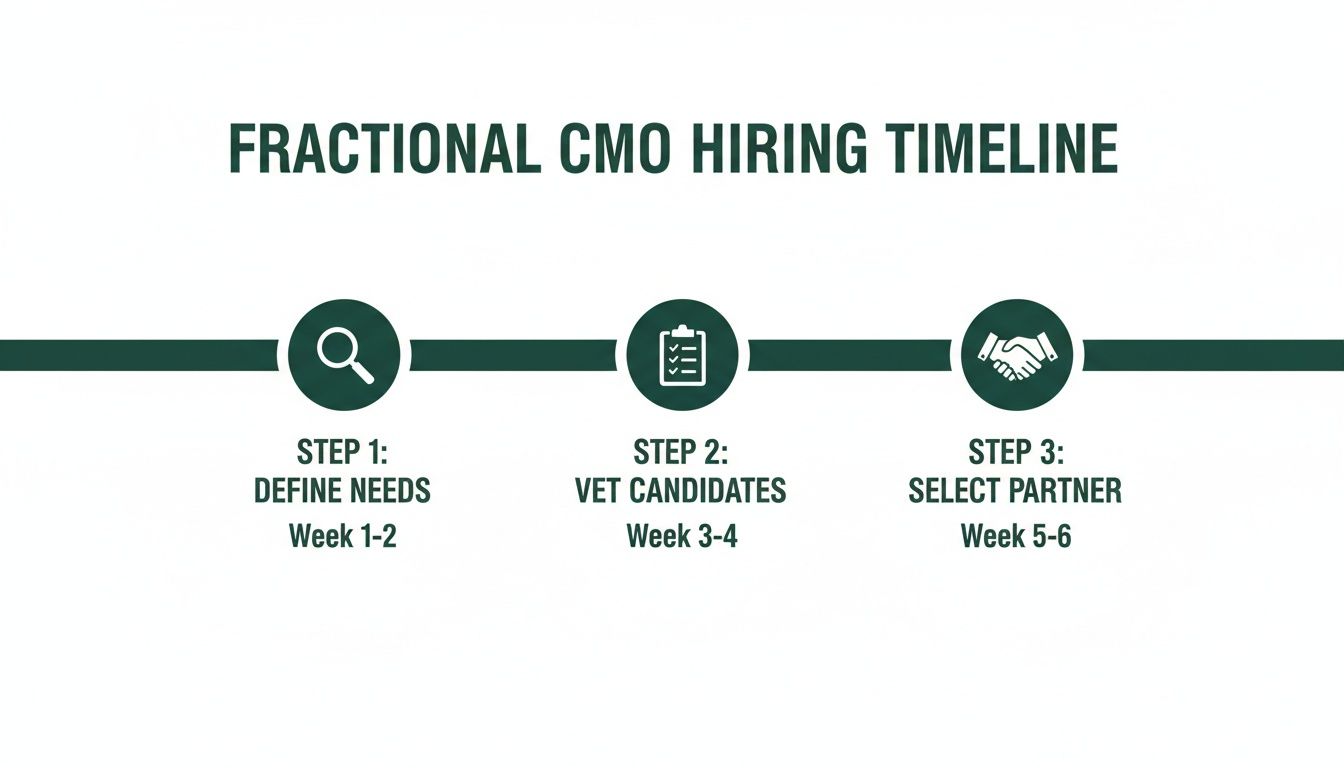
The key deliverables are a revised messaging and positioning framework that sharpens your value proposition and a 90-day GTM roadmap. This roadmap clearly outlines priorities, required resources, and the specific metrics that define success.
The final leg of this sprint is where planning turns into building. Your fractional CMO will begin installing the systems and processes required for repeatable, scalable growth. They will architect the demand generation engine, assemble the sales enablement toolkit, and set up the reporting needed to manage marketing by the numbers.
Your role as the founder is to provide context, clear internal roadblocks, and ensure your marketing leader has the access they need to people and data.
By the end of the first 90 days, you should have a clear strategic direction, see tangible improvements in your marketing execution, and have the foundation of a real growth engine ready to scale.
I get these questions all the time from B2B SaaS founders. These are not hypotheticals; they are the high-stakes questions that precede a major decision. Here are the straight answers.
The lines can seem blurry, but the difference is fundamental. A consultant typically parachutes in, delivers a specific, pre-scoped project—like a market analysis or a messaging framework—and then leaves. Their job is advisory.
A fractional CMO for SaaS, on the other hand, plugs directly into your leadership team. They own the entire marketing function, are held accountable for revenue-focused KPIs, and actively manage your team or agency partners. They do not just hand you a plan; they are on the hook for executing it and delivering results over a sustained period, usually 6-24 months.
Think of it this way: a consultant sells you a blueprint. A fractional CMO is the executive architect who oversees construction, manages the crew, and is responsible for the building standing strong.
This is a question of pain, not revenue. If you're pre-product-market fit and wrestling with customer discovery, you are too early. Your only job is building something people want.
But the moment you have early signals of PMF—even at just $500k ARR—the math changes. If founder-led sales is becoming a bottleneck, if you cannot build a repeatable pipeline, or if you are stuck moving from a few opportunistic wins to a systematic growth engine, then the timing is right.
Hiring a fractional CMO at this stage is an offensive move. You are buying expertise to sidestep the costly go-to-market mistakes that kill most early-stage companies and building the foundation for your next phase of growth.
A fractional CMO is not a replacement for product-market fit. They are an accelerant once you have it. Hiring one too early is burning capital; hiring one at the right time is buying leverage.
Yes. This is one of their most critical functions. A great fractional CMO has spent years managing teams, vendors, and agencies. They bring the strategic leadership that your junior marketing manager or tactical agency is desperate for but cannot provide themselves.
They step in to:
A fractional CMO does not replace your team; they make your entire marketing investment—people and programs—enormously more effective. They are the missing leadership layer that connects day-to-day activity to business impact.
Ready to stop guessing and start building a repeatable revenue engine? Big Moves Marketing provides the strategic clarity and GTM execution that B2B SaaS startups need to win their market. Let's talk about your growth challenges.
Explore Big Moves Marketing services and resources:



%20-%20white.svg)