%20png%20copy.avif)
Treat every event as a pipeline campaign, not a logistics project. That single shift separates teams that generate revenue from events and teams that generate badges.
Three things to do right now:
Assign a single accountable owner for the full campaign. That person hands off scored leads to sales within 48 hours and coordinates with ops on logistics. Sales owns outreach. Marketing owns routing, scoring, and nurture.
Track three KPIs for the first 180 days: registration-to-ICP rate, influenced pipeline at 90 and 180 days, and cost per qualified meeting. Everything else is secondary.
B2B event marketing generates pipeline when it runs as a full campaign with a single commercial KPI, CRM-first measurement, and a 48–72 hour sales follow-up SLA from day one.
| Point | Details |
|---|---|
| Set one commercial KPI first | Define qualified meetings or influenced pipeline before booking any venue or platform. |
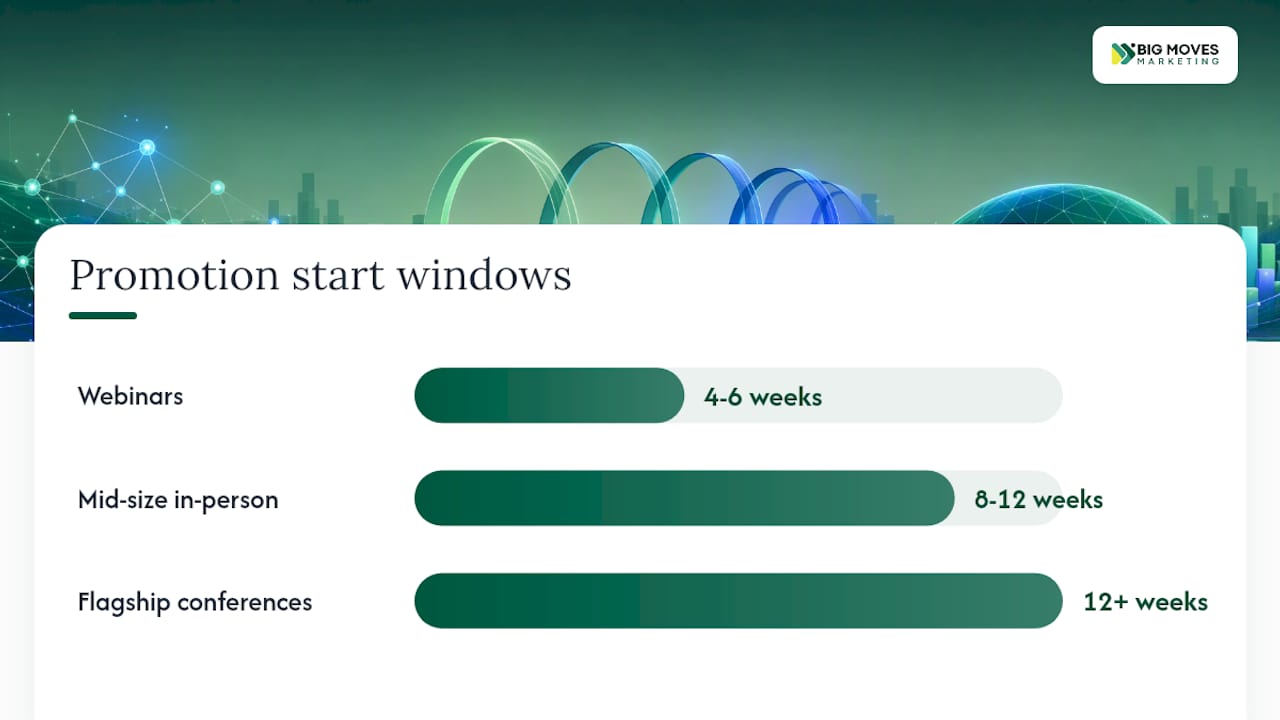
| Start promotion 4–12+ weeks out | Webinars need 4–6 weeks; flagship in-person events need 12 or more weeks of runway. |
| Organic beats paid for registrations | Attendee advocacy costs $4–$18 per registration versus $30–$90+ for paid LinkedIn. |
| Measure ROEI at 180 days | Healthy programs deliver near 3–5x ROEI; report a 30-day snapshot first, then the full review. |
| Bigmoves for mid-market SaaS teams | Bigmoves builds the event strategy, CRM routing, and demand engine so your team owns the pipeline, not a vendor. |
B2B event marketing is the practice of planning and executing events — conferences, trade shows, webinars, roundtables, roadshows, and VIP dinners — to generate pipeline, build named-account relationships, and accelerate deals across long buying committees.
The goal is not ticket sales or brand impressions. It is qualified conversations with the right buyers at the right stage.
That distinction matters operationally. A consumer event succeeds when attendance is high. A B2B event succeeds when the right accounts show up, engage, and move forward in a sales cycle. B2B buyer behavior now spans multiple cohorts with different channel preferences, which means format selection and experience design both need to match the audience, not just the budget.
Two benchmarks worth anchoring your planning to: events account for roughly 17% of B2B marketing budgets, and healthy programs deliver near 3–5x ROEI at 180 days. That is a meaningful return, but only when the program is instrumented from the start.
One compliance note for U.S. teams: any data you collect at events — badge scans, form fills, business cards — is subject to CAN-SPAM for email follow-up and, for any EU attendees, GDPR. Capture consent at registration and tag it in your CRM before the event runs.
Format choice is a commercial decision, not a preference. Each format has a different cost profile, pipeline velocity, and ideal buyer stage.
Conferences and owned events build category authority over time. They are the right call when you have an existing community or want to create one. Budget and lead time are high.
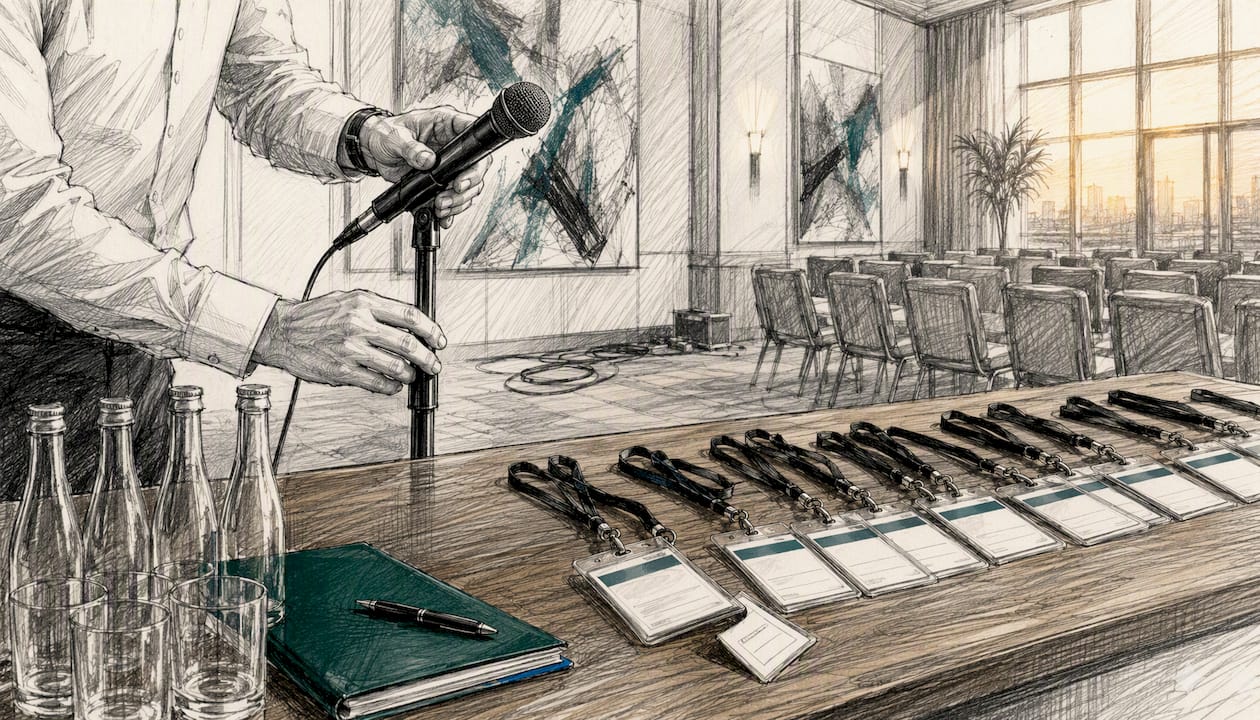
Trade shows give you access to named accounts in one room. The ROI depends entirely on pre-scheduled meetings, not foot traffic. Walk in with a meeting list or stay home.
Webinars are the highest-volume, lowest-cost format for top-of-funnel education. Email drives a large share of webinar registrations, and registration pages convert well for warm traffic. The ceiling is reach; the floor is show-up rates for webinars are often moderate.
Executive roundtables are the most underused format in mid-market SaaS. Twelve to fifteen senior buyers, a facilitated conversation, no pitch deck. The conversion rate from roundtable to pipeline is consistently higher than any other format at comparable cost.
VIP dinners work for retention and late-stage deals. They do not scale, but they do not need to.
Event marketing works as a full campaign with SMART goals, a locked budget, and a promotion timeline that starts well before the event date. Small events need at least one month of runway. Large multi-day events need three or more.
Before you commit to a venue or platform:
Pre-launch checklist (12+ weeks out for flagship; 4–6 weeks for webinars):
On-site / live checklist:
Post-event checklist:
Pro Tip: Decide your registration-to-pipeline gate before you buy the venue. If you cannot define what a qualified attendee looks like and how sales will act on them within 48 hours, the event will generate activity, not pipeline.
Promotion start windows by format: webinars need 4–6 weeks; mid-size in-person events need 8–12 weeks; flagship conferences need 12 or more weeks.
The channel hierarchy for B2B event promotion runs organic first, paid last. Attendee advocacy delivers registrations at roughly $4–$18 each versus $30–$90+ for paid LinkedIn. Well-run advocacy programs see moderate attendee share rates and conversion to registrations. That math makes organic the default, not the fallback.
| Weeks out | Channel | Activity | Conversion outcome |
|---|---|---|---|
| 12+ | Speaker/sponsor outreach | Brief speakers on sharing; build advocate kits | Early registrations, social proof |
| 8–10 | House-list email (sequence 1) | Save-the-date + agenda teaser | Warm registrations from known contacts |
| 4–6 | LinkedIn organic + partner networks | Speaker posts, ‘I’m attending’ cards, partner co-promotion | Mid-funnel registrations |
| 1–2 | Paid LinkedIn retargeting + reminder emails | Retarget page visitors and email openers; 7-day, 1-day, 15-min reminders | Last-mile conversions, show-up rate |
Creative that converts for B2B audiences:
Spend organic effort first. Use paid LinkedIn only to retarget warm audiences: people who visited the registration page, opened an email, or engaged with a speaker post. Broad paid social for cold B2B audiences is expensive and slow to convert.
Pro Tip: Give every speaker a unique tracked registration link. It tells you which speakers drive the most registrations and gives you data to negotiate speaker value at the next event.
Every tool in your event stack needs to connect to your CRM before the event goes live. Data that lives in a separate platform and gets exported manually after the event is data that arrives too late for sales to act on.
| Tool type | Purpose | Integration requirement |
|---|---|---|
| Registration platform | Capture attendee data, payments, UTMs | CRM campaign ID, form field mapping |
| Webinar platform | Host virtual/hybrid sessions, polls, Q&A | Attendance data, engagement scores to CRM |
| Lead capture / enrichment | Badge scans, QR codes, real-time firmographic append | Direct CRM push, not CSV export |
| Live engagement tools | Polls, Q&A, networking matchmaking | Engagement score export to CRM |
| Content repository | Session recordings, post-event assets | Gated asset tracking tied to contact record |
Integration checklist before launch:
Questions to ask any tech vendor before signing:
First-party event data is one of the most valuable assets a B2B marketing team can own. Every attendee interaction, session view, poll response, and networking connection is a signal. Own that data, do not rent it.
For teams building out marketing automation flows around event triggers, the integration between registration, CRM, and email platform is the backbone of the entire post-event sequence.
Enterprise event programs that align KPIs directly to pipeline and integrate event tech with CRM consistently outperform those that report on attendance alone. The KPI set below covers the full funnel from registration to revenue.
Primary KPIs:
| KPI | What it measures | Reporting window |
|---|---|---|
| Registration-to-ICP rate | % of registrants who match your ICP | Pre-event |
| Show-up rate | % of registrants who attend | Day of event |
| Engaged attendee rate | % of attendees who complete a session, join networking, or take a CTA | During event |
| Cost per qualified meeting | Total event cost ÷ qualified meetings held | Post-event |
| Influenced pipeline (30/90/180 days) | Pipeline from accounts that attended | 30, 90, 180 days post |
| ROEI at 180 days | Influenced pipeline ÷ total event cost | 180 days post |
Simple ROEI formula:
Healthy programs deliver near 3–5x ROEI at 180 days. That benchmark gives you a floor to defend budget and a ceiling to set expectations with finance.
CRM tags every event campaign needs:
Reporting cadence: Send a preliminary 30-day snapshot to marketing and finance showing show-up rate, qualified meetings, and early pipeline. Run the full ROEI review at 180 days when influenced deals have had time to progress. For measuring marketing ROI across your full demand program, event attribution should feed the same model as every other channel.
B2B attendees](https://www.emarketer.com/content/b2b-event-marketing-2026) say they would add more networking to their ideal event. That is not a preference. It is a design brief.
Networking moments need to be structured, not left to chance. Assign tables by industry vertical at roundtables. Build 20-minute “topic tables” into lunch breaks. Use a matchmaking tool that surfaces shared interests before the event starts. Every named-account connection made at the event is a measurable signal: log it in CRM the same day.
Engagement mechanics that surface intent:
Live content plan:
Record every session with permission. Gather speaker amplification assets (headshots, pull quotes, short clips) during the event, not after. Capture permissioned UGC: attendee photos, testimonials, social posts tagged to your event handle.
Pro Tip: For hybrid events, assign a dedicated “virtual host” whose only job is managing the online audience. The in-room team cannot do both. Build a streaming fallback (a pre-recorded backup of the keynote) and test it 48 hours before the event. Real-time data capture for virtual attendees needs the same CRM routing as in-person.
The 48–72 hour window after an event is the highest-conversion period in the entire campaign. Intent is at its peak. Sales outreach that arrives within that window consistently outperforms outreach sent a week later.
Follow-up timeline:
Segmentation and scoring:
Content repurposing schedule:
The 48–72 hour SLA for sales outreach is not a courtesy. It is a pipeline attribution rule. Deals touched within that window are far more likely to be credited to the event in your CRM, which protects your ROEI number at the 180-day review.
Event brief template:
| Field | Your input |
|---|---|
| One-line purpose | What pipeline outcome does this event create? |
| ICP definition | Title, company size, industry, buying stage |
| Primary KPI | Qualified meetings / influenced pipeline target |
| Primary CTA | What action do you want attendees to take? |
| Campaign owner | Name + backup |
| Budget (locked) | Total + line items |
| Tech stack | Registration, CRM, lead capture, webinar platform |
| Follow-up SLA | Sales outreach within 48–72 hours of event close |
Promotion timeline snippet (webinar example):
KPI dashboard fields (export from CRM at 30/90/180 days):
This kind of result is repeatable when the system is instrumented before the event runs, not assembled afterward.
The right operating model depends on volume, internal skill, and how much of the first-party data you want to own directly.
Decision checklist:
Engagement models:
| Model | Best for | Pipeline trade-off |
|---|---|---|
| In-house event marketer | High-frequency, owned events | Full data ownership, faster iteration |
| Fractional event marketer | Mid-market teams without dedicated headcount | Lower cost, slower ramp |
| Project-based agency | Flagship production, complex logistics | High production quality, less CRM integration |
| Retained agency | Ongoing program management | Consistent execution, shared data risk |
Keep in-house: attendee advocacy programs, ABM invite lists, CRM routing and scoring, post-event nurture sequences. These are your pipeline levers. Outsourcing them means outsourcing your attribution.
Agencies add real value for: large-scale production (AV, venue, multi-city logistics), speaker management at scale, and creative production for flagship events.
When hiring external help, negotiate these contract terms:
For teams that need event strategy aligned with broader marketing outcomes, the in-house vs. agency decision is also a question of where your demand engine lives.
Most event marketing advice focuses on the event itself: the agenda, the speakers, the booth design. The pipeline comes from everything that happens before and after the event, not during it.
The pre-event work that actually moves deals is the meeting list. Not the keynote lineup. The booth is a meeting room. Treat it that way.
The post-event work that gets skipped most often is the 48–72 hour sales follow-up. Teams spend months planning an event and then let leads sit in a spreadsheet for a week while sales “gets organized.” That window is when intent is highest. A lead that gets a personalized follow-up within 48 hours converts at a materially higher rate than one that waits seven days. The data on this is consistent across programs.
The other thing most guides understate: attendee advocacy is not a nice-to-have. At $4–$18 per registration versus $30–$90+ for paid LinkedIn, it is the most cost-efficient channel in the mix. Speaker kits, tracked links, and a 10-minute briefing call with your top three advocates will outperform a $10,000 LinkedIn campaign for most mid-market events.
What I see working consistently for scaling SaaS teams: run events as repeatable systems, not one-offs. Instrument the funnel, own the first-party data, and measure at 90 and 180 days. The teams that do this build a compounding demand engine. The teams that treat each event as a standalone project start from zero every time.
Most B2B SaaS teams have the event idea. What they lack is the system behind it: the CRM routing, the promotion timeline, the post-event nurture, and the attribution model that proves pipeline to the CFO.
Bigmoves builds that system. From go-to-market positioning to event-ready landing pages and full demand generation execution, the work is scoped to your stage and your ICP, not a generic agency playbook. Veb has run this for over 75 B2B SaaS and technology companies, from early-stage teams running their first webinar series to mid-market firms managing multi-city roadshows.
If your events are generating activity but not pipeline, that is a systems problem, not a creative one. Book a strategy call with Bigmoves to map the gaps and build the demand engine your events deserve.
These sources back the claims in this guide and are worth bookmarking for internal benchmarking and slide decks.
To build internal benchmarks: pull the ROEI and cost-per-registration figures from Attendir and Scryon, map them against your last three events, and present the gap to leadership as the business case for a more instrumented program.
B2B event marketing is the practice of planning and running events — conferences, webinars, trade shows, roundtables, and VIP experiences — to generate pipeline, build named-account relationships, and accelerate deals with business buyers. The goal is qualified conversations and influenced revenue, not attendance volume.
The rule of 7 holds that a buyer needs roughly seven touchpoints with a brand before taking action. In B2B event marketing, this means a single event rarely closes a deal on its own; it works as one touchpoint in a multi-channel sequence that includes pre-event outreach, the event itself, and a structured post-event nurture.
Definitions vary across practitioners, but a common version covers Purpose (the commercial goal), People (the ICP and audience), Promotion (channels and timeline), Place (format and venue), and Performance (KPIs and attribution). Each maps directly to a decision in the planning checklist above.
%20-%20white.svg)