%20png%20copy.avif)
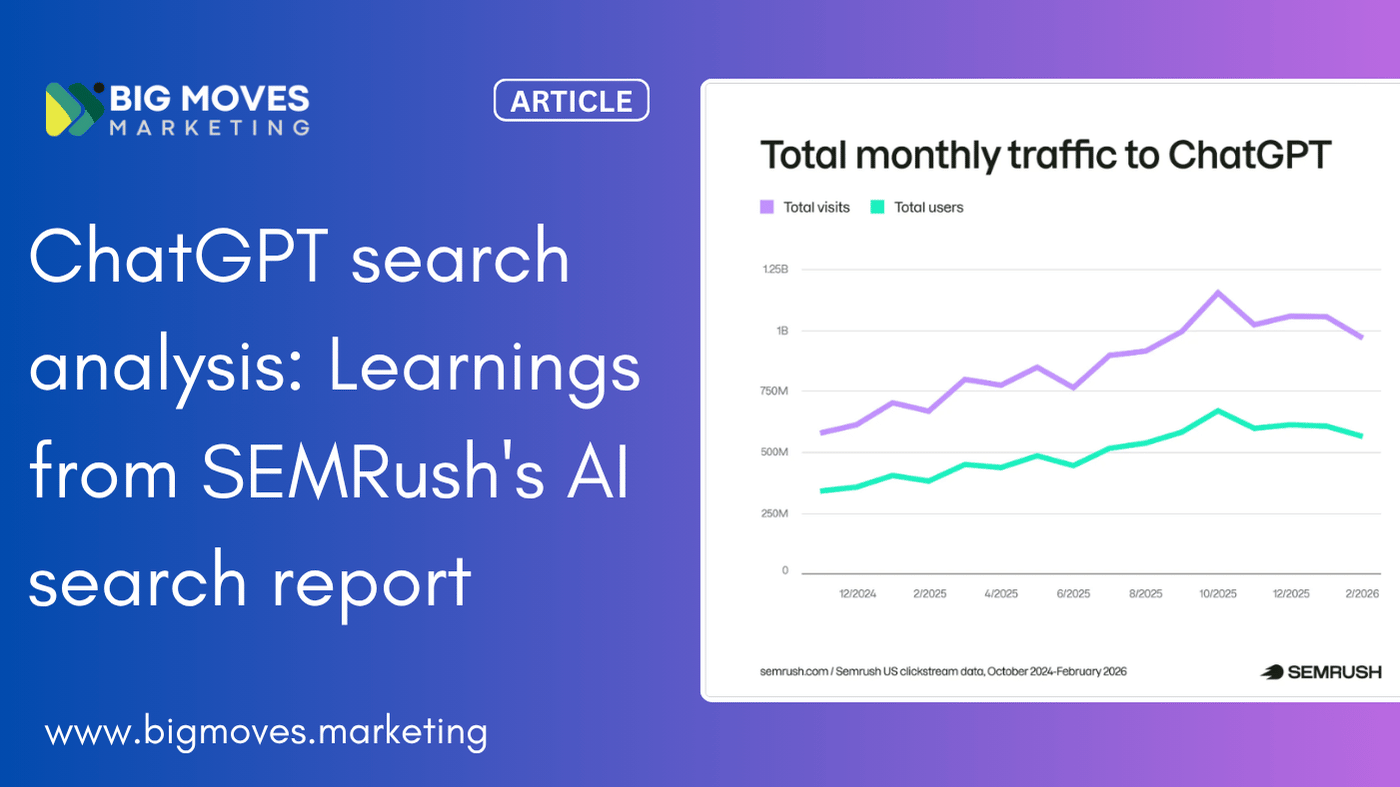
In April 2026, Semrush published an analysis of more than a billion lines of U.S. clickstream data spanning 17 months of ChatGPT usage. The headline numbers were the kind that get screenshotted into board decks: outbound referral traffic up 206% year-over-year through 2025. Over 30% of all referrals concentrated in just ten domains. Search enabled on only about one-third of queries. Average prompts per session up 50% in the final four months of the study window.
The report's framing is sharper than the numbers suggest. Semrush argues that ChatGPT is no longer a destination — it has become a doorway. The shift from "search as endpoint" to "search as gateway" sounds incremental until you sit with it for ten minutes and realize the entire B2B demand-generation playbook was built for a model that no longer describes how buyers actually research.
For senior B2B marketers, this is not a story about whether AI search replaces Google. It plainly does not, at least not in the next three years, and the relationship between the two channels is far more layered than the binary framing suggests. The real story is how the buyer journey has reorganized itself around an answer engine that synthesizes, recommends, and routes — and how the implications cascade through brand-building, content strategy, attribution, and measurement.
This piece extends the Semrush data with cross-referenced research from Gartner, Forrester, 6sense, G2, the LinkedIn B2B Institute, and a handful of GEO-specific studies. Seven findings emerge that should change how growth-stage B2B marketing teams allocate budget and effort over the next eighteen months.
The single most important takeaway from the Semrush study is structural, not tactical. ChatGPT's total traffic plateaued around November 2025 at roughly one billion monthly visits. But its outbound referral traffic kept climbing — up 206% year-over-year comparing January 2025 to January 2026. The platform stopped growing as a destination but accelerated as a router.
This pattern is not unique to Semrush's panel. Similarweb's separate analysis of the top 1,000 global websites found that AI platforms generated over 1.13 billion referral visits in June 2025 — a 357% jump from the prior year, with ChatGPT responsible for over 80% of those referrals. Two independent datasets, two different methodologies, same directional finding: AI search is no longer a walled garden. It increasingly behaves like an interface layer over the open web.
Belinda Conde Bautista, SVP Marketing at Datos (a Semrush company), made the framing explicit in the study: marketers should stop seeing ChatGPT as a destination. AI platforms are becoming the gateway through which buyers discover brands, decide what to click, and form initial trust judgments — much as Google did fifteen years ago.
The early B2B-specific signal supports this. Forrester estimates that AI-generated B2B traffic is currently 2–6% of organic and growing at over 40% month over month. A channel growing at that rate moves from immaterial to dominant inside a year. Vercel has publicly reported that ChatGPT now drives roughly 10% of new signups, and Tally — a bootstrapped form-builder — recently named ChatGPT its #1 referral source.
The conversion behavior of that traffic is the more interesting story. Similarweb's analysis found that users referred from ChatGPT convert to transactional sites at roughly 7%, compared to 5% for Google referrals. For B2B specifically, the multiplier is steeper: industry analyses suggest AI-referred B2B traffic converts at 4–5x the rate of traditional organic. The reason is intuitive once you sit with it. By the time a prospect clicks through from an AI answer, they have already pre-validated the vendor in conversation, asked clarifying questions, narrowed their consideration set, and arrived with intent. The lower funnel is shorter, but it is also narrower.
The implication for B2B marketers is uncomfortable. Pipeline volume from AI referrals will look small for another two or three quarters. The conversion quality is already disproportionate. And the brands that fail to be in the answers will not just lose referral visits — they will lose pre-qualified consideration before the buyer ever appears in any tracked channel.
A note of intellectual honesty: AI referrals remain a small slice of total web traffic. Conductor's data, cited in Digiday, found that AI platforms drive only about 1% of overall web traffic across ten major industries. Similarweb's December 2025 Generative AI Landscape report similarly noted that AI referral volume has plateaued even as platform usage grows — because the platforms are designed to retain attention, not distribute it. This is not a contradiction with Semrush's growth numbers. It is the boundary condition. The traffic is small, growing fast, and high-quality — which is exactly the profile of a channel that becomes strategically necessary before it becomes volumetrically dominant.
The single most underrated finding in the Semrush dataset has nothing to do with AI as a competitor to Google. It has to do with AI as Google's largest referrer.
Over 21% of all ChatGPT referral traffic now goes to google.com — up from roughly 14% at the start of the study. The next nine domains combined account for another 8.6%, bringing the top ten domains to just over 30% of all ChatGPT outbound traffic. Google alone is the single largest beneficiary of ChatGPT's referral economy.
This finding inverts a lot of the GEO marketing rhetoric of the last twelve months. The dominant narrative — "AI is killing SEO; pivot the budget" — does not hold up against the clickstream evidence. What the data shows instead is a layered behavior pattern: users get an initial answer or recommendation in ChatGPT, then click through to Google to verify, navigate, or research further. Sometimes they want a brand's homepage. Sometimes they want third-party reviews. Sometimes they want to confirm that the AI's answer was not hallucinated. In every case, the second step is Google, not the brand.
This compounding pattern matters because it changes the economics of search investment. If your brand has weak SEO and strong AI visibility, the AI can recommend you, but the user's verification step will surface competitors who outrank you. If your brand has strong SEO and weak AI visibility, you never enter consideration in the first place. The two channels are no longer substitutes; they are sequential dependencies.
This is consistent with what G2 found in its April 2026 Answer Economy study, which surveyed 1,076 B2B software buyers across North America, EMEA, and APAC. Fifty-one percent of respondents now begin their software purchasing process in an AI chatbot rather than a traditional search engine — up from 29% just twelve months earlier. Sixty-nine percent said an AI chatbot led them to select a different vendor than they originally intended. ChatGPT alone accounted for 63% of that AI chatbot research.
But — and this is the load-bearing nuance — the same buyers continue to validate AI recommendations through traditional channels. Review sites, vendor websites, and Google searches all play roles in the validation loop. G2's separate analysis found that the #1 confidence-inspiring signal in an AI answer, according to B2B buyers, is a citation from a review site. For self-identified power users of AI chatbots, that confidence signal rises to 50% — a stronger preference for review citations than for any other source type.
Putting these data points together yields a clear hierarchy of investment for B2B brands:
The first priority is showing up in the AI answer at all. The second is having strong, indexed third-party citations — review sites, analyst coverage, comparison pages — because these are both how the AI builds confidence in your answer and how the user verifies it after clicking. The third is owning the SEO ground around your branded and category-defining queries on Google, because that is where users land after the AI recommendation.
AirOps research, referenced in Foundation's GEO analysis, makes the point starkly: 85% of brand mentions in AI answers come from third-party sources, not from the brand's own website. Brands are 6.5 times more likely to be cited through external content than their own domain — and roughly 90% of those third-party mentions come from listicles, comparison pages, and review roundups. That is not a number you can move with on-site content alone. It is a function of category coverage on G2, Capterra, TrustRadius, plus earned media in publications the AI considers authoritative.
The brands winning AI visibility are also the brands winning SEO. They are not separate strategies. They are the same strategy.
The most provocative chart in the Semrush study is the one showing that between 65% and 85% of ChatGPT prompts cannot be matched to any traditional search keyword in Semrush's database of 27 billion queries. The shape of the prompt has changed.
Semrush's example sums it up: a Google query is "best project management software." A ChatGPT prompt for the same underlying need might be "I manage a 12-person remote engineering team and we're constantly missing sprint deadlines. What should I change about our weekly standups?" The first is a category query the SEO industry has been targeting for fifteen years. The second is a situational, context-laden description of a problem — phrased as a problem, not as a category.
Two patterns emerge from the underlying data. First, prompts that do match traditional search keywords are dominated by navigational and transactional intent — "notion login," "buy running shoes nike." These are queries where the user already knows what they want. Second, the share of prompts using traditional search language nearly doubled between October 2025 and February 2026, from 18.9% to 34.9%. Users are bringing more search-style behavior to ChatGPT over time, but the long tail of context-rich, situational prompts is still the majority of the dataset.
The implication for B2B content strategy is deeper than "write more conversational content." It is that the unit of optimization has changed. Traditional SEO optimizes for the keyword. Generative search optimizes for the job to be done — the buyer's underlying problem, expressed in their own language, with their own constraints embedded.
This aligns with how the underlying retrieval works. AI systems supplement model knowledge with retrieval-augmented generation, pulling document segments from external sources whose semantic content closely matches the query — not whose title or H1 matches a keyword string. Content that explicitly maps situations to solutions, that names the problem in the way buyers describe it, and that structures answers as discrete, citable claims will perform disproportionately well in this retrieval regime. Content built around exact-match keywords will continue to rank in traditional Google but increasingly fail to surface in AI answers.
A research study published by MarTech in February 2026 makes this concrete for B2B. Across more than 1,000 prompts, 29 brands, and four AI engines (ChatGPT, Perplexity, Grok, and Google AI Mode), only 21% of analyzed B2B brands appeared in more than 25% of the prompts that mattered to their category. One-third of the brands surveyed appeared in fewer than 5% of the relevant AI answers. In two-thirds of the categories analyzed, even the top-visibility brand was returning visibility scores below 25%. There is, in other words, a yawning gap between which brands buyers are likely to be researching and which brands the AI is actually surfacing.
The same study found that LinkedIn long-form articles — even those posted years earlier — show up disproportionately often in AI answers, while Reddit and Wikipedia, the most-cited sources for B2C queries, had limited impact for B2B brands. For 60% of brands, Wikipedia did not even crack the top 25 cited domains. The earned-media surface area that matters for B2B AI visibility is different from the earned-media surface that matters for B2C — and different again from what most CMOs would predict.
The practical work in this finding is twofold. First, B2B content audits need to start asking a new question: not "what keywords does this page rank for," but "what problem situations does this page demonstrably solve, in the buyer's own framing." Second, content distribution needs to extend beyond owned media to the surfaces AI engines actually retrieve from — long-form LinkedIn, analyst-reviewed third-party publications, and the review sites that anchor the consideration set.
Most B2B keyword research stacks were built for an era when search demand could be measured by query volume. In a world where most prompts have no traditional-search analog, keyword volume becomes a partial signal at best. The complementary data — what prompts buyers in a category are actually asking, what topics show up in AI answers, what citations the AI is drawing from — is now its own measurement layer. Tools like Semrush's AI Visibility Toolkit, Profound, Evertune, AirOps, and Brandi have emerged to close this gap, and they will be standard parts of the B2B marketing stack within twelve to eighteen months. Teams that wait for the category to mature will be measuring a partial picture of demand.
The Semrush data shows that average queries per ChatGPT session jumped 50% in the final four months of the study — from a stable 1.16–1.21 range through most of 2025 to 1.75 by February 2026. ChatGPT's traffic plateau coincided with deeper engagement from a more committed user base. Less casual, more power user.
For B2B, this is the most consequential behavioral shift in the dataset, because the multi-turn session is the new research window. The buyer is no longer entering a single keyword and scanning ten blue links. They are spending fifteen, twenty, sometimes forty minutes inside a conversation with an AI — narrowing requirements, comparing options, asking about pricing, asking about edge cases, asking about competitors. The cumulative output is a shortlist they bring with them when they finally arrive at a vendor's website.
This compresses the dark funnel rather than eliminating it. 6sense's 2025 Buyer Experience Report, drawing on nearly 4,000 B2B buyer responses, found that 94% of buyers now use LLMs during their buying journey — but the number of vendor interactions has barely budged. Sixteen vendor interactions per buyer in 2025, compared to 17 in 2024 and 16 in 2023. AI is not replacing vendor engagement. It is changing where the research happens before that engagement begins.
The more telling shift in 6sense's data is the timing. The point of first contact between buyer and seller has moved from approximately 70% of the way through the journey to 60% — what the firm now calls the 60/40 shift. Buyers are reaching out to vendors roughly 3.5 weeks earlier in their evaluation, but only because they need to validate AI capabilities they already half-believe exist. The earlier engagement does not mean lighter research. It means the AI front end has compressed the research-to-validation cycle.
A closely related finding: the vendor a buyer contacts first still wins roughly 8 out of 10 deals. That ratio has held across multiple 6sense studies and was reaffirmed in the 2025 report. What has changed is the route by which a vendor becomes the first contact. The route now runs through ChatGPT.
The G2 Answer Economy data closes the loop. One-third of B2B software buyers in G2's April 2026 study reported purchasing from a vendor they had never heard of before the AI surfaced it. The 4-week-deeper, multi-turn session in ChatGPT is the surface where unfamiliar vendors enter the consideration set — and where familiar vendors get displaced.
The strategic implication is simple to state and uncomfortable to act on. The center of gravity of B2B research has moved upstream of every analytics tool you currently use. You cannot directly measure what the buyer is asking ChatGPT, you cannot see who the AI recommended alongside you, and you cannot intercept the conversation. You can only show up in it, or not.
A finding that will be especially relevant to product marketers and PR leaders is buried in the middle of the Semrush study. As of February 2026, ChatGPT enables web search on only 34.5% of queries, down from 46% in late 2024. The remaining two-thirds of queries are answered from training data alone.
The cutoff matters. ChatGPT's training data, as of January 2026, runs through June 2024. Anything that has happened in the intervening 18 months is invisible to the model unless web search is triggered — and it is triggered less often than most marketers assume. Queries about recent product launches, new pricing, new positioning, recent funding announcements: these depend on web retrieval. Queries about category fundamentals, vendor reputation, established alternatives, and longstanding industry conventions are answered from baked-in knowledge.
This is the modern AI-search corollary of the LinkedIn B2B Institute's 95:5 rule. The Ehrenberg-Bass Institute's research, popularized by John Dawes, established that only about 5% of B2B buyers in any category are in-market at any given time — and that the brands buyers eventually choose are typically the ones already lodged in memory long before the buying window opens. Mental availability is the marketing asset that decides who gets shortlisted when the trigger event occurs.
In the AI-search era, mental availability has a literal mirror in model weights. If your brand was named, defined, and described in widely-cited content during the years before the model's training cutoff, you are baked into the parametric knowledge of every model that learned from that data. If you were not, you are dependent on web search being triggered, on your site being retrieved, and on your content being structured well enough to be cited. The first condition is a structural advantage that compounds. The second is a tactical scramble.
This reframes the brand-versus-performance debate. The brands investing heavily in third-party citations, analyst coverage, owned thought leadership, and category education during 2024 and 2025 were inadvertently buying mental availability inside language models. The brands that pulled back to performance marketing during the same period have a knowledge gap to close — and the only way to close it is to invest now, ahead of the next model training cycle.
Two practical implications follow. First, content built to define a category — and to associate your brand with that category — has a longer half-life than ever, because it will be encoded in successive model generations. Second, brands launching new products, repositioning, or entering new categories cannot rely on training-data presence; they need to be designed around live retrieval from the outset, with structured content, schema, citation-friendly statistics, and active distribution to authoritative third-party surfaces.
The concentration story in the Semrush data deserves more attention than it usually gets. Just over 30% of all ChatGPT referral traffic flows to ten domains, with Google alone capturing 21.6%. This concentration has been remarkably stable: the top ten have held between 20% and 32% of all referrals since October 2024.
Combined with what we know about AI visibility volatility, this paints a picture of two parallel concentrations. At the destination level — where ChatGPT users land — the top ten domains absorb most of the traffic. At the source level — which sites the AI cites in its answers — visibility is concentrated among a small set of authoritative sources, but it is also unstable from query to query.
The volatility is the finding that surprises most B2B marketers. AirOps research, referenced in Foundation's GEO analysis, found that only 30% of brands stay visible between consecutive AI answers to the same prompt. Just 20% remain present across five consecutive runs. The model rebalances each answer for diversity, freshness, and coverage; it does not return a static ranked list the way Google does. Two buyers asking ChatGPT the same B2B question on the same day can receive substantially different vendor consideration sets.
The implication is that AI visibility is not won once. It is defended continuously, across many citation surfaces, with redundancy built in. A brand with a single strong G2 page and one analyst mention may show up in 20% of relevant AI answers. A brand with deep coverage across G2, Capterra, TrustRadius, multiple analyst reports, an active LinkedIn long-form presence, recent earned media, and clear schema-marked product pages may show up in 60% — and even then, not consistently.
This also reframes how B2B teams should think about competitive benchmarking. The metric that matters is not where you rank in AI answers (because there is no ranking in the SEO sense). It is your brand mention share — what percentage of relevant AI responses include your brand, measured across many runs and many phrasings of the same underlying intent. This is the metric Walker Sands, Evertune, Profound, and others now build dashboards around, and it is the closest analog the GEO era has to share of voice.
A final cautionary signal in the concentration data: Deepseek.com sat at #7 in the top destinations of ChatGPT referrals as of February 2026, ahead of several mainstream commercial sites. ChatGPT users are routinely bouncing between AI platforms within a single research session. The buyer who started in ChatGPT may end up in Perplexity, Claude, or Gemini before the session is over. Cross-platform AI visibility — not just ChatGPT visibility — is the actual goal. Brand mention share matters across the entire answer-engine layer, not within any single one.
The most important takeaway from the entire Semrush study, and the one that should anchor every B2B marketing plan in 2026, is the explicit refutation of the substitution narrative. Eli Goodman, SVP of Product Solutions at Semrush, framed it bluntly in the report: AI search is not cannibalizing search. It is layering on top.
The Semrush survey of 1,000+ U.S. consumers referenced in the clickstream report found that most respondents now use AI and traditional search in combination, not as alternatives. The clickstream data confirms this from the other side: 21% of all ChatGPT outbound traffic flows to Google. The two channels are interlinked at the user-behavior level — buyers are not choosing AI or search; they are choosing AI and search, sequentially, within the same research session.
For B2B specifically, this is supported by every major buyer study published in late 2025 and early 2026. Gartner's 2026 strategic predictions project that by 2028, 90% of B2B buying will be AI-agent-intermediated, pushing more than $15 trillion of B2B spend through AI agent exchanges. Yet Gartner's separate research, released in mid-2025, argues that 75% of B2B buyers will prefer sales experiences that prioritize human interaction over AI by 2030, especially in complex, high-stakes deals. The two predictions are not contradictory. AI dominates the early-stage research and shortlisting work. Humans remain decisive in the validation, negotiation, and trust-building work. The buying journey now has two engines, and they run in series.
This is also why the "ChatGPT killed our traffic" narrative that surfaced in some parts of the publishing industry in 2025 does not translate cleanly to B2B. Publisher traffic and B2B vendor traffic respond to different drivers. For publishers, the zero-click reality of AI answers is genuinely catastrophic — Pew Research found that fewer than 1% of users click on links in Google's AI Overviews, and news search no-click rates have risen from 56% to nearly 69% since AI Overviews launched. For B2B vendors, the equivalent question is not whether the buyer clicks through; it is whether the buyer ends up in the consideration set. A buyer who never clicks through to your site but enters your sales process two months later because the AI consistently recommended you has not cost you traffic. The traffic was never the goal.
This is the conceptual move that most growth-stage B2B marketing teams have not yet made. The KPI shift away from referral volume — and toward brand mention share, AI-cited citations, and influenced pipeline — is the practical expression of treating AI and search as a layered system rather than a replacement.
The seven findings above do not act independently. They compound, and the compound effect is what reshapes the B2B marketing playbook.
The doorway effect (finding 1) means buyers arrive pre-qualified, with shorter funnels and higher conversion intent. The Google compounding effect (finding 2) means that landing in AI answers without strong SEO is a wasted advantage, because verification routes through Google. The conversational-grammar shift (finding 3) means that content built for keyword-matching is increasingly invisible to the AI surfaces that now front-load the buying journey. The multi-turn session pattern (finding 4) means that the buyer's research happens off your property, in a conversation you cannot observe. The training-data dynamic (finding 5) means that brand investment compounds across model generations in a way that performance marketing does not. The visibility volatility (finding 6) means that AI visibility is a maintained position, not a captured one. And the layered-channel reality (finding 7) means that none of this replaces SEO; it adds a second concurrent channel that has to be staffed, measured, and optimized in parallel.
Put together, the picture for B2B marketers is this: the surface area where buyers form vendor preferences has expanded. It now includes AI conversations, model training data, third-party citation networks, review-site signals, and earned media — in addition to the website, paid media, and organic search that defined the previous decade. Each surface has its own measurement system, its own optimization mechanics, and its own time-to-impact curve.
The losing posture is to treat AI search as a single new channel to "add" to the existing stack. The winning posture is to recognize that the buying journey is now distributed across surfaces in a way that requires a portfolio approach — with brand-building work feeding training data, third-party citation work feeding live retrieval, and traditional SEO feeding the verification step that follows the AI recommendation. None of these substitute for the others.
The brands ahead of this curve in 2026 are not the ones with the biggest GEO budgets. They are the ones who recognized that the work of becoming the answer is the same work that earns you the SEO ranking and the analyst coverage and the LinkedIn engagement and the review-site presence. The compounding effect of consistent, high-quality, citation-friendly content across multiple surfaces produces AI visibility, search visibility, and human credibility at the same time.
Treat brand mention share as the primary leading indicator of AI visibility. Referral traffic from ChatGPT and other AI platforms will lag behind real influence on buyer decisions for at least the next two quarters. The earlier signal is the percentage of relevant prompts in which your brand is mentioned. Tools like Semrush's AI Visibility Toolkit, Profound, Evertune, and Walker Sands' GEO frameworks now make this measurable. Build a baseline before benchmarking to competitors, because cross-vendor comparisons without context will mislead.
Audit your third-party citation surface, not just your website. Foundation's analysis suggests that 85% of B2B brand mentions in AI answers come from third-party sources. That means review-site presence (G2, Capterra, TrustRadius), analyst coverage, comparison-page inclusion, and long-form LinkedIn presence are not just brand-building activities — they are the literal mechanisms by which AI surfaces decide who shows up in answers. The G2 Answer Economy study reinforces this: review-site citations are the #1 confidence signal in AI answers for B2B buyers.
Publish pricing, structure content for retrieval, and reduce ambiguity. The pattern across multiple GEO studies is that AI models cannot recommend what they cannot verify. Brands with transparent pricing, structured comparisons, and clearly stated category positioning are surfacing more often. Brands with "contact us for pricing," vague positioning, or content that requires interpretation are getting paraphrased inaccurately or replaced with cleaner-content competitors.
Re-examine your content KPIs through the lens of jobs-to-be-done, not keywords. If 65–85% of ChatGPT prompts have no traditional-search analog, then the long tail of situational, problem-framed buyer language is invisible to your existing SEO tools. The shift is to build content explicitly around the questions buyers ask in their own words — not the keywords your tools think they should be searching. This is closer to a jobs-to-be-done framework than to traditional keyword research, and it requires direct interview data and prompt research as inputs, not just SEO tool exports.
Plan for two-channel measurement, not channel substitution. The teams under-investing in SEO because they over-rotated to GEO are walking into a wall: 21% of all ChatGPT referrals route to Google. The teams ignoring GEO because organic traffic is still flat are walking into a different wall: by the time the GEO signal is unmistakable in their analytics, the consideration sets that drive 2027 pipeline will already have been formed inside AI conversations they never measured. Both channels need to be funded, staffed, and instrumented now.
The fundamentals of B2B marketing have not changed. Buyers still want clarity, social proof, validated outcomes, and a vendor they can trust. The 95:5 distribution of in-market versus out-of-market buyers is still the mathematical core of why brand-building generates pipeline. Mental availability is still the asset that decides who gets shortlisted when a buying window opens.
What has changed is the execution environment. The surfaces where mental availability is built and measured have multiplied. The grammar of buyer queries has fragmented into dozens of conversational variants that no traditional keyword tool fully captures. The window of buyer research has compressed in time but expanded in scope, with multi-turn AI sessions doing the work that used to require multiple website visits, vendor calls, and analyst report downloads. And the channels have stopped being substitutes and started being layered dependencies.
The B2B marketers who win 2026 and 2027 will not be the ones with the most aggressive GEO playbooks or the largest content production pipelines. They will be the ones who recognized that the answer engine and the search engine are now two stages of the same buyer journey — and who built one integrated marketing operation to win on both surfaces at once. The 17 months of clickstream data behind the Semrush study is the clearest signal yet that this transition is no longer hypothetical. The doorway is open. The question is whether you are visible on either side of it.
Explore Big Moves Marketing services and resources:
June 26, 2026


%20-%20white.svg)