%20png%20copy.avif)
Most founders don’t need “consulting.” They need a smaller set of better decisions, made earlier, with less self-deception.
That’s the part the market hides. The phrase business startup consulting services sounds useful, but it lumps together wildly different things: generic small-business advice, outsourced execution, coaching, deck-driven strategy theater, and the rare engagement that actually changes how a B2B SaaS company goes to market. Those are not interchangeable. Treating them as interchangeable is how founders burn time, confuse teams, and pay for answers to the wrong question.
The popular advice is to “get help.” That’s too vague to be useful. If you’re building a B2B SaaS company, you are not buying help. You are buying decision quality. You are buying a clearer ICP, a sharper narrative, a better launch sequence, a tighter sales motion, and fewer expensive detours. If the engagement doesn’t improve those things, it’s overhead.
Most startup consulting is a waste because it sells comfort instead of strategic advantage.
Founders are often sold a neat package of planning documents, broad recommendations, and familiar business advice. None of that matters if the company still can’t answer basic go-to-market questions. Who is the best-fit buyer? Why should they switch now? What objection kills the deal most often? What message belongs on the homepage versus in the sales call? Those are the questions that move revenue.
The market is getting bigger, not better. The global business consulting market is projected to expand from USD 198.29 billion in 2025 to USD 273.64 billion by 2031, according to Intel Market Research’s business consulting market projection. More supply sounds good until you realize what it usually means in practice: more generalists, more recycled frameworks, and more polished advice aimed at everyone and useful to no one.
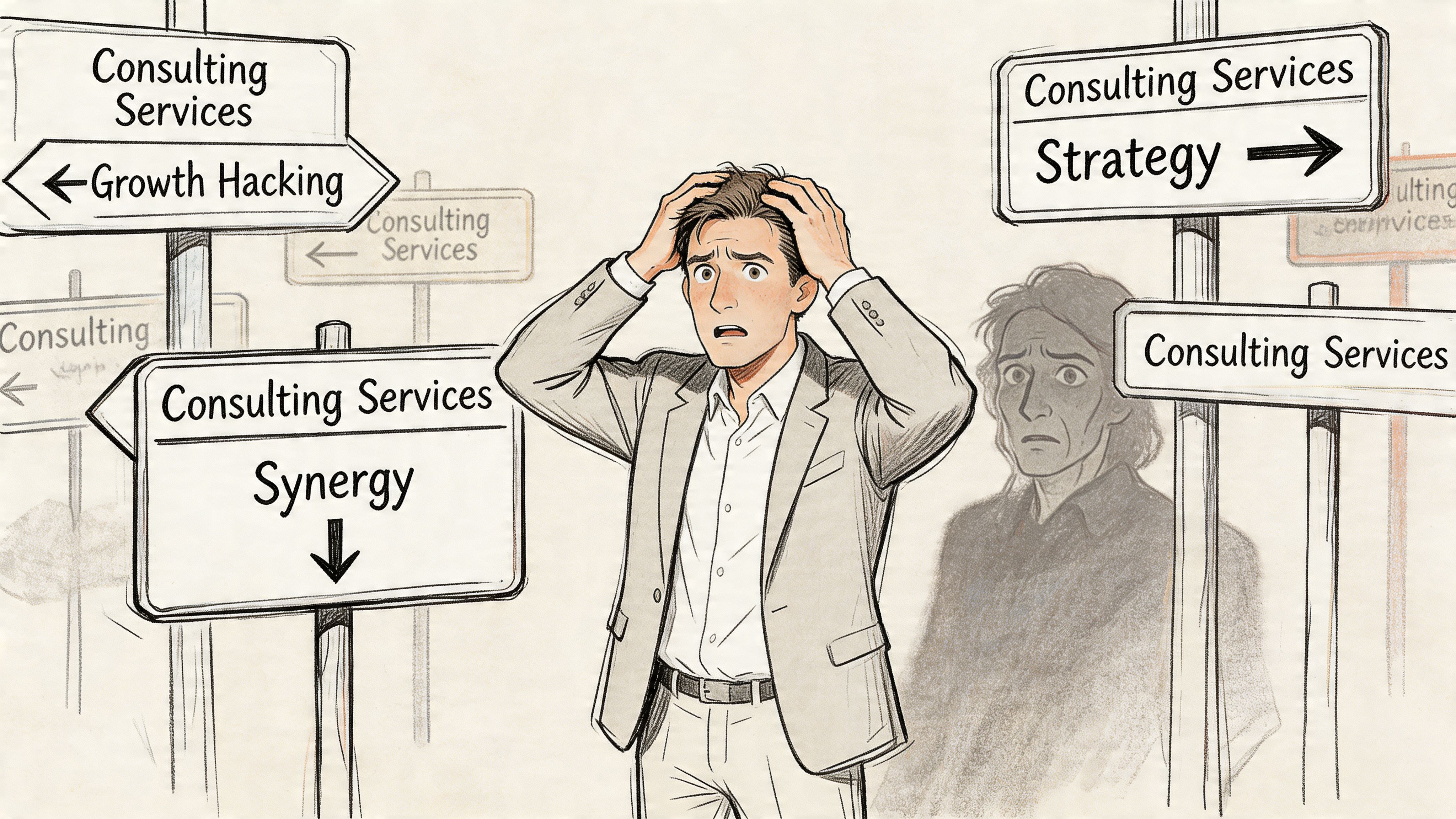
A lot of consulting sounds reasonable because it addresses visible surface issues. You need a better business plan. Better social media. Better org structure. Better process. Fine. But early-stage and growth-stage SaaS teams rarely stall because they forgot a template. They stall because the company hasn’t translated product truth into market clarity.
That distinction matters.
| What founders buy by accident | What they should buy instead |
|---|---|
| General advice | Specific GTM decisions |
| Broad audits | Clear prioritization |
| Hours and meetings | Deliverables the team can use |
| Theory | A working operating model |
If you’re trying to sort the useful from the useless, a narrower frame helps. This is why I’d start with a more SaaS-specific lens like consulting services for startups, not the broad and often misleading category of generic startup help.
Practical rule: If the consultant can’t show how their work changes positioning, pipeline quality, sales velocity, or decision speed, you’re probably buying noise.
Waste doesn’t always look dramatic. It usually looks respectable.
Founders are right to be skeptical. Most of that skepticism is earned.
The biggest hiring mistake is simple. Founders buy advice for a small business problem when they have a go-to-market problem.
That confusion sounds harmless. It isn’t. A B2B SaaS company can survive a messy spreadsheet, an imperfect planning process, or an ugly first website. It usually won’t survive prolonged confusion about who it serves, how it wins, and what makes buyers care now.
A critical gap exists because founders often receive advice built for traditional small businesses rather than high-growth tech companies. According to this breakdown of free and low-cost consulting options for small businesses, 68% of early-stage B2B startups fail due to poor go-to-market execution, while only 15% access specialized fractional CMO services. That tells you almost everything you need to know. The market supplies broad advice. Founders need narrow, high-stakes GTM judgment.
Generic business startup consulting services usually focus on foundational business tasks:
Those topics have their place. They are not the core commercial problem for most B2B SaaS teams.
Key questions look different:
A lot of founders hire a “startup consultant” when they actually need someone who can solve one of those five.
Misaligned advice doesn’t just fail to help. It pushes the company in the wrong direction.
A founder gets told to broaden the audience because “more leads” sounds good. Now the homepage gets vague. Sales calls fill with weak-fit prospects. The sales team starts taking every meeting because qualification is fuzzy. Product hears inconsistent feedback because the buyer set is incoherent. Marketing starts reporting activity because revenue quality is harder to explain.
That’s how companies create complexity they later call a growth problem.
Advice built for a bakery, local agency, or traditional small business won’t save a SaaS company with category confusion and a shaky sales story.
If you need a better filter for what kind of help fits your stage, this view of what a startup consultant should actually solve is closer to reality than the catch-all consulting label founders usually start with.
A serious engagement starts with a sharply defined commercial problem.
Not “we need marketing help.”
More like this:
That’s how an operator thinks. You’re not hiring for reassurance. You’re hiring to remove a costly bottleneck.
Most consulting categories are too broad to be useful. Founders need to think in terms of engagements with hard commercial outputs.
The right work doesn’t give you a pile of observations. It changes the company’s ability to explain value, enter the market with precision, and move opportunities through a credible sales process. Effective consulting does this by identifying overlooked market gaps through competitive analysis and operational clarity, helping address the financial mismanagement and poor strategic positioning behind over 42% of startup failures, as noted in Spartan Capital’s analysis of how consulting transforms startups.
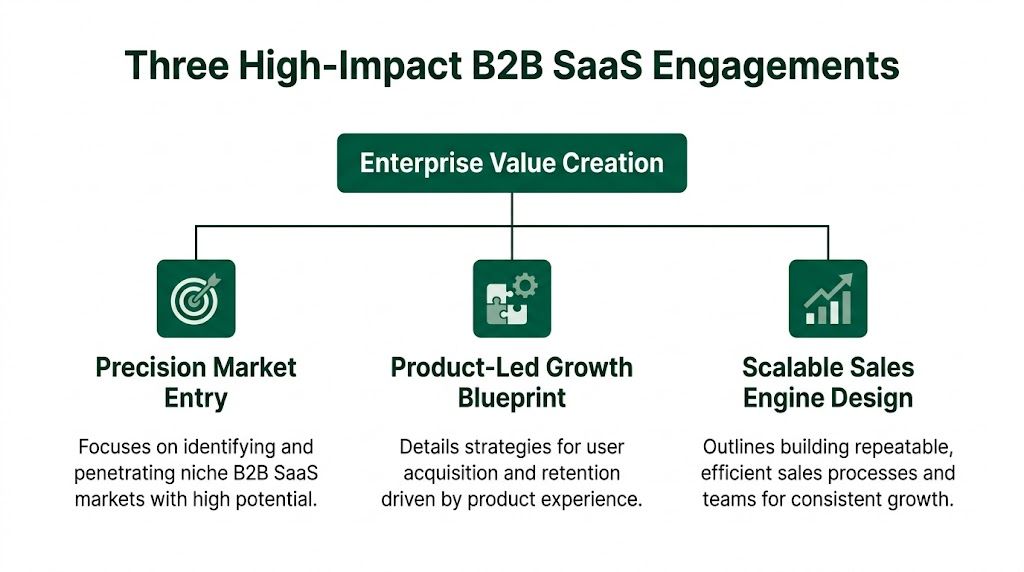
This is the most impactful engagement for companies that have a decent product and a muddy market story.
The symptom is easy to spot. The team describes the product through features, architecture, and internal language. Buyers don’t buy internal language. They buy a change in their world. If your site sounds precise to your team but forgettable to the market, your positioning is weak.
A strong positioning engagement should produce:
This work matters because it fixes the source material every downstream function depends on. Website copy, SDR outreach, paid acquisition, sales decks, demo flow, customer stories, and product marketing all get cleaner when the message improves.
What should make you skeptical? A consultant who starts with visual brand language before resolving market language. In SaaS, verbal clarity comes first. Design amplifies understanding. It doesn’t create it.
This engagement is for teams that know what they built but haven’t yet turned that into an effective market entry plan.
A proper launch strategy is not a campaign calendar. It’s a set of decisions about sequence, focus, and resource allocation. Most founders waste early go-to-market budget by trying to look established before they’ve proven a repeatable path into demand.
The deliverables should be concrete:
| Critical area | What you should expect |
|---|---|
| Target segment | A prioritized market entry wedge |
| Offer structure | Clear articulation of the initial promise |
| Channel plan | A reasoned case for what to test first |
| Sales assumptions | Qualification logic and early pipeline definitions |
| Learning loops | How the team will capture signal from calls and campaigns |
The best launch strategies are boring in the right way. They force discipline. They stop founders from spreading across SEO, paid search, LinkedIn, events, partner motions, outbound, and content all at once without message-market fit.
Operator’s view: The first job of a GTM launch isn’t scale. It’s signal quality.
For B2B SaaS, that means asking uncomfortable questions early. Should the company lead with founder-led outbound because the message still needs shaping? Should the website optimize for booked demos or for category education? Is the sales motion transactional, consultative, or multi-stakeholder? Is the product easier to sell top-down or bottom-up? Those answers drive channel choice.
Many startups discover they never had a scalable sales motion. Instead, they had a persuasive founder.
The founder knows which examples to use, when to challenge the buyer, how to handle objections, and what not to say too early. None of that is written down. The first account executive joins, follows the deck, books meetings, and loses deals the founder would have won. That’s not a rep problem. It’s a transfer problem.
A useful sales enablement engagement usually includes three layers.
First, message transfer. The company needs usable artifacts: sales decks, battle cards, talk tracks, discovery questions, qualification criteria, and follow-up narratives.
Second, pipeline design. Stages need to reflect how the company sells. If your CRM stages exist just because someone imported a standard template, they’ll hide friction instead of exposing it.
Third, feedback loops. Sales calls should improve positioning, not just close deals. A startup that doesn’t systematically collect objections, lost-deal language, and buyer confusion is wasting expensive market feedback.
Here’s what founders should demand before signing anything:
Named deliverables
If the consultant can’t define the actual outputs, walk away.
A diagnosis phase with teeth
They should challenge assumptions, not politely validate them.
Cross-functional utility
The work should help marketing, sales, product marketing, and leadership speak the same language.
Evidence of SaaS pattern recognition
They should understand founder-led sales, long cycles, committee buying, weak differentiation, and the tension between PLG and sales-led growth.
A serious consultant doesn’t sell “support.” They build commercial infrastructure the team can keep using after the engagement ends.
Most founders measure strategic consulting the wrong way.
They ask what happened during the engagement. How many leads came in. How many campaigns launched. How many meetings were booked. Those can matter, but they’re usually a bad primary lens for strategic work. Strategy earns its keep by improving the system that produces results later.
That doesn’t make ROI vague. It makes it more demanding.
Consultants using data-driven frameworks can enhance customer acquisition growth by up to 45%, and the value isn’t limited to immediate lead flow. It also comes from building a stronger acquisition funnel with a 7x median ROI on investment, according to Systems and Teams on how consulting helps startups succeed. The key point is this: the payoff often shows up in better decisions, not just near-term activity.
A strong engagement should reduce unforced errors.
That includes targeting the wrong ICP, broadening the message too early, over-investing in low-signal channels, hiring reps before the sales story is transferable, or launching demand generation before the website can carry the narrative. Those mistakes don’t always show up in a dashboard immediately. They show up as months of drift.
Ask these questions instead of staring at top-of-funnel vanity:
Time matters. Strategic confusion is expensive.
A good advisor compresses the time it takes to answer difficult commercial questions. If a team reaches conviction faster on pricing logic, category framing, or buyer sequencing, that’s a financial outcome. It means less wasted motion and faster execution.
If you need a more disciplined operating lens for this, how to measure marketing ROI is a better frame than asking what one channel produced in one month.
Good strategy should shorten debate cycles. If the same arguments keep resurfacing after the engagement, the work probably lacked depth.
The final ROI test is simple. Can your internal team use what was built without the consultant in the room?
A weak engagement produces consultant dependency. A strong one produces internal capability.
Look for these signs:
| Weak ROI signal | Strong ROI signal |
|---|---|
| More meetings required to interpret the work | Team can apply the framework on its own |
| Messaging lives in a slide deck | Messaging shows up in site, sales, and outbound |
| Strategy depends on one external brain | Leadership can make faster aligned decisions |
That’s the standard. Not whether the consultant was smart. Whether the company got sharper.
Most consultants are good at selling consulting.
That’s why founders need a vetting process that tests judgment, not charisma. The consulting industry is heavily referral-driven, with 60% of consultants securing their first client through their network, according to Consulting Success’s consulting industry statistics. That should shape how you buy. Trusted relationships and proven work matter more than polished outbound.
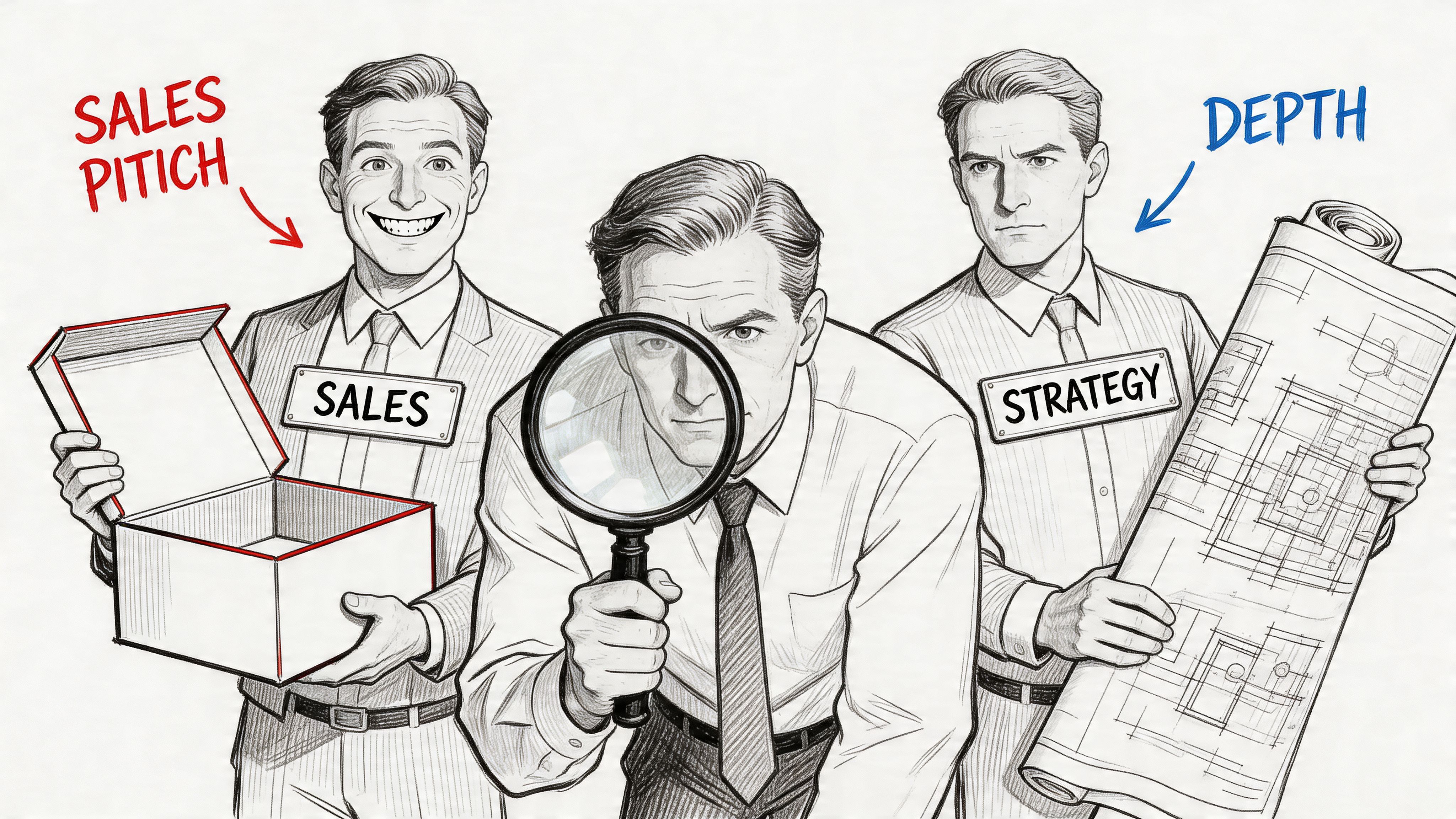
Don’t ask whether they can help with growth. Everyone says yes.
Ask questions that force pattern recognition into the open.
What kind of SaaS company should not hire you?
Good advisors know their boundaries. Generalists fake universality.
Tell me about a recommendation you made that turned out wrong. What did you miss?
If they can’t answer this cleanly, they’re performing expertise, not practicing it.
How do you distinguish a positioning problem from a channel problem?
Weak consultants jump to tactics. Strong ones diagnose where the breakdown lies.
What would you audit first in our funnel, and why?
Listen for sequencing. Serious operators have a logic tree.
What trade-offs would you force us to make in the first month?
Mature advice includes constraint.
A bad-fit consultant often reveals themselves quickly.
| Red flag | What it usually means |
|---|---|
| They lead with channels before market clarity | They sell execution before diagnosis |
| They agree with every internal opinion | They don’t know how to challenge a team |
| They rely on fashionable language | They’re hiding weak commercial thinking |
| They prescribe the same package to everyone | They sell inventory, not judgment |
One more red flag matters in B2B SaaS. If they can’t discuss founder-led sales, deal friction, multi-stakeholder buying, CRM stage design, or how homepage messaging affects demo quality, they’re probably not a GTM strategist. They’re adjacent to the problem.
You can learn a lot from how someone scopes the work.
A serious consultant will ask for call recordings, sales notes, CRM patterns, lost-deal reasons, current messaging, and leadership assumptions. They will try to locate the bottleneck before proposing the fix. A lightweight seller will jump to packages.
If you want a broader procurement lens for external partners, this step-by-step hiring guide for external firms is useful because it sharpens the diligence side of the decision, even though the category is different.
This short video is also worth reviewing before you sign anything:
There’s also a structural mistake founders make here. They compare consultants to agencies as if the choice is mainly about cost or channel execution. It isn’t. An agency for B2B marketing can be useful when the strategy is already sound. If the strategy is shaky, execution just scales confusion.
Hire the person who improves your thinking before they improve your activity.
A lot of startup consulting sounds abstract until you put it next to real commercial friction.
Here are three common B2B SaaS situations. None of them are rare. Most of them sit in plain sight for months because the team is too close to the problem.
Before: the homepage is packed with product modules, integrations, technical language, and claims about efficiency. It explains what the product does, but not why a specific buyer should care now. Traffic arrives. Some people click around. Sales says prospects still need the company explained from scratch on every first call.
After: the company reframes the site around a specific buyer problem, the cost of staying with the status quo, and a cleaner sequence of proof. The site stops trying to say everything. It starts helping the right visitor self-identify.
The result isn’t just “better copy.” Sales calls start closer to the actual problem.
Before: every inbound lead gets treated as potential revenue. The team celebrates demo volume. Reps spend time with poor-fit accounts, tiny budgets, vague use cases, and buyers who want education but not change. Marketing reports activity. Revenue leaders get frustrated because the pipeline looks healthy until it doesn’t close.
After: leadership defines a tighter ICP, updates qualification language, and rebuilds forms, messaging, and routing around fit. Some inbound volume drops. That’s fine. The team stops mistaking noise for demand.
Better pipeline often starts with rejecting more people earlier.
Before: the founder closes the biggest deals because the founder understands the market story instinctively. New reps repeat the deck and lose momentum when buyers push back. Leadership concludes they haven’t hired strong enough sellers.
After: the founder’s tacit knowledge gets turned into a usable sales system. Discovery questions improve. Objection handling gets codified. Proof points are tied to buyer risk. Reps stop improvising and start learning from a common model.
That’s when scale becomes possible. Not when you hire more people. When the commercial logic becomes transferable.
A consultant shouldn’t spend the first month discovering what your leadership team should already know.
If your internal inputs are weak, the engagement becomes remedial. That’s expensive. Good business startup consulting services work best when the company has already done the basic internal homework, even if the data is messy and incomplete.

Bring evidence, not opinions.
This doesn’t need to be polished. It needs to be available.
A good advisor can work with rough material. They can’t work with leadership folklore.
Most wasted engagements start with internal disagreement that no one names.
Get aligned on these points before the first workshop:
The single most urgent commercial question
Not five priorities. One. If everything is urgent, nothing is.
Who owns the final decision
Consensus sounds mature until it slows every hard choice.
What assumptions are currently under debate
ICP, pricing, product readiness, enterprise fit, PLG handoff, sales readiness. Put the disagreements on the table.
What success should look like operationally
Not vague improvement. A clearer story, a cleaner launch plan, a more usable sales system.
If you need a stronger internal prep template, this checklist for B2B SaaS startup marketing and sales execution is a useful pre-engagement filter.
The fastest way to waste outside expertise is to hire it before the leadership team has decided what problem it wants solved.
A startup consultant's job is not to be impressive. It’s to make the company less confused.
That means better decisions, faster alignment, and fewer self-inflicted mistakes. It means installing frameworks the team can use when the consultant is gone. It means naming trade-offs clearly, pressuring weak assumptions, and forcing a sharper connection between product truth and market reality.
Founders should stop thinking of consulting as outsourced wisdom. That framing is too passive. High-value consulting is a temporary injection of judgment that upgrades how the company thinks about growth. If the work is good, the team becomes harder to mislead. Messaging gets tighter. Sales gets more consistent. Priorities get cleaner. Launches get less chaotic.
That’s the standard.
If you’re paying for business startup consulting services, don’t pay for reassurance, activity, or jargon. Pay for strategic advantage. Pay for decision velocity. Pay for commercial clarity your team can put to use.
If your B2B SaaS team needs sharper positioning, a clearer go-to-market story, or a more usable sales and demand framework, Big Moves Marketing is built for that kind of work. It’s a strategic growth partner for founders and revenue leaders who want better decisions, not more noise.
Explore Big Moves Marketing services and resources:




%20-%20white.svg)