%20png%20copy.avif)
Most B2B SaaS teams don't have a positioning problem. They have an operational discipline problem. They write a clean statement, hand it to marketing, and act surprised when it falls apart in the homepage hero, the sales deck, the demo, and every paid click that lands on a different promise.
That's why so much brand positioning strategy sounds sharp in a workshop and useless in the market. Positioning is not a paragraph. It's the logic of where you compete, who you're for, and why buyers should care, repeated with discipline across every place they encounter you. When that discipline is weak, the brand feels generic even if the product is good.
Strong positioning matters because buyers reward clarity. Gartner-cited research reports that 81% of customers are willing to pay more for a superior experience, consistent brand presentation across channels can raise revenue by 10% to 20%, and in B2B, 75% of purchasers want branded content that helps them explore business ideas, while 93% of brands still center content around promoting their own products Shno brand positioning statistics. That gap is the problem.
If you want the basic definition first, what is positioning strategy is a useful primer. But the harder question is why so many teams still get this wrong after they understand the definition.
For a related view on trust signals in the market, see why authenticity beats advertising in B2B buying.
The most common mistake is treating positioning like a deliverable instead of a system. Teams draft a neat statement, then let sales improvise, let the website drift, and let paid media invent its own version of the truth. That is not positioning. That is fragmentation.
Buyers don't experience your brand in a single readout. They see a LinkedIn ad, skim a homepage, sit through a demo, read an email, and compare you against three other vendors with nearly identical claims. If the promise changes across those moments, your position weakens fast.
Practical rule: if a rep can't repeat the positioning without rewriting it, the market won't remember it.
There's a reason the category still rewards coherence. Brand positioning became formalized in the late 1960s and early 1970s, when Al Ries and Jack Trout popularized it as securing a distinct place in the customer's mind. A historical account places the modern concept in 1969 and notes public discussion by 1972 in the line of thinking later tied to Positioning: The Battle for Your Mind Wray Ward on positioning's evolution. The old lesson still holds, the product matters less than the perception around it.
Strong positioning doesn't scream louder. It gives the buyer a cleaner mental shortcut. The company that wins is usually the one whose promise feels most consistent, most plausible, and easiest to carry across channels.
That's why teams that obsess over “unique differentiation” often miss the point. In crowded SaaS categories, the edge is often coherence. The buyer should hear one story on the homepage, in search results, in nurture, and in sales. Anything less, and you're forcing the market to do your work.
Brand positioning strategy is a deliberate market choice. You choose the buyer, the problem you own, the competitive frame, and the reason anyone should remember you over the alternatives. That is broader than messaging and narrower than brand.
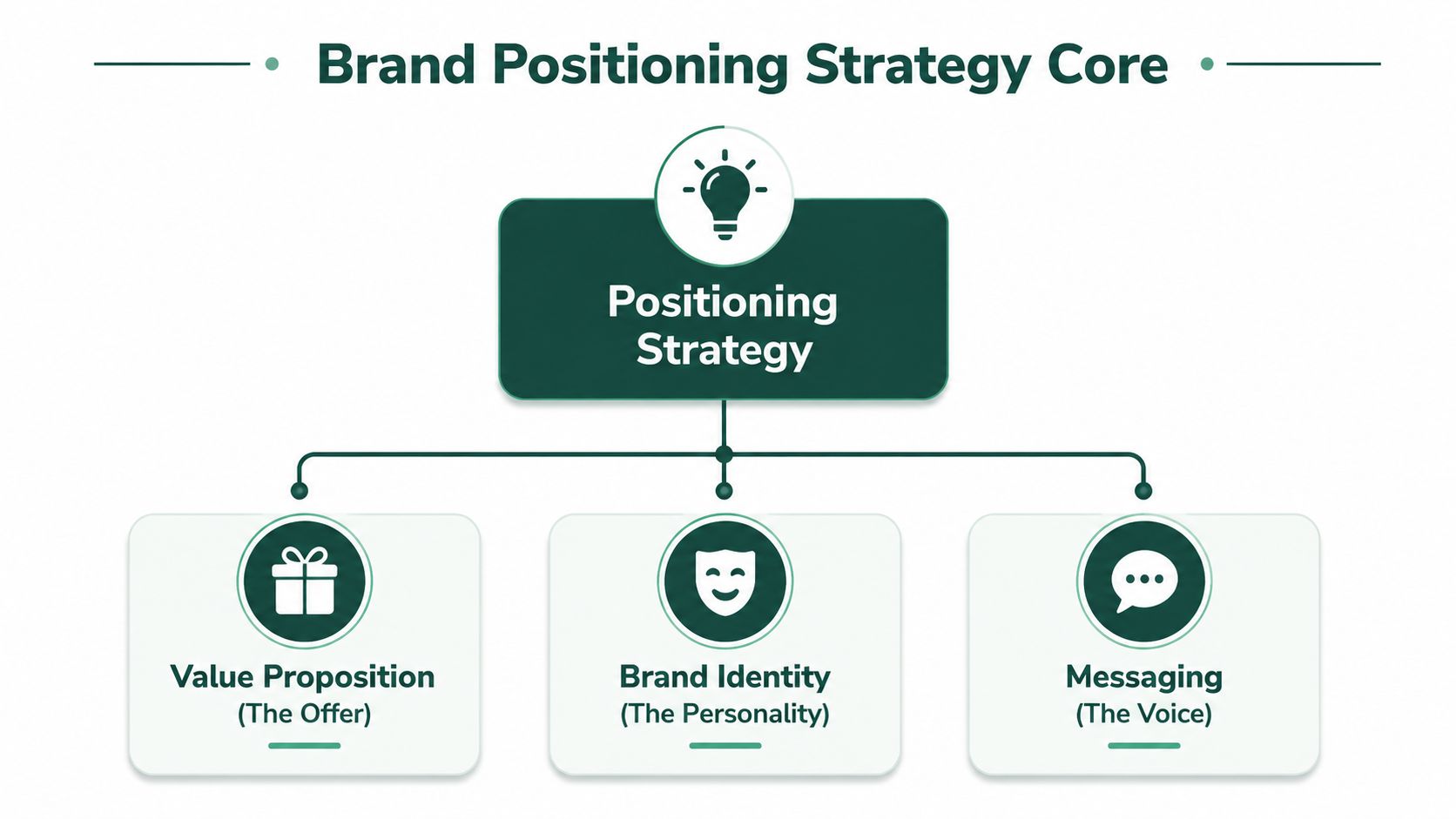
Positioning sets the strategic direction. Brand identity is the personality and visual system that express it. Messaging is the language that carries it into market. When those three get blurred, founders waste time debating copy when they should be deciding category logic.
The cleanest way to frame it is simple. Positioning defines where you belong in the buyer's mind, while identity and messaging define how you show up there. One sets the direction. The others bring it to life.
The Ries and Trout era was never about slogans. It was about mental availability and differentiation through surrounding signals like price, naming, packaging, and messaging. The market does not judge only what you say about the product. It judges the whole frame.
That still matters in B2B SaaS. A serious buyer reads the homepage, compares you with a known competitor, checks whether your proof feels credible, and decides whether you sound like a category leader or just another vendor with better copy.
A useful way to pressure-test that frame is the positioning map template. Use it to see how the market likely sorts you before you polish the wording.
Start with the buyer, not the tagline. If you do not know which accounts win fastest with your product, every positioning choice after that is guesswork. The right ICP is not a slide full of adjectives, it is a decision rule.
Strong positioning starts with the Ideal Customer Profile. That profile tells you where the company wins most often and fastest. It should spell out buyer role, firmographic shape, psychographic pattern, and the jobs the product must solve. “Mid-market tech buyers” is too vague to be useful.
Use a target-audience-first filter:
If your ICP is broad enough to make everyone nod, it is too broad to guide real positioning.
Competitor analysis should go well beyond features. Compare channels, messaging themes, target audience, substitutes, proof points, and conversion paths. That is how you see why prospects treat one vendor as “enterprise safe” and another as “fast but risky.”
Teams building new B2B SaaS categories often separate SEO from positioning, treating them as independent work streams. That creates fractured messaging. Search intent, category language, and buyer objections should all feed the same strategic view. Use the positioning map template to sort what the market already believes, then decide which slot you can own. Do that work before anyone polishes copy.
A working position needs four parts. Leave one out, and the message turns vague even if the copy looks polished. The four parts are the target buyer, the frame of reference, the point of difference, and the reason to believe.
Start with the buyer's story. Who they are, what is happening in their world, what before-state they want to escape, what after-state they want to reach, and why your company is the right partner with proof that holds up under scrutiny. That is the spine of the statement. The product positioning pillars for B2B SaaS give you the structural checks, but the message still has to sound like a real buying decision.
For a SaaS company selling workflow software to RevOps leaders, the draft should read like logic, not polished copy:
That is the raw material. The positioning statement comes after.
A strong SaaS GTM framework should document the ICP with firmographic and psychographic detail, write a one-sentence value proposition plus three core differentiators, map the competitive analysis to identify the top three win themes, and choose a primary GTM motion such as PLG, SLG, or CLG with supporting channels. That matters because a position that works in self-serve can fail in enterprise sales if the proof burden changes.
The Crown Advisory product positioning framework makes the same point from a different angle, and it is the right one: positioning is not a slogan exercise. It is a decision about who you are for, how you win, and what the market must believe before it buys.
For teams tightening the offer and the conversion path, proven B2B CRO strategies can help connect the promise to the page and the funnel. Positioning that does not survive conversion is vanity.
Weak positioning shows up in one sentence. It sounds safe, broad, and forgettable. “We help teams streamline operations with a versatile platform” could describe half the market.
Strong examples choose a buyer, a problem, and a comparison set. A developer platform can win by being the fastest path to integration. A vertical SaaS product can win by speaking one industry's language better than horizontal tools. An enterprise workflow tool can win by being the safer operational choice.
A strong statement does not try to do everything. It commits.
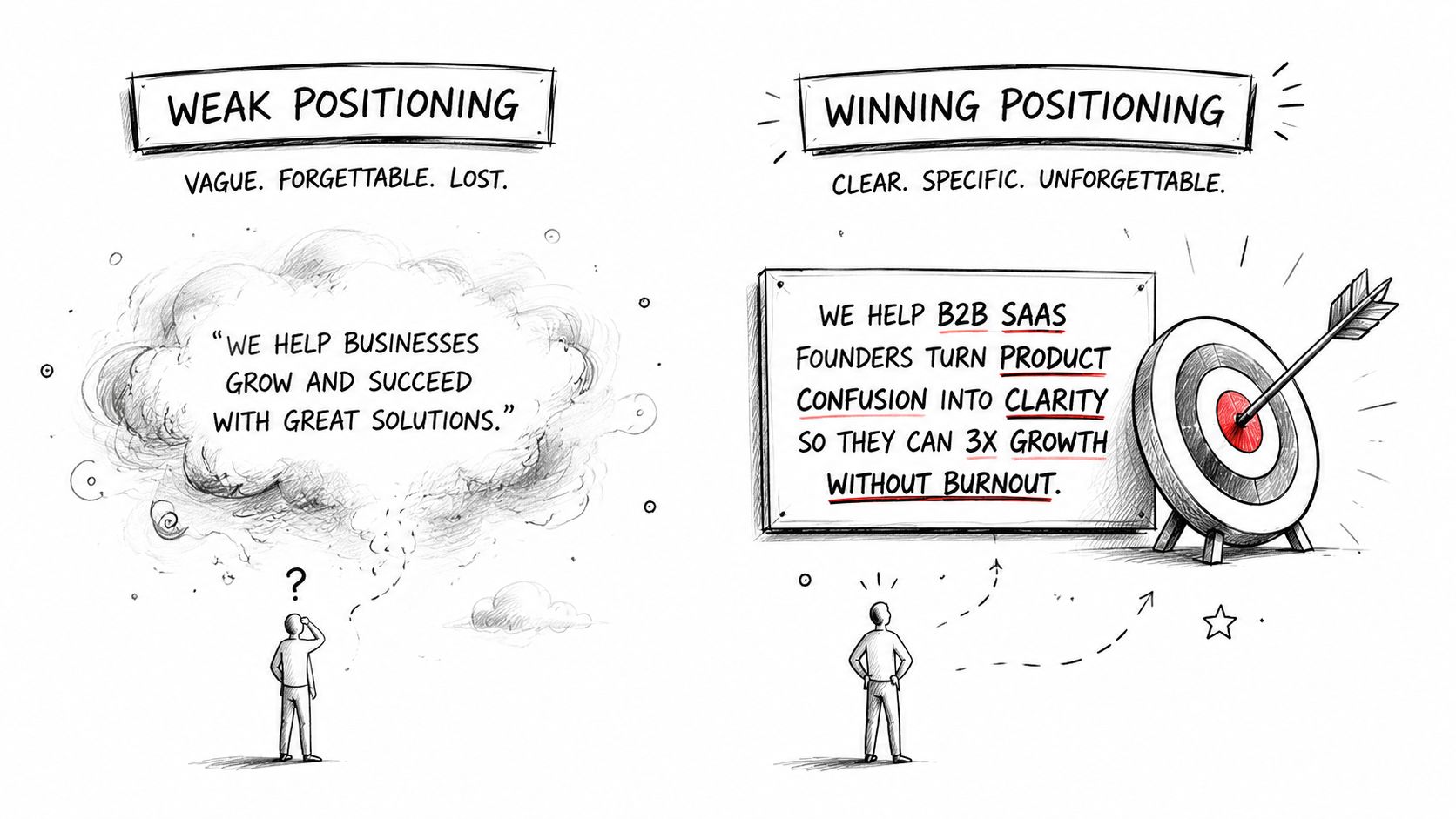
A strong statement should answer four questions in plain language:
That is the difference between a vendor claim and a market position. If any clause sounds interchangeable with a competitor, cut it.
For a tighter structure, how to write a positioning statement gives a useful template to pressure-test before anyone starts polishing copy.
A good statement also has to survive how the market sees you. A brand can sharpen its story when it stops speaking in generalities, and how Cleffex Digital ltd repositioned a renovation shows that move clearly.
The point is simple. Write for the buyer you want, the category you mean, and the proof you can defend.
Positioning without proof is advertising. Buyers don't trust your self-description just because you wrote it well. They trust what matches their experience, what competitors fail to say, and what evidence feels externally credible.
Brand positioning research in B2B works best when it's built around perceived strengths and weaknesses relative to competitors, because that reveals the decision drivers that influence buyer choice B2B International on brand positioning research. That's the part most internal teams miss. They gather evidence for what they want to say, not for what the market will believe.
A useful proof stack has four layers:
The point is not to sound impressive. The point is to make the promise feel safe.
Positioning should show up in the right conversations and the right deals. Watch whether content resonates with the intended personas, whether sales hears the same objections less often, whether win rates improve against the same competitors, and whether pipeline quality becomes cleaner. If the promise is working, the market stops forcing your team to over-explain.
Practical rule: when the same competitor keeps coming up in late-stage deals, your position is not yet distinct enough.
If you want a sharper review process, how to measure marketing effectiveness is the right internal read to pair with positioning work. Measure the signal, not the mood.
The mistake many teams make now is separating SEO from positioning. SEO drives discovery. Positioning drives trust. Those are not competing functions, they're different layers of the same system Frontiers in Communication on channel-coherent positioning.
The homepage should say what you are. Search content should reinforce the problem you solve. Sales decks should sharpen the comparison. Paid ads should not invent a different story just because the click needs a hook. If each surface tells a slightly different truth, buyers feel the drift.
That drift is where many SaaS brands lose momentum. The company sounds credible in one asset and generic in another. The market doesn't separate those moments. It just remembers inconsistency.
A 2025 mixed-methods study found that value-based and emotional positioning significantly improved customer loyalty and brand equity, while differentiation mattered especially in crowded markets JIER study on positioning and loyalty. That nuance matters. In saturated categories, being “different” isn't always the strongest lever. Sometimes the buyer needs a clearer sense of value, confidence, or emotional fit.
Scenario-driven positioning becomes useful. As markets shift, segment needs change, or buying committees get more complex, the story has to adapt without breaking coherence Frontiers in Communication on channel-coherent positioning. Static statements fail because markets don't stay static.
Big Moves Marketing works on this exact problem, connecting positioning, website messaging, and go-to-market planning so the story holds across channels instead of collapsing under them. If your market story is already drifting, visit Big Moves Marketing and compare your current position against the market reality you're selling into.
If your positioning only exists in a doc, it's already weak. The work is to turn it into a market system, one that holds up in search, sales, content, and buyer conversations without drifting. That's the difference between a story and a strategy.





%20-%20white.svg)