%20png%20copy.avif)

AI product marketing is the practice of applying machine learning, automation, and AI-driven personalization to position products, engage buyers, and accelerate revenue in B2B technology markets. The industry term for this discipline is “AI-powered marketing,” and it covers everything from automated content generation to real-time campaign optimization. AI automation consistently saves time and cost in professional marketing environments, freeing teams to focus on strategy instead of repetitive execution. The shift is not incremental. Marketing teams that adopt AI product marketing practices are building always-on systems that outpace competitors still running quarterly campaign cycles.
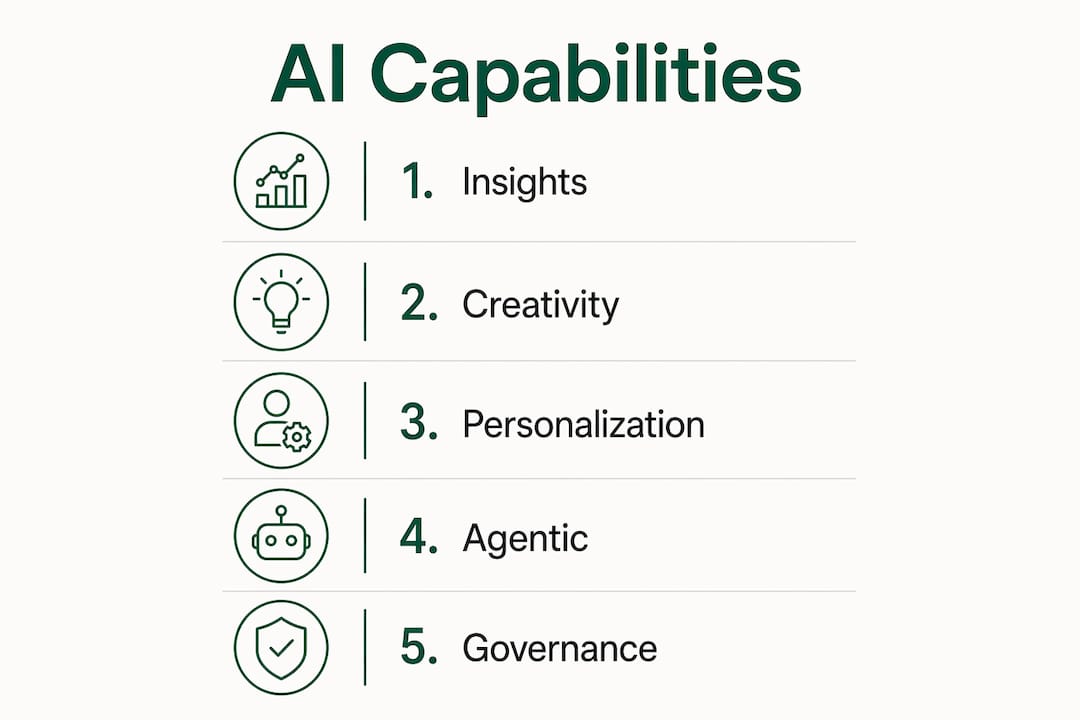
The marketing model is shifting from discrete campaigns to continuous growth, driven by five AI capabilities: insights, creativity, personalization, agentic commerce, and optimization. Each capability addresses a specific bottleneck that B2B product marketers face at scale. Together, they form the foundation of a modern AI marketing strategy.
Insights are the starting point. AI tools cluster large volumes of transcript and feedback data to reveal themes that would take a human analyst weeks to surface. AI enables faster analysis of qualitative data at scale, which means persona development and competitive intelligence move from quarterly exercises to continuous inputs.

Personalization is where AI delivers the most visible impact for B2B buyers. AI systems read behavioral signals, firmographic data, and intent signals to tailor messaging dynamically. A product marketer at a SaaS company can serve a CFO a pricing-focused message and serve a VP of Engineering a technical architecture message, all from the same campaign, without manual segmentation.
Agentic commerce is the newest frontier. Always-on AI systems accelerate customer journeys by making real-time decisions about content, channel, and timing without waiting for a human to approve each step. This compresses the time between a buyer’s first signal of interest and their first sales conversation.
The remaining two capabilities, creativity and optimization, work together. AI generates draft messaging, ad copy, and positioning variants at speed. Optimization then runs experiments across those variants and feeds results back into the next generation of content.
Pro Tip: Map each of the five AI capabilities to a specific bottleneck in your current product launch process before selecting any tool. Buying AI software without a bottleneck to solve is the fastest way to waste budget.
Effective AI integration starts with the quality of what you feed the system. Without rich context, AI produces generic language that fails to resonate with B2B buyers. The Kickstart Context framework addresses this directly: before prompting any AI system, define your audience profile, tone, market constraints, value proposition, and the competitive context you are working within.
The Kickstart Context framework is not a one-time setup. It is a living document that your team updates as you gather new customer intelligence. Here is how to build it:
Human governance must enforce policies to keep AI content aligned with brand values. This means a senior marketer reviews AI outputs before they reach buyers, not after. The review is not a bottleneck. It is the quality gate that separates differentiated messaging from the generic content flooding every B2B inbox.
Pro Tip: Build a shared “context library” in Notion or Confluence that stores your Kickstart Context inputs. Every team member who prompts AI pulls from the same library, which keeps outputs consistent across campaigns.
The most common mistake product marketers make is treating AI as a shortcut rather than a thinking partner. AI accelerates draft creation but cannot replace human judgment or evidence-driven strategy. The marketers who get the best results use AI to process data faster and generate options, then apply their own strategic judgment to select and refine.
The most effective AI tools in B2B product marketing combine customer intelligence with generative AI to produce content that is both fast and grounded. Microsoft’s internal marketing team built two agentic tools, MarThrive and AI Messaging Assistant, that access extensive customer voice data to tailor marketing content at scale. These tools show what is possible when AI is connected to real customer intelligence rather than operating on generic prompts.
The table below maps common B2B product marketing tasks to the AI technique that produces the best results.
| Marketing task | AI technique | Primary benefit |
|---|---|---|
| Persona development | Qualitative data clustering | Surfaces themes from hundreds of transcripts in hours |
| Messaging creation | Generative AI with Kickstart Context | Produces customer-language drafts grounded in evidence |
| Competitive monitoring | Automated sentiment analysis | Tracks category shifts and competitor positioning in real time |
| Campaign optimization | Real-time A/B testing with ML | Allocates budget to winning variants without manual review |
| Demand forecasting | Predictive modeling on CRM data | Identifies high-intent accounts before they raise their hand |
Automated sentiment analysis is particularly underused in B2B product marketing. Most teams read a sample of reviews manually. AI tools process every review, support ticket, and community post and return a ranked list of themes by frequency and sentiment. That output directly informs feature prioritization and messaging hierarchy.
Small teams benefit most from AI augmentation. A two-person product marketing team using agentic tools can produce the output volume of a team three times its size. The leverage comes from removing the manual steps between insight and execution, not from replacing the strategic thinking that connects them.
The biggest risk in AI-driven product marketing is not a technical failure. It is brand dilution from unsupervised AI content. When every company in a category uses the same AI tools with similar prompts, the output converges. Buyers read messaging that sounds identical across vendors, and differentiation collapses.
AI marketing transitions teams to dynamic, always-on operating systems with rapid experiment cycles. That speed is an advantage only when governance keeps quality high. Without guardrails, speed produces volume without value.
Competitive advantage in AI marketing comes from transforming processes into continuous, adaptive systems rather than merely automating existing workflows. Teams that automate without redesigning their operating model will produce more of the same mediocre content, faster.
The following guardrails protect brand integrity as AI scales:
The teams that get AI governance right treat it as a product discipline, not a compliance exercise. They build feedback loops between AI outputs, customer response data, and their context library so the system improves over time.
AI product marketing delivers the most value when human strategic judgment governs AI-generated outputs, customer evidence grounds every prompt, and governance systems prevent brand dilution at scale.
| Point | Details |
|---|---|
| Five AI capabilities drive growth | Insights, creativity, personalization, agentic commerce, and optimization form the core of modern AI marketing strategy. |
| Kickstart Context improves outputs | Feeding AI detailed audience profiles, tone constraints, and real customer quotes produces differentiated, specific messaging. |
| Governance prevents brand dilution | Human review of AI content before it reaches buyers is the primary defense against generic, undifferentiated messaging. |
| Agentic tools multiply small team output | Tools that connect customer intelligence with generative AI let small teams produce enterprise-scale marketing volume. |
| Continuous systems beat campaign cycles | Teams that redesign their operating model around AI outperform those that simply automate existing workflows. |
The conversation about AI in B2B marketing tends to split into two camps. One camp treats AI as a content factory. The other camp dismisses it as a threat to strategic thinking. Both are wrong, and both miss the actual opportunity.
What I have seen working with over 75 SaaS and technology companies is that the marketers who get the most from AI are the ones who bring the most to it. They feed AI their best raw material: real customer quotes, specific win-loss findings, and honest competitive assessments. The AI-native product marketer uses AI to process that material faster, not to replace the process of gathering it.
The skill that matters most right now is not prompt engineering. It is knowing what good looks like. If you cannot evaluate whether an AI-generated positioning statement is differentiated or generic, you cannot govern the output. That judgment comes from years of reading customer research and testing messaging in the market. AI accelerates execution. It does not build the judgment that makes execution worth accelerating.
The teams I see struggling are the ones that adopted AI tools before they had a clear B2B GTM strategy in place. They produce more content with less clarity. The teams winning are the ones that used AI to sharpen a strategy they already understood, then scaled it.
My advice: treat AI as a senior analyst who works at machine speed but needs your strategic direction. Give it the best inputs you have. Review everything it produces. And never let it write your positioning without a human who has talked to customers signing off on the output.
— Veb
B2B technology companies that want to move from manual campaign cycles to AI-driven growth need more than tools. They need a clear positioning foundation and a marketing operating model built to use AI effectively.
Bigmoves works with SaaS and technology companies to build exactly that. The branding and strategy services at Bigmoves cover positioning, messaging, and go-to-market planning designed for teams that want to use AI without losing their differentiation. Veb’s fractional CMO practice brings 17 years of B2B marketing experience directly into your team, helping you set the governance, context frameworks, and quality standards that make AI work at scale. If your team is ready to build a marketing system that compounds over time, Bigmoves is the right partner to start with.
AI product marketing is the use of machine learning, automation, and generative AI to position products, personalize buyer engagement, and optimize campaigns in B2B technology markets. It applies AI capabilities across the full marketing function, from persona development to campaign execution.
The Kickstart Context framework feeds AI detailed audience profiles, tone constraints, approved proof points, and real customer language before generating any output. Without this context, AI produces generic language that fails to differentiate B2B products in competitive markets.
The biggest risk is brand dilution from unsupervised AI content. When AI operates without governance, it produces messaging that converges with competitors, eroding the differentiation that drives buyer preference.
Agentic marketing tools like MarThrive and AI Messaging Assistant combine customer intelligence with generative AI to make real-time content and targeting decisions without manual intervention at each step. Standard AI tools require a human to initiate each task.
Small teams should start with the bottleneck that costs the most time: typically qualitative data analysis or first-draft content creation. AI tools that cluster transcript and feedback data deliver the fastest return for teams that lack the headcount to process customer research manually.


%20-%20white.svg)