%20png%20copy.avif)
Most advice on hiring an agency for B2B marketing is backwards. It starts with vendor lists, service menus, and RFP templates. That's procurement thinking. It's the wrong frame.
Founders don't usually have an agency problem. They have a go-to-market diagnosis problem. They're seeing slow pipeline, weak conversion, uneven lead quality, or a sales team that keeps rewriting the story on every call. An agency can help. It can also magnify the mess.
The hard truth is simple. If your message is sharp, your ICP is clear, and at least one acquisition path shows real signal, an external team can accelerate you. If those pieces are still fuzzy, paying for more activity won't save you. It will just make the confusion more expensive.
Stop treating this like a vendor search.
If you rush into agency calls because pipeline is soft or the team is stretched, you will likely buy activity, not progress. Founders do this all the time. They assume the problem is execution capacity when the problem is go-to-market uncertainty. The message is weak. The ICP is blurry. Sales and marketing are chasing different buyers. An agency cannot fix that by publishing more content or launching more campaigns.
An agency does one thing well. It multiplies whatever is already true in your business. Clear positioning gets stronger. Confused positioning spreads faster.
Practical rule: Do not hire external execution to solve internal ambiguity.
That is the key hiring decision. You are not choosing between one agency and another. You are deciding whether you need a strategic partner to help you validate your go-to-market story, or an execution partner to scale a story that already converts.
Plenty of firms can sell you confidence. Fewer can tell you, plainly, that your problem starts upstream. If your team cannot answer basic commercial questions with consistency, agency selection is the wrong first project. Start by diagnosing the gap. Is the market message broken, or is the message working and your team cannot produce enough of it?
If the bottleneck is strategic, a broad agency retainer is usually premature. A tighter first move is often a strategy engagement or a fractional marketing model for B2B growth leadership that helps you sort out positioning, channel focus, and ownership before you add execution horsepower.
The question is simple. Do you need someone to scale a working system, or someone to fix the system first?
Before you talk to agencies, audit your own readiness. Teams often skip this because it's uncomfortable. That's exactly why they should do it.
Ironpaper reports that only 56% of B2B companies say they generate enough qualified leads, and 49% struggle to digitize the buyer's journey, as summarized in this B2B marketing statistics resource. That's not an execution footnote. That's evidence that many companies try to scale before the basics are stable.

A lot of SaaS teams claim they're ready to scale when they're still in search mode.
Search mode means your company is still testing major assumptions:
Scale mode looks different:
If you don't know which mode you're in, assume search until proven otherwise. False certainty burns budget.
For a more useful stage lens than generic startup maturity charts, compare your situation against a B2B company growth stages framework. Most hiring mistakes happen when a team labels itself “growth-stage” because of funding, while its GTM system still behaves like an early experiment.
Don't overcomplicate this. Audit three areas and be ruthless.
| Area | What to ask | What failure looks like |
|---|---|---|
| Messaging | Can five people explain who you serve and why you win in roughly the same language? | Every function tells a different story |
| Channels | Is there one channel you trust enough to invest more into? | You have activity, not signal |
| Sales feedback | Do reps hear repeatable pain points and objections? | Every deal sounds “unique,” which usually means the narrative is weak |
A direct internal review should also surface where the actual bottleneck sits:
Strategy problem
You don't need more campaigns. You need positioning, segmentation, and a tighter offer narrative.
Execution problem
The strategy is credible, but the team can't ship fast enough. An external execution partner can help.
Operating model problem
The issue isn't message or channel. It's poor handoffs between marketing, sales, and CRM.
If your website, sales story, and channel tests all point in different directions, hiring an agency won't create alignment. It will expose the lack of it.
That's the value of the audit. It tells you whether to buy strategic correction or execution capacity.
Founders get this wrong all the time. They hire an agency against a reporting problem when the company has a go-to-market problem.
A brief full of KPIs does not give an agency direction. It gives them permission to stay busy. More MQLs, more content, lower CAC, better conversion rates. Those are scorekeeping lines, not a mission. If your agency starts from that list, you will get activity shaped around dashboards instead of work shaped around revenue.
The right brief starts with the business decision you are trying to force. Are you proving that a new segment is worth pursuing? Replacing founder-led selling with a repeatable demand engine? Tightening the path from first visit to qualified sales call? That is the job.
Agencies rarely push back hard enough here. They hear a stack of requests from the founder, the head of marketing, and the board, then turn the mix into deliverables.
That is how companies end up with traffic growth, content calendars, paid campaigns, and no meaningful change in pipeline quality or sales velocity.
A weak brief usually sounds like this:
None of those tells a serious partner what commercial problem they own.
A strong mission has consequences. It forces trade-offs. It tells the agency what to ignore. Buyers now evaluate agencies more on business impact than creative polish, which matches the broader shift in the B2B marketing category noted earlier.
A usable mission usually includes four parts:
Commercial context
What changed in the business that made this a priority right now?
Targeted scope
Which segment, product line, buyer type, or region comes first?
Expected business effect
What should improve if the work succeeds?
Boundaries
What is outside the engagement so the team does not spread itself thin?
Here is the difference.
| Weak brief | Strong mission |
|---|---|
| Need SEO support | Prove whether organic search can generate qualified demand in one defined segment |
| Need paid media help | Test whether paid acquisition can create sales-ready opportunities without founder involvement |
| Need content marketing | Build a message system sales and marketing can use across the site, outbound, and nurture |
This section is where agency selection becomes a GTM validation exercise. If the message is still unproven, hire a strategic partner who can sharpen positioning and offer narrative first. If the message already works and the issue is speed or capacity, hire an execution partner. If you skip that distinction, you will buy the wrong kind of help.
The scorecard comes after the mission. Use metrics to judge whether the mission is working, not to define the mission itself. SuperX's KPI guide is a useful reference because it separates vanity reporting from metrics tied to actual business decisions.
One more filter. Pay attention to how an agency reacts to your brief. If they accept a vague mission and rush to propose channels, they are probably selling a package. The better agencies challenge the framing, narrow the scope, and force clarity before they pitch. If you need a benchmark for what that market looks like, review this list of B2B marketing firms and compare how clearly each one defines the problem it solves.
A standard RFP is usually a waste of time. It rewards agencies that know how to write polished answers, pad timelines, and mirror your language back to you. It does not reliably surface the team that can fix a broken GTM motion.
Treat agency evaluation like GTM validation. Your job is to find out whether you need a strategic partner to correct the message and offer, or an execution partner to scale a message that already converts. If you blur those two jobs, you will hire the wrong agency and blame the channel.
Start with the visual summary below.
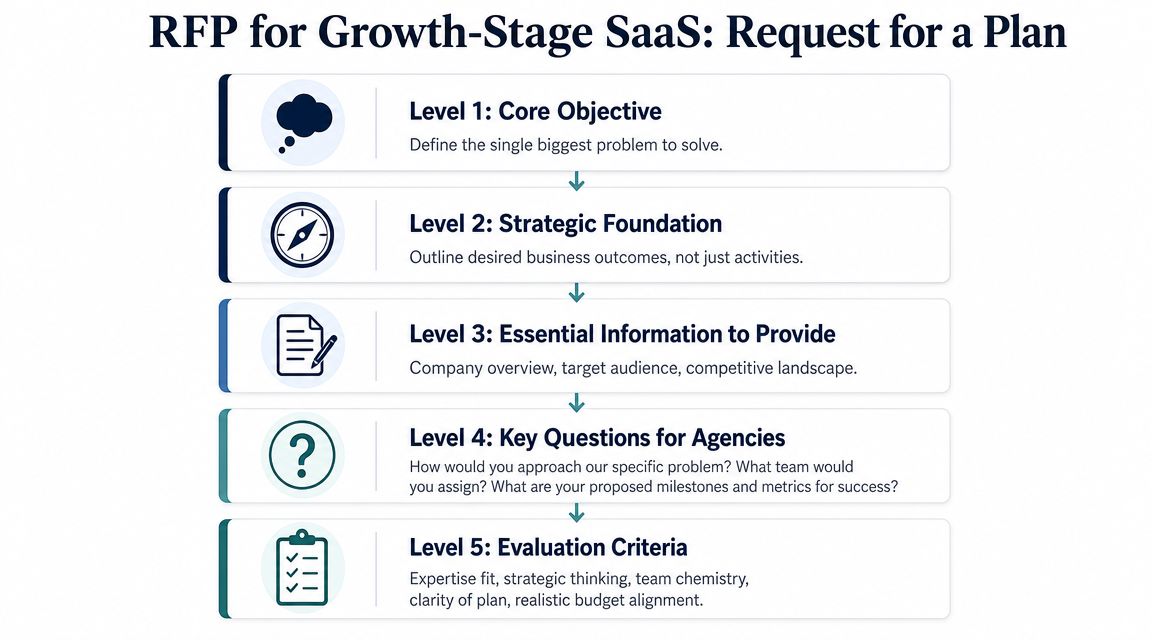
Keep the brief short. Force specificity. A good agency should come away with a clear problem to solve and enough context to tell you what is missing.
Include these elements:
The mission
State one business problem with a clear decision attached to it.
The constraints
Include budget range, internal bandwidth, market realities, timeline, and any platform limitations.
The assets you already have
Spell out existing demand, founder credibility, customer proof, product usage data, sales capacity, and anything the agency can use immediately.
Definition of success
Name one or two measures tied to pipeline, revenue, or sales efficiency.
A strong screening test is simple. Watch the quality of their questions. If the agency does not challenge your assumptions, narrow the scope, or expose gaps in your thinking, they are probably mapping you to a standard service package.
Category fit also matters. If you are comparing options, this list of B2B marketing firms for different agency models and specialties is a useful way to separate broad execution shops, narrow specialists, and true strategic partners.
The best B2B agencies usually stand out in two areas: RevOps depth and attribution logic. This distinction is important, as agencies must connect campaign activity to systems like HubSpot or Salesforce instead of reporting isolated channel metrics. The VSSL agency review of measurable-growth B2B tech agencies is useful here because it shows how agencies frame measurable outcomes and operational maturity, not just channel tactics.
A short explainer helps here:
Founders get distracted by polish. Ignore the deck.
Judge the diagnosis, the decision-making, and the operating model behind it.
Ask questions like these:
The right agency pressure-tests your plan before it scales your budget.
Use a simple framework during evaluation:
| Type | Good for | Risk |
|---|---|---|
| Execution-heavy agency | Teams with clear positioning and proven channel signal | Produces activity while weak strategy stays untouched |
| Specialist shop | Narrow problems like SEO, paid search, or lifecycle work | Fixes one slice while the wider funnel remains broken |
| Strategic partner | Companies that need message, site, and experiments aligned | Requires more upfront work before campaign volume ramps |
Big Moves Marketing is one example of that third category. Its model combines fractional CMO work with B2B marketing consulting across positioning, messaging, websites, and GTM pilots. That model fits companies that need strategic correction before execution, or at the same time as execution.
Pricing tells you what behavior the relationship will reward. Ignore that, and you'll end up paying for the wrong kind of effort.
Most founders look at agency pricing as a budget question. It's really an incentive design question.
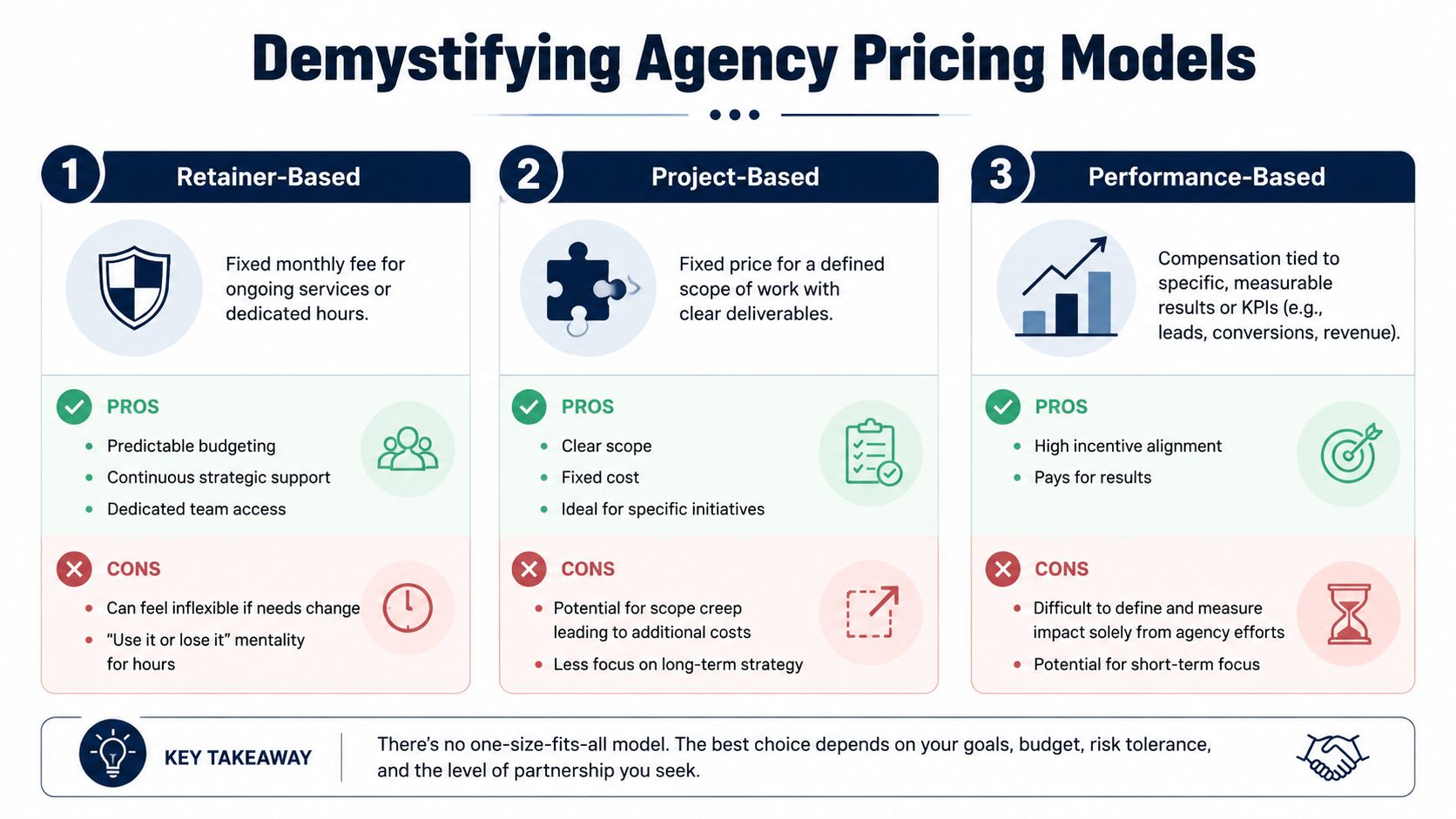
Retainer models are good when the work requires continuity. Messaging refinement, paid optimization, lifecycle systems, and cross-functional coordination all benefit from ongoing involvement. The problem is obvious. Retainers can drift into recurring activity with weak scrutiny.
Project-based work is cleaner when the output is discrete. A positioning sprint, website rebuild, messaging architecture, or CRM cleanup fits this model well. It gives you cost certainty. It also creates handoff risk if nobody owns the system after delivery.
Performance-based pricing sounds founder-friendly and often isn't. It can push an agency toward low-quality lead volume, aggressive attribution claims, or short-term channel decisions. It also falls apart if your tracking is weak or the sales cycle is long.
Decision test: If the pricing model rewards more spend, more leads, or more hours regardless of pipeline quality, expect misalignment.
One of the most common traps is percentage-of-spend pricing. It can work in some contexts, but many B2B SaaS teams should be skeptical. If compensation rises when ad spend rises, the agency has a built-in reason to push budget expansion before the commercial model is proven.
For a useful lens on structuring commercial terms around outcomes rather than arbitrary packaging, this piece on value-based pricing is worth reading.
Here's the simpler way to decide:
I'd also insist on a few commercial safeguards:
| Contract feature | Why it matters |
|---|---|
| Clear exit terms | Prevents perma-retainers with no accountability |
| Named team | Stops the bait-and-switch after the deal closes |
| Defined ownership | Clarifies who controls data, creative, and systems |
| Review cadence | Forces strategy discussion before more spend is approved |
The right pricing model won't save a bad engagement. But the wrong one can gradually corrupt a good strategy.
The first quarter decides whether the partnership becomes useful or noisy. Most failed engagements don't collapse because the agency was lazy or the client was impossible. They fail because nobody established the operating system.
A serious onboarding process starts with access and instrumentation. Benchmarks summarized by GTM 80/20's B2B marketing agency statistics report 748% ROI for organic search and 9.10 ROAS when execution is disciplined. That only matters if attribution is set up well enough to prove what's happening.

Clients often expect results while withholding the inputs required to produce them.
Your side needs to provide:
System access
CRM, analytics, ad accounts, past performance data, call recordings, and reporting history.
Human access
Founder, sales lead, product marketer, customer success, and if possible, direct customer conversations.
Decision access
Someone must be able to approve changes quickly. Slow approvals kill early learning.
If you want the agency to improve messaging, give them sales calls. If you want them to improve conversion, give them form data and funnel visibility. If you want them to improve paid efficiency, give them CRM outcomes, not just click data.
A practical support tool here is a strong marketing brief template, especially if your internal stakeholders tend to give vague requests and conflicting feedback.
A competent partner should return the favor with structure.
In the first 90 days, I want to see:
A diagnosis
What's broken, what's promising, and what shouldn't be touched yet.
A 30-60-90 day plan
Early fixes, controlled experiments, and the specific decisions each phase is meant to inform.
A reporting hierarchy
Business outcomes first, channel performance second, activities last.
An experiment log
Hypothesis, change made, expected signal, observed outcome, next action.
A good reporting stack usually looks like this:
| Reporting level | What belongs there |
|---|---|
| Business outcomes | Pipeline, qualified opportunities, revenue-linked movement |
| Channel performance | Conversion rates, cost efficiency, progression quality |
| Activity metrics | Pages shipped, campaigns launched, emails sent |
If the weekly meeting is mostly about assets produced, the engagement is already drifting.
One more point. The first 90 days should not feel like passive onboarding. It should feel like a controlled effort to reduce uncertainty. The partner is there to create signal, not theater.
No agency relationship should be indefinite by default.
The best partnerships make the company stronger, not more dependent. That means the engagement should have an exit ramp, a handoff path, or a clear next-stage evolution.
The strategic choice often isn't agency or no agency. It may be agency versus specialist versus fractional CMO. As discussed in Factors.ai's review of B2B demand generation agencies, that decision depends on whether you need full-funnel ownership or a sharper positioning-and-pipeline reset before scaling spend.
Use a quarterly review to ask a blunt question. Is this partner still providing capability we can't or shouldn't build internally yet?
Good reasons to evolve the relationship include:
Internal maturity increased
You've hired a strong in-house marketing lead who can own more of the system.
The bottleneck changed
What started as a positioning problem is now a paid media optimization problem, or the reverse.
The external partner succeeded
They built process, reporting, and operating rhythm your team can now run.
Bad reasons to continue include habit, political convenience, or fear of rebuilding ownership internally.
A healthy engagement creates transfer, not dependency. If the partner can't explain how your team becomes more self-sufficient over time, you're not buying strategic support. You're renting motion.
If your team is deciding whether it needs strategic correction before more execution, Big Moves Marketing is built for that kind of conversation. The work is centered on positioning, messaging, website clarity, and focused GTM pilots so founders and revenue leaders can see where real signal exists before committing to more spend.
Explore Big Moves Marketing services and resources:




%20-%20white.svg)