%20png%20copy.avif)
In a B2B software market crowded with look-alike solutions, product differentiation is what makes your product the obvious choice for your ideal business customer. It’s the deliberate process of engineering your offering to be distinct from—and more valuable than—everything else out there. This isn't about a single killer feature; it's about the entire experience you deliver.
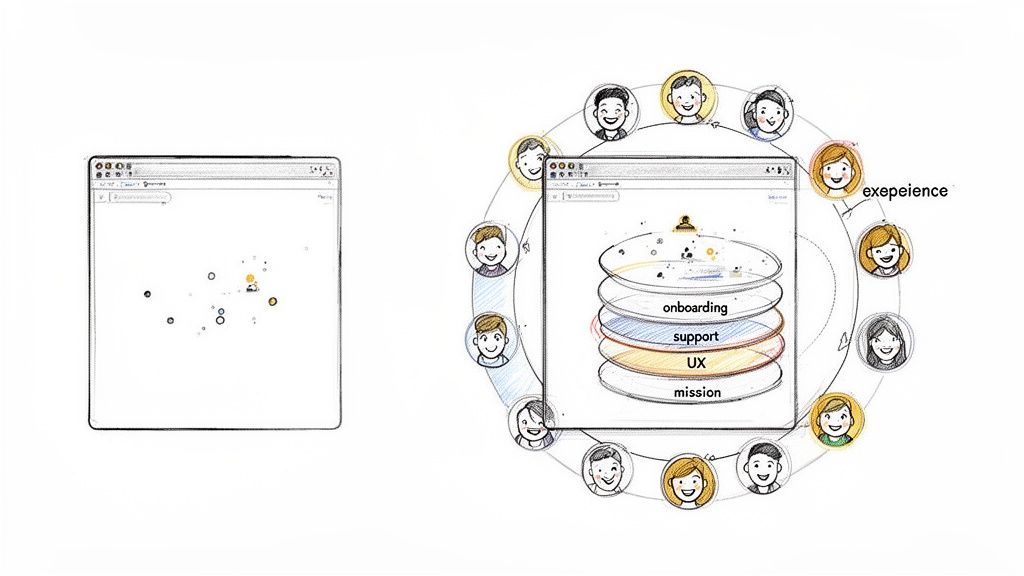
Picture two B2B software companies. Both sell nearly identical CRM tools. One company fights for every deal, constantly slashing prices just to get a signature. The other is thriving, commanding a premium price and attracting a loyal, ever-growing customer base. The secret ingredient? A powerful differentiation strategy.
At its core, product differentiation is a fundamental business decision. It's the art of carving out a unique space in your customers' minds so that when they face a certain business problem, your name is the first one they think of. This isn’t about being different just for the sake of it; it’s about being meaningfully different in a way your target market genuinely values.
Without a clear point of difference, B2B products inevitably fall into the commoditization trap. It’s a dangerous place to be. When price becomes the only thing separating you from other vendors, you’re pulled into a downward spiral of shrinking margins and relentless pressure to be the cheapest.
True differentiation is your escape hatch.
It’s the bedrock for your company's growth and authority. When your product is well-differentiated, you can:
A strong differentiation strategy transforms your product from just another tool into the only option for the right business customer. It’s the source code for building a memorable brand and a durable business.
This is all deeply connected to how you talk about your product. To learn more about articulating this unique value, it helps to understand what is a value proposition and how it communicates your point of difference.
Ultimately, differentiation isn’t just a marketing concept—it's a strategic imperative. It influences everything from product development to your sales process. It’s about making a deliberate choice to stand for something specific, ensuring your business doesn’t just survive, but thrives.
So, why should a B2B founder obsess over product differentiation? Because it is the single most powerful tool you have for shaping your company's financial destiny and cementing your authority in the market. In the unforgiving world of B2B SaaS, a differentiated product isn’t some abstract marketing goal; it’s a critical financial instrument.
Genuine differentiation is your ticket out of the soul-crushing race to the bottom on price. When your solution is seen as unique—even irreplaceable—you gain real pricing power. This is the freedom to charge what your product is actually worth, which flows directly into your margins, your revenue, and ultimately, your valuation.
Without a distinct identity, your product becomes just another line item on a spreadsheet, forced to compete on price alone. That’s a battle you can’t win long-term. A unique position, however, fundamentally shifts the conversation from, "How much does it cost?" to, "How does this solve my specific business problem in a way no one else can?"
This shift isn't just theoretical; it has a measurable impact on how you acquire and keep business customers.
A well-differentiated B2B product carves out a category of one in the buyer's mind. It moves beyond features to become the essential solution, creating a powerful economic moat that protects your business from other vendors.
This link between differentiation and financial health is more than just a gut feeling. Research consistently shows a direct line between a brand's perceived uniqueness and its ability to command premium prices and grow market share. In fact, a deep analysis of brand performance found that a "Meaningful Difference" accounts for a staggering 94% of a brand's pricing power.
This statistic alone should be a wake-up call for B2B founders. Building financial resilience starts by focusing on what makes you unique from day one. When you nail this, you hand your sales team the ammunition they need to justify your price and close bigger deals. To dig deeper, you can explore our expert guide on how to price software products and align your pricing with your differentiated value.
The same research also highlights that even a modest 10% improvement in brand differentiation can boost market penetration by 2.2%. That might not sound like much, but it outpaces the impact of just being well-known or even having satisfied customers. For a B2B startup, that early traction is everything—it's the difference between blending into the background and building a financial foundation strong enough to scale. You can find more insights on how differentiation drives pricing power and penetration at Kantar.com.
Differentiation isn't some monolithic, abstract concept. It’s a multi-faceted game of carving out your unique space in the market, and for B2B founders, understanding the different ways to play is the first step toward building a business that’s both memorable and defensible.
Forget looking for a single "right way" to stand out. Instead, think of it like a toolkit. There are six proven paths you can explore, combine, and master to build a real advantage.
When you get this right, the impact is huge. Effective differentiation directly unlocks two of the most critical drivers for any SaaS business: pricing power and market penetration.
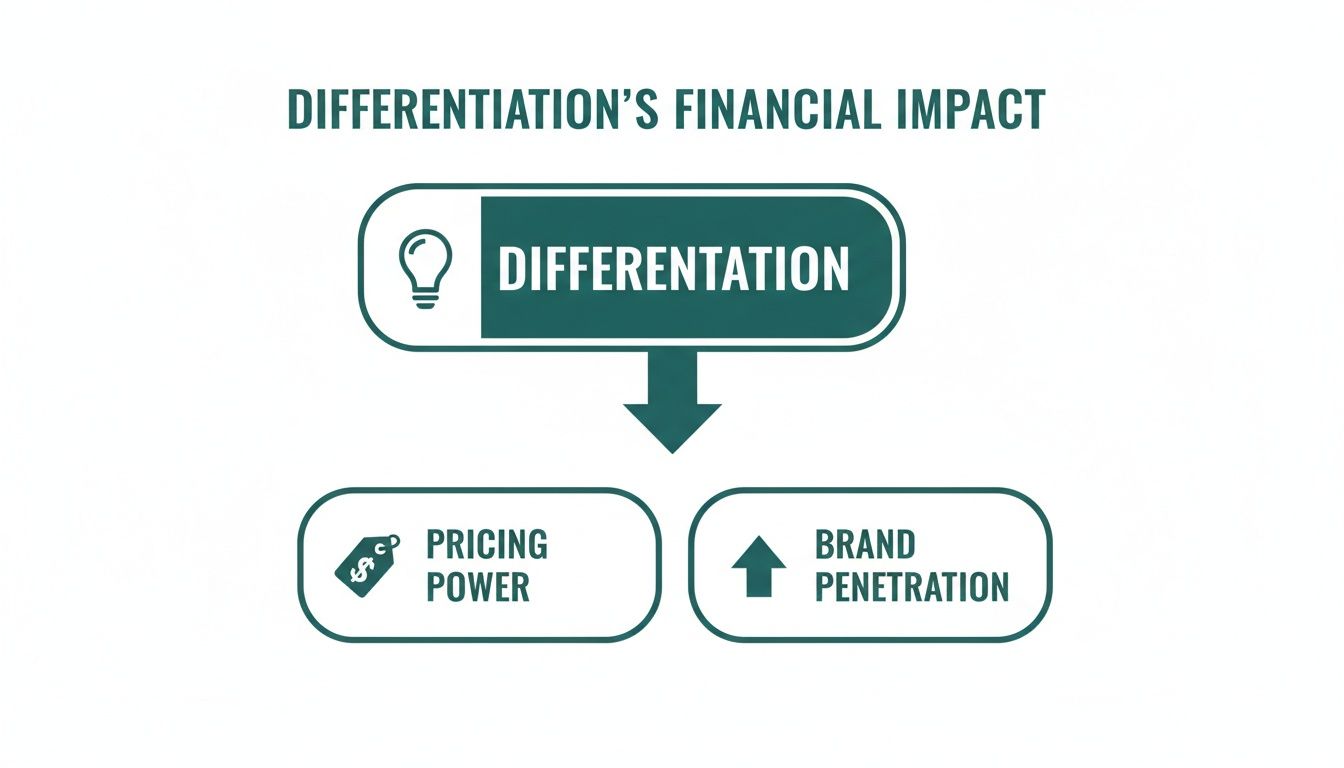
This isn’t just a branding exercise. It’s a direct line to healthier margins and a stronger, more defensible footprint in your market. Each of the following paths offers a distinct way to build that advantage.
This is the classic "build a better mousetrap" approach, and it’s often the first place B2B SaaS companies look to create separation. It's all about offering functionality or underlying tech that your rivals simply can't match.
We’re not talking about minor, incremental feature additions that can be copied in the next sprint. The key here is true, defensible innovation—a proprietary algorithm, a one-of-a-kind workflow, or a performance metric that's an order of magnitude better than the status quo.
Mini Case Study: Gong
Gong's "Revenue Intelligence" platform didn't just record sales calls; it used proprietary AI to analyze them. While other vendors offered simple recordings, Gong’s tech could identify topics, track talk-time ratios, and automatically surface deal risks. This deep technological advantage created an entirely new category, giving sales leaders a tool that delivered insights, not just data.
In the B2B world, the product is often only half the equation. The other half is the human expertise that ensures customers actually succeed with it. Differentiating on service means turning your support, onboarding, and customer success into a core part of your value proposition.
This path is especially powerful in complex industries where implementation and adoption are massive hurdles. Think dedicated onboarding specialists, 24/7 expert-led support, or a success team that acts more like a strategic consultancy than a help desk.
When the product is complex, world-class service isn't a cost center—it's your most powerful sales tool. It creates advocates who will never leave you for a slightly cheaper, self-serve alternative.
Mini Case Study: Kinsta
Plenty of companies offer managed WordPress hosting, but Kinsta built its brand on exceptional, expert-led support. Every single customer, no matter their plan size, gets access to the same team of veteran WordPress developers. For businesses that can't afford downtime or slow ticket resolutions, that promise of fast, competent help is a game-changer.
A powerful product with a clunky, unintuitive interface is a recipe for churn. Differentiating on user experience (UX) is about making your software not just usable, but genuinely efficient and even enjoyable. It’s about solving customer problems with the least amount of friction possible.
This goes way beyond aesthetics. A great UX means designing workflows that map perfectly to how your users think, reducing the clicks it takes to get a job done, and presenting complex data in a simple, actionable way. An intuitive UX can slash training time and accelerate a customer’s time-to-value.
Mini Case Study: Slack
Before Slack, internal team communication was a chaotic mess of emails and random chat apps. Slack's genius was its UX. With its clean channels, dead-simple integrations, and searchable history, it made collaboration feel organized and effortless. The design was so user-centric that it completely changed how modern businesses communicate.
How you charge for your product can be just as unique as what it does. Differentiating on your business model means creating pricing structures that align better with customer value or dramatically lower the barrier to entry. This isn't just about being cheaper; it’s about being smarter.
A few ways to do this include:
Mini Case Study: Twilio
Twilio completely upended the telecommunications space with its developer-first, pay-as-you-go model. Instead of locking businesses into complex, long-term contracts, they let developers embed powerful communication APIs with totally transparent, usage-based pricing. This removed all the friction and made enterprise-grade tools accessible to everyone.
B2B software never exists in a vacuum. Your product's value explodes when it connects seamlessly with the other tools your customers depend on every day. Differentiating through integrations means building a robust, interconnected ecosystem around your platform.
Deep, reliable connections to essential tools like Salesforce, HubSpot, or AWS become a powerful, sticky reason for customers to choose and stay with you. To learn more, check out our guide on customer segmentation for B2B to pinpoint which integrations your key audiences value most.
Mini Case Study: Zapier
Zapier's entire business is a masterclass in ecosystem differentiation. It doesn't really perform a core business task itself; its value comes from being the indispensable "glue" that connects thousands of other apps. By positioning itself as the central hub of the modern tech stack, it has built an advantage that’s incredibly difficult for anyone to cross.
Finally, you can stand out through your brand’s story, its values, and its mission. This is about building an emotional connection by standing for something more than just features and functions. It could be a powerful origin story, a deep commitment to a specific B2B niche, or a bold vision for the future of an industry.
A strong brand doesn't just attract customers—it builds a community of true believers.
Mini Case Study: Basecamp
Basecamp differentiates through its strong, opinionated brand. The founders have built a loyal following by championing a calmer, more sustainable way to work. Their mission-driven approach resonates deeply with businesses that are fed up with the "hustle culture" and want tools that reflect their own values.
To help you sort through these options, here's a quick summary of each path, its primary goal, and a potential challenge to keep in mind.
Ultimately, the strongest companies don't just pick one path. They strategically blend several of these approaches to create a multi-layered defense that other companies find nearly impossible to replicate.
Real product differentiation does more than just win you the next deal; it can actually redefine an entire industry, creating massive value where everyone else saw a dead end. This isn't about inventing a whole new category out of thin air. It’s about finding a new, fundamentally better way to deliver value that makes the old way feel instantly obsolete.
This is exactly how sleepy, commoditized markets get a jolt of energy. It’s the story of how a seemingly ordinary product, sparked by the right insight, can become a high-value category leader.
Let's look at the humble water bottle. For years, it was a race to the bottom on price—a basic utility you grabbed at a convenience store. Then, in 2010, S’well came along. Founder Sara Kauss didn’t just sell a container for water. She differentiated with elegant, triple-layered stainless steel designs that kept drinks cold for 24 hours or hot for 12.
Suddenly, a simple utility became a fashion statement. A status symbol. The result was incredible. S'well skyrocketed to $100 million in annual revenue and kicked off explosive growth across the entire category as stylish, high-performance bottles became must-have accessories.
A truly disruptive idea doesn't just capture market share—it expands the market itself. It elevates customer expectations to a point where the old, commoditized version is no longer acceptable.
This exact playbook is incredibly powerful for B2B SaaS founders. Think about it: an established industry giant might offer a sprawling, feature-heavy platform, but a startup can come in and disrupt it with a radically simplified UI that solves one specific job flawlessly.
A legacy provider might lean on generic data models, but a new challenger can win with a hyper-specialized AI model trained on a niche dataset that delivers obviously superior results. This is the kind of meaningful difference that grabs attention and builds momentum. It’s about finding the friction in how things are currently done and building your entire product experience around eliminating it.
This shift in thinking is also changing how early-stage B2B companies get funded. For a long time, the only metric that seemed to matter to investors was Total Addressable Market (TAM). But a massive market filled with lookalike products is just a recipe for sky-high customer acquisition costs and razor-thin margins.
Today, savvy investors are prioritizing differentiation over sheer market size. They've seen how a unique B2B product can reshape entire industries. Take the mattress industry. Legacy players just confused shoppers with endless, nearly identical SKUs. Then Casper flipped the script with one transparent, customer-centric bed-in-a-box. By 2018, they had surpassed $600 million in revenue, fueling a direct-to-consumer wave that captured 10% of the $15 billion US market.
True innovators create their own demand. Investors know that a company with a deep, defensible point of difference can carve out a profitable niche even in the most crowded space. As a deeper analysis reveals, investors see that product differentiation outweighs market size in early-stage investing.
This approach is sales enablement gold. For SaaS founders, it means building value proposition playbooks and objection-handling guides that give your sales team the exact language to highlight your unique advantages—like that proprietary AI algorithm solving a niche B2B pain point—that commoditized rivals simply can't match. This is the heart of what we do at Big Moves Marketing, helping founders translate their unique technology into a story that sells.
Knowing you need to be different is one thing. Actually building a strategy to get there is a whole different beast. For a B2B founder, the process can feel frustratingly abstract.
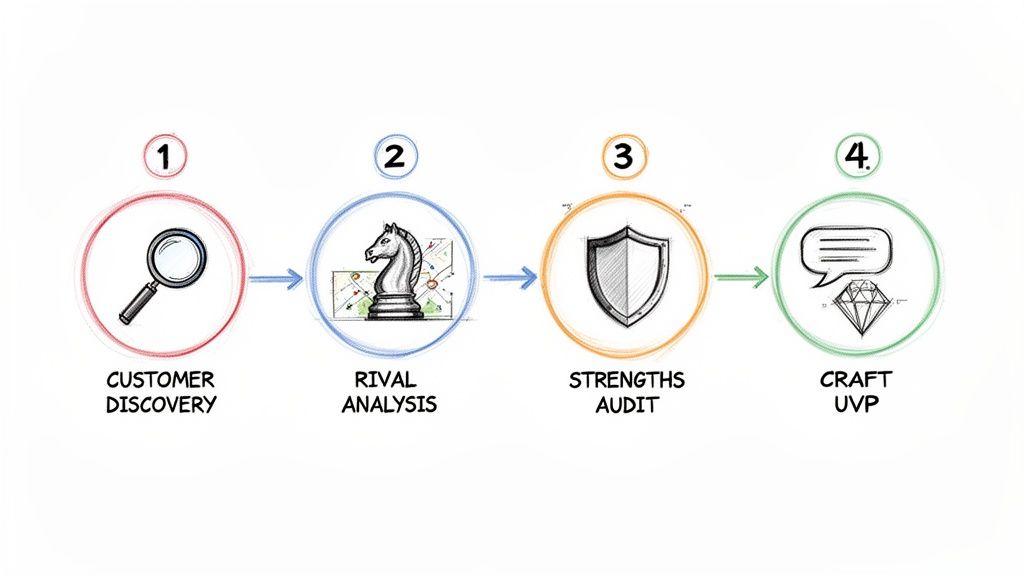
The key is to move from a vague idea to concrete execution with a repeatable framework. This isn't about a single, caffeine-fueled brainstorming session. It's a disciplined process of discovery, analysis, and validation designed to turn inspiration into a defensible market position.
The goal is simple: build a strategy grounded in reality—what your B2B customers desperately need, what your rivals are completely ignoring, and what your team can do better than anyone else.
First things first, you have to go beyond surface-level business pain points. Your customers will always tell you they want a faster, cheaper solution. But your real opportunity? It lies in the unstated needs and hidden frustrations they've just accepted as the cost of doing business.
This means getting past surveys and into real, meaningful conversations. You’re trying to unearth the "job to be done" hiding behind their feature requests.
Try asking questions that dig a little deeper:
This is how you uncover the emotional and operational context of their problems. It’s the raw material you need to build something genuinely unique.
Once you're inside your customer's world, you need to map it against the options they already have. An honest analysis of your rivals isn’t just about making a feature-for-feature checklist. It’s about understanding their game so you can choose to play a different one.
Are they all duking it out over enterprise clients with bloated, complex feature sets? Maybe there’s a massive opening for you to serve mid-market companies with radical simplicity.
To really see these opportunities, a positioning map is your best friend. We have a great positioning map template you can use to plot where rivals sit on key axes, like "Ease of Use vs. Power" or "Niche Focus vs. General Purpose." This exercise makes market gaps jump off the page, showing you exactly where the uncontested ground lies.
With a clear picture of customer needs and market gaps, the lens turns inward. What does your company, your team, or your tech do exceptionally well? Your most defensible point of differentiation will always be rooted in an authentic strength.
Trying to differentiate on world-class service when your team is built for product-led growth is a recipe for disaster. Likewise, claiming technological superiority without a genuine, defensible innovation is a strategy with a very short shelf life.
Be brutally honest. What are your unique assets?
Your differentiation strategy must amplify who you already are, not who you wish you were.
The final step is to pull all your findings together into a clear differentiation hypothesis. This is your proposed unique value proposition—the sweet spot where what your customer wants, what rivals don't offer, and what you do best all intersect. To do this right, you really need to understand what is a product strategy at its core.
A strong differentiation hypothesis isn't just a marketing slogan; it's a strategic choice that dictates your product roadmap, your hiring decisions, and your sales messaging. It's the central organizing principle for your business.
Now, before you bet the farm, test it. Take your newly crafted value prop to a handful of your ideal prospects. Does it resonate instantly? Do their eyes light up? If you have to spend five minutes explaining why it’s great, you haven’t nailed it.
This early validation is critical. It ensures your strategy will actually connect in the real world, turning a brilliant idea into tangible business results.
Let's be blunt: a brilliant differentiation strategy is completely useless if it just sits in a slide deck on a shared drive. To actually move the needle, you have to translate that internal strategy into sharp, compelling messaging that connects with real-world B2B buyers.
This is where the rubber meets the road. It’s the bridge between knowing you’re different and proving it to the market.
Your differentiation becomes real when it shows up consistently across every single customer touchpoint—from the headline on your website to the theme of your content and the punchline of your ad campaigns. It all starts by crystallizing your unique position into a powerful one-liner.
From there, you build out a full messaging framework to ensure everyone in your company is telling the same story, the same way. There are plenty of great messaging framework examples out there to see how this gets done. This unified voice is what turns a good strategy into a brand people remember.
Marketing can crack the door open, but your sales team is the one that has to walk through it and close the deal. This is why sales enablement is the engine that brings your differentiation to life.
And effective sales enablement is so much more than just handing reps a new pitch deck. It’s about building a complete toolkit that empowers your team to articulate your unique value with unshakable confidence in every single conversation.
Your differentiation is your sales team’s greatest asset. When they can clearly explain why you are the only real choice, price objections fade and conversations shift from cost to value.
To get this done, focus on creating these three core assets:
Finally, to truly activate your differentiation, developing a comprehensive B2B LinkedIn marketing strategy is essential for reaching your target audience and communicating that unique value directly where they spend their time.
When your marketing channels and your sales conversations are perfectly aligned around your differentiation, your entire go-to-market motion becomes a powerful, self-reinforcing engine for growth.
As you start mapping out your own differentiation strategy, some very real, practical questions are bound to pop up. These are the common sticking points I see B2B founders run into when they move from the idea of differentiation to the nitty-gritty of getting it done. Let's get you unstuck with some straight answers.
This is the question I hear most often, especially in crowded B2B SaaS spaces. The answer is simple but powerful: look beyond the code. If your core features have hit parity with other vendors, your biggest opportunity to stand out is in the experience around the product.
This is where you can build a truly defensible moat by doubling down on the things your rivals are probably neglecting:
It's easy to get these two tangled up, but the distinction is crucial. Think of it like this: differentiation is what you build into your product and company, while positioning is how you frame it in your prospect’s mind. They’re two sides of the same coin, but they are not the same thing.
Differentiation is about creating real, substantive value—building better tech, offering incredible service, or designing a superior user experience. Positioning is about how you communicate that unique value to a specific market so they get why you're the only choice for them.
You can’t have killer positioning without genuine differentiation to back it up. All sizzle and no steak just leads to disappointed customers and high churn.
Your differentiation strategy isn't a "set it and forget it" document you create once and then file away. It’s a living, breathing guide for your business that needs regular attention. Markets shift, new vendors pop up out of nowhere, and your customers' needs are always evolving.
A good rule of thumb is to formally pressure-test your strategy at least quarterly. Beyond that, you need to do a full-on review anytime a major event happens—like a new, well-funded rival crashing your party or a big technology shift that changes how your business customers work. Staying agile is how you keep your edge sharp.
At Big Moves Marketing, we help B2B SaaS founders build and activate the powerful differentiation strategies that win deals and secure market leadership. Let's build your go-to-market plan.
Explore Big Moves Marketing services and resources:


%20-%20white.svg)