%20png%20copy.avif)

Most B2B SaaS teams explain their product by listing features. This is the default motion for product-obsessed founders, and it’s a strategic error that stalls growth. It forces the buyer to connect the dots between your technology and their business problem—work they won’t do.
Feature-benefit selling is the discipline of translating what your product does into why a customer should care. It's not a sales tactic. It’s a core communication framework that bridges the gap between your technical capabilities and a prospect's business outcomes. It answers their silent, critical question: "So what?"
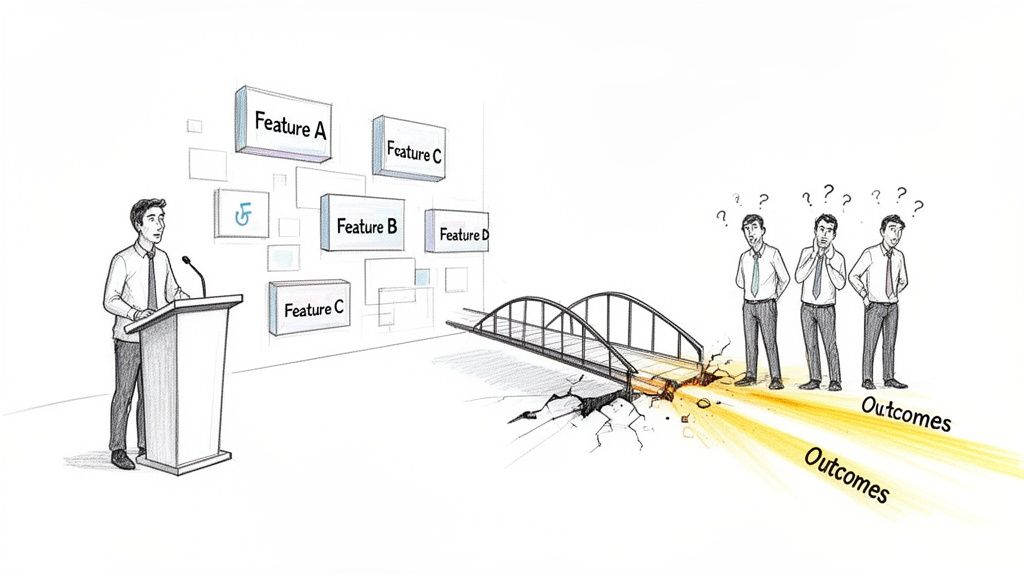
Product-obsessed founders live and breathe technical details. This is a strength in product development, but a liability in go-to-market. The instinct is to give prospects a tour of your product's capabilities, assuming the value is self-evident.
It never is.
Sophisticated B2B buyers don't acquire features; they invest in outcomes. They are looking for a solution to an expensive, high-stakes operational problem. When you lead with a feature-first pitch, you force them to translate your "AI-powered dashboard" into their problem of "unreliable pipeline forecasting." This friction kills deals and commoditizes your solution, reducing it to a checklist comparison against competitors.
The breakdown isn't in your product; it's in the communication gap between ‘what our product is’ and ‘what your business will achieve because of it.’ This is a common failure point for early-stage SaaS companies.
Here’s why it consistently fails:
The central mistake product-led founders make is assuming the buyer understands the value proposition as deeply as they do. They don't. Your job is to make the connection from feature to outcome explicit and undeniable.
This trap is a primary reason why B2B product startups struggle with growth, even with a superior product. The problem isn’t the engineering; it’s the failure to articulate the business advantage. Overcoming this requires a deliberate shift from explaining your product to selling your customer’s success.
Feature-benefit selling is not a sales script. It’s a core communication discipline. I see too many teams treat it as a tactic, but it's a structured way of thinking—a process for translating what your product is into what it does for a customer's business. For founders and revenue leaders, getting this right is non-negotiable.
Mastering this discipline forces a critical shift in perspective. It pulls your team out of an internal monologue about your technology and into a dialogue about the tangible advantages it delivers to the customer.
The distinction is simple, but it’s where most product-led teams stumble.
Features are the ‘what.’ They are the technical specifications and capabilities of your software. A feature is an objective fact, like "SSO integration with Okta."
Benefits are the ‘so what.’ They are the direct impact that a feature has on a customer’s operations, revenue, or strategic goals. The benefit answers the prospect’s unspoken question: "Why should I care?"
The benefit of that "SSO integration with Okta" isn't the integration itself. The real benefit is the ability to "slash IT overhead by 15% by eliminating manual user provisioning" or to "pass our next security audit by enforcing uniform access policies."
In a crowded SaaS market where your features can be replicated, the only defensible moat is how well you articulate benefits. It’s the difference between being a commodity tool and becoming a strategic partner.
This distinction is crucial because it plugs your product directly into the buyer's motivations. This isn't just about better messaging; it’s about aligning with how humans make business decisions. While logic is used for justification, research shows you can explore insights into selling benefits over features, and the reality is that purchasing decisions are heavily influenced by confidence in a desired outcome. Features appeal to the rational brain, but benefits answer the core question every buyer has: "What's in it for me?"
Adopting this discipline provides your entire GTM function with a new mental model. It moves your team from diagnosing the symptom—"our pitches are falling flat"—to operationalizing the solution. It becomes the filter for building pitch decks, writing website copy, and training sales reps.
This is about making your message effective. When you get this right, you connect your product's capabilities to a clear and compelling business outcome. This is the first and most critical step in building a strong value proposition that resonates with your market.
Without this foundational layer, any attempt at value-based selling is built on sand. Your team will be left explaining features and hoping the prospect connects the dots. Hope is not a strategy.
Knowing the theory is insufficient. Execution is what matters.
It’s one thing to understand the difference between features and benefits. It’s another to build a system that enables your entire team to translate one into the other, consistently. Most companies treat this as an art, relying on the intuition of their best reps. This is a mistake—it creates inconsistent messaging and puts a ceiling on growth.
The answer isn't a 100-page messaging guide that no one reads. It’s a simple, repeatable framework that becomes the operating system for anyone discussing your product.
For every feature that matters, your team must connect the dots through three questions. This isn't just a marketing exercise; it's the raw material for every pitch deck, landing page, and sales call.
This three-step chain forces a disciplined path from the technical what to the business why.
This visual breaks down how that progression works, connecting what your product is to why your customer should care.
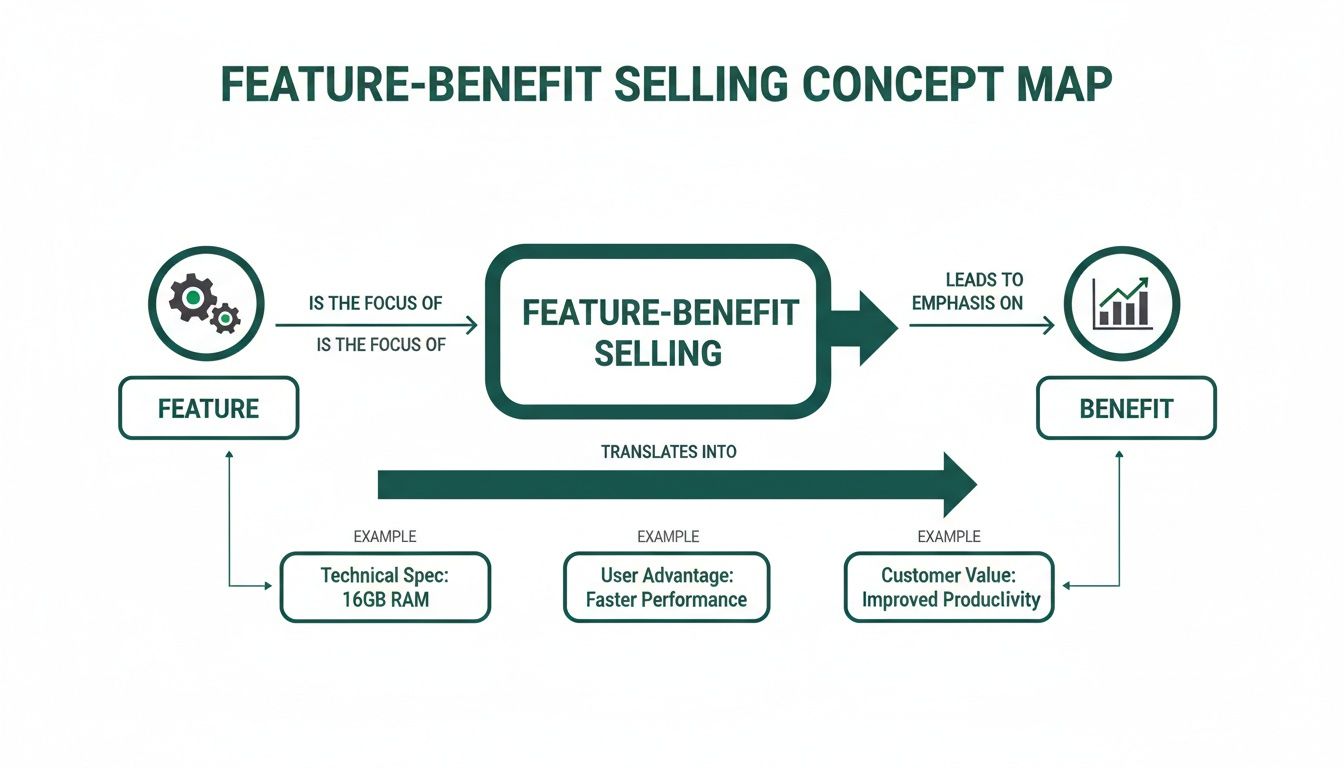
It strips away jargon and shows a clear path from a technical component (your feature) to a strategic outcome (their benefit).
Let’s apply this logic to common B2B SaaS scenarios. Note how the benefit is always framed in terms of business metrics—time, money, or risk.
Example 1: FinTech Platform
Example 2: CRM Software
A feature describes what your product has. A benefit describes what the customer gets. Your messaging must operate in the second category.
The next step is to institutionalize this logic. A simple translation matrix is one of the most effective sales enablement tools you can create. This is not a one-off project; it’s a living document that evolves with your product. Our guide on building a brand messaging framework template provides a solid structure.
Turning this framework into a shared resource is where the real leverage is. A simple matrix forces clarity and creates a single source of truth for your GTM team. It’s a reference for marketing copy, a cheat sheet for sales calls, and a reality check for product development.
Here is a basic structure:
Creating and maintaining this matrix is not about writing better marketing copy. It’s about codifying the strategic DNA of your go-to-market motion.
By building this discipline, you equip your entire team to stop selling software and start selling business outcomes.
Mastering the feature-to-benefit translation gets you in the game. To win in a crowded B2B SaaS market, you need another layer of precision: tailoring those benefits to specific buyer personas.
A single feature rarely creates a universal benefit. Different stakeholders within a target account care about entirely different outcomes. A generic, one-size-fits-all pitch signals a fundamental misunderstanding of their world.
This is where most GTM teams fail. They identify one primary benefit and apply it universally—a critical error. The "so what?" is different for every person involved in the buying decision.
B2B sales is not about selling to a company; it’s about building consensus within a buying committee of individuals, each with their own pressures, priorities, and metrics for success. A benefit that excites a Head of Sales may be irrelevant to the CFO who approves the budget.
Presenting the wrong benefit to the right person is as ineffective as a feature-only pitch. It creates immediate friction and forces them to translate your message into their language—work they should not have to do.
A single, static pitch deck is a symptom of a lazy go-to-market motion. Your messaging must be dynamic, adapting the benefit to the role of the person you're speaking to. This isn't about having different products; it's about having different conversations about the same product.
Documenting and operationalizing persona-based messaging directly correlates to GTM success. Research often points to the fact that companies that exceed revenue goals are more likely to have documented buyer personas. This isn’t a coincidence. It is the result of disciplined, customer-centric messaging. You can read more about the pitfalls of overemphasizing features and benefits in sales.
Let's make this tangible. Imagine your SaaS platform has one feature: an Advanced Analytics Dashboard. A weak team would claim the benefit is "better data insights." A strong team maps that single feature to the unique pressures of each buyer.
For the CEO: The feature is tactical noise. The benefit they care about is strategic oversight. This dashboard enables them to spot market trends, monitor business health in real-time, and enter board meetings with the data to back high-stakes decisions.
For the Head of Sales: Their world is the pipeline. For them, the benefit of the same dashboard is improved forecast accuracy and team performance. They can instantly see which reps are on track, which deals are at risk, and where bottlenecks are forming, allowing them to intervene before the quarter is lost.
For the Sales Ops Manager: This person is responsible for process and data integrity. The benefit is reduced manual reporting time and improved data accuracy. The dashboard automates reports that previously required hours in spreadsheets, freeing them for more strategic work and eliminating human error.
One feature. Three distinct, role-specific benefits.
This level of messaging discipline demonstrates a true understanding of your customers. It proves you’ve considered not just what your product does, but how it integrates into the daily reality of each stakeholder. To sharpen this capability, learn more about using buyer personas to accelerate B2B marketing and sales in our article. This is how you make your solution feel indispensable.
A messaging framework is worthless if it remains a theoretical document. It has zero value until it's woven into the tools your team uses to engage the market. Too many founders complete a messaging exercise and then fail to operationalize it. This is where you translate theory into revenue.
Think of feature-benefit thinking as the operating system for your entire GTM function. This isn't an additional task; it’s an upgrade to the quality of every interaction a prospect has with your brand, ensuring your message is consistent and impactful at every touchpoint.

Your website is your 24/7 sales engine. Most SaaS homepages are graveyards of features presented as headlines. They announce, "Here's what we built," not "Here's what you will achieve."
This is the first place to apply the discipline. Every headline, sub-headline, and call-to-action must pass the benefit test. Does it speak to a customer's pain or desired outcome? If not, rewrite it.
The first describes your tech. The second speaks directly to a Head of Sales who was just questioned by their board for missing the quarterly forecast. That is the difference between talking about yourself and solving a problem.
Your pitch deck is not a product tour. I will repeat: it is not a product tour. Its sole function is to tell a compelling story about the customer's problem and how your solution provides a clear, beneficial resolution.
Start with the pain. Acknowledge the cost of inaction. Then, and only then, introduce your features as the specific mechanisms that deliver the benefits that resolve that pain. Each slide must build a clear picture of the prospect's better future. If you spend the first ten slides on system architecture, you have already lost.
Your sales reps are on the front lines. Arming them with a feature list is sending them into a complex fight unprepared. They need battlecards that explicitly map features to the specific benefits that matter to each buyer persona.
A strong sales battlecard doesn’t just list what a feature does. It tells the rep what benefit to emphasize when speaking to a CFO versus a Head of Engineering. It provides the precise language to make the message resonate with that individual's professional reality.
This is critical for competitive positioning. When a competitor has a similar feature, your rep must know how to frame your benefit as superior and more relevant to that buyer’s specific problems. To do this effectively, you must understand your target audience; learning how to create buyer personas is a non-negotiable first step.
The standard SaaS demo is a feature-by-feature walkthrough that fails to engage. A benefit-driven demo is a problem-solving session. It should feel less like a presentation and more like a high-value consultation.
A strong demo doesn't start with the product. It starts with discovery questions to confirm the prospect's primary challenges. From there, the script follows a simple loop:
This structure transforms the demo from a passive viewing into an interactive workshop where the prospect sees their specific problems being solved in real-time. Implementing this discipline across your GTM motion creates a powerful feedback loop and a significant competitive advantage.
The process of moving from what your product does to what it delivers is the bridge to the ultimate goal: value selling. This is where you graduate from stating an advantage to proving a quantifiable business impact.
Once you have articulated a clear benefit, the crucial next step is to attach a number to it. This is the language that unlocks C-suite buy-in and defends your pricing against competitors focused on a race to the bottom.
This progression is non-negotiable for any team seeking to move upmarket. It shifts the conversation from operational improvements to financial impact.
The first statement is good; it gets a nod from a manager. The second statement is what gets a CFO to approve the purchase. It builds an undeniable business case, turning your software from an expense into a strategic investment with a clear ROI.
Feature-benefit selling gets you into the conversation. Quantifiable value selling closes six- and seven-figure deals. Without this final step, you leave money on the table and force executive buyers to build the business case for you—a risk you cannot afford.
This discipline is a strategic imperative. It is the engine that shortens complex sales cycles, justifies a higher price point, and carves out a defensible market position. For ambitious founders, this is the escape from the feature-for-feature deathmatch that plagues the mid-market. Exploring how to define value-based pricing is a critical next step on this path.
The final takeaway is a challenge: stop selling your product and start selling your customer's success.
Your features are the delivery mechanism for a business outcome. Your benefits are the articulation of that outcome. Quantified value is the proof that the outcome is worth paying for.
Every conversation, every pitch deck, and every piece of marketing copy must be ruthlessly focused on this progression. This is how you build a go-to-market engine that doesn't just explain what your product does, but proves why it is indispensable to your customer’s growth.
Putting feature-benefit selling into practice raises tactical questions. Here are the most common ones I hear from founders and GTM leaders.
No, but they are directly related. Think of it as a necessary progression.
Feature-benefit selling is the foundational step of translating ‘what our product does’ into ‘why that matters to your work.’ You are building the bridge of relevance.
Value selling is the next level. It takes that benefit and quantifies it into a measurable business outcome—hard numbers like ROI, cost savings, or revenue growth. You cannot jump straight to an ROI discussion. You must master feature-benefit selling first to earn the credibility to have a value-based conversation.
This is a critical challenge. Do not frame this as a "marketing initiative"—that will trigger skepticism.
Position this as a tool for product clarity and discovery.
Run a workshop with your engineers and product managers using the Feature-to-Benefit Translation Framework. Forcing them to articulate the end-user benefit of the features they are building reframes their perspective. Show them how this clarity leads to better feature prioritization, more successful launches, and more users appreciating the product they worked to build. It connects their code to customer impact.
No. That is a common mistake. This is an exercise in prioritization, not exhaustion.
Mapping every minor feature creates noise and dilutes your core message. You will end up with a laundry list, not a compelling narrative.
Start with the 5-7 core features that directly solve the top three pain points for your Ideal Customer Profile (ICP). Your goal is not to create an encyclopedia of your product's capabilities. It is to build a focused narrative around the features that deliver the most significant impact. These are the heart of your value proposition; everything else is supporting detail. Focus your energy where it matters most to your customer.
At Big Moves Marketing, we help B2B SaaS founders move beyond feature-dumping to build powerful, benefit-driven messaging that accelerates growth. We work with you to install the strategic discipline needed to align your product, marketing, and sales teams around a story that actually sells. If you're ready to stop selling software and start selling outcomes, let's connect. Learn more about our approach.
Explore Big Moves Marketing services and resources:


%20-%20white.svg)