%20png%20copy.avif)

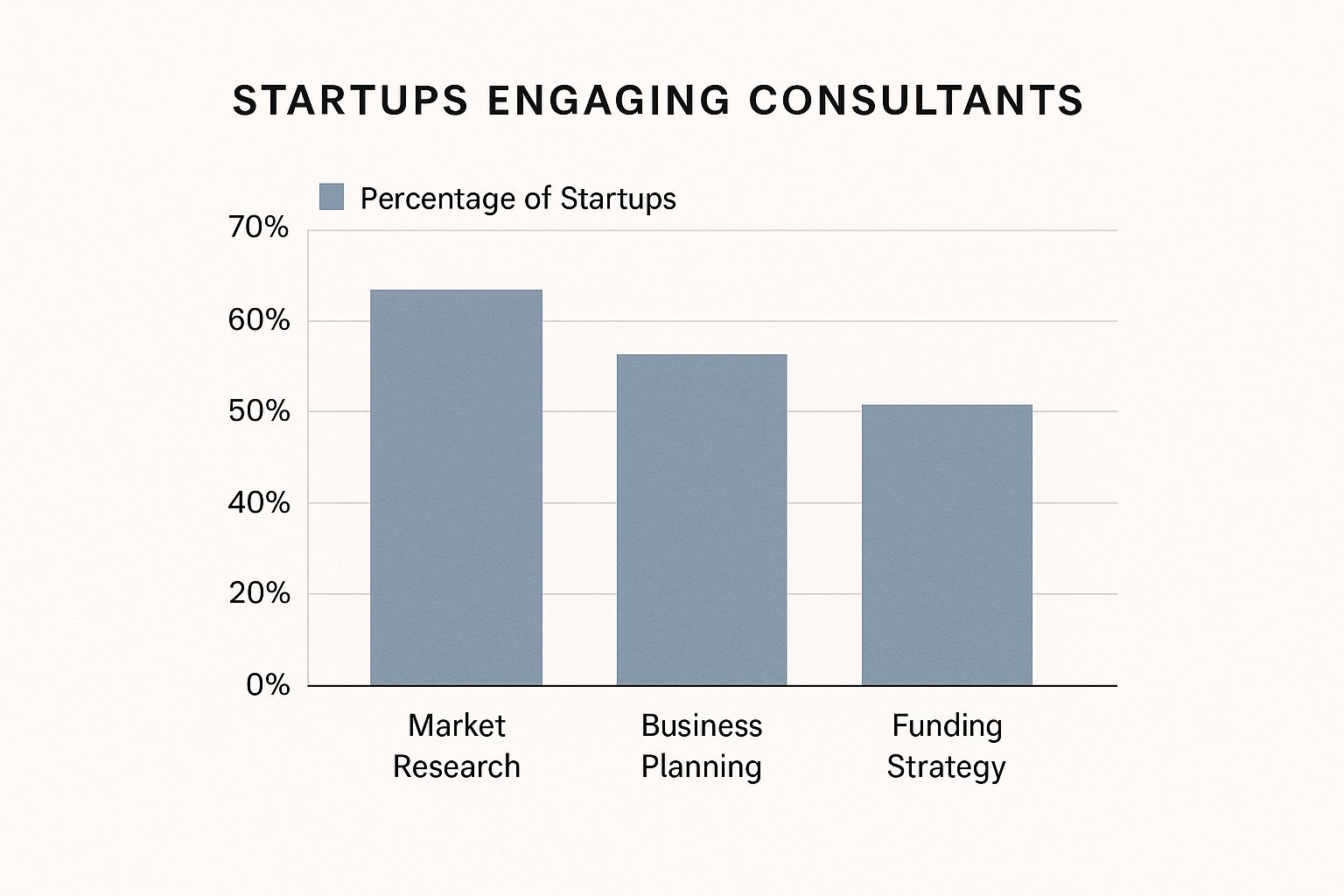
A startup consultant isn't just someone who gives advice; they're a key strategic partner. They bring expertise and an objective viewpoint, both invaluable during critical growth periods. This allows founders to use the consultant's experience to navigate complex issues and seize opportunities.
Not all startup consultants are the same. Some are generalists, offering broad guidance across a company's functions. Others are specialists, zeroing in on specific areas like fundraising, marketing, or operations. Choosing the right type depends on what your startup needs.
For instance, if securing seed funding is a struggle, a fundraising specialist may be your best bet. If you need to refine your overall business strategy, a generalist consultant could be a better fit.
To help illustrate the diverse landscape of startup consultants, let's look at the table below:
To help founders navigate the various types of startup consultants, we've compiled the following table:
Types of Startup Consultants by Specialization
This table breaks down the different types of specialized startup consultants and the specific services they provide to early-stage businesses.
| Consultant Type | Core Services | Best For | Typical Cost Range |
|---|---|---|---|
| Fundraising Specialist | Pitch deck refinement, Investor networking, Deal structuring | Startups seeking seed or Series A funding | $5,000 - $25,000+ per project |
| Marketing Specialist | Go-to-market strategy, Brand building, Digital marketing campaigns | Startups needing to acquire initial customers | $2,000 - $10,000+ per month |
| Operations Specialist | Process optimization, Team building, Scaling infrastructure | Startups experiencing rapid growth | $3,000 - $15,000+ per month |
| Legal Specialist | Incorporation, IP protection, Contract negotiation | Startups navigating legal complexities | $250 - $750+ per hour |
| Financial Specialist | Financial modeling, Budgeting, Fundraising strategy | Startups needing financial planning and control | $150 - $500+ per hour |
As this table shows, different consultant specializations cater to diverse needs within a startup's lifecycle. Understanding these differences is the first step to making the right choice for your business.
One key advantage of working with a startup consultant is the focus on measurable results. A good consultant can help you enter the market faster, be better prepared for investors, and make your operations more efficient. These translate to real results, like more revenue, lower costs, and a stronger presence in the market.
The global management consulting industry, which includes startup consultants, is expected to hit $1.0 trillion in 2024. This demonstrates the growing demand for specialized advisory services, especially for small and medium-sized enterprises (SMEs). The number of SMEs rose from 347 million in 2022 to 358 million in 2024, further highlighting this increasing demand. Learn more about the growth of the management consulting industry here.
Knowing when to bring in a startup consultant is as crucial as knowing who to hire. Significant milestones often signal the need for expert help. This might include gearing up for a funding round, scaling operations, or moving into a new market. Bringing in a consultant during rapid growth can help keep things moving smoothly and prevent expensive missteps.
The data chart below visualizes the impact of startup consultants across various business areas, based on founder surveys:
Data for the Data Chart:
This chart clearly shows the positive influence consultants can have, especially in securing funding and accelerating market entry. The CAC reduction highlights the value they add in optimizing marketing spending. These data points show that strategic consultant engagement can lead to tangible improvements throughout a startup's development. By understanding this value, founders can make well-informed choices to boost their chances of success.

Engaging a startup consultant offers advantages that go beyond general business advice. These professionals provide crucial market intelligence, something often overlooked by internal teams immersed in day-to-day operations. This external perspective can reveal hidden opportunities and sharpen a startup's competitive advantage.
For example, a consultant might identify untapped customer segments or emerging market trends that offer new avenues for revenue.
A key strength of a startup consultant lies in their ability to identify blind spots within a business model. Founders, deeply involved in their ventures, can sometimes miss critical weaknesses or inefficiencies. A consultant provides an objective viewpoint, pinpointing these areas and suggesting corrective strategies.
This could involve streamlining operations, adjusting pricing models, or even a complete pivot in business strategy. Consultants also provide a fresh perspective on market analysis, helping startups discover untapped revenue streams and innovate their products.
Startup consultants excel at helping companies navigate the competitive landscape. They offer insights into competitor strategies, market dynamics, and emerging industry trends. This empowers startups to make data-driven decisions about product development, marketing, and overall business strategy.
Furthermore, startup consultants bridge crucial knowledge gaps. Early-stage companies often lack expertise in specialized areas like fundraising, legal compliance, or scaling operations. A consultant can address these gaps, providing targeted knowledge to overcome challenges.
The consulting industry saw revenues climb to over $600 billion in 2022, an increase of nearly $30 billion from the previous year. This growth reflects the increasing demand for consultant services, particularly vital for navigating the challenges of a post-pandemic world. You can find more detailed statistics here.
Finally, measuring a startup consultant's impact on your growth trajectory is essential. Key metrics to consider include revenue growth, customer acquisition cost, market share, and fundraising success. Tracking these metrics ensures your consultant delivers tangible value and contributes to your long-term goals.
This data-driven approach allows for strategic adjustments and ensures the consultant's efforts remain aligned with your evolving business needs. This collaborative relationship fosters sustainable growth and equips the startup to handle future challenges independently.

Choosing the right startup consultant can significantly impact your business. Sifting through marketing promises can feel overwhelming. These seven questions are designed to help you find a consultant who genuinely fits your startup's needs.
"Can you share specific examples of your success with similar startups?" Look for concrete examples, not vague claims. A strong consultant can show how they've helped businesses at your stage, in your industry, facing similar obstacles. Quantifiable results are key. Generic stories or an inability to detail specific achievements should be a red flag.
"What's your approach to understanding our business and its unique needs?" The right consultant commits to understanding your specific context. They should have a clear process for analyzing your business model, target market, and overall objectives. Be wary of superficial answers or a one-size-fits-all approach.
"Describe your methodology for achieving measurable outcomes. How will you track and report progress?" A reliable consultant uses a data-driven approach. They can clearly explain how they set objectives, track key performance indicators (KPIs), and provide regular updates. This ensures transparency and accountability.
"How do you prefer to communicate, and how often will we receive updates?" Open communication is crucial for a successful consultant relationship. Discuss communication preferences upfront and establish a regular reporting schedule that works for you. This keeps you informed and allows you to address any concerns promptly.
"What are your payment terms and fee structure?" Transparency about compensation is essential. Find out if they charge by the hour, project, or retainer. Discuss payment milestones and ensure the structure fits your budget. Any hesitation to discuss fees is a serious warning sign.
"How do you ensure your incentives align with our success metrics?" The best consultants are invested in your success. Look for fee structures tied to achieving specific results. This demonstrates a shared commitment to your business goals.
Asking these seven questions can help you choose the right startup consultant. This careful vetting process sets you up for a productive partnership and increases your chances of achieving your goals. Big Moves Marketing, for example, specializes in fractional CMO services for B2B SaaS and tech companies, helping founders and teams implement go-to-market strategies to gain a competitive edge.
Many startup-consultant relationships fail to deliver optimal value, not because of a lack of expertise, but because of poor relationship management. This section provides actionable strategies for maximizing the return on your consulting investment. This includes creating clear scopes of work, establishing strong communication, and ensuring smooth knowledge transfer.
Successful founders start by crafting crystal-clear scopes of work. This document outlines the consultant's responsibilities, deliverables, and timelines. Think of it as a roadmap that guides the engagement and keeps everyone aligned. Including measurable deliverables is critical. These provide concrete benchmarks for assessing progress and holding the consultant accountable. For example, instead of "improve marketing," a deliverable might be "increase website conversion rates by 15% within three months."
Effective communication is the cornerstone of a successful partnership. Establish a regular communication rhythm, whether it's weekly check-in calls or email updates. These touchpoints provide opportunities to discuss progress, address challenges, and make any necessary adjustments. Don't just receive reports; provide feedback. Your input helps the consultant fine-tune their approach and ensure their efforts align with your evolving needs. This collaborative dialogue maximizes the value of the engagement.
The SME sector's increasing reliance on management consultants underscores the growing importance of this relationship. The global management consulting market is projected to grow from $510 billion in 2025 to $897 billion by 2034. This reflects a broader shift where startups, particularly SMEs, which make up 99% of businesses globally, prioritize scalable solutions. Discover more insights about this market trend here.
A startup consultant's recommendations are only valuable if implemented effectively. Develop a process for integrating these recommendations into your operational workflow. This might involve training your team on new processes or adapting existing systems. Knowledge transfer is also essential. Ensure your team learns from the consultant throughout the engagement. This empowers your team to take ownership of the implemented strategies and reduces long-term reliance on external expertise.
As your startup matures, your needs will change. Develop a strategy for gradually reducing your dependency on the consultant while retaining access to their specialized knowledge. This might involve transitioning to a retainer agreement or scheduling periodic consultations for strategic guidance. This approach lets you retain valuable insights while empowering your internal team to take the lead. Building this internal capacity ensures sustainable growth and positions your startup for long-term success.

Finding the right startup consultant can make or break your venture. Why? Because consultants bring specialized expertise to the table. This section explores five key specializations and when they become vital to your growth trajectory. Understanding these distinctions empowers you to make informed decisions when seeking external guidance.
Business model consultants help you refine your core revenue generation strategies. They analyze your existing model, pinpoint weaknesses, and recommend improvements for both profitability and scalability. This could involve adjusting your pricing strategy, identifying new revenue streams, or even fundamentally shifting your business model. For example, a business model consultant might help a subscription service implement tiered pricing to target different customer segments, potentially leading to increased revenue and higher customer lifetime value.
Securing investment is often a critical step for startups. Funding specialists excel at preparing you for this process. They help refine your pitch decks, connect you with potential investors, and navigate the intricacies of deal structuring. Crucially, they can guide you through the due diligence process, ensuring you're prepared for investor scrutiny.
Operations experts focus on optimizing your internal processes. By analyzing workflows, identifying bottlenecks, and implementing targeted solutions, they enhance efficiency and productivity. This becomes especially valuable during periods of rapid growth when scaling operations effectively is paramount. Imagine an e-commerce startup struggling to fulfill orders efficiently. An operations consultant could streamline their fulfillment process, reducing shipping times and boosting customer satisfaction.
Marketing strategists develop effective customer acquisition strategies. They help define your target audience, craft compelling marketing messages, and execute successful campaigns across various channels. This encompasses both online and offline marketing tactics, from content marketing and social media management to public relations and event planning. Consider a new SaaS business. A marketing strategist could build a content strategy centered around valuable blog posts and webinars, attracting qualified leads and converting them into paying customers.
Technology advisors guide startups through the ever-evolving technological landscape. They provide expertise on software selection, system integration, and digital transformation. This is invaluable for tech-focused businesses that rely heavily on software and online platforms. For example, a technology advisor might help a startup migrate its data to a cloud-based platform like AWS or Azure, enhancing data accessibility and security.
To make the most of any consultant, diligently assess their experience, approach, and track record. Seek referrals and testimonials to validate their expertise and confirm alignment with your business objectives. For specialized fractional CMO services tailored to B2B SaaS and tech companies, consider the expertise of Big Moves Marketing to bridge the gap between strategy and execution, especially in competitive markets.
To help visualize potential returns, let's examine some typical ROI metrics from startup consulting engagements:
Introducing the table below, "Startup Consulting ROI Metrics by Business Stage," which outlines typical return on investment metrics from consulting engagements, categorized by startup development stage, to help founders set realistic expectations.
| Business Stage | Key Consulting Focus | Average ROI Timeframe | Common Measurable Outcomes |
|---|---|---|---|
| Pre-Seed | Business Model Validation, Market Research | 6-12 Months | Refined Value Proposition, Target Market Identification, Early Traction Metrics |
| Seed | Funding Strategy, Product-Market Fit, Go-to-Market Strategy | 12-18 Months | Secured Seed Funding, Increased Customer Acquisition, Improved Conversion Rates |
| Series A | Scaling Operations, Team Building, Market Expansion | 18-24 Months | Streamlined Workflows, Key Hires, Increased Market Share |
| Growth Stage | Strategic Partnerships, International Expansion, Exit Strategy | 24+ Months | Strategic Alliances, New Market Entry, Acquisition or IPO |
This table highlights the evolving focus and expected outcomes of consulting engagements across different stages of a startup's journey. As your startup matures, the focus shifts from foundational elements like business model validation to more complex challenges such as scaling operations and navigating strategic partnerships. The timeframe for realizing ROI also tends to lengthen as the scope of the engagements broadens and the complexity of the challenges increases.
Remember, these are average figures, and actual ROI can vary significantly based on factors like industry, market conditions, and the startup's execution capabilities. Choosing the right consultant with proven expertise in your specific needs is critical for maximizing your return on investment.
Deciding between tackling challenges in-house and bringing in a startup consultant is a pivotal moment for founders. This section explores the factors influencing this decision, offering a framework for making the right choice for your startup. We'll examine elements like available funds, current team skills, market dynamics, and your growth ambitions.
Several key questions can help determine if a startup consultant is the right investment. First, consider your available capital. Consultants are an investment. If funds are tight, using internal resources might be necessary. However, a good consultant can unlock growth, potentially justifying their cost.
Next, evaluate your team's capabilities. Do you have in-house expertise in crucial areas like finance, marketing, or operations? If not, a consultant can bridge these gaps and accelerate growth.
Market complexity is another factor. Competitive or quickly evolving markets often benefit from external expertise. A consultant can provide market insights and help navigate complex regulations.
Finally, align your decision with your growth objectives. If rapid scaling is the goal, a startup consultant can offer the guidance needed to achieve ambitious targets.
Some functions are well-suited for in-house management, especially early on. Day-to-day tasks like social media, basic content creation, or customer support can often be managed internally, especially with limited budgets.
Early-stage product development can also be handled in-house, allowing founders close control. However, as complexity increases or specialized skills are needed, external guidance can be beneficial.
Some business functions often greatly benefit from external expertise. Fundraising, for example, is complex and requires specialized knowledge. A startup consultant specializing in fundraising can significantly improve your funding prospects.
Similarly, developing a go-to-market strategy often requires expert market analysis and marketing campaign development. A specialized consultant can help create and execute a robust product launch plan.
Startups with limited resources can use hybrid models, combining selective consulting with internal skill development. This involves engaging consultants for specific high-impact projects, like developing a financial model. Simultaneously, you can train your team to handle less specialized tasks, gradually reducing reliance on outside help.
This blended approach offers a cost-effective way to access expert advice while developing your team’s skills. This balance maximizes resources and supports sustainable growth.
To determine your organization's readiness for a consultant, consider these areas:
Honest answers to these questions will help you identify where external expertise will have the greatest impact. This self-assessment leads to informed decisions and increases the chance of a successful consulting partnership. Big Moves Marketing can help guide you through this process, offering personalized guidance to find the right balance between DIY solutions and professional support.
The startup world is ever-changing. To thrive, founders must understand and adapt to emerging trends. This section explores how technology, specialized services, and evolving compensation models are shaping the future of startup consulting. By recognizing these shifts, you can better position your venture for success.
Technology is reshaping how consulting services are delivered. AI-augmented services are increasingly common, offering data-driven insights and automating routine tasks. This allows consultants to concentrate on high-level strategic thinking and personalized guidance. For example, AI can analyze market data to identify emerging trends and opportunities, freeing up consultants to develop targeted strategies for their clients.
Specialized micro-consulting platforms are also gaining momentum. These platforms connect startups with experts in specific niches for short-term, focused projects. This offers a cost-effective way to access specialized knowledge without long-term contracts.
Hybrid virtual/in-person engagements are becoming the new normal. This flexible approach combines the convenience of remote work with the benefits of in-person connection. It offers the best of both worlds, fostering stronger relationships while minimizing travel time and expenses.
Traditional hourly or project-based fees are evolving into more flexible, outcome-focused models. Results-based pricing links compensation directly to the consultant's impact on key metrics, aligning incentives with your startup's success. Imagine a marketing consultant whose fees are partially based on hitting specific lead generation goals. This shared focus on outcomes fosters a more collaborative and productive partnership.
Equity participation is another growing trend, especially for early-stage startups. Offering equity can attract top consultants who are willing to invest their expertise for a share of future growth. This model can be especially appealing for startups with limited cash flow.
Subscription models are becoming more common for ongoing support and advisory services. This offers predictable pricing and consistent access to expert guidance, a valuable asset for startups dealing with complex regulations or rapidly changing markets.
Some consulting specializations are experiencing significant growth, reflecting evolving startup needs. Sustainability consultants are in high demand as companies prioritize environmentally sound practices. With increasing consumer and investor focus on environmental, social, and governance (ESG) factors, startups are seeking guidance on incorporating sustainable practices into their operations.
Digital transformation remains a key area. Consultants specializing in areas like cloud computing, cybersecurity, and data analytics are helping startups use technology to drive growth and efficiency. This is essential as businesses increasingly rely on data-driven decisions and automated processes.
Cross-border expansion is another growth area. Consultants with international expertise help startups navigate complex regulations, tailor products and services to local markets, and build a global presence. This is increasingly relevant as startups aim for international scalability and reach.
By understanding these trends, founders can more effectively use the expertise of startup consultants. The right consultant, paired with effective strategies, can significantly boost growth and provide a competitive edge in the ever-evolving startup landscape.
Ready to discuss your go-to-market strategy? Connect with Big Moves Marketing for fractional CMO services designed for B2B SaaS and tech companies.





%20-%20white.svg)