%20png%20copy.avif)
Most B2B teams buy social media management services for the wrong reason. They think they need more posts, better scheduling, or a cleaner feed. What they usually need is positioning discipline, a tighter message, and a way to connect social activity to pipeline without fooling themselves with vanity reporting.
That's the pattern I've seen across founder-led SaaS teams and later-stage growth teams alike. The provider comes in, publishes consistently, polishes the brand, and hands over monthly charts that look respectable. Six months later, the feed is better, but sales still can't point to qualified conversations, and leadership still can't explain what social changed.
The market itself tells you social has moved far beyond lightweight content support. One industry estimate put the social media management market at USD 29.93 billion in 2025 and projected USD 171.62 billion by 2033, with a 24.8% CAGR from 2026 to 2033 Grand View Research. Another estimate placed it at USD 32.48 billion in 2025 and projected USD 164.52 billion by 2034 Grand View Research. That scale matters because social media management is no longer a sidecar to marketing. It sits where content operations, paid distribution, community, and analytics meet revenue.
The mistake is buying “social” when the actual gap is usually narrative clarity and distribution control. Buyers don't reward activity for its own sake. They reward relevance, consistency, and proof that your company understands the problem better than the next vendor.
Practical rule: If a provider can't explain how its work will affect qualified conversations, it's an output shop, not a growth partner.
That's the lens I'd use here. Not “who can run our accounts.” The better question is, who can turn social into a revenue-attribution discipline that supports positioning, demand generation, and sales enablement at the same time. If you're evaluating Big Moves Marketing, or any other serious operator, this is the standard to apply. For a related view on why buyers increasingly respond to authenticity over polished ad language, see why B2B buyers are betting on authenticity over advertising.
Most B2B social engagements fail in a quieter way. They keep publishing, keep reporting, and keep looking busy while the market ignores them. Founders usually discover they bought a content cadence, not a system that creates demand.
Scheduling posts, repurposing webinars, and filling a queue are basic execution tasks. They do not prove that social is helping the business. The true test is whether the work sharpens positioning, gives the market a clearer reason to care, and supports qualified conversations.
That is where most providers miss. They optimize for post volume, impressions, or follower growth because those numbers are easy to report. They are much harder to connect to pipeline, and that gap lets weak engagements survive longer than they should.
The cost is not just retainers that produce little. It is lost time while competitors tighten their narrative and claim a stronger place in the buyer's mind. For B2B SaaS teams, especially from pre-PMF through Series C, that delay is expensive.
Founders ask for social media management because it feels visible and easy to outsource. Positioning does not feel that way. It is internal, harder to resolve, and often forces uncomfortable decisions about ICP, differentiation, and what the company should stop saying.
Strong engagements start with the message, not the calendar. A serious provider should help define what the company stands for, who it serves, what pain it addresses, and why the category story is believable. Without that work, social becomes content production with no point of view.
You do not have a social problem until the company can already explain itself clearly.
That is why the right standard is higher. Social media management services matter when they sit at the intersection of brand, demand gen, and sales enablement. If they live only in the marketing queue, they get treated like a commodity. If they sit inside the revenue system, they force better decisions about how the company is perceived and how leads move.
For founders who want social to do more than fill a feed, the benchmark is simple. Demand a provider that can connect content to positioning, distribution, and revenue attribution, and watch how buyers respond to authenticity over advertising: why B2B buyers are betting on authenticity over advertising.
A B2B engagement should cover five operational pillars. If a provider cannot speak to all five, you are buying a partial function and hoping it behaves like a full one. That usually gets expensive.
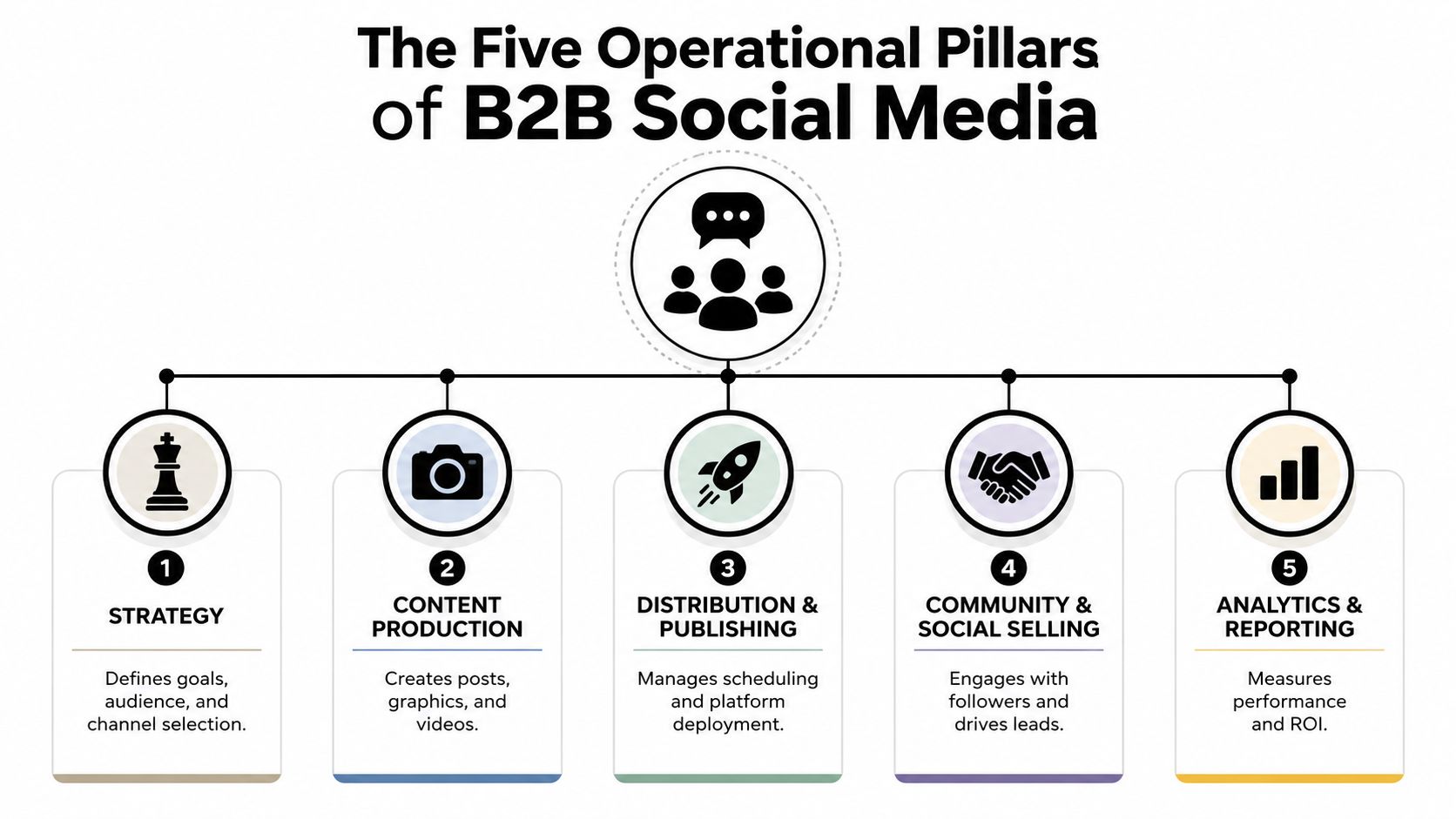
Strategy should come first. In B2B, that means a positioning audit, ICP definition, channel selection, messaging architecture, and editorial pillars tied to buyer pain. If the strategy work is real, it leaves the founder and team with a documented point of view they can use.
Content production comes next, but it should never be random output. The work usually includes short-form posts, long-form LinkedIn content, carousels, video scripts, executive thought leadership, and repurposing systems that turn one core idea into multiple formats. Strong providers do not ask, “What should we post this week?” They ask, “What idea should the market remember after seeing this ten times?”
Distribution is where many teams get lazy. Strong execution includes scheduling, employee amplification, paid amplification where appropriate, and outbound social signals that reinforce the right accounts and themes. Community work gets ignored even more often. That includes comment handling, DM triage, LinkedIn engagement on target accounts, and partner or influencer activation where it makes sense.
Analytics should close the loop. Likes and impressions are not enough. You want pipeline-sourced, pipeline-influenced, and conversion-velocity reporting. If a provider cannot connect activity to CRM-adjacent outcomes, they are not managing a growth function. They are managing a publishing routine.
A useful monthly review should produce these deliverables:
That is the operational bar. If the provider only talks about content calendars, they are skipping the system that makes social matter.
A serious engagement is not a content calendar with a retainer attached. It is a positioning and revenue-attribution system that should expose what the market believes, what prospects react to, and where social activity helps create pipeline.
Discovery has to produce real operating material, not a rushed intake call. You should leave with documented positioning, a defined ICP, a channel thesis, and a clear answer to what social is supposed to do inside the revenue motion. Teams skip this and jump into briefs because it feels fast. It usually cements the wrong assumptions.
Content system design is the next test. The provider should define pillar topics, voice guidance, repurposing logic, approval rules, and how founder content and brand content work together. If that system is weak, the calendar fills up and the message splinters. You end up with volume, not a narrative.
Publishing cadence should never stop at “three posts a week.” Good providers plan account-level targeting, time-of-day testing, and executive ghostwriting workflows. They also treat founder content differently from brand content, because each one serves a different job in the buyer journey.
Community handling is where weak engagements collapse under pressure. The comment and DM workflow disappears first, which is a serious problem because B2B social is a relationship surface, not a one-way broadcast channel. If the team stops replying, the channel loses its conversational value and attention does not turn into opportunity.
Reporting is the final filter. Strong reporting should connect social activity to MQLs, SQLs, and pipeline, not just engagement charts. If the provider cannot show what happened after a post drew attention, they are not managing demand. They are managing output.
If the reporting deck does not change what the team does next, it is decoration.
Use onboarding and renewal to inspect these stages directly. Ask for the positioning brief. Ask for the content system. Ask how comments and DMs are handled. Ask where CRM data appears in reporting. Strong providers answer with specifics, because they know the work has to stand up to revenue scrutiny.
B2B teams waste time by trying to be visible everywhere. That instinct feels safe, but it usually produces shallow execution and weak attribution. Channel strategy should follow buyer intent and the ability to tie activity to pipeline.
LinkedIn earns the heavy focus for B2B social media management. Adobe Express benchmarks show stronger engagement on LinkedIn than on Facebook or X, and Martal reports better visitor-to-lead conversion on LinkedIn than those same channels. That combination matters because reach without lead quality is just noise.
| Channel | Recommended Effort % | Avg. Engagement Rate | Primary B2B Use Case | Conversion Potential |
|---|---|---|---|---|
| 60 to 70 | Strong engagement around 3% to 3.5% or higher Adobe Express | Founder-led positioning, thought leadership, account engagement | Highest | |
| X | Smaller supporting slice | About 0.04% to 0.15% (per Adobe Express benchmarks) | Category commentary, customer support, monitoring | Limited, but useful in the right niche |
| Smaller supporting slice | About 0.06% to 0.2% (per Adobe Express benchmarks) | Retargeting and niche groups | Moderate in narrow cases | |
| YouTube | Targeted support only | Not standardized across the brief | Repurposed demos, explainers, search-friendly assets | Strong when used as a content library |
| Threads, Reddit, other emerging channels | Monitoring first | Not standardized across the brief | Listening, community scanning, issue detection | Early-stage and situational |
LinkedIn deserves the biggest share because it combines professional context, buyer visibility, and a cleaner path to attribution. Founder-led posts, document carousels, employee amplification, peer comments, and direct follow-up all belong there. For a practical view of how a breakdown of LinkedIn B2B marketing tactics fits a broader motion, use LinkedIn as the core channel and treat the rest as support.
X is better for category commentary and support. Facebook still has use in retargeting and niche groups. YouTube works when repurposed demos and explainers need to keep compounding after the post goes live. Emerging channels deserve monitoring, not a big budget.
HackerContent is built for cybersecurity teams that need accurate positioning, not generic content volume. The agency focuses on technical cybersecurity content, social media, SEO, marketing strategy, and video for security vendors and communities, so the work stays grounded in how technical buyers evaluate credibility.

That matters because social media in cybersecurity fails fast when it is treated like a scheduling service. The primary job is to explain a complex product clearly, build trust with skeptical operators, and keep the message consistent across posts, comments, and follow-up. HackerContent covers technical blog posts, whitepapers, landing pages, tutorials, documentation, social scheduling, practitioner-led community engagement, SEO for cybersecurity niches, video production, and broader marketing strategy. It also offers generative engine optimization for citation visibility in AI tools and search experiences.
The fit is strongest for teams that need domain knowledge, not generic brand polish. HackerContent says it works only in cybersecurity, uses practitioner-created material, and offers a monthly retainer structure that starts at $2,000 USD per month. It also presents first-month social management averages of about 14x impressions, 5.5x new followers, 3.6x profile visits, and 1.8x mentions. I'm using those figures as the agency presents them, not as a market benchmark HackerContent social media management for cybersecurity companies.
For a security vendor, that is a sensible option when technical credibility, channel consistency, and content depth drive the decision. For broader B2B SaaS, the bar is higher. Use a specialist only when the product and audience demand that level of domain expertise.
Most pricing discussions are backwards. They start with deliverables and only later ask what the work is supposed to change. That is the wrong order. Social media management services should be priced around operating responsibility and outcome pressure, not just post volume.
The common tiering is straightforward. Execution-only usually sits around $2,000 to $4,000 per month and covers content creation, scheduling, basic engagement, and light reporting. Strategy plus execution usually lands in the $5,000 to $10,000 per month range and adds research, messaging guidance, editorial planning, and tighter monthly review. Fractional social leadership is typically $12,000 to $25,000 per month and should look much closer to embedded leadership, with oversight, team coordination, and executive reporting Leadmore.
Paying only for activity is the fastest way to get shallow work. Tie 30% to 50% of fees to agreed performance measures, because the service should be accountable for business movement, not just production. The lead KPI should be pipeline-influenced and sourced meetings. After that comes qualified follower growth, engagement quality, and share of voice against named competitors. Vanity reach metrics belong outside the compensation model.
For a clear way to connect social performance to revenue, use how to measure marketing ROI.
Contract rule: If the provider will not discuss performance-linked renewals, they probably do not believe their work changes outcomes.
A quarterly business review should answer five questions. What themes drove qualified attention? Which accounts engaged? Which posts created meetings or assisted opportunities? What changed in the ICP mix? What should stop next quarter? If the answers stay at impressions and impressions alone, you are not reviewing the business. You are reviewing a dashboard.
The vendor proposal should answer these questions before you sign:
Most social media management services fail for the same reason. They are sold as content production, then measured like a marketing system. That mismatch kills pipeline value.
The usual failure patterns are predictable. Teams publish without a positioning brief, treat LinkedIn like a broadcast channel, skip CRM attribution, and leave the founder out once the work starts. The result is busy activity that never compounds into credibility or revenue.
Start with positioning, not the calendar. Lock the engagement to a documented brief, then force the provider to work from it. If they do not need ICP interviews or messaging input, they are templating the engagement. Keep the team close to pipeline reviews so they hear the objections, account patterns, and sales language that matter.
Founder voice also needs a real operating rhythm. If the CEO is absent, the content usually drifts toward generic thought leadership. That is a weak substitute for differentiated B2B demand. A provider should also explain how how a B2B marketing agency approach differs from social management because the job is broader than posting content and narrower than full-funnel agency work.
Demand attribution tied to qualified opportunities or closed-won influence, not just engagement metrics. If the reporting stops at likes, impressions, or follower growth, the provider is managing activity, not outcomes.
The structural fix is simple. Social media management services should sit inside messaging, sales enablement, and RevOps workflows. Without that, they produce motion without business gravity. The market rewards clarity.
The first 90 days tell you almost everything. Strong providers do not race to publish. They build the operating system first. Weak providers start posting before they understand the company, which is expensive improvisation.
Days 1 to 30 should focus on positioning inputs, ICP interviews, a channel audit, and voice and messaging documentation. This is the phase where the provider earns the right to create anything. If they skip it, they are guessing. They should also show how they will work from the same inputs used across the B2B SaaS startup marketing and sales execution checklist, because social work that sits outside the broader motion rarely reaches pipeline.
Days 31 to 60 should build the content engine. That means pillar definitions, a 90-day editorial calendar, repurposing rules, and the first analytics baseline. Volume is the wrong target. Consistency around the right themes is the point.
Days 61 to 90 should introduce optimization, hook testing, paid amplification decisions, and a formal pipeline attribution review. By this stage, the provider should show whether audience quality and conversation quality are changing. If they cannot, the engagement is off track.
Use a simple scoring model. Ignore vibes.
The contract terms are straightforward. Ask for pipeline-tied bonuses, IP ownership, a clean exit clause, and quarterly business reviews. If a provider resists those terms, you already know the shape of the relationship.
Founders should treat social media management services as a positioning and revenue-attribution decision, not a content subscription. Start with positioning, ICP definition, and a documented messaging framework. Without those inputs, you are paying for output that has no strategic edge.
Demand proof of qualified conversations, ICP follower growth, and assisted pipeline. Posting volume is secondary. A serious B2B SaaS engagement changes how the market sees the company and how sales conversations start.
Hold the provider to the business result. If the proposal only discusses cadence, the work is too shallow.
The best engagements function like a fractional team inside product marketing, sales, and leadership. They report weekly on what is driving response, what is stalling it, and where the message needs adjustment. That is the standard.
If a vendor clears those gates, continue the conversation. If not, walk away. The feed is not the goal. Revenue impact is.



%20-%20white.svg)