%20png%20copy.avif)
At its heart, the difference between a pull vs push marketing strategy comes down to one simple question: are you attracting B2B buyers already looking for a solution (pull) or are you actively placing your message in front of an audience to create demand (push)? For any B2B SaaS company, getting this right is a foundational decision that steers the entire growth model.
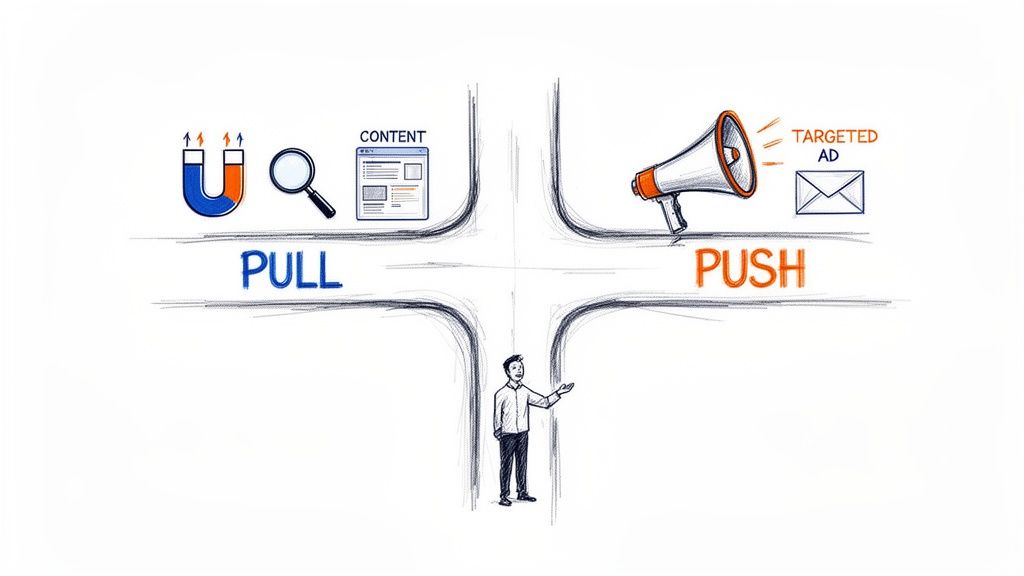
This isn't just another marketing choice for B2B tech founders. It dictates how you connect with high-value accounts, build a brand that people remember, and ultimately, how you'll win. Your decision here shapes everything from budget allocation and team structure to the very DNA of your customer acquisition journey.
It's critical to understand which engine will power your company forward. Pull strategies build long-term assets and authority, turning your brand into a magnet over time. Push strategies, on the other hand, are designed to generate immediate awareness and pipeline. A truly comprehensive B2B growth strategy almost always involves a thoughtful combination of both.
This choice is about aligning your go-to-market motions with how your ideal customers research and purchase complex software solutions. One path builds a magnetic brand over time; the other creates targeted, immediate impact.
When building out your growth engine, you also have to consider the strategic balance between customer retention vs acquisition cost. Each of these approaches impacts this balance in profoundly different ways, influencing the long-term profitability and scalability of your entire SaaS business.
To make the differences crystal clear, let's break down how each approach works in a typical B2B SaaS context. This table gives you a quick snapshot of the fundamental distinctions.
Think of pull marketing as building a library of valuable resources that B2B buyers actively seek out, while push marketing is like running a targeted ad campaign to catch their attention. Both have their place, but knowing when to use which is the key.
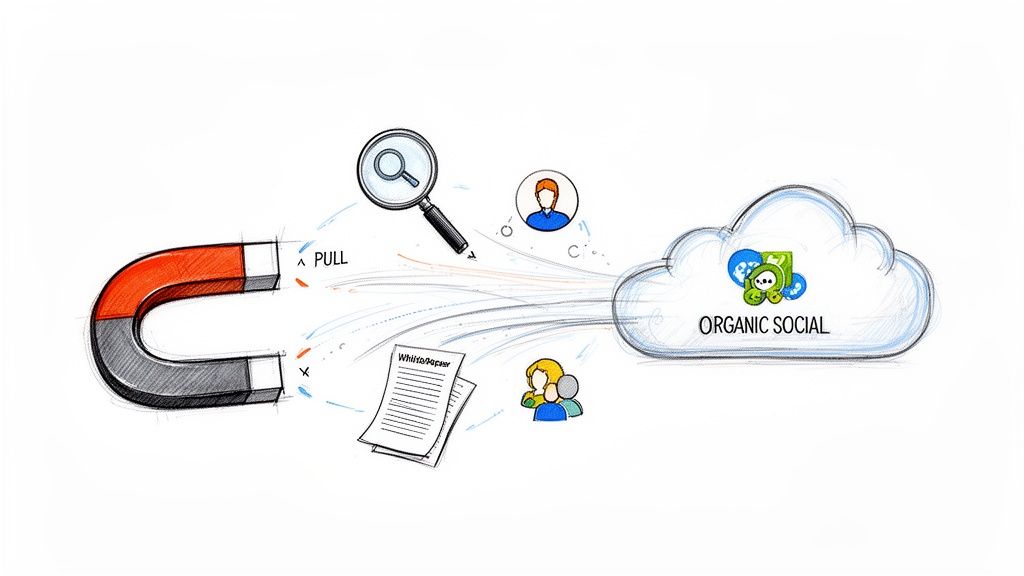
Pull marketing flips the script entirely. Instead of shouting to get attention, you become the trusted resource B2B customers actively seek out. It’s about building so much value that you become the destination when they have a problem to solve, long before a sales pitch is even on the table.
This philosophy lines up perfectly with how modern B2B buyers operate. Decision-makers are already out there, deep in research mode, looking for answers. A pull strategy is about making sure that when they search, they find you—not just as a vendor, but as the most helpful and authoritative voice in the room. For B2B SaaS and AI companies, this means attracting leads who are already aware of their problem and actively hunting for a solution. The quality is just naturally higher.
A solid pull vs push marketing strategy is built on channels that create long-term, compounding assets for your brand. These aren’t one-off campaigns; they’re parts of an engine that work together to attract organic interest and build real trust.
When you get this right, a powerful cycle kicks in. Great content improves your search rankings, which drives more traffic to your site. That increased traffic builds your brand authority and, in turn, grows your social following.
Pull marketing isn’t about chasing leads; it’s about creating a center of gravity. You become so valuable that the right customers are naturally drawn into your orbit, ready for a meaningful conversation.
The modern B2B buyer is a self-educator, which makes pull marketing more critical than ever. Research from Gartner shows that B2B buyers spend only 17% of their time meeting with potential suppliers when they are considering a purchase. The rest of the time is spent researching independently.
By creating SEO-optimized content, you're meeting this preference head-on, drawing in prospects who are already in motion. This is precisely why 72% of marketers report that content marketing—a cornerstone of pull—boosts both engagement and lead generation. You're not just generating leads; you're building an audience that trusts your expertise and sees your product as the logical next step.
While a pull strategy is all about nurturing existing interest, a push strategy is the catalyst that creates demand from scratch. It's the proactive force you use to inject your message directly into your target market's world, sparking awareness where none existed before. This approach is absolutely essential for launching new products, breaking into crowded markets, or just hitting the accelerator on your sales velocity.
Push marketing doesn't wait for prospects to find you; it goes out and finds them. This is especially vital for innovative B2B SaaS or AI products. If your audience doesn't even know a solution like yours is possible, they're certainly not going to search for it. Push tactics cut through the noise to educate the market and create an immediate path to action.
A powerful push marketing strategy relies on channels that let you target with precision and prompt a direct response. This is all about generating measurable results, fast. A well-structured demand generation strategy will almost always lead with these methods to fill the top of the funnel.
Key B2B push channels typically include:
These channels work because they are direct, measurable, and built for speed. You get to control who sees your message and when, making them indispensable for driving immediate pipeline growth and grabbing market share.
Push marketing is the engine of market creation. It's how you introduce a game-changing idea to an audience that isn't looking for it yet and convince them they can't live without it.
This approach truly shines when speed and awareness are everything. For new product launches, push tactics can boost visibility significantly in the first quarter alone. When tailored for B2B tech, methods like targeted LinkedIn ads put your MVP in front of unaware decision-makers quickly, often yielding higher click-through rates of 2-5% compared to the slower ramp-up of organic pull channels. You can find more data behind effective push vs pull marketing for B2B launches.
For B2B SaaS founders, the whole pull vs push marketing strategy debate isn't about finding a single winner. It’s about knowing which lever to pull for a specific goal at a specific time. One approach builds a lasting asset that reels in high-intent buyers, while the other blasts your message into the market for immediate impact.
To make the right call, we have to move past a simple pros-and-cons list. Let's break these strategies down across the four areas that really matter for sustainable B2B growth.
Push marketing often means direct ad spend, so your Customer Acquisition Cost (CAC) is high and obvious right away. Imagine running a targeted LinkedIn ad campaign for a new AI tool—you're paying for every single click and lead, and success is measured in immediate sign-ups. The ROI is direct, but it evaporates the second you turn off the spend.
Pull marketing is a different beast. It demands an upfront investment in content and SEO that can feel like a leap of faith initially. But a single, high-ranking blog post can become a lead-generating machine for years, driving your CAC down over time. The ROI compounds, turning each piece of content into a long-term asset.
When you need to fill the pipeline yesterday—maybe for a new product launch or to improve a rough quarter—push marketing is your go-to. A sharp paid ad campaign or a targeted email blast can start booking demos within days, sometimes even hours. It’s all about predictable, short-term velocity.
Pull strategies, on the other hand, are a long game. Building the authority and search rankings needed to attract organic traffic can easily take six months to a year. The results are far more sustainable, but they won't help you hit next week's sales quota. This is about laying a foundation for future growth, not a quick fix.
The core differentiator is time-to-value. Push marketing buys attention for immediate impact, while pull marketing earns attention for compounding, long-term growth.
The origin of a lead tells you almost everything you need to know about its quality. A prospect who clicked a LinkedIn ad (push) was likely interrupted during their day. They often need a ton of nurturing just to understand their own problem, let alone your solution. These leads tend to be less qualified and convert at lower rates.
Now, contrast that with a lead who finds your in-depth guide on "integrating AI into logistics workflows" (pull). This person is already deep in the buying journey—they're problem-aware and actively looking for answers. They show up with high intent because they sought you out. These leads are usually more educated and ready for a real conversation, leading to higher conversion rates and shorter sales cycles.
An effective integrated media strategy can amplify the reach of these valuable pull assets. Discover how to build one by exploring our guide on why an integrated media strategy is the new advantage in B2B.
With push marketing, scalability is almost always tied directly to your budget. To get more leads, you simply have to spend more money. This often leads to diminishing returns as you saturate your audience or as ad costs climb, making it a linear and sometimes unsustainable way to grow.
Pull marketing scales organically. As your domain authority grows, your content starts ranking for more keywords, attracting an ever-increasing flow of traffic and leads without a proportional jump in spending. This creates a powerful growth engine that actually gets more efficient over time, building a defensible moat around your business.
To help you see how this plays out in practice, let's put these strategies head-to-head across the metrics that truly matter to a founder.
This table makes it clear: the choice isn't about which is "better," but which is right for your current stage and goals. Early on, you might need a dose of push marketing to get the engine started, but the most resilient B2B SaaS companies eventually build a powerful pull marketing machine that drives predictable, long-term growth.
Knowing the theory behind pull vs. push marketing is one thing. Knowing exactly when to deploy each strategy is what separates stagnant startups from high-growth SaaS machines. Execution is everything, and your choice should be a direct reflection of your immediate business goals and your position in the market.
This simple decision framework can help you align your primary objective—whether that's long-term, sustainable growth or immediate market impact—with the right strategic approach.
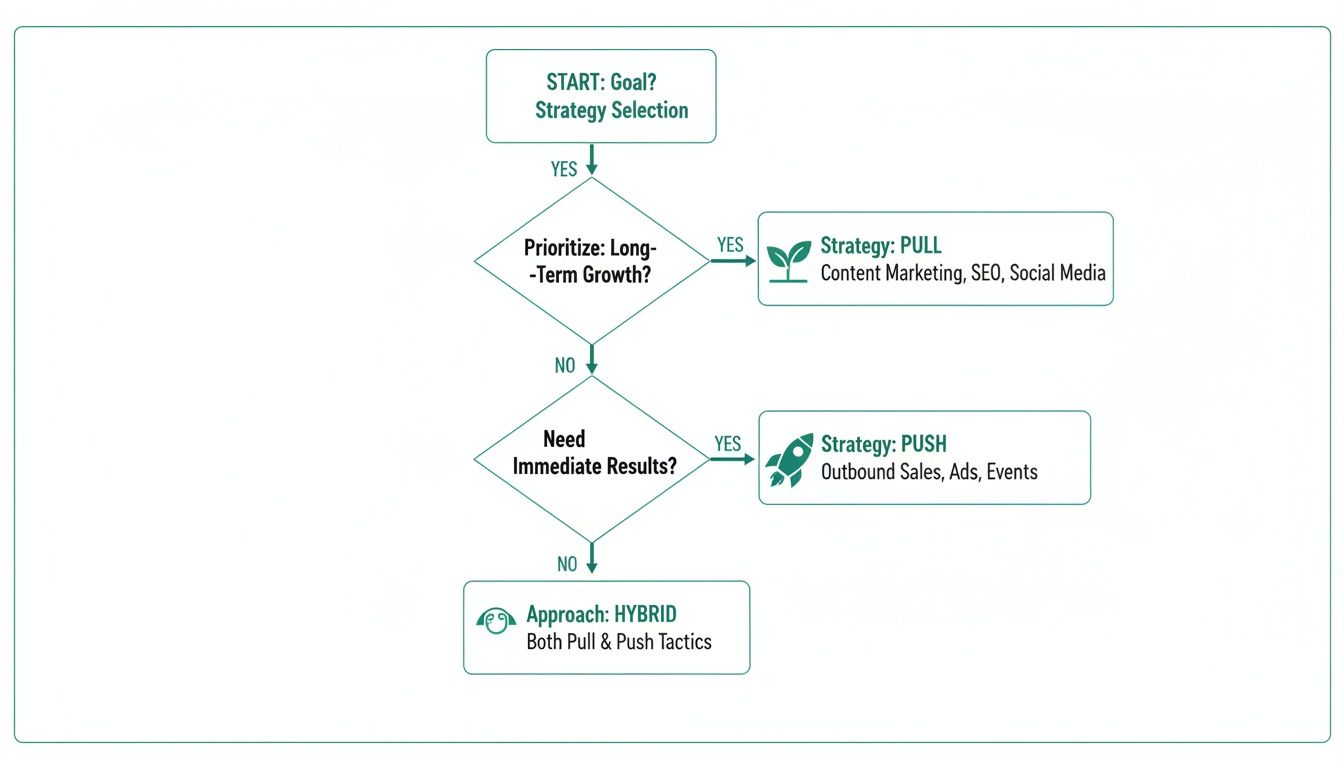
The flowchart boils it down to a core strategic choice. If your goal is to build compounding brand authority and generate a steady stream of organic leads, you need to prioritize pull. But if you need to build awareness fast and get your pipeline humming, you have to lean into push.
When you're bringing a truly new B2B solution to market—something the industry doesn't even know it needs yet—a strong push strategy is non-negotiable. Your ideal customers aren't out there searching for you. Why would they? They don't know a solution like yours even exists.
Your mission here is all about education and demand creation. That means getting proactive with targeted campaigns, like running LinkedIn ads aimed at specific job titles and industries or doing strategic outreach to educate potential early adopters. You have to interrupt their day-to-day to show them there's a better way.
In a new category, you can't wait for demand to appear; you must create it. Push marketing is the tool for building a market from the ground up, educating one prospect at a time.
On the flip side, if your goal is to become the definitive, trusted name in an already established category, your focus has to shift to a dominant pull strategy. In this arena, the battle is won through authority, trust, and expertise.
Your audience is already well aware of their problem and is actively researching solutions. Success means being the most helpful, credible resource they find on their journey. This requires a heavy investment in expert-led content, comprehensive guides, and powerful case studies that don't just state your value—they prove it, building unshakable credibility.
Different market conditions and business goals call for different playbooks. Here’s a look at a few common scenarios and our recommendations:
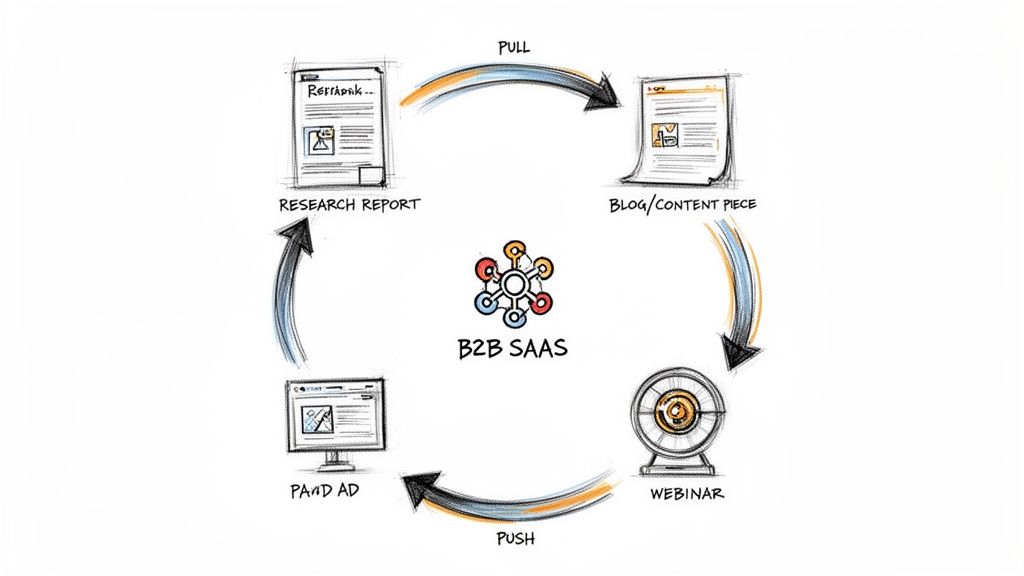
Here’s the thing about the whole pull vs push marketing strategy debate: the most successful B2B SaaS companies don't pick a side. They've figured out that the real magic happens when you masterfully weave them together.
Think of it less as a choice and more as creating a growth flywheel where each strategy feeds and amplifies the other. A siloed approach will always have a ceiling. A hybrid model, on the other hand, builds a resilient, multi-channel engine that gets stronger over time.
This integrated approach creates a powerful cycle. Push tactics give your pull assets the initial velocity they need, while your pull assets create a warm, engaged audience that makes your future push campaigns exponentially more effective.
When you get this right, you stop just executing campaigns and start building a genuine growth system—a self-reinforcing loop that becomes more efficient with every turn.
Here’s what that looks like in the real world:
Promote Pull Assets with Push Tactics: You just published an incredible, data-rich research report (a core pull asset). Instead of just waiting for Google to find it, you use targeted LinkedIn ads (a classic push tactic) to get it in front of your ideal customer profile today. You’ve just jumpstarted lead generation and engagement.
Capture Push Interest with Pull Content: A prospect clicks on one of your paid ads. Instead of dumping them on a cold, generic sales page, you guide them to a high-value, educational blog post that directly addresses their pain points. You're building trust and nurturing their interest long before you ever ask for a demo.
Build an Audience for Push Activities: Your blog (pull) is already attracting thousands of monthly visitors. You use that organic traffic to build a rock-solid email list. Then, you can promote a high-impact product webinar (push) to that captive audience, ensuring a virtual room packed with highly qualified attendees.
This combination transforms your marketing from a series of disconnected activities into a connected system where every component adds momentum.
The hybrid model isn’t just a strategy; it’s a mindset. It’s about recognizing that push marketing can create the audience for your pull content, and pull content can warm up the prospects for your push campaigns.
And the data backs this up, overwhelmingly. Research shows that combining push and pull strategies consistently delivers the highest ROI. In B2B SaaS, these hybrid approaches have been shown to boost overall marketing effectiveness by up to 50%.
Companies that get this right see lower acquisition costs, higher customer lifetime value, and engagement rates that single-strategy approaches simply can't match. To really see the numbers, you can dive deeper into the powerful results of a hybrid push-pull approach and get the full picture.
For new founders, my advice for most bootstrapped or seed-stage startups is to start with a focused pull strategy.
Your first move should be creating genuinely helpful content that solves a very specific, painful problem for your ideal customer. Think deep-dive blog posts, a niche calculator, or a comprehensive guide. This approach builds a long-term asset that generates organic traffic and leads for years, all without the constant cash burn of paid ads.
You can then layer in highly targeted, low-cost push tactics to get some early conversations going. For example, spending a few hours a week on manual, personalized outreach to a handful of perfect-fit prospects on LinkedIn is a great way to generate initial feedback while your content engine is still warming up.
Once you have some traction and a dedicated marketing budget, a 70/30 split in favor of pull marketing is a powerful and common allocation for growth-stage B2B SaaS companies. I’ve also seen a 60/40 split work well.
The majority of your budget—that 60-70%—should fuel the creation of long-term assets like pillar content, SEO, and building your brand's authority. These are the investments that have compounding returns and lower your customer acquisition costs over time.
The remaining 30-40% is your firepower for more immediate, short-term goals using push marketing. This is perfect for driving sign-ups for a new feature launch, accelerating leads already in your pipeline, or targeting a new market segment. This ratio ensures you’re building a sustainable inbound engine for the long haul while still having the agility to hit quarterly targets.
For pull marketing, you're playing the long game. The key metrics to watch are:
For push marketing, the feedback loop is much faster and more direct. You'll want to track:
No matter which side of the pull vs push marketing coin you're looking at, you absolutely must track two universal metrics: Customer Acquisition Cost (CAC) and Lifetime Value (LTV). These are the ultimate arbiters of truth that tell you if your entire growth model is profitable and scalable.
Ready to build a B2B marketing strategy that drives real growth? At Big Moves Marketing, I partner with B2B SaaS and AI startups to develop the positioning and launch strategies that win deals and secure market adoption. Let's build your growth engine together at https://www.bigmoves.marketing.
Explore Big Moves Marketing services and resources:




%20-%20white.svg)