%20png%20copy.avif)
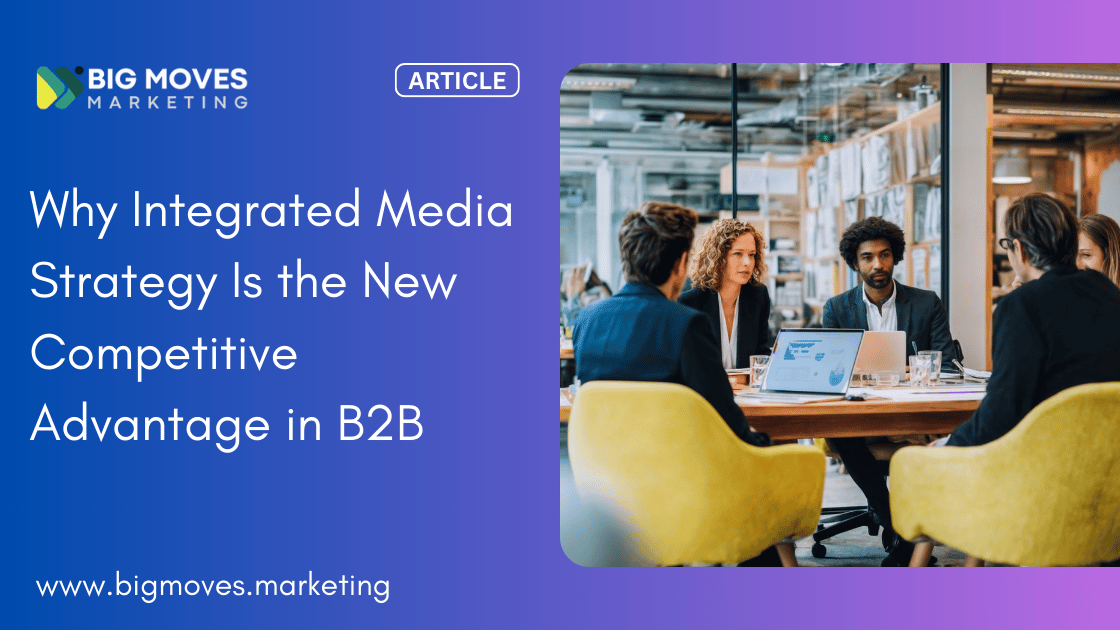
How forward-thinking B2B enterprises are unlocking 50% higher returns by abandoning siloed marketing and embracing a Connected Media Strategy
Every B2B company wants to grow. But the path to predictable, scalable growth has become increasingly challenging—and for most organizations, paid media has been relegated to the status of cost center rather than primary growth driver.
The core issue? Most B2B companies don't know how to use media investments to maximize growth. They're flying blind, uncertain of how to leverage media to its full potential. They're stuck in a cycle of disjointed campaigns, siloed data, and ambiguous results—leaving significant value on the table.
But here's what makes this moment different: a new breed of ambitious, modern B2B enterprises has cracked the code. According to groundbreaking research from Horizon Business, these organizations are delivering 50% higher returns from their media investments compared to the average B2B enterprise. They've achieved this by abandoning outdated models and embracing what researchers call a "Connected Media Strategy."
This isn't incremental improvement. It's a fundamental shift in how winning B2B companies approach their entire media portfolio.
The Horizon Business research, which drew on three years of interviews with more than 100 CMOs, senior marketing leaders, and C-level stakeholders from leading B2B companies, uncovered a troubling pattern: B2B organizations are significantly underperforming their potential by managing customer engagement channels as independent silos rather than as an orchestrated portfolio.
The problem runs deeper than most realize. While 90% of Association of National Advertisers members now self-identify as having a B2B division or business component, most continue to operate marketing channels independently rather than as coordinated content strategies that create consistent narratives across paid, earned, owned, and shared environments.
The research revealed the typical allocation of B2B marketing budget resources:
Media TypeBudget AllocationOwned Media28.5%Technology and Tools18.0%Paid Media16.5%Earned Media16.5%Data, Analytics, and AI8.0%Shared Media7.7%Other4.8%
The takeaway is clear: paid media is just a fraction of the total investment. Yet different marketing teams often manage paid, owned, earned, and shared media in separate—and often competing—silos. True value is only unlocked by orchestrating this entire portfolio as a unified engine for growth.
The case for integrated media isn't just theoretical. Research from McKinsey reveals that brands with strongly integrated media strategies achieve 23% higher revenue growth compared to those operating in channel silos. Yet according to Cision's Global Communications Report, while 78% of communications leaders cite channel integration as their top priority, only 34% have successfully implemented truly integrated approaches.
This gap creates both a challenge and an opportunity for B2B marketers willing to do the work.
The costs of fragmentation are substantial. Research from Gartner reveals that bad data costs companies $12.9 million annually per company—a staggering figure that includes missed growth opportunities and wasted investments. When data is stored by separate departments in separate systems, inconsistencies, duplicates, and incompatibilities slowly invade your information, eroding trust in the data you collect.
Meanwhile, a survey of data professionals found that on average they spent 56% of their time on operational execution and routine data management, which meant only 22% of their time was given to innovation that added value.
The customer experience suffers too. While 76% of customers expect consistent interactions across departments, only 54% of customers think that sales, services, and marketing teams share information. This matters because 70% of customers spend more with companies that offer fluid, personalized, and seamless customer experiences.
The research identified more than 30 best practices clustered around five key levers: audience, content, integration, alignment, and innovation. But across all 100+ conversations, one truth emerged consistently: the team that connects the most dots wins.
The most fundamental marketing silo is often the most damaging: a disconnected audience strategy. Traditional marketing casts an inefficient net, relying on broad campaigns and outdated, manual segmentation. This wastes budget on uninterested audiences, resulting in a slow, unqualified pipeline. Sales cycles stall, and ROI becomes difficult to measure.
The connected approach is different. Stop wasting budget talking to everyone. Start converting your ideal buyers. Use AI-powered analytics for surgical precision, pinpointing high-propensity accounts and in-market buyers ready to convert. This focused approach eliminates waste, accelerates conversion velocity, and maximizes marketing ROI.
Research indicates that nearly half of organizations (47%) cite siloed data as their primary obstacle to gaining customer insights. Breaking down these silos enables you to understand the buyer's mindset, facilitating a cross-channel approach that delivers the right content to the right people on the right channels at the right time.
"Content chaos" reigns in most B2B organizations. Teams create redundant assets for isolated campaigns, bombarding customers with generic, disconnected messages. Valuable content sits dormant, unused in sales conversations. This dysfunction leads to poor engagement, stalled deals, and an inability to prove content's value or contribution to revenue.
The solution is building a unified content architecture with modular, persona-based messaging to deliver consistent, personalized experiences. This means aligning all content with the customer journey—from thought leadership to sales enablement—to drive higher conversions, improve lead flow, and deliver business impact at scale.
According to Content Marketing Institute research, 81% of organizations now measure content performance, a rise from 75% the previous year. While there is progress on quantifying impact, only 42% say their approach is very effective. The organizations seeing real results are those that have unified their content strategy across the entire buyer journey.
Even the best message fails if it's delivered through fragmented, low-impact campaigns that create a disjointed customer journey. Marketing that launches many fragmented campaigns, with each channel operating in isolation and optimizing for its own narrow metrics, creates friction between sales and marketing and a disjointed customer journey that fails to drive meaningful growth.
The connected approach architects high-impact, orchestrated omnichannel campaigns with a "more wood, fewer arrows" approach. This means investing in full-funnel activities across the entire revenue cycle and using Account-Based Marketing to align sales and marketing. The result is a seamless, connected customer journey that drives superior business outcomes.
Companies with aligned teams generate 208% more revenue from marketing efforts. But that only happens when you're tracking metrics that actually matter across the entire funnel, not just the ones that look good in board meetings.
It's strategic marketing malpractice to treat the transaction as the finish line. Chasing top-of-funnel leads while ignoring post-sale success is a self-defeating strategy that guarantees customer churn and tanks lifetime value. In the complex B2B world, the deal isn't won at the signature; it's won when the customer achieves real value, creating the foundation for loyalty and expansion.
The data supports this: the probability of selling to an existing customer is 70% versus just 5-20% for new prospects. This vast difference highlights that retaining and growing accounts requires dedicated nurturing across the entire revenue cycle—from awareness through evaluation, purchase, adoption, and expansion.
A Connected Media Strategy corrects the fatal flaw of transactional thinking. By investing across the entire revenue cycle, you create a powerful halo effect, elevating the efficiency and effectiveness of every marketing dollar spent. This integrated approach doesn't just close deals; it fortifies loyalty, prevents churn, and unlocks the massive potential of expansion revenue.
The traditional playbook on media economies of scale is a costly delusion. It promises that massive media buys will deliver cost efficiencies and preferential placements, but in the fragmented world of B2B, this is largely a myth. The promised scale benefits of volume rarely materialize.
The Horizon Business research identified a fundamental shift in what's trending in importance for B2B media:
Decreasing in importance: Working media volume spend
Increasing in importance: Data, content, technology, and alignment
This flawed obsession with maximizing "working media" starves the very intelligence—data, content, and technology—needed to actually find your buyers. The new economy of scale isn't about buying more impressions; it's about building a data-driven engine for personalization at scale, powered by an open, intelligent, and performance-centric media ecosystem.
A study from Demandbase highlights how aligned teams using customer data platforms can shorten sales cycles by up to 20%, as shared data fosters mutual understanding of customer journeys. Meanwhile, Content Marketing Institute research reveals that B2B marketers adopting data-driven personalization see a 15% uplift in lead quality.
AI-powered search and answer engines are redefining how people discover, evaluate, and connect with brands. Today's customers don't follow a linear, query-and-click path—they engage in complex, conversational searches and expect immediate, accurate, and trusted answers.
For marketers, this marks a fundamental shift: optimizing channels in isolation no longer works. Success in the AI-driven discovery era demands an intelligent, connected marketing ecosystem where every touchpoint is orchestrated to deliver context, coherence, and performance.
Why this matters for Connected Media:
A Connected Media Strategy transforms your marketing from a series of disconnected activities into a single, intelligent ecosystem. By unifying your audiences, content, and data, you send clear, consistent, and credible signals into the AI search universe. This cohesion provides AI engines with the authoritative information they need, ensuring your brand is surfaced more often, driving higher visibility and engagement.
In the new era of AI Search and Answer Optimization, algorithms reward clarity, authority, and interconnectedness. When your paid ads, website, and social channels tell different stories, AI systems get confused. The result is lower rankings, lost relevance, and missed opportunities. But when your brand narrative is harmonized across every channel, the entire ecosystem strengthens itself.
The true power of Connected Media lies in its intelligent feedback loops:
When these loops are managed with shared data and AI-driven insights, you can dynamically optimize spend, content, and creative for maximum impact across the entire customer journey.
For B2B marketing leaders ready to move beyond siloed execution, the path forward requires both strategic vision and practical implementation.
Start with alignment, not tactics. Fewer than 4% of B2B marketers measure impact beyond six months, even though sales cycles are long. This disconnect between measurement timeframes and buying cycles creates misread performance, misaligned goals, and missed opportunities. Before launching new campaigns, ensure your organization has shared definitions, shared metrics, and shared accountability across marketing and sales.
Invest in the infrastructure of connection. Over 90% of B2B organizations are deploying revenue operations strategies to better align marketing with sales operations, teams, systems, data, and processes that support the revenue cycle from awareness through expansion. This means paid media can no longer work in isolation from other marketing and sales channels.
Design for outcomes, not outputs. Siloed marketing operates in its own world, chasing marketing goals instead of business outcomes. Teams create one-off content for isolated campaigns, optimizing their slice of the funnel. This leaves stakeholders in the dark and leads to a scramble for misleading "full-funnel" reports that waste time and obscure real business impact. The connected approach ties marketing strategy directly to shared business goals to build trust, maintain focus, and drive collective success across the organization.
Test before you scale. The research suggests a 12-week validation period to confirm your Connected Media Strategy hypotheses and replace marketing guesswork with verified intelligence, actionable insights, and proof that spend is driving growth. This approach identifies your unique competitive advantages, maximizes marketing impact by replacing guesswork with data-driven understanding, and builds a predictable growth pipeline with an actionable roadmap.
The B2B companies winning today aren't necessarily the ones with the biggest media budgets or the fanciest tech stacks. They're the ones who have stopped managing channels as independent silos and started orchestrating their entire media portfolio as a unified engine for growth.
The research is clear: B2B marketers who integrate paid, earned, owned, and shared media as a connected strategy can increase the business impact of their media investments by more than 50%. In a competitive landscape where every marketing dollar is scrutinized and every campaign must prove its worth, that kind of performance advantage isn't just nice to have—it's essential for survival.
The question isn't whether to adopt a Connected Media Strategy. The question is how quickly you can make the shift before your competitors do.
At Big Moves Marketing, we help B2B companies break down the silos that are limiting their growth. As a fractional CMO partner, I work with leadership teams to design and implement integrated marketing strategies that connect the dots across paid, owned, earned, and shared media—delivering the kind of measurable business outcomes that justify your investment and accelerate your growth. Let's talk about what a Connected Media Strategy could mean for your business.
Explore Big Moves Marketing services and resources:



%20-%20white.svg)