%20png%20copy.avif)
Product marketing and growth marketing solve different problems. Product marketing defines what your product means and who it’s for. Growth marketing figures out how to reach those people at scale. Confuse the two and your GTM falls apart fast.
Here’s how each function breaks down:
Product marketing is the function that makes your product legible to the market. It answers three questions: Who is this for? What problem does it solve? Why choose us over the alternatives?
The four pillars of product marketing are product, positioning, messaging, and go-to-market strategy. Everything else product marketers do flows from those four foundations.
Core responsibilities include:
Product marketing’s influence is indirect. It shapes pipeline quality by improving how well the market understands your value. A great product marketer shifts buyer perception over a quarter. You won’t see it in next week’s dashboard.
Pro Tip: Run win/loss interviews every quarter, not just after a bad quarter. The patterns you find in wins are just as useful for messaging as the patterns in losses.

Growth marketing is a system, not a set of tactics. It covers the full customer lifecycle: acquisition, activation, retention, referral, and expansion. The goal is to find what works, scale it, and keep improving it.
Growth marketers operate on hypotheses. They run experiments, read the results fast, and double down on what moves the numbers. Creative fatigue, algorithm changes, and shifting conversion rates are their daily reality.
Core responsibilities include:
Growth marketing directly impacts pipeline volume. A strong growth team can double lead flow in a quarter. But if the messaging is wrong, more leads just means more noise.
Pro Tip: Treat every growth experiment as a hypothesis with a clear success metric before you run it. “Let’s try this” is not a growth strategy. “If we change X, we expect Y to improve by Z” is.

The practical differences between product marketing and growth marketing show up most clearly in how each function operates day to day.
| Dimension | Product Marketing | Growth Marketing |
|---|---|---|
| Primary focus | Positioning, messaging, market perception | Channel execution, acquisition, retention |
| Main activities | Buyer research, launch planning, sales enablement | A/B testing, paid campaigns, lifecycle automation |
| Success metrics | Win rates, message adoption, NPS trends, sales cycle length | CAC, conversion rates, lead-to-opportunity rate, channel ROI |
| Evidence type | Qualitative (win/loss interviews, buyer conversations) | Quantitative (A/B test results, funnel analytics) |
| Timeline | Quarterly: shifts buyer perception over months | Weekly: optimizes buying actions over days or weeks |
| Skill set | Storytelling, market research, cross-functional alignment | Data analysis, channel expertise, experimentation design |
| Pipeline impact | Indirect: improves pipeline quality | Direct: drives pipeline volume and conversion |
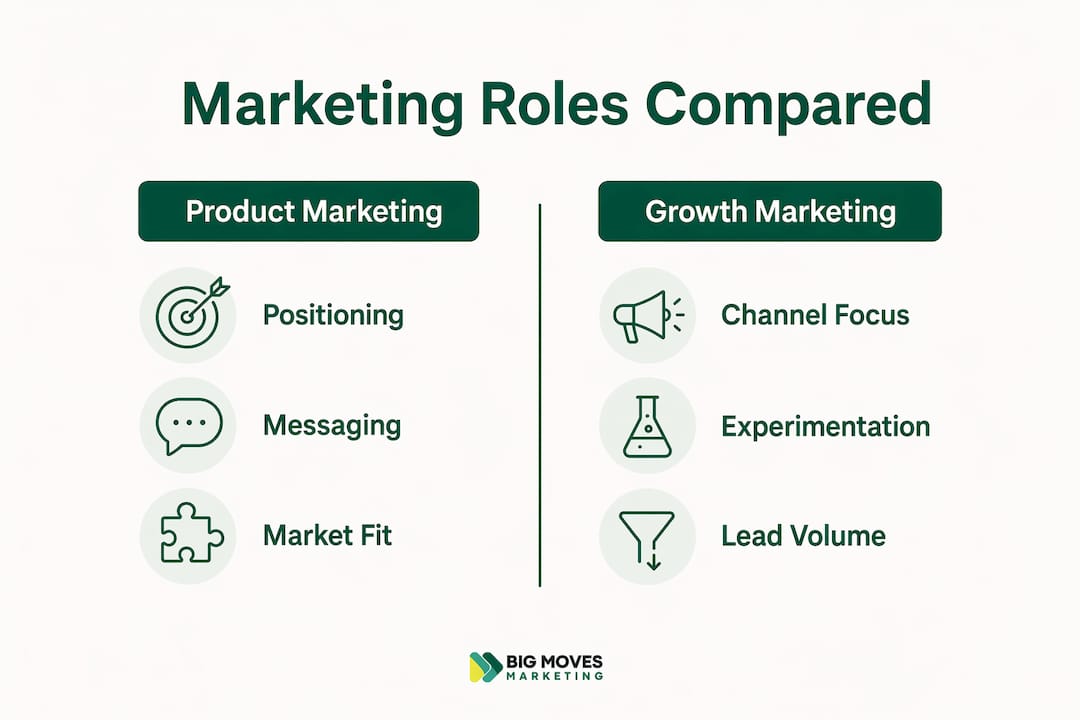
Product marketing manages competitive positioning across the full buyer journey. Growth marketing focuses on channel performance: conversion rates on paid search, landing page optimization, email open rates. Same buyer, different lens.
The timeline difference matters most. Product marketing works on a quarterly cycle because changing how a market thinks about your product takes time. Growth marketing runs on weekly loops because channel performance shifts constantly. Managing these two time horizons separately prevents both functions from being held to the wrong standard.
The best marketing organizations treat these two functions as a relay, not a competition. Product marketing sets the story. Growth marketing runs with it.
Effective collaboration requires:
The most expensive collaboration failure is running campaigns on outdated ICP data. One Series B HR SaaS company learned this the hard way: growth marketing scaled campaigns while product marketing had already refined the ICP based on new win/loss data. Lead volume went up. Revenue went down. The fix was a shared ICP document with a defined update cadence and a standing sync between the two teams.
Pro Tip: Set a monthly 30-minute sync between your PMM and growth lead. Agenda: what positioning changed, what channel data surprised us, what experiments are running. That one meeting prevents most misalignment.
Blurring the lines between product marketing and growth marketing is one of the most common and costly GTM mistakes in B2B SaaS. When one person or one team tries to own both functions, neither gets done well.
The organizational cost of role confusion shows up in predictable ways: launches that generate traffic but no pipeline, sales teams using inconsistent messaging, growth campaigns that optimize for the wrong audience. Each symptom traces back to the same root cause: no one owns positioning, or no one owns channel performance, or both.
High-performing teams track distinct KPIs for each function and align budgeting accordingly. Product marketing gets measured on win rates and message adoption. Growth marketing gets measured on CAC and conversion rates. When both teams report to the same metric, the function with the shorter feedback loop always wins the budget argument, and positioning work gets deprioritized until it becomes a crisis.
Some SaaS companies spend significantly more in sales and marketing relative to new ARR added, reflecting inefficiencies when growth marketing operates without a strong product marketing foundation. That ratio is what happens when growth marketing operates without a strong product marketing foundation: you scale spend without scaling message-market fit.
| Organizational model | Outcome |
|---|---|
| Roles merged, one owner | Positioning neglected; channel execution reactive |
| Roles separated, no sync | Campaigns misaligned with positioning; wasted spend |
| Roles separated, regular sync | Compounding results; efficient CAC; stronger pipeline quality |
Product marketing has roots in brand management, formalized at Procter & Gamble in the 1930s when brand managers were assigned to own the full commercial strategy for a single product. The discipline migrated into B2B technology in the 1990s as software companies needed someone to translate complex products into market-ready narratives for buyers who weren’t engineers.
Growth marketing is younger. Sean Ellis coined the term “growth hacker” in 2010 to describe a marketer whose north star was growth, not brand. The discipline formalized through the 2010s as SaaS companies like Dropbox and HubSpot demonstrated that systematic experimentation across the customer lifecycle could produce compounding results that traditional campaign-based marketing couldn’t match. By 2020, “growth marketing” had replaced “growth hacking” in most job titles as the function matured beyond viral tricks into a rigorous operating model.
The two disciplines developed in parallel, solving different problems. Product marketing solved the “what does this mean and who is it for” problem. Growth marketing solved the “how do we find those people and keep them” problem. The tension between them in modern SaaS organizations reflects that parallel history.
Slack separated product marketing and growth marketing early. Product marketing owned the positioning shift from “team chat” to “where work happens,” a messaging change that required months of buyer research and internal alignment. Growth marketing ran the channel experiments that scaled adoption within organizations once a foothold was established. Neither team could have done the other’s job.
HubSpot built one of the clearest examples of growth marketing as a system. Their content and SEO function operates as a growth channel, not a brand exercise, with every piece of content mapped to a stage in the buyer journey and measured on pipeline contribution. Product marketing owns the category narrative (“inbound marketing”) that gives all that content a coherent frame.
Figma used product-led growth as its primary acquisition motion, but product marketing was responsible for the positioning that made “design collaboration” legible to non-designers. Growth marketing then optimized the activation flow so new users reached that collaborative value quickly. The two functions reinforced each other.
The pattern across all three: product marketing built the story, growth marketing built the system to spread it.
Product marketers and growth marketers use different toolsets because they’re solving different problems.
Product marketing tools:
Growth marketing tools:
The toolset overlap is minimal by design. When both teams are living in the same analytics platform without clear ownership of what they’re measuring, you get competing interpretations of the same data. Separate tools with defined data-sharing protocols work better than a shared stack with no governance.
For building an integrated growth strategy that connects these toolsets into a coherent system, the key is defining which metrics each team owns before choosing the tools.
Product marketing career path: Most product marketers start in content marketing, brand, or sales enablement before moving into a PMM role. The progression runs from Associate PMM to PMM to Senior PMM to Director of Product Marketing to VP or CMO. In B2B SaaS, senior PMMs often move into VP of Marketing or Chief Marketing Officer roles because they understand both market strategy and cross-functional execution.
Core skills: written communication, market research, competitive analysis, cross-functional influence, and the ability to synthesize qualitative data into clear narratives. A PMM who can’t write a crisp positioning statement or run a structured win/loss interview is missing the fundamentals.
Growth marketing career path: Growth marketers often start in performance marketing, analytics, or demand generation. The path runs from Growth Analyst to Growth Manager to Senior Growth Manager to Head of Growth to VP of Growth. Some growth leaders move into COO or Chief Revenue Officer roles as their scope expands beyond marketing into product and sales.
Core skills: data analysis, channel expertise (paid, SEO, email, product analytics), experimentation design, and statistical literacy. A growth marketer who can’t read an A/B test result with appropriate skepticism will scale the wrong things. Tracking SaaS marketing metrics with precision is a baseline expectation at the senior level.
The two career paths rarely cross mid-career. A strong PMM and a strong growth marketer have genuinely different strengths, which is another reason merging the roles into one job description produces mediocre results in both directions.
Where product marketing and growth marketing sit in the org chart determines how well they collaborate and how much authority each has.
Reporting to the CMO: Both functions report to the same marketing leader. This is the most common structure in mid-market SaaS. It works when the CMO actively manages the handoff between positioning and execution. It breaks down when the CMO defaults to prioritizing the function with the most visible short-term metrics, which is almost always growth.
Product marketing under Product, growth marketing under Marketing: This split is common in product-led companies. Product marketing gets closer to the roadmap and the product team, which improves launch coordination. The risk is that messaging drifts away from what the market actually responds to, because product marketing loses visibility into channel performance.
Separate VP-level leaders: The cleanest structure for scaling companies. A VP of Product Marketing and a VP of Growth each own their function fully, with a defined sync cadence and shared OKRs. This structure requires a CMO or CEO who actively manages the relationship between the two leaders. For B2B SaaS companies at different growth stages, the right structure shifts as headcount and revenue scale.
Early-stage companies (under $5M ARR) often have one person covering both functions out of necessity. That’s acceptable as a temporary state. The mistake is treating it as a permanent structure past the point where the company can afford to separate the roles.
Product marketing builds the strategic foundation; growth marketing scales it through channel execution and experimentation. Separating these roles with clear KPIs and regular syncs is what turns a marketing team from reactive to compounding.
| Point | Details |
|---|---|
| Distinct roles, distinct metrics | Product marketing owns win rates and message adoption; growth marketing owns CAC and conversion rates. |
| Timeline separation matters | Product marketing works quarterly; growth marketing works weekly. Managing both on the same cycle creates unrealistic expectations. |
| Shared ICP is non-negotiable | Campaigns built on outdated buyer profiles waste budget; both teams need the same current ICP. |
| Role clarity prevents GTM failure | Merging the two functions without clear swim lanes leads to misaligned launches and wasted spend. |
| Org structure determines effectiveness | Separate VP-level ownership with a defined sync cadence produces the strongest compounding results. |






%20-%20white.svg)