%20png%20copy.avif)

A marketing department covers brand management, campaign execution, content creation, analytics, sales collaboration, and technology management. These are not support activities. Done well, they drive pipeline, revenue, and market position.
The functions of marketing break into seven foundational areas: information management, product management, pricing, promotion, selling, distribution, and financing. Every task a marketing team runs traces back to one of these.
Here is what a full marketing department handles day to day:
Additional modern functions such as brand management, content creation, marketing operations, and performance analytics are layered onto these foundational seven, but every task connects back to one of the seven essential marketing functions.
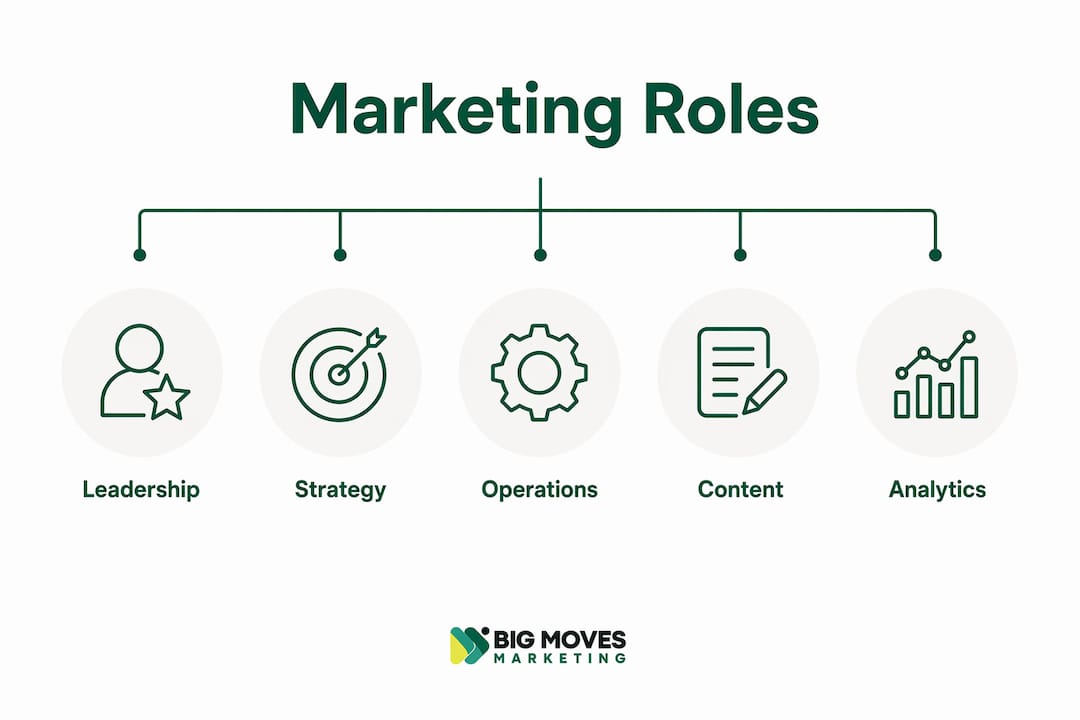
Key roles include the marketing manager, content specialist, demand generation manager, SEO specialist, paid media manager, and marketing operations manager. In B2B SaaS specifically, modern marketing departments organize tasks into five core categories: strategic planning, demand generation, product marketing, content strategy, and marketing operations.
Marketing departments carry more responsibility than most org charts show. The work spans strategy, execution, technology, and cross-functional coordination, all at once.
Every campaign starts with a plan. Marketing teams develop go-to-market strategies, conduct competitor analysis, define buyer personas, and set quarterly priorities. The marketing plan gets a full revision annually and a quarterly review to stay current with market shifts. Without this foundation, execution becomes guesswork.
Campaign management covers the full lifecycle: brief, asset production, channel coordination, launch, and post-campaign review. Cross-channel campaigns require tight coordination across paid media, email, social, and content. Tracking performance in real time lets teams shift budget toward what works before a campaign ends.

Content is how marketing builds credibility and drives organic traffic. The content team produces blog posts, long-form guides, case studies, email newsletters, and website copy. SEO specialists handle keyword research, on-page optimization, technical audits, and link building. Together, they build a content engine that compounds over time.

The marketing tech stack typically includes a CRM platform, marketing automation software, social media management tools, ad campaign managers, attribution tools, website analytics, SEO tools, A/B testing tools, and content management systems. Marketing operations managers integrate these platforms, keep data clean, and prevent the attribution errors that distort budget decisions.
Marketing and sales share a pipeline. Shared definitions of MQLs and SQLs, joint battlecards, and regular lead handoff reviews keep both teams working from the same playbook. On the product side, marketing and product teams share customer personas and positioning work. When these connections break down, messaging drifts and campaigns miss.
Core marketing functions and associated tasks:
| Function | Key tasks |
|---|---|
| Marketing information management | Market research, competitor analysis, go-to-market strategy |
| Product management | Positioning, messaging, sales enablement, launch coordination |
| Pricing | Pricing strategy and market response |
| Promotion | Paid campaigns, SEO, email marketing, webinars |
| Selling | Lead handoffs, battlecards, shared pipeline reviews |
| Distribution | Channel management and product delivery |
| Financing | Budget optimization and spend forecasting |
Additional modern functions such as performance analytics, marketing operations, innovation programs, and specialized team training layer onto the classic seven foundational marketing functions.
Pro Tip: Build a shared content calendar that both marketing and sales can view. It prevents duplicate outreach, aligns messaging, and gives sales advance notice of campaigns before they hit prospects.
Marketing team responsibilities shift significantly based on company size. Small teams run generalists who handle strategy and execution simultaneously. Enterprise teams hire specialists for each sub-function. Both approaches work, but only when ownership is clear.
Chief Marketing Officer (CMO). The CMO owns the overall marketing direction and connects it to business objectives. They manage budgets, build executive relationships, and make the positioning calls that shape how the company competes. In 2026, CMOs are accountable for direct revenue contribution, not just brand awareness.
Marketing Director / VP of Marketing. This role translates strategy into execution. Marketing directors oversee team performance, manage campaign planning, and ensure every initiative aligns with stated goals. In smaller companies, they often carry hands-on execution responsibilities alongside the strategic work.
Marketing Manager. The marketing manager runs day-to-day operations. They delegate tasks, monitor progress, and serve as the primary coordination point between marketing and other departments. They own specific programs like email campaigns, content calendars, or paid media initiatives.
Marketing Operations Manager. This role integrates the tech stack, bridges CRM and ad platforms, and prevents the attribution errors that lead to budget mismanagement. Without a strong ops function, data quality degrades fast.
Marketing Analyst. Tracks KPIs, builds dashboards, runs attribution analysis, and surfaces the insights that guide budget decisions. Teams that skip this role tend to misallocate resources and miss growth opportunities.
Campaign Coordinator. Acts as project manager for marketing initiatives. Manages timelines, coordinates with stakeholders, and keeps campaigns on schedule.
Role categories and core competencies:
| Role category | Focus area | Key metric owned |
|---|---|---|
| Leadership | Strategy, budget, team direction | Revenue, pipeline contribution |
| Content and SEO | Organic growth, audience education | Organic traffic, MQLs from content |
| Paid media | Paid pipeline generation | ROAS, cost per lead |
| Marketing operations | Tech, data, automation | Attribution accuracy, workflow efficiency |
| Analytics | Performance measurement | CAC, ROI, channel performance |
| Product marketing | Positioning, launch, sales enablement | Win rate, sales cycle length |
Smaller teams combine strategic and tactical roles across fewer people, while large teams prioritize specialization for each sub-function. Both structures work when role ownership is explicit and metrics are shared.
Marketing’s value goes well beyond awareness. A well-structured team delivers measurable impact across revenue, brand, and operations.
Revenue generation. Marketing creates the conditions that make sales possible. Demand generation programs fill the pipeline with qualified leads. Content builds credibility that shortens the sales cycle. Marketing-sales alignment with shared lead definitions and joint assets accelerates conversion from prospect to customer.
Brand consistency. Every channel, from the website to sales decks to social posts, carries the same message when marketing owns brand standards. Consistency builds recognition. Recognition builds trust. Trust shortens buying decisions.
Market intelligence. Marketing teams study competitors, track buyer behavior, and monitor industry trends. This intelligence informs product decisions, pricing strategy, and messaging. It supports the entire organization, not just the marketing department.
Operational efficiency. Campaign workflow automation covers project creation, approval processes, content pipelines, lead management notifications, and performance reporting. Automation lets teams execute complex strategies at scale without proportional headcount growth.
Key benefits a structured marketing department delivers:
Marketing that collects customer and product feedback from sales and product teams and feeds it back into positioning and messaging keeps strategy connected to reality. Teams that skip this loop build campaigns around assumptions rather than evidence.
The biggest shift in 2026 is accountability. Marketing teams now align all activities directly with revenue goals, replacing vanity metrics with tangible ROI. CMOs are front-line revenue drivers, not brand stewards.
This shift changes how teams are built and measured. Demand generation, marketing operations, and product marketing carry more weight than they did five years ago. Brand and content roles now report against pipeline contribution, not just traffic or engagement.
Marketing operations has become a critical function. Integrating CRM and ad platforms, maintaining data accuracy, and ensuring clean attribution are not back-office tasks. They are the foundation that makes every other function reliable. Teams that underinvest in operations end up with reporting they cannot trust and budgets they cannot defend.
The relationship between marketing and sales has also matured. Strong alignment goes beyond shared goals. It requires shared definitions of lead quality, joint assets like battlecards and playbooks, and regular reviews where sales shares what is working in conversations and marketing adjusts accordingly. For B2B SaaS teams, this is where go-to-market strategy either holds together or falls apart.
Team structure continues to vary by stage. Early-stage companies need generalists who can move across strategy and execution. Scaling companies need specialists with clear ownership of specific channels and metrics. The constant across both is marketing operations: without it, neither structure scales.
Pro Tip: Avoid the tactical trap of running campaigns without a positioning foundation. Allocate time each quarter to revisit your messaging, competitive differentiation, and buyer personas before planning the next campaign cycle. Execution without positioning is just noise.
AI tools are changing how content is produced, how campaigns are personalized, and how performance data is analyzed. Harvard’s research on AI in marketing points to AI reshaping marketing roles rather than eliminating them, with marketers who use AI for content scaling and data analysis gaining a measurable productivity edge. Platforms built for AI-driven content marketing are becoming standard parts of the marketing tech stack for teams that need to produce at volume without sacrificing quality.
Most B2B SaaS companies do not need a 15-person marketing department. They need clear positioning, a working demand generation system, and a website that converts. That is exactly what Bigmoves delivers.
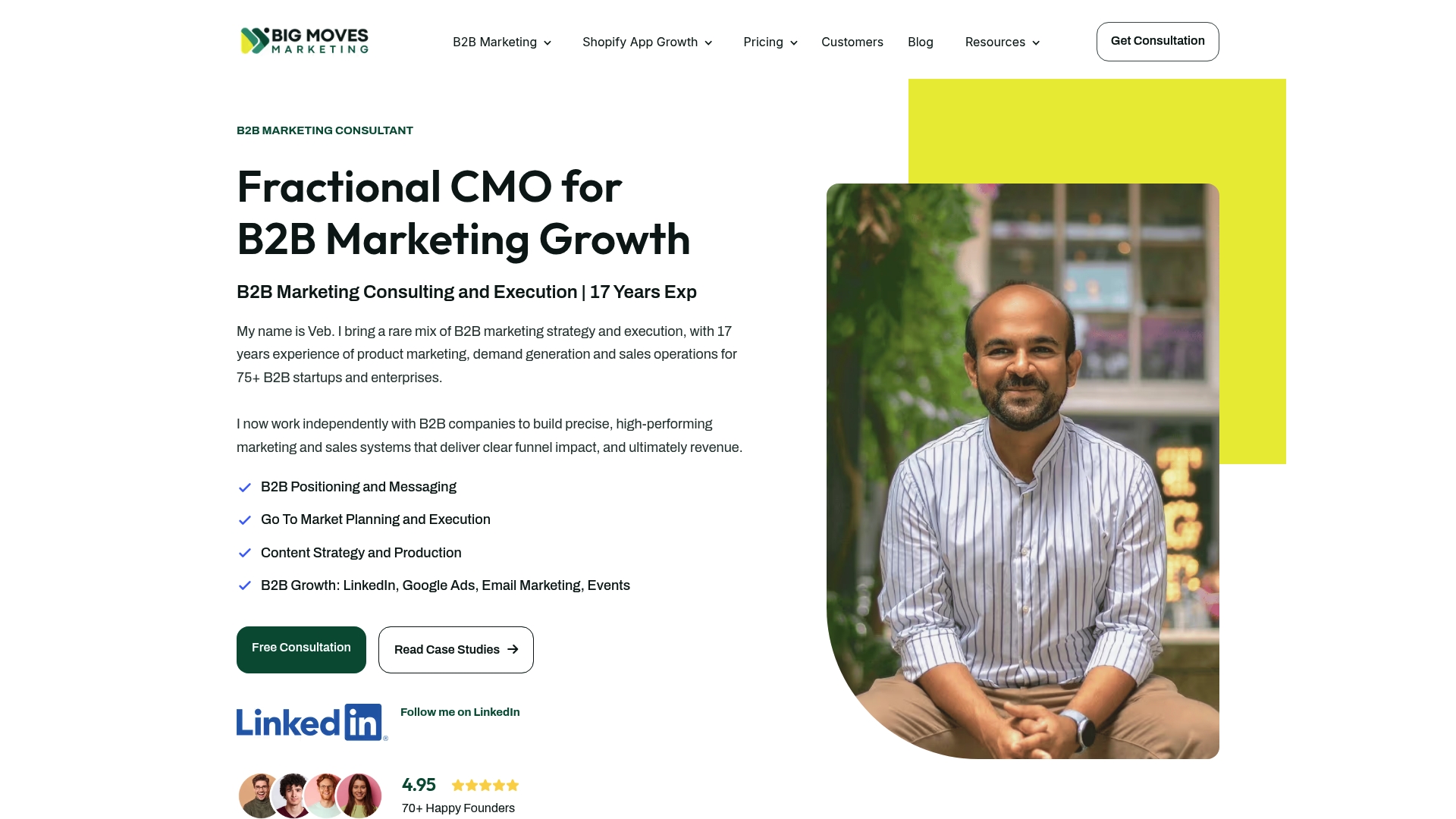
Led by Veb, with 17 years of experience across more than 75 SaaS and tech companies, Bigmoves works as a fractional marketing partner. The firm handles go-to-market strategy, messaging development, demand generation across LinkedIn, Google Ads, and email, and Webflow website deployment built for conversion. You get the output of a full marketing team without the overhead of building one from scratch. If your marketing function needs structure, direction, or execution capacity, get in touch with Bigmoves to see how the engagement works.
A marketing department’s core value is revenue generation, not just awareness, and that requires clear role ownership, aligned operations, and consistent execution across every function.
| Point | Details |
|---|---|
| Seven foundational functions | Every marketing task maps to marketing information management, product management, pricing, promotion, selling, distribution, or financing. |
| Role structure scales with size | Small teams need cross-functional generalists; larger teams need specialists with clear metric ownership per sub-function. |
| Operations is the foundation | Marketing operations integrates the tech stack and maintains attribution accuracy, making every other function reliable. |
| Sales alignment drives revenue | Shared lead definitions, battlecards, and joint pipeline reviews convert marketing output into closed deals. |
| Bigmoves for B2B SaaS teams | Bigmoves delivers go-to-market strategy, demand generation, and conversion-focused websites for scaling SaaS companies. |






%20-%20white.svg)