The B2B Sales Funnel is a Liability, Not an Asset

Most founders get their B2B sales funnels completely wrong. They treat them as a process to be optimized, tweaking stages and chasing fractional conversion gains. That is their first—and most expensive—mistake.
A sales funnel isn’t a passive system for sorting leads. It is an active machine that consumes capital, time, and focus with every unqualified prospect it touches. Pouring more leads into the top only amplifies the waste.
Your Funnel's Job is Disqualification, Not Conversion
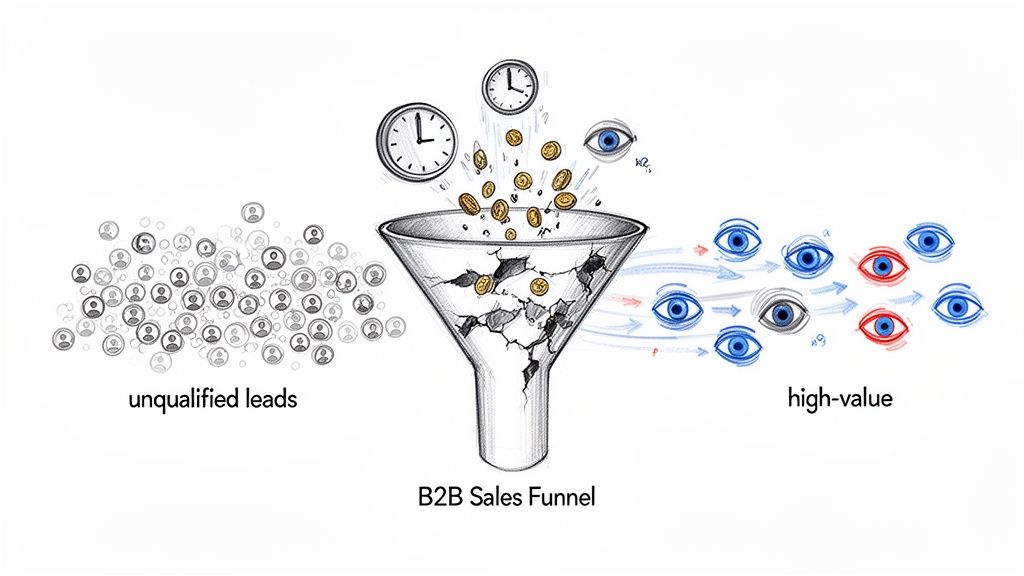
The classic diagram of a B2B sales funnel—a neat, linear slide from awareness to purchase—is dangerously obsolete. It’s a model built for a world that no longer exists, one that rewards marketing teams for hitting volume targets completely disconnected from revenue.
This flawed model creates symptoms every SaaS founder recognizes: a bloated pipeline, demoralized sales reps, and a chasm between marketing activity and closed-won deals.
This is not a tactical problem fixed with better automation or more A/B testing. It's a strategic failure rooted in a misunderstanding of what the funnel is actually for.
The job of a B2B sales funnel is not to process contacts. Its job is to efficiently disqualify the wrong accounts and accelerate the right ones. Every stage must be a filter, not a conveyor belt.
When you view your funnel as a series of liability points, the entire game changes. Each stage where a bad-fit prospect lingers represents a direct cost: wasted sales cycles, diluted team focus, and delayed feedback from your ideal customers.
Those "leaks" in your funnel aren't just lost leads. They are hemorrhages of capital and opportunity.
The Math of Inefficiency
Most B2B funnels are incredibly inefficient by design.
Overall conversion rates from a website visitor to a paying customer often hover between a brutal 1% and 5%. This is driven by long buying cycles and the need to convince multiple decision-makers. The drop-off at each stage is severe; a typical 2-5% visitor-to-lead rate can plummet to a 13-26% conversion from marketing qualified to sales qualified.
This math shows where resources are really going. Pouring more leads into the top of a funnel that fails to qualify rigorously only scales the waste.
The core challenge isn’t pushing more prospects through. It's building a system that aggressively filters for intent, authority, and strategic fit from the first touchpoint. To get a better handle on your numbers, you need to understand how to improve your sales conversion rate in our dedicated guide.
Before you "optimize" another landing page, you must reframe the objective. Stop treating your funnel as an asset to be polished and start treating it as a liability to be contained.
The Great Divide: Why MQLs Fail To Become Revenue
The most critical failure point in a B2T sales funnel is not a leaky stage—it’s the chasm between marketing and sales. This divide is institutionalized by one of the most durable and destructive metrics in SaaS: the Marketing Qualified Lead (MQL).
The MQL was born from a noble idea: measure marketing’s contribution to pipeline. In practice, it has become a smokescreen for misalignment. It rewards marketing for hitting volume targets—webinar attendees, content downloads, booth scans—while sales sifts through contacts with no real intent, budget, or authority.
This is not a simple conversion problem. It's a systemic breakdown in your go-to-market strategy. We've seen this pattern play out in dozens of B2B SaaS companies: marketing smashes its MQL target, leaders celebrate, yet the sales pipeline remains stubbornly flat and revenue goals are missed.
An MQL is a guess based on behavioral proxies. It operates on the dangerous assumption that a whitepaper download equals purchase intent. This is a fundamentally broken premise that poisons your pipeline from the very first handoff.
When marketing is incentivized to produce MQLs, it will. The focus shifts from generating qualified pipeline to chasing superficial engagement that checks a box in a marketing automation platform. This floods sales with noise, burns out your best reps, and destroys marketing’s credibility.
The Anatomy of a Failed Handoff
At its core, the issue is a complete lack of a shared definition of what a “qualified” lead is. Marketing defines it by engagement signals; sales defines it by a readiness to buy. They are speaking two different languages.
This disconnect shows up in predictable ways:
- Abysmal Conversion Rates: Sales reps learn that chasing MQLs is a waste of time, leading to half-hearted follow-up and terrible conversion rates.
- Wasted Resources: Every hour a sales rep spends on a low-intent MQL is an hour they aren't spending on high-value accounts.
- Friction and Finger-Pointing: Marketing blames sales for not working the leads. Sales blames marketing for sending junk. The founder is stuck in the middle, watching revenue evaporate.
The numbers tell the same story. A major bottleneck in B2B funnels is the MQL-to-SQL transition, where conversion rates hover between 12-18%, with some benchmarks landing at a paltry 15%. A huge portion of marketing handoffs are dead on arrival. For founders, poor alignment can waste up to 85% of leads before they even reach a demo. For a closer look at the data, see these B2B sales pipeline conversion rates from MarketJoy.
Shifting From Volume to Value
The solution isn't to "fix" the MQL. It's to abandon it entirely as the primary contract between marketing and sales. Instead, both teams must rally around a single, revenue-focused definition of what makes a lead qualified.
This is a tough, but necessary, shift. Marketing's job is not to generate leads; its job is to generate qualified pipeline and, ultimately, revenue. That means measuring marketing on metrics that matter—like Sales Qualified Leads (SQLs), pipeline generated, and closed-won deals.
When you align incentives this way, you force a change in behavior. Instead of casting a wide net with generic content, marketing must focus on high-intent channels and messaging that attracts buyers actively solving a problem. To get this right, you need a solid strategy for lead generation for SaaS that focuses on quality.
Stop celebrating MQLs. Start holding your marketing team accountable for revenue. It’s the only way to turn your funnel into an efficient growth engine, not a source of constant organizational friction.
Rethinking Funnel Architecture For Modern SaaS Buyers
Knowing your funnel is broken is one thing; designing one that works is another. Most founders still cling to the TOFU/MOFU/BOFU model, but it’s too generic to be useful. It describes a theoretical process but offers zero guidance on how to build a system that turns strangers into customers.
Your funnel architecture must be a direct reflection of your product, ideal customer, and pricing. Get this wrong, and even a brilliant product will struggle.
The biggest mistake I see is teams defaulting to a standard, sales-led approach without considering the alternatives. This is a critical strategic error. How you attract, qualify, and convert customers must be engineered to fit your specific go-to-market reality.
There’s no single "best" B2B sales funnel. Instead, there are distinct architectures, each with its own mechanics, trade-offs, and use cases. Choosing the right one is one of the most important decisions a founder makes.
The High-Intent Sales-Led Funnel
This is the classic architecture for complex, high-ACV (Average Contract Value) enterprise deals. It’s built for products that solve a massive business problem, need buy-in from multiple stakeholders, and have a lengthy implementation.
The main event here is a high-intent, explicit hand-raise: "Request a Demo" or "Talk to Sales."
- Lead Motion: The system is built to find and engage accounts that fit a strict Ideal Customer Profile (ICP). Marketing’s job is to create demand within those target accounts and capture their intent the moment they're ready to talk.
- Key Stages: The funnel moves from initial qualification (is this a real person with a real budget?) through deep discovery, solution validation, stakeholder alignment, and negotiation. It's a consultative, relationship-heavy process.
- Critical Handoff: The handoff from marketing to sales must be immediate and seamless. This isn't just another name in a CRM; it's an active buying signal from a pre-qualified company. This is where most sales-led funnels break.
This diagram shows exactly where that failure point happens. A poorly defined handoff between marketing and sales is a recipe for pipeline decay.
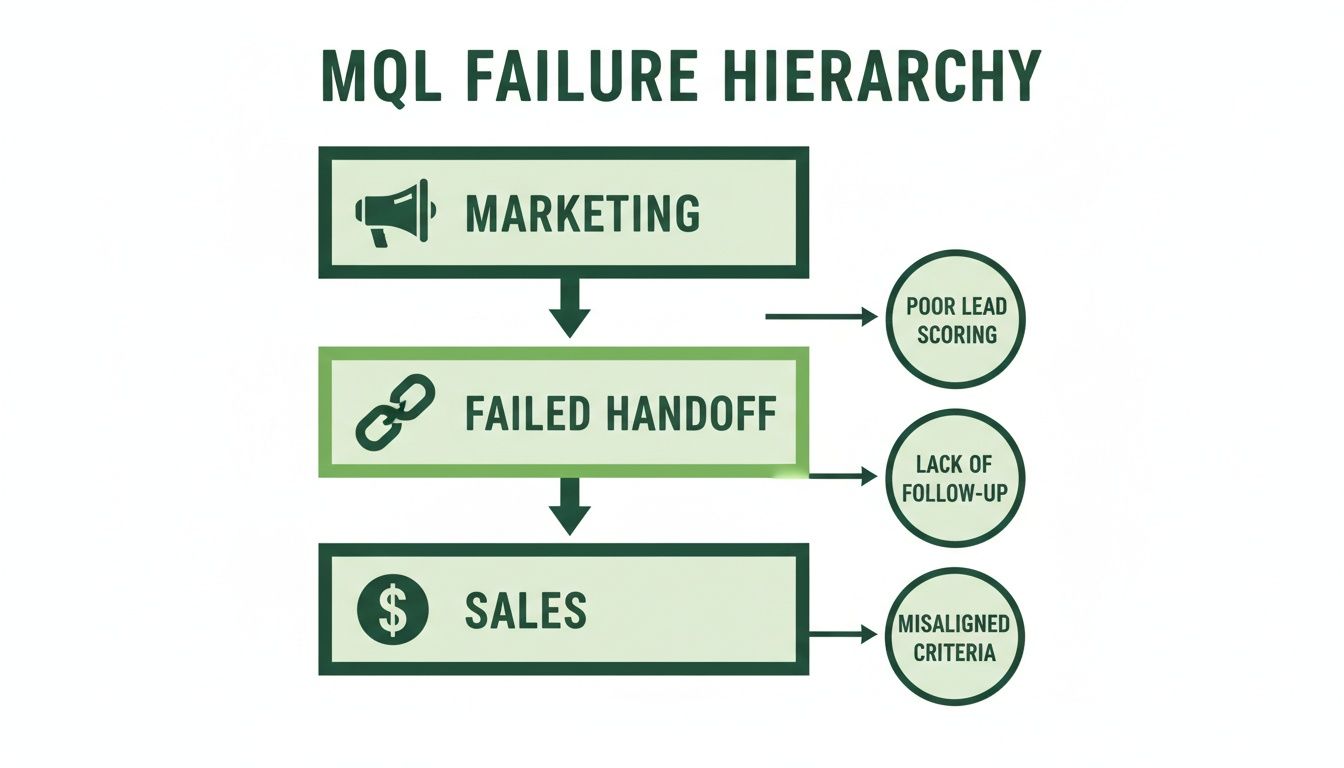
Without a unified qualification framework, the momentum marketing builds fizzles out before it becomes a real sales opportunity.
The Product-Led Growth (PLG) Funnel
In a PLG model, the product does the heavy lifting. It's your primary engine for acquisition, conversion, and expansion. This architecture is perfect for products with a low barrier to entry, a fast time-to-value, and a buying motion driven by the end-user, not a committee.
Here, the main conversion trigger is a free trial or a freemium sign-up.
- Lead Motion: Success is all about user activation and engagement. You measure the funnel by in-product milestones—did the user complete onboarding? Did they invite a teammate? Did they use a key feature?
- Key Stages: The journey flows from sign-up to activation, and then to a Product Qualified Lead (PQL)—a user whose product usage signals they are ready to buy.
- Critical Handoff: The sales team (if one exists) only engages with PQLs. Their job isn’t to sell the product's value—the product already did that. Their role is to help highly engaged users upgrade, expand usage, or move to an enterprise plan.
A PLG funnel inverts the traditional model. Instead of selling a promise, you deliver value first. The sale becomes a natural next step.
The Hybrid or PLG-Assisted Model
Many SaaS companies live between these two extremes. They have a self-serve option for smaller teams but need a sales team to close larger, complex deals. This hybrid model offers flexibility but demands discipline to manage effectively.
This architecture has two primary conversion triggers: the self-serve sign-up (PLG motion) and the high-intent sales inquiry (sales-led motion).
- Lead Motion: You are running two funnels in parallel. One is automated and product-driven for individual users. The other is a high-touch sales process that engages PQLs at certain usage thresholds or enterprise prospects who reach out directly.
- Key Stages: It’s a combination of both models. You track user activation metrics alongside traditional sales pipeline stages like discovery and qualification for larger accounts.
- Critical Handoff: The biggest challenge is defining the rules of engagement. When does a salesperson reach out to a self-serve user without being intrusive? What specific usage patterns trigger that handoff? A sloppy process creates channel conflict and confuses buyers.
The following table breaks down the core differences between these three funnel architectures.
Comparison of B2B SaaS Funnel Architectures
Choosing your funnel architecture is a core business strategy. It dictates who you hire, where you invest capital, and how you define success. As you adapt your funnel for today's SaaS buyers, you must think about scale from day one. For more on this, check out these 10 High-Impact SaaS Marketing Strategies to Scale Your Growth.
Defining The Metrics That Actually Drive Growth
Your go-to-market strategy is only as good as the numbers you use to steer it. Most B2B SaaS founders are flying blind, obsessed with vanity metrics that create the illusion of progress while hiding deep strategic flaws.
MQL volume, cost-per-lead, and website traffic feel comforting, but they are useless for making hard decisions. They are lagging indicators of activity, not leading indicators of growth. Focusing on them is like a pilot staring at the fuel gauge instead of the altitude and airspeed. It tells you what you’ve spent, but nothing about where you’re going.
To build an efficient growth engine, you must shift your focus from activity metrics to outcome metrics. This means building a hierarchy of KPIs that connect directly to revenue, efficiency, and the health of your B2B sales funnels.
The Top-Tier CEO Dashboard Metrics
At the highest level, only a handful of numbers matter. These are the metrics that tell you if the entire GTM machine is working. Forget departmental KPIs; these are the company's vital signs.
- Pipeline Velocity: This is the single most critical measure of your funnel's throughput. It calculates how much qualified pipeline you're creating and how quickly it moves toward a closed deal. You can’t game this number by stuffing low-quality leads into the top.
- Customer Acquisition Cost (CAC) Payback Period: This metric tells you how long it takes to earn back the money spent to acquire a new customer. It's the ultimate test of your GTM efficiency and a direct reflection of your unit economics.
- Net Dollar Retention (NDR): For any SaaS business, NDR is a powerful indicator of product-market fit and long-term health. It measures revenue growth from your existing customer base, showing how well you retain and expand those accounts.
These three metrics provide an unflinching look at the health of your business. If they're strong, your strategy is likely on track. If they're weak, no amount of MQL growth will save you.
Diagnostic Metrics That Drive The Outcomes
High-level metrics tell you if you have a problem. Diagnostic metrics tell you where the problem is. These are the levers your team can pull to influence those top-tier outcomes.
Vanity metrics make you feel busy. Outcome metrics make you smart. Diagnostic metrics make you effective. The goal is to connect all three, using diagnostics to improve the outcomes that matter.
Here are the key diagnostic metrics for your B2B sales funnel:
- Sales Qualified Lead (SQL) to Close Rate: This is the ultimate measure of lead quality and sales effectiveness. A low rate points to a fundamental misalignment between what marketing delivers and what sales can sell.
- Average Contract Value (ACV): Tracking ACV reveals whether you're successfully moving upmarket or attracting lower-value customers. Any change in ACV directly impacts your CAC Payback period.
- Sales Cycle Length: This measures the average time from first real contact to a closed-won deal. A lengthening sales cycle can signal friction in your process, a product that's too complex, or a value proposition that isn't landing.
When you instrument your funnel this way, you create a system of accountability. Marketing is no longer judged on leads but on its contribution to pipeline velocity and SQL-to-close rates. Sales isn't just measured on quota but on sales cycle length and ACV. You can learn more by exploring the essential SaaS marketing metrics that matter.
This approach forces every team to think like a revenue leader, aligning all efforts toward a predictable, efficient growth engine.
Arming Your Sales Team To Close, Not Just Chase
A well-designed B2B sales funnel is just a blueprint. It creates potential energy but does nothing to convert it into sales. The most brilliant funnel architecture is useless without a team equipped to execute within it.
This is where most early-stage companies get it backward. They invest all their capital in generating pipeline, then hand their first sales hires a generic slide deck and expect them to perform miracles. This is a surefire way to burn cash and kill momentum.
Real sales enablement isn’t about building a massive content library. It's about crafting a toolkit of precise instruments, each designed to overcome a specific point of friction in the sales cycle. The goal is to arm reps to articulate value and build trust, not just bombard prospects with follow-ups.
Sales enablement assets are the tangible expression of your go-to-market strategy. If your pitch deck and your ideal customer profile tell two different stories, your strategy is just a document.
From Discovery to Decision: The Core Sales Toolkit
For B2B SaaS—especially in founder-led sales or when scaling the first few reps—you don’t need a sprawling content library. You need a handful of high-impact assets that map directly to the buyer's journey.
Your sales process should dictate your enablement needs, not the other way around.
Here are the non-negotiables:
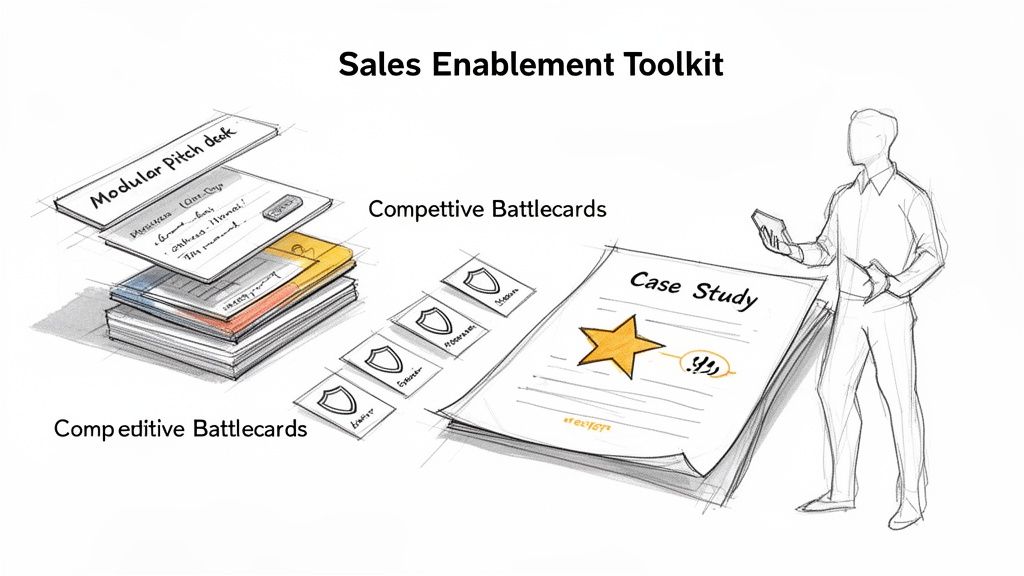
A Modular Pitch Deck: Forget the 50-slide monolith. Your team needs a core deck that can be reconfigured for different scenarios. The first discovery call demands slides focused on the problem and your point of view, not a deep dive into features. A later-stage technical demo needs the opposite. A modular approach ensures reps deliver the right message at the right time.
Competitive Battlecards: Your reps will face objections and competitor mentions. Good battlecards are more than feature comparisons. They equip your team with sharp talking points on your core differentiators, landmines to lay for the competition, and clear responses to common FUD (Fear, Uncertainty, and Doubt).
Client-Facing Case Studies: In B2B, social proof is the currency of trust. A strong case study tells a relatable story of transformation. It must articulate the painful "before" state, walk through the implementation, and showcase the quantifiable "after" state of success—mirroring the journey your prospect is considering. For a deeper dive, check out our guide on sales enablement best practices.
Purpose-Built Assets for Specific Funnel Stages
The value of these assets is in the timing. Each tool has a specific job at a critical point in the funnel. Giving a prospect a case study too early is as useless as trying to close on the first call.
The table below aligns these core assets with the stages of a typical sales-led motion.
Essential Sales Enablement Assets by Funnel Stage
Without these fundamental tools, your sales team is flying blind, forced to reinvent messaging on every call. This leads to inconsistency, confusion, and lost deals.
A disciplined approach to sales enablement turns your funnel strategy from a theoretical diagram into a repeatable process that closes business.
The Founder’s Mandate: Stop Optimizing and Start Aligning
Building an effective B2B sales funnel is not a departmental task. It is a founder-level strategic imperative. For too long, leadership has treated funnel performance as a series of tactical problems to solve—throw more budget at it, buy more tech, hire more reps. This misunderstands where the real leverage is.
The single biggest source of wasted capital and motion in a B2B SaaS company is the friction between marketing and sales. You don’t solve that friction by tweaking landing pages. You solve it by executive mandate.
Your funnel isn’t a marketing project or a sales process. It is the operational expression of your entire go-to-market strategy. Its alignment is the direct responsibility of the CEO.
Your Directives Are Clear
Stop funding a marketing engine that celebrates vanity metrics like MQLs. Your marketing team’s primary KPI is qualified pipeline contribution. Period. Tie their success to the same revenue outcomes as the sales team.
This alignment must start with a unified qualification framework. Whether you choose MEDDPICC, BANT, or another framework matters less than this: it must be a single, non-negotiable contract between both teams. Marketing’s job is to generate leads that meet this exact criteria. Sales’ job is to be accountable for working them aggressively.
Stop asking, “How can we generate more leads?” Start asking, “What is the most efficient path to revenue with our ideal customers, and how do we align every resource to that path?” This one shift reframes the entire discussion from volume to value.
Finally, resist the siren song of more martech. Your core problems are strategic, not technological. Fix the message. Fix the handoff. Fix the incentives. Technology should only ever scale a process that already works, not put a band-aid on one that is fundamentally broken.
This isn’t about optimization; it’s about strategic clarity. Your mandate is to tear down the silos, kill the metrics that create division, and force a unified, relentless focus on revenue. This is how you build a growth engine that lasts.
Frequently Asked Questions
What Is a Realistic Conversion Rate For a B2B SaaS Sales Funnel?
There is no single number, but a realistic end-to-end conversion rate for most B2B SaaS companies—from website visitor to closed-won customer—hovers between 1% and 3%.
The biggest leaks occur at the top of the funnel and during the MQL-to-SQL handoff, where it's common to see only 10-15% of leads make it through.
Instead of obsessing over universal benchmarks, focus on your own stage-by-stage metrics. A healthy SQL-to-Close rate of 20-30% is a much stronger signal of a healthy funnel than a high volume of low-quality leads at the top.
How Is a PLG Funnel Different From a Traditional Sales-Led Funnel?
The core difference is how you qualify a lead.
A traditional, sales-led funnel qualifies buyers based on explicit intent and demographic data—a demo request from a company fitting your Ideal Customer Profile. A Product-Led Growth (PLG) funnel qualifies users based on their in-product behavior.
The main gate in a PLG model is the Product Qualified Lead (PQL). This is a user who has signed up, used the product, and hit key activation milestones that signal they’ve experienced its value firsthand.
In a PLG model, the sales team’s job isn't to convince cold leads of the product's value. The product has already done that. Instead, sales engages with PQLs to drive expansion, handle complex questions, or convert them to higher-tier plans.
What Is The Single Biggest Mistake Founders Make With Their Sales Funnel?
The most common—and expensive—mistake is the failure to get marketing and sales to agree on a single, unified definition of a "qualified lead."
This misalignment is the root cause of the classic dysfunction: marketing celebrates hitting its MQL target, while sales complains they have nothing to work with. It creates a perpetual cycle of wasted resources, finger-pointing, and missed revenue.
The fix is to implement a strict qualification framework like BANT or MEDDPICC and make it the non-negotiable contract between both teams. Without this fundamental alignment, your funnel will always leak focus, money, and morale.
Ready to build a go-to-market strategy that aligns your entire organization and drives real revenue? Big Moves Marketing partners with B2B SaaS founders to bring new products to market with the positioning and sales tools that win deals. Learn more about our approach.
%20-%20Alternate.svg)
%20-%20white.svg)